



Fire Sprinkler Reducer Bushing: Sizing, Connections, and Selection in 2026
A fire sprinkler reducer bushing can match the nominal pipe sizes and still be the wrong fit for the system. The connection type, material compatibility, and product documentation matter just as much as the size transition. Choosing by size alone can lead to a mismatch in the piping assembly.
To compare options, identify the nominal size and connection type at each end, then check the fitting’s material and product information against the system records. This guide explains how to assess spigot, socket, and threaded ends, compare materials, and review product documentation before selecting a fitting.
The right choice depends on the system, not just the fitting. Fire Protection Parts specializes in fire protection components, including Viking CPVC pipe and related fittings. As you assess your system’s requirements, use product details and system documents together to identify compatible components.
Key Takeaways
- A fire sprinkler reducer bushing must match the system’s connection geometry and requirements, not just its nominal pipe sizes.
- Spigot, socket, and threaded describe how a fitting connects to adjoining components.
- Compare material, nominal size, end type, and product documentation when assessing fit.
- Use system records and product markings to verify details instead of relying on visual estimates.
- A specialist fire protection catalog can help you source related components, including Viking CPVC pipe and fittings.
What a fire sprinkler reducer bushing does in a piping system
A fire sprinkler reducer bushing connects components with different nominal sizes, providing a transition between a larger opening and a smaller pipe or fitting as allowed by the system design. That function does not make every bushing suitable for every sprinkler system. The fitting’s material, end configuration, manufacturer instructions, and applicable approvals all affect whether it is appropriate.
A size transition may be specified in a new installation or needed during a repair when adjoining components have different nominal sizes. The bushing joins those components, but does not determine whether reducing the connection is acceptable. A fire sprinkler system is a coordinated assembly, so assess a small fitting in the context of the surrounding piping and system design.
How a reducer bushing changes the connection
The larger and smaller nominal sizes identify the two sides of the transition. Nominal size is a designation, not a direct measurement of outside diameter. Don’t use a ruler or compare visible openings alone to identify a fitting. Check product markings, system records, and product documentation.
End labels describe how the fitting joins an adjoining pipe or component. For example, a 1-inch-by-3/4-inch bushing might have a 1-inch spigot end and a 3/4-inch slip-socket end. “Spigot” indicates an end that fits into a compatible opening; “socket” refers to an opening that receives a compatible end. This illustrates one size and connection pairing, not a recommendation for a particular system.
A reducer bushing serves a different purpose from other CPVC fittings. Elbows change direction, tees create a branch, and couplings join compatible pipe ends. A bushing addresses a size transition at a specific connection. It does not replace the need to assess the rest of the piping layout or treat different fittings as interchangeable.
Where system context matters
Physical fit is only one part of selection. A fitting may connect to adjoining components and still be unsuitable for the installed piping system. Confirm that its material and end configuration match the system, then compare product documentation and applicable approvals with the design and manufacturer instructions. Appearance alone cannot establish compatibility.
This is especially important with CPVC. Don’t assume that a fitting intended for one piping material or connection method is suitable for another. For system-specific information on CPVC pipe, consult the Viking CPVC fire sprinkler pipe guide. Use it alongside the relevant product documentation, not as a substitute for checking whether a particular fitting meets the application requirements.
Spigot, socket, and threaded ends: understand reducer bushing configurations
End labels describe how a fitting connects to the adjoining pipe or component. They are not interchangeable terms, and matching nominal sizes alone does not establish a suitable connection. Before comparing options, identify the end configuration on both sides and compare it with the system documents.
A spigot is an end shaped to fit into a compatible opening. A socket is the receiving opening, sometimes called a “slip socket.” Threaded ends connect through matching threads. These terms describe connection geometry, not approval for a specific fire protection application.
Reading a spigot-by-socket size description
Read the nominal sizes and end labels together. A listing for a 1-inch spigot by 3/4-inch slip socket identifies the nominal size on each side and which end is the spigot versus the socket. This is an example of a reducer-bushing configuration, not a universal recommendation or confirmation that the fitting suits a particular system.
Don’t treat two descriptions with the same nominal sizes as equivalent. A 1-inch-by-3/4-inch fitting can have different end types on either side, which changes how it connects to adjoining components. Compare the full product description, drawings, and markings rather than relying on the size pair alone. If the listing does not clearly identify the connection ends, use the product documentation to establish the configuration before selecting it.
When threaded configurations need closer review
For a threaded fitting, check the thread type specified for the fitting and the adjoining component. Confirm that both are intended to connect and that the product documentation describes the same configuration. A generic “threaded” label may not provide enough detail to establish a match.
Don’t assume a threaded connection can substitute for a spigot-and-socket connection, or vice versa. These are different configurations, and selection depends on the installed piping and approved system design. Review manufacturer instructions and applicable product documentation. The National Fire Protection Association (NFPA) provides standards and resources relevant to fire protection, while project requirements depend on the applicable design and approvals.
Before selecting a fitting, record each end separately, including its nominal size and connection type. Compare those details with the system records and product documentation. This helps prevent a common mismatch: finding the right size pair but the wrong connection arrangement. For related fire protection hardware and CPVC components, browse fire protection components as you assess the system’s needs.
Compare reducer bushings by material, size, and system compatibility
A reducer bushing may match the nominal sizes on a project drawing and still be unsuitable if its material, end configuration, or documentation does not align with the piping system. Compare the details together. The table below can help organize that review, but it is not an approval or a design determination.
| Detail | What to compare | Documentation to review |
|---|---|---|
| Material | Fitting material against the system’s documented pipe and fitting requirements | Product markings, manufacturer data, and system documents |
| Nominal sizes | Each side of the size transition against the specified adjoining components | Drawings, system records, and product description |
| End types | Connection type at each end, such as spigot, socket, or threaded | Product description and manufacturer documentation |
| Compatibility and approvals | Whether the specific fitting is identified for the intended system | Applicable listing information, instructions, and project requirements |
Match the fitting material to the piping system
Start with the material identified in the system records, then compare it with the fitting’s documented material. Don’t rely on color, shape, or a general plumbing description to establish compatibility. For example, evaluate a CPVC fitting in relation to the specific listed system and product instructions. Don’t assume it is suitable simply because the pipe is CPVC. The details of fire protection CPVC fittings matter to that assessment.
Check markings, listings, and project documentation
Review the fitting markings and manufacturer documentation for material, size, connection type, and any stated use or listing. Treat UL Listed or FM Approved status as product-specific: verify it for the exact component rather than inferring it from a brand, category, or similar-looking part.
Compare those details with the approved system design and project requirements. If a product description and project documents appear to differ, pause the selection rather than assuming the fitting is acceptable. Requirements depend on the specific system and its governing documentation; this guide and the table do not replace that review.
For a fire sprinkler reducer bushing, record the material, both nominal sizes, and each end type before comparing candidates. Keep the supporting product information with the selection so the reason for choosing that configuration is clear. This helps distinguish a fitting that merely appears to fit from one whose documented characteristics align with the piping system.
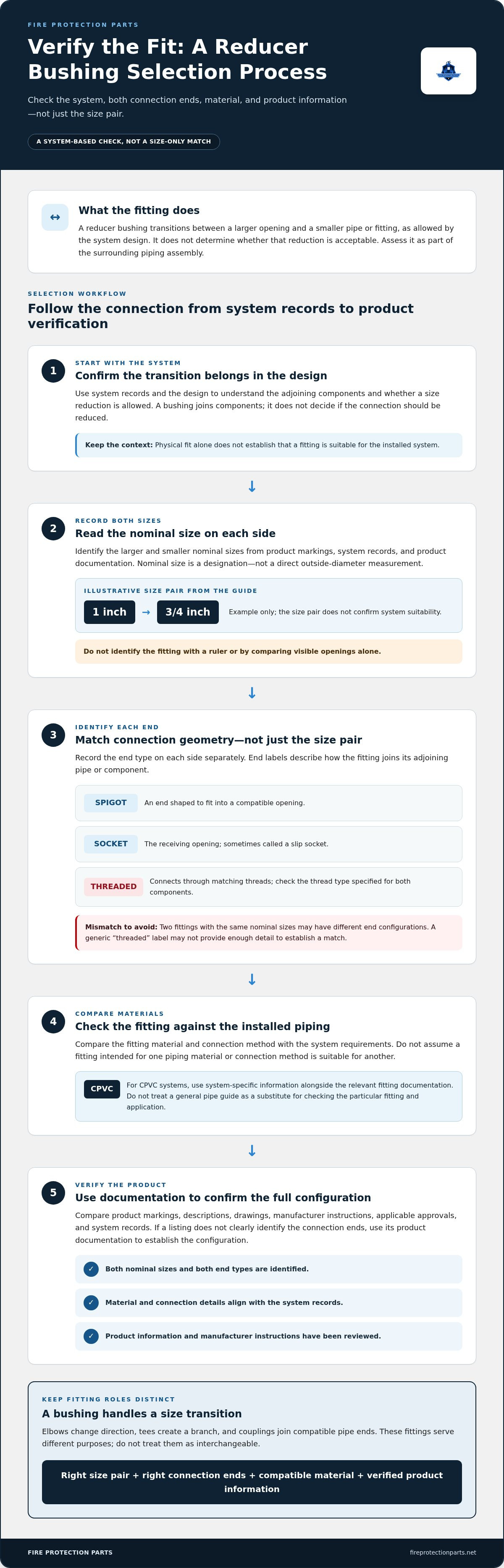
A practical checklist for identifying the correct fire sprinkler reducer bushing
Use a consistent process before selecting a replacement or specified fitting. Similar-looking parts can differ in nominal size, end configuration, material, or documented use. Base the comparison on system records and product markings, then confirm that the proposed part aligns with the system’s compatibility requirements and design intent.
Identify the system, record both sizes, confirm each end type, verify the material, and review the product documentation. These five checks help narrow the selection without treating appearance alone as proof of fit.
- Identify the system. Review project documents and system records to establish the piping type and relevant design requirements. A replacement must suit the system it serves, not just the point where it connects.
- Record the sizes. Note the nominal size on each side of the connection from system records or legible product markings. Don’t estimate nominal size from the visible opening or rely on a ruler alone.
- Confirm the ends. Record the connection type at both ends, such as spigot, socket, or threaded. The ends may differ, so identify each separately.
- Verify the material. Compare the fitting’s documented material with the piping system’s requirements. Don’t infer compatibility from color, shape, or a broad product-category label.
- Review documentation. Compare the exact product description, markings, manufacturer instructions, and applicable listing information with the project documents before choosing.
Record the existing connection details
Record the sizes, end types, material, and any legible manufacturer or product identification from system records or existing documentation. If a detail is missing or unclear, mark it as unresolved instead of filling the gap with a visual guess. Don’t dismantle or modify an active sprinkler system to identify a fitting. Use appropriate records and qualified project review to resolve uncertainty.
Resolve mismatches before ordering
Compare the recorded details with the proposed product’s exact documentation. A mismatch in size, material, end type, or listing information is a reason to pause, not assume a similar part will work. If a specification is unclear, resolve it against the design and manufacturer instructions through qualified project review before proceeding. Fire protection parts and hardware for repairs provide broader context for coordinating components during repair work.
Keep the records and product details together so the selection can be reviewed against the system’s design intent. This is especially important for a fire sprinkler reducer bushing, where the size transition is only one part of compatibility. For related fire protection components, browse the fire protection parts catalog as you compare documented requirements.
Source fire protection components with confidence
A focused fire protection catalog brings related hardware categories together and helps professionals compare product information in context. Fire Protection Parts carries a large inventory of top-brand UL Listed and FM Approved components. These catalog credentials do not establish that a particular fitting is listed or suitable for a specific sprinkler system.
What to review on a product listing
Before selecting a fire sprinkler reducer bushing or another component, compare the product details with the documented system requirement. Review the listing and use the manufacturer’s documentation to resolve details a brief description may not cover.
- Size: Compare each nominal size with system records and the specified adjoining components.
- Material: Confirm that the listed material matches the documented piping system requirements.
- Connection ends: Check the configuration on both sides, not just the size pair.
- Markings: Review product identification and compare it with the listing.
- Manufacturer documents: Read applicable instructions and product-specific approval details.
Don’t transfer a specification or approval from one fitting to another, even if the parts look similar or share a product category. Listings and documented uses apply to the specific components identified. Compare the product information with the project requirement and manufacturer documentation before ordering.
Find related fire protection parts
Fire Protection Parts is an online source for fire protection hardware and related system components. Its focused catalog includes Viking CPVC fire protection pipe and related fittings, with product details to support comparison. Assess each selected component on its own merits, including its material, dimensions, connection configuration, and product-specific documentation.
Technical support is available by phone, chat, email, and in-store assistance for product questions. Use the product details alongside the project’s approved design; support does not replace that design or establish system suitability. Keep the requirement and product documentation together as you make the selection, so you can compare component details before purchase.
Once you’ve identified the required specifications, browse fire protection parts and components to explore related hardware for your project.
Make your next component decision with confidence
Before ordering, compare the selected component details with the project records. This final check helps keep procurement aligned with the design, especially when a fire sprinkler reducer bushing is being considered as a replacement or part of a larger piping assembly. Resolve any unclear detail before proceeding rather than relying on appearance or assumption.
Fire Protection Parts focuses on fire protection components, including Viking CPVC pipe and related fittings. Product questions can be directed to the team by phone, chat, email, or in-store. Product-specific approval and system suitability depend on the component documentation and project requirements.
Ready to source related hardware? Browse fire protection parts and components and compare product details with your documented requirements.
Frequently Asked Questions
What is a fire sprinkler reducer bushing?
A fire sprinkler reducer bushing connects components with different nominal sizes. It provides a size transition at a specific connection, but does not replace a coupling, elbow, or other fitting with a different purpose. If a drawing specifies a size change, compare the required bushing configuration with the adjoining components and system documentation before selecting a part.
Can a reducer bushing be used in any fire sprinkler system?
No. A reducer bushing must be compatible with the particular piping system and its design. A fitting that connects physically may still be unsuitable if its material, end configuration, or documented use does not match system requirements. For a replacement, don’t assume an existing size transition is appropriate for a changed design. Use the project documents and manufacturer instructions to guide selection.
What is the difference between a spigot end and a socket end?
A spigot end is the projecting end designed to fit into a compatible opening; a socket end is the opening that receives a compatible end. Product descriptions may identify one of each on the same fitting. Read the labels alongside the nominal sizes. Two bushings with the same size pair can have different end configurations, so their descriptions are not necessarily interchangeable.
Does a reducer bushing affect water flow in a sprinkler system?
A size transition changes the connection’s internal passage, so it may matter to the system’s hydraulic design. The actual effect depends on the fitting and system configuration; nominal sizes alone cannot determine it. Don’t substitute a smaller or differently configured component based only on physical fit. The approved system design and project documentation should establish whether the selected fitting is appropriate.
Can a plumbing PVC reducer bushing be used for fire sprinklers?
Not automatically. A general plumbing description or PVC appearance does not establish that a fitting is suitable for a fire sprinkler application. The material, connection type, manufacturer instructions, and product-specific documentation must align with the installed system and project requirements. For CPVC systems, use documentation for the specific fire protection piping system rather than assuming a general-purpose PVC fitting is compatible.
What information should I record before ordering a replacement reducer bushing?
Record the system or pipe material, nominal size on each side, connection type at both ends, and any legible manufacturer markings or identifiers. Compare those details with project records and the proposed product documentation. A clear photo of visible markings may help with identification, but it cannot replace written specifications. Don’t dismantle or modify an active system to gather details; resolve missing information through qualified project review.
Do reducer bushings need to be UL Listed or FM Approved?
That depends on the specific component and the project’s applicable requirements. Don’t assume every bushing needs both marks, or that a mark shown for one product applies to another. Check the exact product documentation and compare it with the approved system design and governing project requirements. If listing information is unclear, resolve that detail through qualified project review before selecting the fitting.

