



Backflow Preventer for Fire Protection: The Comprehensive 2026 Guide
A single mistake in your fire system's design could turn a life-saving asset into a liability for your entire community. Choosing the correct backflow preventer fire protection assembly is the only way to keep stagnant fire water from contaminating the public's potable supply. With the 2026 edition of NFPA 25 now in effect, the margin for error has disappeared. You need a solution that balances hydraulic performance with absolute containment, and you need it to meet the latest jurisdictional standards.
It's frustrating to deal with the conflicting demands of health departments and fire marshals, especially when you're caught between DCVA and RPZ specifications. We understand that compliance isn't just about passing an inspection; it's about protecting lives and infrastructure. This guide provides the technical clarity you need to master selection criteria and maintain a safe, code-compliant system. We'll examine the updated 2026 requirements, explain how to verify parts against the June 2026 USC-approved list, and help you source the reliable hardware your facility requires.
Key Takeaways
- Identify the specific hazard level of your fire system to determine whether a DCVA or a high-protection RPZ assembly is required for your facility.
- Master the 2026 NFPA 25 mandates for your backflow preventer fire protection, including the critical requirements for annual testing and five-year internal inspections.
- Ensure hydraulic performance remains uncompromised by matching assembly sizing and flow requirements to your existing pipe diameter.
- Verify that all hardware carries essential UL/FM approvals and appears on the current USC-approved list to guarantee long-term code compliance.
- Understand the heightened protection standards necessary for systems utilizing chemical additives or antifreeze to prevent toxic contamination of the water supply.
The Critical Role of Backflow Preventers in Fire Protection
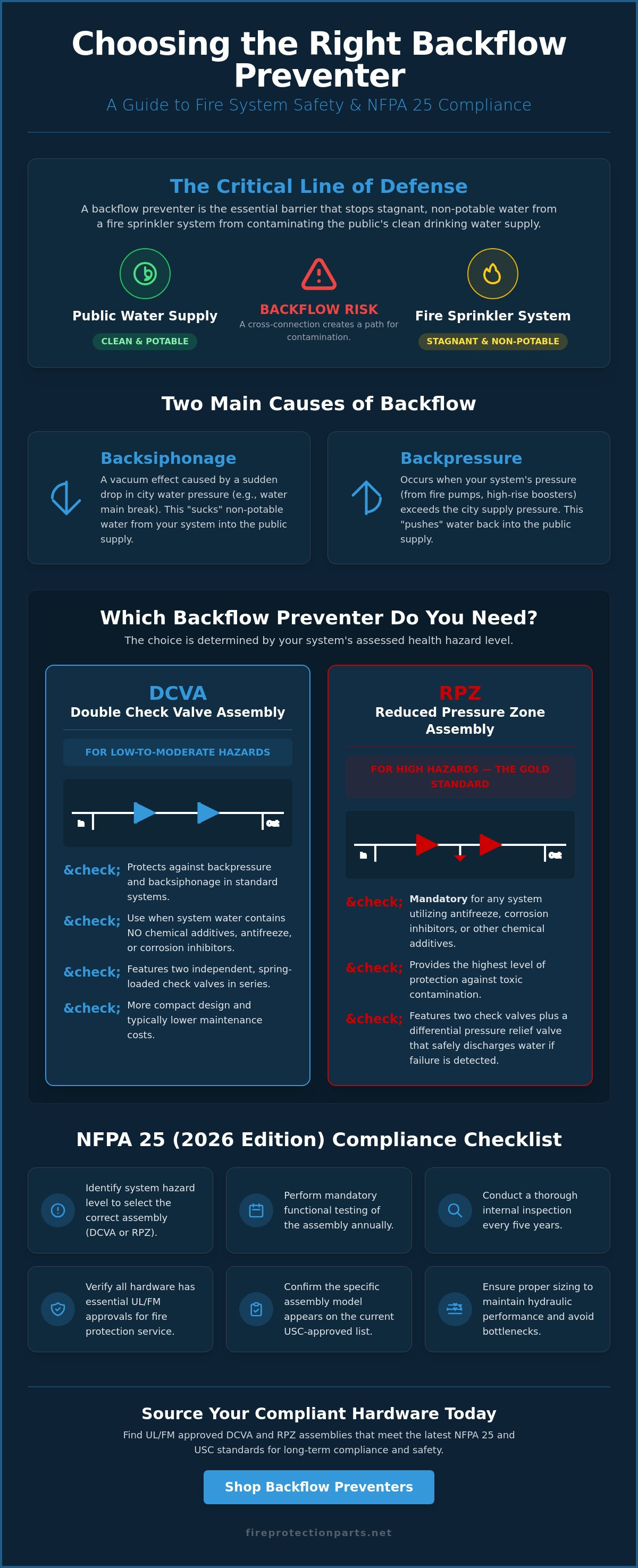
A backflow prevention device serves as the final line of defense between a building's fire suppression system and the public's drinking water. A backflow preventer is a one-way valve system designed to protect drinking water. Without this mechanical barrier, the stagnant, non-potable water sitting inside sprinkler pipes can migrate into the municipal supply. This reversal of flow creates a cross-connection, which is a direct link between a potable water source and a potential pollutant. It's a critical safety component that keeps your facility's fire suppression needs from compromising the health of the community.
Fire sprinkler water is inherently hazardous because it's essentially "dead" water. It sits motionless for months or even years, creating an ideal environment for bacteria, scale, and rust to accumulate. In many commercial applications, the risk is even higher. Systems that utilize chemical additives, corrosion inhibitors, or antifreeze are classified as high-health hazards. The Environmental Protection Agency (EPA) and local health authorities enforce strict mandates on backflow preventer fire protection to prevent these toxic substances from entering the public grid. Compliance isn't optional; it's a legal imperative backed by significant fines and the threat of water service termination.
How Backflow Occurs: Backsiphonage vs. Backpressure
Backflow happens through two distinct physical processes that every facility manager must understand. Backsiphonage occurs when there's a sudden drop in city water pressure. This is often caused by a nearby water main break or heavy demand from fire departments fighting a blaze elsewhere on the grid. This drop creates a vacuum effect that "sucks" water out of your building and into the main. Backpressure is the opposite; it happens when the pressure inside your facility exceeds the supply pressure. This is a constant risk in buildings that use fire pumps, high-rise boosters, or elevated storage tanks. Historical contamination incidents prove that even a brief pressure imbalance can lead to widespread illness if the assembly fails or is bypassed.
The Interface Between Fire Safety and Public Health
Fire protection systems present a unique engineering challenge. Unlike standard plumbing, these systems must remain pressurized and ready for immediate, high-volume flow at any second. This requires hardware that offers unwavering reliability under extreme conditions. It's not just about stopping water; it's about ensuring the device doesn't create a hydraulic bottleneck when the life-safety system activates. Choosing the right assembly eliminates doubt. It ensures your facility remains compliant with the 2026 NFPA 25 standards while fulfilling your ethical obligation to protect the public's health. You're not just installing a valve; you're installing a protector.
Understanding the Types: DCVA vs. RPZ Assemblies
Selecting a backflow preventer fire protection assembly requires more than just picking a part from a catalog. It involves a precise evaluation of your system's hazard level and hydraulic needs. Most jurisdictions rely on two primary configurations: the Double Check Valve Assembly (DCVA) and the Reduced Pressure Zone Assembly (RPZA). While both prevent the reversal of flow, their internal mechanisms offer vastly different levels of protection. You can't simply swap one for the other without consequences for your compliance status.
Double Check Valve Assemblies (DCVA) Explained
A DCVA uses two independent, spring-loaded check valves in series. These valves remain closed unless the supply pressure is higher than the system pressure. This configuration is the standard for low-to-moderate hazard systems that don't contain hazardous chemicals. They're compact and offer the benefit of lower maintenance costs over time. Since they don't vent to the atmosphere, you can often install them in pits or areas with limited drainage, provided local health codes allow it. They provide excellent protection against backpressure in most standard commercial buildings.
Reduced Pressure Zone (RPZ) Assemblies Explained
The RPZ assembly is the gold standard for high-hazard environments. It's the only choice when your system utilizes anti-freeze for fire sprinkler system or corrosion inhibitors. It features two check valves with a pressure-differential relief valve located between them. This relief valve acts as a failsafe. If the pressure between the checks drops too low, the valve opens and dumps water to the floor. This physical air gap ensures that no cross-contamination can occur. Installation requires a dedicated floor drain or a discharge pipe to handle potential flooding. It's a robust solution for the most demanding safety requirements.
Hydraulic Performance and Monitoring
Every valve added to a fire line creates friction. This pressure drop can be significant, especially with RPZ models which require more force to open the check valves. You must re-evaluate your system's hydraulic calculations whenever a backflow preventer is added or replaced. If the pressure drop is too high, your sprinklers might not meet their design density during a fire. Additionally, many water authorities require "Detector" versions of these assemblies. These units include a small bypass meter that tracks unauthorized water flow or leaks. This helps identify water theft or system issues that might otherwise go unnoticed. Investing in reliable backflow preventors ensures your system remains both safe and hydraulically sound.
Selecting the Right Backflow Preventer for Your System
The selection of a backflow preventer fire protection assembly is a critical engineering decision that dictates the long-term reliability of your suppression system. It's not enough to simply match the pipe size. You must evaluate the specific hazard level of the water being contained. For standard wet-pipe systems where water remains clean, a Double Check Valve Assembly is often sufficient. However, if your system incorporates chemical additives or is connected to an auxiliary water source like a pond, you must step up to a Reduced Pressure Zone assembly. Making the wrong choice doesn't just risk a failed inspection; it risks the safety of the local water grid.
Sizing the assembly correctly is vital for maintaining hydraulic integrity. If the device is undersized relative to the pipe diameter, it creates excessive friction loss. This can prevent sprinkler head parts from receiving the required flow during an emergency. Material selection also plays a major role in longevity. While ductile iron has been the industry standard for decades, stainless steel is increasingly preferred for its superior resistance to corrosion and scale buildup. Investing in high-quality materials ensures the internal components don't seize over years of inactivity.
Residential vs. Commercial Requirements
Requirements change significantly when moving from commercial NFPA 13 systems to residential NFPA 13D installations. Residential riser rooms are notoriously tight. You'll often need compact backflow assemblies designed specifically for small-scale applications. These systems frequently integrate with Residential Fire Pump Systems to ensure adequate pressure in homes. In these scenarios, the backflow preventer must be rated to handle the pump's discharge pressure without causing a bottleneck that starves the sprinklers. Choosing a device with a smaller footprint shouldn't mean sacrificing performance or code compliance.
Retrofitting and System Repairs
Retrofitting an existing system presents unique challenges. You must identify whether a failing assembly requires a simple internal kit or a total replacement. If the body of the valve shows signs of pitting or structural wear, replacement is the only safe path. When sourcing fire protection parts online, ensure the new hardware is compatible with your existing piping materials, such as Viking Plastics CPVC. All replacement hardware must meet original system design specifications. This consistency preserves the hydraulic calculations that were approved when the system was first installed, keeping you safe from liability and system failure.
Compliance, Installation, and Annual Testing
Compliance with the 2026 edition of NFPA 25 is the only way to guarantee your system's operational integrity. This standard mandates that all backflow preventer fire protection assemblies undergo professional testing once a year. During this process, a certified tester verifies that the internal check valves close drip-tight and that the relief valve, if applicable, opens at the correct pressure differential. Beyond the annual requirement, the 2026 code also requires a comprehensive internal inspection every five years to check for structural wear and component fatigue. Maintaining accurate compliance logs isn't just a best practice; it's a legal requirement for local authorities and insurance providers.
Failure points often emerge in systems that remain stagnant for long periods. Mineral buildup can prevent check valves from seating properly, while spring fatigue may lead to premature relief valve discharge. Identifying these issues early prevents costly emergency repairs. If your assembly fails its annual certification, you must act quickly. You can source code-compliant backflow preventers and replacement kits to restore your system to full operational status immediately. Delaying these repairs puts your facility at risk of significant fines or the loss of potable water service.
Installation Best Practices
A successful installation starts with proper orientation. Most assemblies are designed for horizontal placement, and installing them vertically without specific approval can lead to mechanical failure. Accessibility is equally critical. You must ensure a minimum clearance of 12 to 30 inches above the floor or grade to allow testers to reach the ports. In colder climates, protection from freezing is mandatory. We recommend using heated enclosures or heat trace solutions to prevent ice from cracking the valve body. Finally, always perform a forward flow test at the system's full demand to verify that the assembly won't restrict flow during a fire event.
Troubleshooting Common Issues
A leaking relief valve on an RPZ assembly is a frequent problem that often indicates a simple fix. In most cases, debris has become lodged in the first check valve, preventing it from closing completely. This causes the relief valve to sense a pressure imbalance and discharge water. Another common issue is air entrapment following a maintenance cycle. Trapped air can cause the internal components to "chatter," leading to unnecessary wear on the seals. Always bleed the system through the test cocks after any repair to ensure smooth operation. Verifying that your hardware appears on the June 5, 2026, USC-approved list is the best way to eliminate doubts about performance and compatibility.
Sourcing High-Quality Backflow Prevention Hardware Online
Securing your facility requires more than just technical knowledge; it requires the right hardware at the right time. When an inspection reveals a failure, the speed of your response determines your facility's safety status. Procuring a backflow preventer fire protection assembly from a specialized retailer ensures you aren't just buying a valve, but a verified safety component. General hardware suppliers often lack the specific UL/FM-rated assemblies required for high-stakes fire lines. By choosing a professional-grade source, you eliminate the risk of purchasing non-compliant parts that will fail during your next annual certification.
One of the most significant advantages of specialized sourcing is the ability to choose between full assemblies and targeted repair kits. This distinction is vital for managing maintenance budgets and system downtime. If an annual test identifies a minor leak caused by a worn seal, a seat repair kit can restore the unit's integrity quickly. However, if the valve body shows signs of pitting or structural fatigue, a full replacement is the only responsible path. Professional retailers provide the granular parts needed for specific models, ensuring that your repairs meet the original system design specifications without requiring a total system overhaul.
Verification is the cornerstone of fire safety. Every part you install should carry the necessary approvals to satisfy both the fire marshal and the local health department. Looking for UL/FM approvals on all backflow preventer fire protection hardware provides the peace of mind that the equipment has been rigorously tested for the extreme pressures of a fire event. It's about more than just passing a test; it's about ensuring unwavering reliability when lives are on the line. High-quality hardware stands up to years of inactivity, remaining ready to perform the moment a pressure imbalance occurs.
Why Fire Protection Parts is the Professional Choice
Contractors and facility managers need a partner that understands the urgency of compliance. Specialized retailers offer access to a comprehensive range of components that appear on the June 2026 USC-approved list. You don't have to guess if a part will meet local codes; the expertise is built into the inventory. With fast shipping options, you can meet tight inspection deadlines and avoid the penalties associated with system deficiencies. It's a results-oriented approach that respects your time and your safety obligations.
Completing Your System
A backflow preventer doesn't operate in isolation. It's part of a larger ecosystem that includes control valves, risers, and seismic bracing. For those managing dry systems, it's also important to consider air compressor for dry sprinkler system requirements to ensure the entire assembly remains pressurized and functional. Whether you are installing Viking Plastics CPVC or upgrading a residential riser, every component must work in harmony. Secure your system today by sourcing the industry's most reliable, code-compliant hardware from a partner you can trust.
Protect Your Facility with Code-Compliant Hardware
Mastering the technical requirements of your suppression system is the first step toward long-term safety. You've seen that selecting the right assembly depends on your specific hazard level and that maintaining 2026 NFPA 25 compliance requires rigorous annual testing. Choosing a backflow preventer fire protection assembly isn't just about meeting a plumbing code; it's about eliminating the risk of water supply contamination. When you prioritize UL/FM approved components, you're investing in the unwavering reliability your facility demands.
Don't leave your compliance to chance or settle for generic parts that might fail under pressure. Our comprehensive inventory is trusted by professional contractors to meet the most demanding standards. Shop Code-Compliant Backflow Preventers and Parts at Fire Protection Parts to find the exact hardware you need for your next inspection. With the right equipment in place, you can move forward with the expert confidence that your system is fully protected, compliant, and ready to perform when it matters most.
Frequently Asked Questions
What is the difference between a backflow preventer and a check valve?
A check valve is a single mechanical component that allows water to flow in only one direction. A backflow preventer is a complete, testable assembly that includes multiple check valves, shut-off valves, and test cocks. While a check valve provides basic flow control, it isn't sufficient for cross-connection control because it can't be verified for drip-tight closure. Fire systems require the full assembly to ensure public safety.
How often does a fire system backflow preventer need to be tested?
The 2026 edition of NFPA 25 mandates that all backflow prevention assemblies in fire protection systems undergo testing once a year. Additionally, you must perform a comprehensive internal inspection every five years to identify wear on springs and seals. Local health departments or your Authority Having Jurisdiction might require more frequent testing if your facility is classified as a high-hazard site.
Does a fire sprinkler system always require a backflow preventer?
Most jurisdictions require a backflow preventer fire protection assembly whenever a suppression system connects to the public water supply. If your system uses chemical additives or is connected to an auxiliary source like a pond, the requirement is mandatory. These devices protect the municipal grid from the stagnant, non-potable water that sits inside sprinkler piping for long periods.
Why is an RPZ required for systems with antifreeze?
Antifreeze for fire protection is classified as a high-health hazard, making a Reduced Pressure Zone (RPZ) assembly necessary. Unlike a standard double check valve, an RPZ features a relief valve that opens to create a physical air gap if a check valve fails. This failsafe ensures that toxic chemicals cannot migrate into the drinking water supply under any pressure condition.
Can I repair a backflow preventer myself or do I need a pro?
You can source the necessary repair kits and hardware yourself, but the actual maintenance and certification must be handled by a state-certified tester. Many regions, including California, require testers to complete specialized 40-hour training courses. Once the repair is finished, the device must be re-tested immediately to verify it meets NFPA 25 performance standards and remains code-compliant.
How much pressure drop should I expect from a backflow assembly?
You should anticipate a pressure drop between 5 and 12 PSI depending on the model and current flow rate. RPZ assemblies typically cause a higher pressure loss than DCVA models because of the force required to maintain the relief valve's differential pressure. It's critical to factor this loss into your hydraulic calculations to ensure your sprinklers receive adequate pressure during an emergency.
What happens if a backflow preventer fails an annual inspection?
A failed inspection means your system is no longer code-compliant and must be repaired or replaced immediately. If you don't address the failure, you risk facing significant municipal fines, increased insurance liability, or the disconnection of your water service. After the repair is complete, a certified professional must re-test the assembly to provide the necessary documentation for your local authorities.
Are backflow preventers for fire systems different from domestic ones?
Yes, fire-rated assemblies must be UL/FM approved and are often "Detector" models that include a bypass meter. This meter detects unauthorized water usage or leaks specifically within the fire line. While the basic principles of backflow prevention are the same, fire system hardware is engineered to handle the high-volume flow and pressure surges unique to life-safety infrastructure.

