



Buying Guide: Choosing the Right Deluge Valve for Fire Protection in 2026
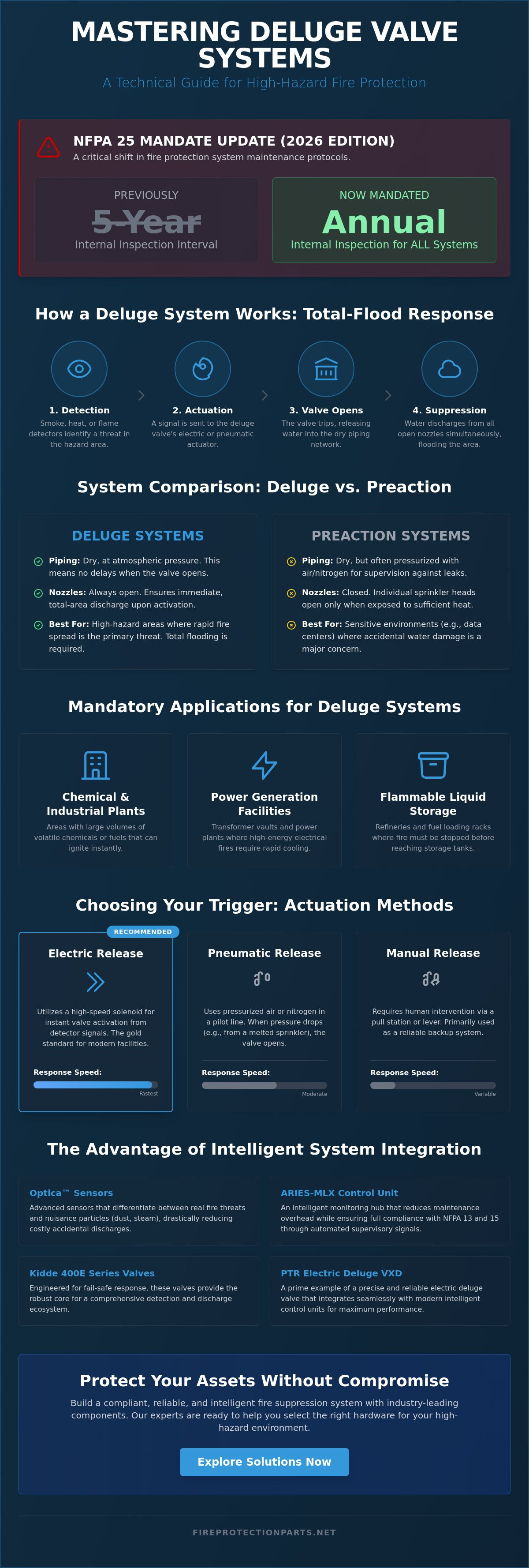
The 2026 edition of NFPA 25 has officially eliminated the five-year internal inspection interval, now mandating a rigorous annual check for every system. This regulatory shift highlights a critical truth: your deluge valve for fire protection is the most vital component in your high-hazard suppression strategy. You already know that a single failure or accidental discharge in a power plant or chemical facility leads to catastrophic downtime. The stakes are higher than ever for facility managers who must balance strict compliance with the need for absolute reliability.
This guide provides the technical roadmap you need to master selection criteria and system integration. You'll learn how to navigate evolving UL standards and implement Kidde Commercial solutions, such as the 400E series, to ensure a fail-safe response. We'll examine how intelligent monitoring through units like the ARIES-MLX can reduce your maintenance overhead while keeping you fully compliant with NFPA 13 and 15. You will gain the expert confidence to build a comprehensive detection and discharge ecosystem that protects your assets without compromise.
Key Takeaways
- Understand why a deluge valve for fire protection is the superior choice for high-hazard areas where it's necessary to have rapid, total-area suppression.
- Compare electric and pneumatic actuation methods to select the most reliable trigger for your specific facility environment.
- Learn how to calculate flow capacity and pressure ratings so your hardware matches your water supply and pump capabilities.
- Stay compliant with 2026 NFPA 25 mandates by implementing annual internal inspections and optimizing your riser room for maintenance.
- Explore how intelligent components like Optica™ sensors can differentiate between real threats and nuisance particles so you don't face the costs of accidental discharge.
What is a Deluge Valve for Fire Protection and How Does it Work?
A deluge valve for fire protection serves as the primary control point for high-hazard suppression systems. It's a quick-release, piston or diaphragm-actuated valve designed to stay closed until a specific trigger occurs. Unlike a standard wet-pipe system where water sits behind every sprinkler head, a deluge system keeps its piping empty. These pipes remain at atmospheric pressure, and the discharge nozzles are always open. This design ensures that when the system activates, every nozzle in the zone discharges water simultaneously. It creates a total-flood response that can suppress rapidly advancing fires before they become uncontrollable.
The core mechanism relies on a separate detection network. This network might include smoke, heat, or flame detectors that monitor the hazard area. When these sensors detect a threat, they send a release signal to the valve's actuator. In many modern industrial installations, the PTR Electric Deluge VXD is utilized for its precise and reliable response. Once the valve is tripped, the internal seal opens completely. Water rushes into the dry piping and exits through every open nozzle at once. This immediate, high-volume response is why Deluge fire sprinkler systems are the industry benchmark for high-risk applications like fuel loading racks and chemical storage.
Deluge vs. Preaction Systems: Knowing the Difference
Choosing between a deluge and a preaction system depends on your specific hazard. A deluge system uses open nozzles to provide an immediate, massive volume of water to an entire area. This is essential when fire spread is the primary threat. Conversely, preaction systems use closed sprinkler heads that only open when exposed to heat. Preaction systems are better for sensitive environments where you want to prevent accidental water damage. However, in high-hazard zones, you don't have time for individual heads to activate. You need the atmospheric pressure of deluge piping to ensure there's no delay in discharge when the valve opens.
Common High-Hazard Environments Requiring Deluge Protection
Certain facilities face risks that standard sprinklers can't handle. Deluge systems are mandated in environments where flammable liquids or high-energy equipment are present. These include:
- Industrial hangars and chemical processing units: Where large volumes of fuel or volatile chemicals can ignite instantly.
- Power generation plants and transformer vaults: Where electrical fires require rapid cooling and suppression.
- Flammable liquid storage facilities and refineries: Where the goal is to prevent a small fire from reaching massive storage tanks.
In these settings, the speed of the deluge valve isn't just a feature. It's the difference between a contained incident and a total loss of the facility. You can't afford a delayed response when seconds determine the survival of your assets.
Actuation Methods: Choosing Between Electric, Pneumatic, and Manual Release
A deluge valve for fire protection is only as effective as its actuation method. This trigger mechanism determines how quickly the system responds to a threat. Selecting the right method depends on your facility's environment and the level of integration required with your fire alarm control panel. While the valve provides the physical barrier, the actuation system provides the intelligence to release water exactly when it's needed. Choosing the wrong method can lead to delayed discharge or, conversely, expensive accidental activations.
Electric release has become the gold standard for modern facilities. It utilizes a high-speed solenoid to trip the valve instantly upon receiving a signal from smoke or flame detectors. This method offers the fastest response times and allows for granular monitoring of system health. For those designing high-hazard protection, the PTR Electric Deluge VXD provides a robust solution that integrates seamlessly with intelligent control units. If you're building a system to meet the NFPA 13 standard, electric actuation often simplifies compliance through automated supervisory signals.
Pneumatic and hydraulic methods serve critical roles in specialized environments. Pneumatic release uses pressurized air or nitrogen. When a detector or pilot head activates, the drop in air pressure trips the valve. This is ideal for hazardous locations where electrical sparks pose an explosion risk. Hydraulic release operates similarly but uses water pressure, making it a reliable choice for remote areas without electrical power. Regardless of the primary method, every installation must include a manual override. This physical pull station or handle ensures that a human operator can trigger the system if the automated detection fails.
The Rise of Electric Actuation in Modern Facilities
Intelligent buildings demand data. Electric actuation provides this by feeding real-time status updates back to the command center. High-speed solenoid activation reduces the delay between detection and discharge to milliseconds. This speed is vital in hangars or refineries where fire spreads at exponential rates. To ensure your system remains operational during power fluctuations, you should source fire protection components that prioritize electrical stability and longevity.
Actuation in Challenging Environments
Environmental factors often dictate your hardware choices. In unheated spaces, pneumatic pilot lines are preferred because they don't face the same freeze risks as water-filled lines. For offshore platforms or coastal refineries, corrosion resistance is the priority. These systems require specialized materials to withstand salt air and harsh weather. The trim of a deluge valve is the essential external piping and components that facilitate these various actuation methods. Ensuring your trim is properly configured is the final step in securing a reliable, environment-specific suppression system.
Selection Criteria: Evaluating Your Deluge System Requirements
Selecting the right deluge valve for fire protection requires a methodical assessment of your facility's hydraulic capabilities and environmental risks. It's not enough to simply match the pipe diameter. You must ensure the valve can handle the maximum pressure generated by your fire pumps while maintaining the required flow rate. If the valve is undersized, friction loss will prevent the system from reaching the necessary Gallons Per Minute (GPM) to suppress a high-hazard fire. Conversely, an oversized valve may lead to inefficient discharge or installation complications. Compliance isn't optional. It's the foundation of your safety strategy.
Material selection is another critical variable. While ductile iron is standard for many industrial applications, corrosive environments like chemical plants or coastal refineries often require stainless steel or specialized internal coatings. You don't want to discover corrosion during an annual inspection. Integration is the final piece of the selection puzzle. Your valve must communicate perfectly with your fire alarm control panel. If you're using the PTR Electric Deluge VXD, verify that its solenoid requirements align with your panel's output to avoid actuation delays.
When evaluating your requirements, consider these four primary factors:
- Pressure Ratings: Does the valve's maximum working pressure match your system's pump capacity?
- Flow Capacity: Can the valve deliver the calculated GPM required for total-area suppression?
- Material Durability: Is the valve body resistant to the specific contaminants or salt air at your site?
- Control Compatibility: Does the actuation trim integrate with your existing detection "brains"?
Hydraulic Demand and Pipe Sizing
Every component in a deluge system introduces friction loss. The valve body is often the most significant contributor. When calculating your hydraulic demand, you must account for this loss to ensure consistent pressure reaches the furthest nozzles in the zone. While industrial deluge systems typically utilize steel, light commercial or residential applications might benefit from Viking CPVC fire sprinkler pipe for its ease of installation and corrosion resistance. Proper sizing ensures that the water supply can overcome the atmospheric pressure in the dry piping instantly upon activation.
Environmental and Regulatory Factors
Your deluge valve for fire protection must meet the NFPA 15 standard for Water Spray Fixed Systems. This standard governs how water is applied to specific hazards. If your facility is located in a high-risk geographic zone, you must also consider seismic requirements. Utilizing ASC Seismic Bracing ensures that your valve and riser assembly remain operational during and after a seismic event. Always verify that your chosen configuration carries a UL Listing or FM Approval. These certifications provide the professional assurance that the equipment has been tested under extreme conditions and will perform when lives are on the line.
Installation and Maintenance: Ensuring System Readiness
Operational readiness begins in the riser room. A deluge valve for fire protection requires a layout that prioritizes accessibility for testing and repair. If your technicians can't reach the trim or the manual release, your response times will suffer. You must provide adequate clearance for full-flow testing and internal inspections. As of the 2026 edition of NFPA 25, the previous five-year allowance for certain valve types has been eliminated. You are now required to perform an internal inspection of all deluge valves every single year. This mandate ensures that debris or corrosion won't compromise the clapper's movement when it's needed most.
The Main Drain Test is your primary tool for verifying water supply integrity. By recording the static and residual pressures, you can identify if a city main has been closed or if a pump is failing. After any activation, whether it's a test or a real event, you must follow a strict reset protocol. This involves draining the system completely, clearing the nozzles of any debris, and resetting the priming chamber. If you skip these steps, you risk a system that won't trip or, worse, a valve that leaks constantly. For those needing to replace worn components, you can find fire protection parts online to ensure your hardware meets original manufacturer specifications.
Maintenance Schedules and NFPA 25 Compliance
Compliance is a rolling process, not a one-time event. Quarterly inspections must now include testing for solenoid supervisory signal devices to monitor coil position on electric actuators. Semi-annual checks should focus on the detection system's ability to trigger the release without actually discharging water into the protected space. This "dry run" is essential for verifying the logic of your PTR Electric Deluge VXD without the cleanup costs of a full deluge. Maintaining a rigorous log of these tests is your best defense during a fire marshal audit.
Troubleshooting False Activations and Leaks
Leaks often stem from a compromised solenoid seat or a drop in priming pressure. If the priming chamber loses pressure, the clapper will lift, causing a false activation. You must also manage "water hammer" during high-volume discharge events by using proper pipe supports and ASC Seismic Bracing. A dedicated air compressor is vital for dry-pilot deluge systems to maintain constant supervisory pressure and prevent accidental trips caused by minor air leaks. If you're experiencing recurring issues with your riser assembly, it's time to browse our full inventory of fire protection components to find a permanent remedy.
The Kidde Commercial Advantage: Intelligent Deluge Control
Your deluge valve for fire protection is a mechanical powerhouse, but it remains dormant without a sophisticated command structure. True protection requires a "Detection-to-Discharge" ecosystem where sensors, notification devices, and control panels work in perfect unison. Kidde Commercial provides this integrated approach; it ensures that your suppression system only activates when a legitimate threat is confirmed. By moving beyond isolated hardware, you eliminate the doubt that often accompanies high-hazard fire safety management. This intelligent oversight transforms a simple valve into a precision safety tool.
Effective notification is the second half of the safety equation. The Genesis™ LED Series provides high-candela output to ensure visibility in vast industrial spaces while maintaining an incredibly low power draw. This efficiency allows for more devices per circuit, reducing the complexity of your wiring. When these devices are paired with ConnectedSafety+, you gain 24/7 cloud-based diagnostics. This platform allows you to monitor system health and receive remote alerts before a minor issue becomes a system failure. You can manage your facility's safety with the same digital precision you use for other critical operations.
Optica™ Series: Reducing Nuisance Alarms in Industrial Spaces
Accidental discharges aren't just messy; they're expensive. In high-hazard zones, a false trip can result in thousands of dollars in cleanup costs and lost production time. The Optica™ series uses multi-angle optical sensors to differentiate between actual smoke and nuisance particles like dust or steam. These sensors are fully compliant with UL 268 7th Edition standards, which were specifically designed to reduce false alarms. By implementing this level of detection, you ensure your deluge valve for fire protection only opens when the threat is real. This accuracy provides significant cost-saving benefits and prevents unnecessary downtime in sensitive processing units.
Scalable Control Panels for Any Facility
Whether you're protecting a standalone retail unit or a sprawling industrial campus, your control infrastructure must be scalable. The VM and VS Series panels offer modular flexibility for various commercial needs. For larger environments, the Evolve Series allows for networked protection across multiple buildings. These systems feature intuitive 10-inch touchscreens that simplify system management for facility managers. You don't need to be a programmer to understand your system's status or perform basic diagnostics. To find the right fit for your facility, you can browse the full Kidde Commercial collection for your next project and secure a system built on innovation and trust.
Securing High-Hazard Assets with Professional Precision
A deluge valve for fire protection is the frontline defense for your most critical infrastructure. You've seen that success depends on matching your actuation method to your specific environment and adhering to the updated 2026 NFPA 25 annual inspection mandates. Whether you're managing a refinery or a power plant, the goal remains the same: immediate, high-volume suppression without the risk of accidental discharge. Integrating intelligent detection with robust hardware is the only way to achieve this balance and ensure your facility stays compliant.
Reliability is built on a foundation of proven performance. Kidde Commercial offers over 100 years of fire safety heritage, providing advanced tools like UL 268 7th Edition certified detection and Genesis™ LED low-current notification devices. These solutions simplify complex installations while reducing your facility's long-term maintenance overhead. Shop Kidde Commercial Life Safety Solutions to equip your facility with the industry's most trusted components. You're not just buying parts; you're investing in a fail-safe future for your team and your assets. Take the next step toward professional assurance today.
Frequently Asked Questions
What is the primary purpose of a deluge valve for fire protection?
The primary purpose of a deluge valve for fire protection is to provide immediate, total-area suppression in high-hazard environments. Unlike standard sprinklers that activate individually, a deluge valve releases water through all open nozzles in a zone at once. This creates a massive water curtain to contain fast-moving fires in refineries, chemical plants, or power facilities where standard response times are insufficient.
How does a deluge system differ from a dry pipe sprinkler system?
A deluge system utilizes open nozzles and unpressurized piping, while a dry pipe system uses closed sprinkler heads and pressurized air. In a dry pipe setup, only the heads exposed to heat will open. In a deluge configuration, the entire zone discharges water the moment the valve trips. Deluge systems are designed for rapid fire spread, whereas dry pipe systems primarily protect against freezing in warehouses.
Can a deluge valve be used in freezing environments?
Yes, deluge valves are excellent for freezing environments because the piping remains empty and at atmospheric pressure until activation. Since there's no water in the distribution pipes, there's no risk of pipe bursts in unheated spaces. You must ensure the valve itself and its water supply are located in a heated riser room or protected by heat tracing to maintain operational readiness.
What triggers a deluge valve to open during a fire?
A deluge valve for fire protection is triggered by a dedicated detection system rather than the heat-sensitive elements on the nozzles themselves. This trigger can be an electric signal from a smoke or flame detector, a drop in pneumatic air pressure from a pilot line, or a manual pull station. Once the detection system identifies a threat, it sends a release signal to the valve's actuator to open the clapper.
How often should a deluge system be trip-tested?
According to the 2026 edition of NFPA 25, you should perform a full trip test of your deluge system annually. This test verifies that the detection system, release mechanism, and valve clapper all function correctly. You must also conduct quarterly inspections of solenoid supervisory devices to ensure the electrical components are ready. Frequent testing is the only way to guarantee the system won't fail during a real emergency.
What is the role of a solenoid valve in electric deluge actuation?
In electric actuation, the solenoid valve acts as the interface between the fire alarm control panel and the deluge valve. When the panel receives a fire signal, it energizes the solenoid to vent pressure from the deluge valve's priming chamber. This drop in pressure allows the clapper to lift and discharge water. It's a critical component that enables high-speed, intelligent suppression in modern industrial facilities.
Are deluge valves required for airplane hangars?
Yes, deluge valves are typically required for Group I airplane hangars under NFPA 409 standards. These environments contain large volumes of high-energy fuel, making rapid, high-volume water or foam application necessary. A deluge system can cover the massive floor area of a hangar instantly, providing the cooling and suppression needed to protect expensive aircraft and the building's structural integrity.
Can I reset a deluge valve remotely?
No, standard deluge valves cannot be reset remotely for safety and regulatory reasons. Industry specifications, such as IOGP S-737, require that deluge valves be designed to prevent automatic or remote resetting after operation. A technician must physically inspect the valve, clear the nozzles, and manually reset the clapper and priming chamber at the riser to ensure the system is truly ready for service again.

