

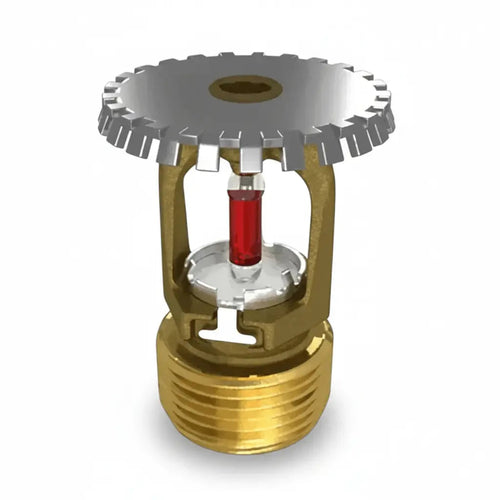


Dry Pendent Fire Sprinkler Heads for System Selection
A sprinkler can protect a cold space without keeping water in its exposed barrel. Dry pendent fire sprinkler heads keep water out of the barrel until heat activates the sprinkler’s heat element. The element releases air and opens the seal, allowing water to flow through the orifice and discharge against the deflector.
Choosing the right head involves more than matching it to the ceiling. K-factor, thread size, temperature rating, configuration, response type, and exposed barrel length all affect selection and fit with the system.
This guide explains how dry pendent sprinklers work and what to compare when selecting them for a wet-pipe system serving an area at risk of freezing. You’ll learn why barrel length matters, how key specifications guide selection, and how to coordinate the sprinkler with the wider system design.
Key Takeaways
- Compare K-factor and thread size with the system’s hydraulic needs and connection requirements to narrow compatible sprinkler options.
- Use the temperature rating and the exposed barrel length to account for heat conditions and reduce freezing risks at the wet-pipe connection.
- Match pendent, concealed pendent, upright, or sidewall configurations to the space and the intended sprinkler placement.
- Understand how quick-response and standard-response models differ before selecting a head for the system design.
K-factor and thread size
K-factor and thread size address two different fit requirements: hydraulic performance and connection to the branch line. Compare both with the system design before selecting a dry pendent head.
K-Factor Options
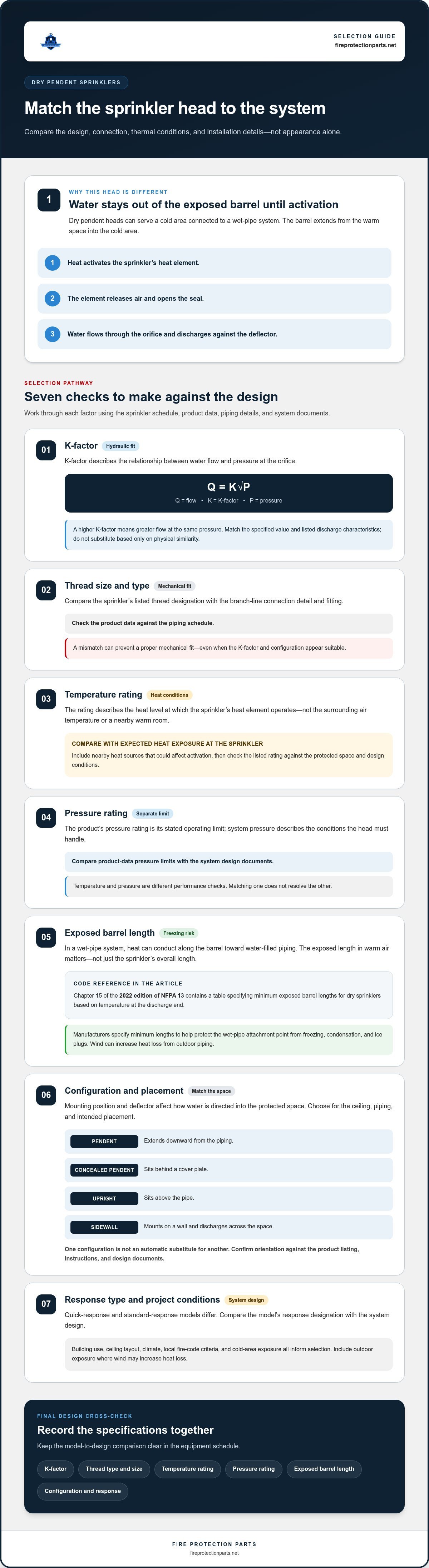
A sprinkler’s K-factor describes the relationship between water flow and pressure at the orifice. The formula is Q = K√P, where Q is flow and P is pressure. A higher K-factor means greater flow at the same pressure, so choose a value that matches the hydraulic design, not appearance alone.
Start with the sprinkler schedule or design criteria when comparing options. Match the specified K-factor to the head’s product data, then confirm that its listed discharge characteristics meet the system’s needs. For example, heads with different K-factors can deliver different flows at the same pressure. Don’t substitute one based only on physical similarity.
Thread Size
Thread size determines whether the sprinkler inlet fits the intended pipe fitting. Compare the head’s listed thread designation with the connection detail in the system documents. A mismatch can prevent a proper mechanical fit, even if the K-factor and sprinkler configuration appear suitable.
Use the product data and piping schedule together. Confirm the thread type and size, then compare them with the branch-line connection before procurement. Treat the thread designation as a specific interface requirement, not a general size description. A connection that looks close may not be compatible.
Keep hydraulic and mechanical checks separate. First, verify that the K-factor aligns with the design basis and required flow conditions. Then confirm the thread specification against the fitting. Record both values in the equipment schedule to compare the selected head consistently with the design documents.
Dry sprinklers have a barrel that extends from the warm space to the sprinkler in the cold area. In wet-pipe systems, the exposed barrel length in warm air matters because heat can conduct along the barrel toward water-filled piping. K-factor and thread size are only part of the selection: compare them with the required sprinkler length and installation configuration.
Temperature rating
Dry pendent sprinkler heads come in different configurations and response types, and each model has a temperature rating. Select a rating suited to the expected heat conditions at the sprinkler location, then compare it with the product’s pressure rating and the system design.
The temperature rating describes the heat level at which the sprinkler’s heat element operates. It is not the same as the surrounding air temperature or the temperature in a nearby warm room. For example, a head below a cold ceiling still needs a rating suited to the protected space and its design conditions. Compare the listed rating with expected heat exposure at the location, including nearby heat sources that could affect activation.
Pressure is a separate selection check. The product’s pressure rating sets the operating limit stated for the sprinkler, while system pressure describes the conditions the head must handle. Compare the product-data rating with the system design documents. Temperature and pressure represent different performance limits, so matching one does not resolve the other. Record both in the equipment schedule for a clear model-to-design comparison.
Length matters alongside these ratings in a wet-pipe system. Chapter 15 of the 2022 edition of NFPA 13 contains a table specifying minimum exposed barrel lengths for dry sprinklers based on temperature at the discharge end. The exposed barrel length in warm air, rather than the sprinkler’s overall length, helps address heat conduction toward water-filled piping. Manufacturers specify minimum lengths to help protect the wet-pipe attachment point from freezing, condensation, and ice plugs.
Use this sequence: identify expected temperature conditions at the discharge end, compare the sprinkler’s temperature rating, then match pressure limits and barrel length to the system documents. A wet-pipe system with a dry sprinkler can still freeze in some ambient conditions because heat conducts along the barrel. Wind can also increase heat loss from outdoor piping, so include exposure in the temperature assessment.
Pendent, concealed pendent, upright, and sidewall configurations
Configuration determines how a sprinkler connects to the piping and directs water into the protected space. Compare the mounting position, ceiling details, and cold-area exposure before selecting a model.
Choosing a Configuration
Choose a dry pendent head when a wet-pipe system serves an area exposed to freezing temperatures, such as a cold storage room. A wet pendent head has water in its sprinkler branch, while a dry pendent head keeps water out of its exposed barrel until activation. Dry sidewall heads suit a different mounting position and discharge pattern. Building use, ceiling layout, climate, and local fire-code criteria all inform selection.
Pendent heads extend downward from the piping; concealed pendent models sit behind a cover plate. Upright heads sit above the pipe, while sidewall heads mount on a wall and discharge across the space. Their positions and deflectors create different water-distribution patterns, so one configuration is not an automatic substitute for another.
For United States projects, compare the product’s stated listing and orientation with the applicable design documents and local requirements. NFPA 13’s 2022 edition includes a Chapter 15 table for minimum exposed barrel lengths, based on temperature at the discharge end. The building’s use and the climate around the sprinkler help determine the design conditions.
There is no single installed cost for every dry pendent head. Configuration, barrel length, piping connection, access, and installation work all affect the total, and these factors differ between new systems and retrofits.
Installation and Orientation
Match the head’s orientation to its listed configuration and product instructions. A pendent model belongs below its piping connection; an upright model sits above the branch line, and a sidewall model mounts on the wall. Keep the selected barrel length aligned with the system design, especially where warm and freezing spaces meet.
Follow the manufacturer’s instructions and system maintenance procedures for inspection and maintenance. Look for visible damage, obstruction, corrosion, or changes around the cover plate. Common concerns include a damaged heat element, blocked deflector, incorrect orientation, or freezing at the wet-pipe connection. Have these conditions addressed through qualified system maintenance.
Quick-response and standard-response models
Quick-response and standard-response describe how a sprinkler’s heat-sensitive element reacts to rising temperatures. Response classification is separate from whether the sprinkler is dry, pendent, upright, or sidewall. Compare response type with the system design rather than treating it as a substitute for configuration, K-factor, or temperature rating.
A quick-response model is designed to react to heat faster than a standard-response model. This difference affects how the sprinkler responds as heat reaches its operating element. Standard-response models have a different response characteristic. Neither label alone identifies the right choice for a particular space; selection must follow the design criteria and exact model information.
Start with the sprinkler schedule when comparing models. Note the required response classification, then match it to the selected head’s product documentation. Keep the other specifications aligned: a quick-response model still needs the specified K-factor, thread connection, temperature rating, and dry configuration. A model that matches the response type but not the connection is not a complete match.
Response type also works alongside the building’s use and the protected area’s design. Room layout, ceiling arrangement, and expected heat conditions inform the system design; the response classification should follow that design, not preference alone. Don’t assume quick response is automatically better or that standard response can replace it. The classifications are not interchangeable simply because the heads look similar.
Before procurement, compare the sprinkler schedule with the product’s model designation and technical data. Resolve any response-type mismatch before ordering, and keep the selected model consistent across project documents. This cross-check helps prevent a specification error from being mistaken for a physical-fit issue during installation.
Ready to move from response type to equipment selection? Explore compatible fire protection equipment for your system requirements.
Fire Protection Parts: Viking Plastics CPVC Pipe for Fire Protection
Fire Protection Parts offers specialized CPVC pipe for fire protection for projects where fire-protection piping is part of the system plan. Selecting dry pendent fire sprinkler heads and coordinating surrounding components are related but distinct decisions. Match each component to the system design and its intended application.
For a cold area served by a wet-pipe system, Fire Protection Parts also offers dry pendent sprinklers. Treat the pipe and sprinkler as separate parts of the wider design, and use project specifications to guide selection. The right product category depends on system requirements, not simply on whether components appear to fit together.
Explore Fire Protection Parts’ system components at fireprotectionparts.net.
Turn Your Selection Into a System-Ready Decision
Before finalizing a sprinkler schedule, align the selected head with the space it protects and the wider system design. Treat the choice as part of a coordinated plan, not an isolated purchase. This helps keep equipment specifications, piping requirements, and project documentation working together.
For projects requiring cold-area protection, dry pendent fire sprinkler heads are one part of the system decision. Fire Protection Parts also offers Residential Fire Pump Systems and PTR Electric Deluge VXD for other fire-protection applications. Each product serves a different system need, so select according to the project requirements.
Bring your system requirements and equipment needs together for the next step. Contact Fire Protection Parts for assistance and continue planning with a clear path forward.
Frequently Asked Questions
How does a dry sprinkler work?
A dry sprinkler keeps water behind a seal until heat activates its operating element. The element opens the seal, allowing air in the barrel to escape and water to reach the sprinkler orifice and deflector. This arrangement is useful where a wet-pipe branch could be exposed to freezing, such as a cold room connected to a warmer area.
What is a dry pendent fire sprinkler head and how does it work?
A dry pendent sprinkler is a downward-facing head with a sealed barrel that separates the sprinkler from water-filled piping. Heat at the head activates its element; the seal opens, and water flows through the barrel to discharge. Unlike a dry-pipe system, this arrangement can protect a specific cold area while the connected piping remains part of a wet-pipe system.
What are the dimensions, lengths, and connection sizes available?
Dimensions, barrel lengths, and connection sizes vary by sprinkler model and system requirements. The required length depends on the distance between the piping connection and the discharge point in the cold area, while the thread must match the intended fitting. Compare these measurements together using the sprinkler schedule and product specifications. A matching connection alone does not establish a suitable overall fit.
Which standards and listings should dry pendent sprinkler heads meet in the United States?
Match the sprinkler’s stated listing and orientation to the applicable design documents and local requirements. NFPA 13’s 2022 edition includes a Chapter 15 table for minimum exposed barrel lengths based on temperature at the discharge end.
How much do dry pendent sprinkler heads cost, including installation?
There is no single installed cost. Configuration, barrel length, piping connection, access, installation work, and whether the job is new construction or a retrofit all affect the total.
How are dry pendent sprinkler heads inspected, tested, and maintained?
Follow the manufacturer’s instructions and system maintenance procedures. Check for visible damage, obstruction, corrosion, cover-plate changes, a damaged heat element, a blocked deflector, incorrect orientation, or freezing at the wet-pipe connection. Have any issues addressed through qualified system maintenance.

