

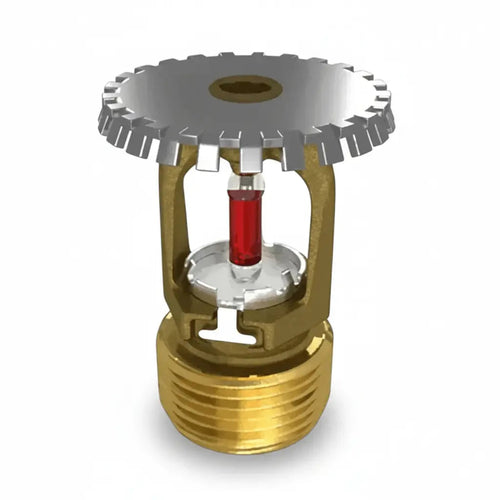


Earthquake Bracing for Fire Suppression: Requirements and Materials
Earthquake bracing for fire suppression systems includes sway braces, flexible connections, pipe restraint, and clearance that lets piping move without striking the building. Whether sprinklers require this protection depends on the building’s seismic design category and the applicable local or state code. NFPA 13 Section 9.3 is commonly used for fire-system seismic design.
It’s easy to assume that adding braces is the whole solution, but the system also needs compatible connections and room to move. This guide explains what seismic protection covers, when commercial buildings and sprinkler systems may require it, and how brace materials and components work together. You’ll also learn how the seismic design category, pipe layout, and building movement shape the bracing approach.
Key Takeaways
- Use the building’s seismic design category and applicable code requirements to determine whether sprinkler-system bracing is needed.
- Match brace direction and support components to the pipe layout, especially for larger branch lines.
- Commercial-building requirements depend on factors such as seismic exposure and piping configuration; bracing is only one part of protection.
- Flexible connections and properly selected seismic components help accommodate movement and reduce the risk of pipe damage.
How to Determine if Sprinklers Require Seismic?
Start with the building’s Seismic Design Category and locally adopted codes. Seismic braces help fire sprinkler systems move with the structure instead of separating during earthquake motion.
Seismic Bracing Code Framework
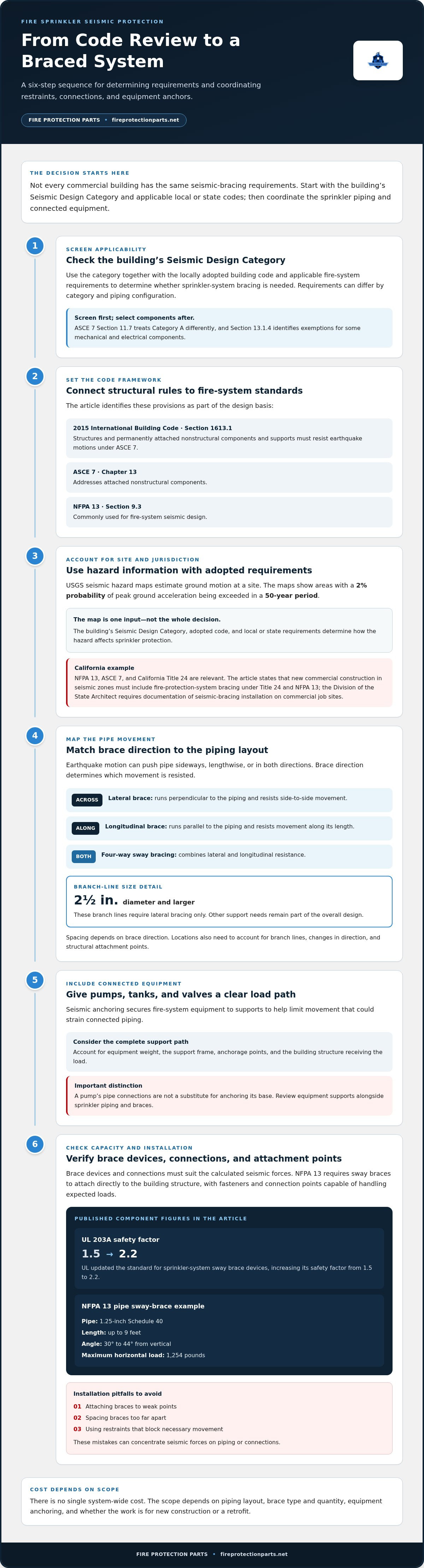
The building-code framework combines structural rules with fire-system standards. The 2015 International Building Code, Section 1613.1, requires structures and permanently attached nonstructural components and supports to resist earthquake motions under ASCE 7. ASCE 7 Chapter 13 addresses attached nonstructural components, while NFPA 13 Section 9.3 is commonly used for fire-system seismic design. The building’s category affects which provisions apply: ASCE 7 Section 11.7 treats Category A differently, and Section 13.1.4 identifies exemptions for some mechanical and electrical components. This screening helps establish the design basis before selecting braces.
Hazard Maps and Local Requirements
Seismic hazard maps estimate the ground motion a site may experience; USGS maps show areas with a 2% probability of peak ground acceleration being exceeded in a 50-year period. The building’s Seismic Design Category, adopted building code, and local or state requirements determine how that hazard affects sprinkler protection. In Southern California, NFPA 13, ASCE 7, and California Title 24 are relevant to fire-system bracing. New commercial construction in seismic zones must include fire-protection-system bracing under Title 24 and NFPA 13. The Division of the State Architect requires documentation of seismic-bracing installation on commercial job sites.
Anchoring Fire-System Equipment
Seismic anchoring secures equipment such as fire pumps, tanks, and control valves to supports, helping limit movement that could strain connected piping. The design must account for the equipment’s weight, support frame, anchorage points, and the building structure receiving the load. For example, a pump’s pipe connections are not a substitute for anchoring its base. Include equipment supports in the system’s seismic review alongside sprinkler piping and braces, so every part has a clear load path to the structure.
How much does earthquake bracing for fire suppression cost? There is no single system-wide cost: the scope depends on the piping layout, brace type and quantity, equipment anchoring, and whether the work is for new construction or a retrofit.
Bracing matters because earthquake movement can damage piping and interrupt fire protection when it is needed. Coordinated restraints, equipment anchors, and code-based design help preserve the system’s ability to function after ground motion.
What materials are commonly used for seismic braces?
Sprinkler bracing uses brace devices and structural attachments selected for the pipe layout and expected seismic forces. Lateral braces run perpendicular to piping, while longitudinal braces run parallel. Four-way sway bracing combines both directions to resist movement across the system. The arrangement matters because an earthquake can push a pipe sideways, lengthwise, or in both directions, creating different loads at supports and connections.
Branch-line size affects the restraint approach. Branch lines 2½ in. in diameter and larger require lateral bracing only. That means the brace resists side-to-side movement, while the line’s other support needs remain part of the overall design. The distinction helps prevent applying the same bracing pattern to every pipe. Pipe size, layout, attachment points, and the expected load all inform the installation.
Brace spacing depends on direction. Lateral spacing limits unsupported movement across sprinkler piping, while longitudinal spacing controls movement along its length. A four-way brace combines both functions at a selected point. Brace locations must also account for branch lines, changes in direction, and structural attachment points. Ignoring these features can leave sections exposed to movement, even when braces are installed elsewhere.
Brace devices and their connections must suit the calculated seismic forces. UL updated UL 203A, the standard for sprinkler-system sway brace devices, increasing its safety factor from 1.5 to 2.2. NFPA 13 also permits a 1.25-inch Schedule 40 pipe, up to 9 feet long and installed 30 to 44 degrees from vertical, to serve as a sway brace for a maximum horizontal load of 1,254 pounds. These limits show why brace geometry and capacity matter.
For a bracing component suited to this application, explore ASC Seismic Bracing as part of your system planning.
Are all commercial buildings required to have seismic bracing?
No. Seismic bracing requirements depend on the building’s Seismic Design Category and applicable codes, including NFPA 13. The brace layout must also account for piping and supports.
Common installation failures include attaching braces to weak points, spacing them too far apart, and using restraints that block necessary movement. These mistakes can concentrate seismic forces on piping or connections.
Brace Types and Pipe Supports
Sway braces resist lateral or longitudinal movement, while restraint hangers and pipe stands support or limit pipe displacement. Their roles differ, so treating them as interchangeable can leave a sprinkler line vulnerable during seismic activity. NFPA 13 requires sway braces to attach directly to the building structure, with fasteners and connection points capable of handling expected loads. Engineers must consider the entire load path, not just the brace itself.
Feed and cross mains, along with other piping, may need seismic bracing depending on the applicable requirements. Branch-line restraints also matter where upward or lateral movement could cause impact damage. NFPA 13 sets a maximum restraint spacing of 30 feet in that condition. Short hanger rods have a specific exception: branch lines supported by rods shorter than 6 inches, measured from pipe top to structural attachment, need no additional restraint.
Maximum Brace Spacing
Maximum brace spacing sets the greatest permitted distance between supports resisting seismic forces. NFPA 13 specifies lateral sway braces at intervals no greater than 40 feet and longitudinal braces at intervals no greater than 80 feet. The final spans also have limits: the last longitudinal brace must be within 40 feet of the pipe end, and the last lateral brace within 6 feet.
Other locations need separate attention. A sprinkler riser exceeding 25 feet requires four-way bracing at maximum intervals of 25 feet. Engineers use piping configuration and expected forces in the calculation; a long straight run and a riser do not receive identical treatment. Restraint placement that ignores end distances, direction, or structural attachment can leave sections exposed even when braces appear regularly spaced.
A building’s commercial status alone does not determine its bracing requirements. Seismic category, applicable code provisions, piping layout, and support conditions govern the design. Reviewing these factors helps align brace selection and installation with the system’s actual load paths.
Flexible couplings, smart anchors, and vibration dampers
NFPA 13’s seismic approach combines sway bracing with flexible connections, pipe clearance, restraint, and limits on hangers and fasteners. Each component has a distinct role. Braces resist movement, while flexible couplings accommodate relative movement between connected pipe sections. Vibration dampers address vibration, but they do not replace seismic bracing or the required restraint.
At sprinkler risers longer than 3 feet, NFPA 13 requires four-way bracing. Flexible couplings at the riser’s base and top help accommodate building-wall deflection during earthquake movement. Together, these details address different forces: the brace limits sway, while the coupling allows movement at the connection. A rigid connection at a point of differential movement can transfer stress into piping or joints.
Where a building includes a seismic joint, the sprinkler system also needs a seismic joint to accommodate differential movement. This prevents the pipe from bridging a building separation that moves independently. The coupling or joint must fit the location and system arrangement; sway bracing still provides restraint elsewhere. NFPA 13’s combined approach matters because a flexible connection alone does not secure the rest of the piping.
Anchors transfer brace forces into the building structure, so their placement and connections affect the system’s load path. The term “smart anchor” does not replace engineering checks: the anchor, fastener, and supporting structure must work together under expected loads. Coordinate electrical components and fire-protection systems in the same seismic design review, so one system’s supports do not interfere with another’s movement or access.
Inspect seismic braces at least once a year and after an earthquake or building modification. Look for changes to connections, supports, and nearby construction that could affect movement or restraint. Properly selected ASC Seismic Bracing can support a coordinated bracing plan for sprinkler piping. Use the system’s design requirements to guide component selection and placement.
Fire Protection Parts: Viking Plastics CPVC Pipe for Fire Protection
Fire Protection Parts offers high-quality CPVC Pipe for Fire Protection and ASC Seismic Bracing for projects specifying these components. Each serves a different role: CPVC pipe carries water through the system, while seismic bracing supports piping against earthquake movement. Match each component to the project design to keep procurement aligned with the planned fire-protection system.
Fire Protection Parts also offers Residential Fire Pump Systems and PTR Electric Deluge VXD for related system needs. Review these products alongside the project documents and building requirements. For product information or help selecting components, contact Fire Protection Parts or visit fireprotectionparts.net.
Make the Next Project Decision with Confidence
Effective earthquake bracing for fire suppression starts with treating seismic protection as part of the overall project plan. Before purchasing components, align your choices with the design documents, building requirements, and the role each item must perform. This keeps decisions focused on compatibility and intended use, rather than selecting parts in isolation.
Fire Protection Parts offers Viking Plastics CPVC Pipe for Fire Protection, Residential Fire Pump Systems, and PTR Electric Deluge VXD. These products serve different fire-protection needs, so use the project specifications to guide your selection. A clearly defined scope helps identify components suited to the system requirements and move planning forward.
For product information and assistance with your next step, contact Fire Protection Parts. With a defined project scope and the right components in view, you can move ahead with greater clarity.
Frequently Asked Questions
What does Seismic Protection Include?
Seismic protection includes restraints and connections that help fire-protection equipment accommodate earthquake movement. Where a sprinkler line crosses a building seismic joint, the piping needs a corresponding joint to accommodate differential movement. Protection also accounts for pipe clearance, support connections, and equipment anchorage, not just braces. These components work together: restraints limit unwanted displacement, while flexible connections allow movement where the building design requires it.
How often should seismic brace inspections occur?
Inspect fire-system seismic braces annually and again after an earthquake or building modification. During each review, look for changes to brace connections, attachments, and surrounding construction that could affect how the piping moves. For example, renovation work near a brace could limit access or interfere with a support. Changes to the building or system deserve attention because they can affect the original bracing arrangement.
So What is a Seismic Design Category?
A Seismic Design Category, or SDC, classifies a building for seismic design purposes and helps establish which requirements apply to attached systems. The category can be determined under International Building Code Section 1613 or ASCE 7. For example, the applicable provisions treat Category A differently from Categories C through F. Knowing the building’s SDC gives designers a starting point for evaluating sprinkler-system seismic criteria.
Why is seismic bracing necessary in Southern California?
Southern California faces earthquake exposure, so fire-system bracing helps limit damage that could impair sprinkler operation. NFPA 13 and ASCE 7 provide relevant bracing specifications, while California Title 24 includes applicable legal requirements. For new commercial construction in seismic zones, fire-protection-system bracing is required under Title 24 and NFPA 13. Bracing supports system continuity when ground movement places force on piping and connections.
What is seismic bracing for fire suppression systems?
Seismic bracing is a system of supports that helps fire-suppression piping resist earthquake forces. It transfers movement-related loads from pipes through braces and their connections into the building structure. A brace must connect to structural support, not simply to another pipe or an unrelated ceiling component. This creates a defined load path for the piping and helps prevent uncontrolled movement from damaging joints or connected equipment.
Which fire sprinkler components require earthquake bracing?
Requirements vary by component and arrangement. Feed mains, cross mains, and other piping require bracing regardless of size. Branch lines 2½ inches in diameter and larger require lateral bracing, while sprigs supplying sprinklers need lateral restraint when they are 4 feet or longer. Riser bracing also depends on its length. These distinctions help explain why one bracing layout cannot be applied uniformly to every pipe section.

