



Fire Protection for Telecom Facilities: 2026 Buyer's Guide
What if a suppression approach that seems safest for equipment does not match the room’s actual fire risks or approved design? Choosing a fire protection system for telecommunication facilities means balancing life safety, equipment exposure, operational continuity, and applicable requirements. One approach will not automatically suit every space.
Facility teams know that fire-related downtime can disrupt critical communications. They also face different conditions across equipment rooms, battery areas, and occupied spaces, which can make system options and code references difficult to compare.
This guide explains common fire-protection approaches for telecom environments and how to evaluate them against room risks, operational needs, and design requirements. It also outlines how NFPA 76, NFPA 75, and locally adopted codes may apply, so you can identify relevant references for your facility with the appropriate design professionals and authority having jurisdiction.
Finally, you’ll learn how to source components to match approved plans and specifications. Fire-protection CPVC pipe, air compressors, backflow preventers, and seismic bracing should be selected only when they match the design and applicable requirements.
Key Takeaways
- Room function and fire risks shape the protection approach. Telecom spaces should not be treated as identical.
- Compare water-based sprinklers, preaction, clean-agent, and inert-gas systems by equipment impact, detection needs, room conditions, and design complexity.
- Applicable standards and local requirements help define the design basis for a fire protection system for telecommunication facilities.
- Use an ordered purchasing workflow to reconcile project documents and specifications before sourcing components.
- Match manufacturer, model, part number, material, connection, rating, quantity, and approved substitutions to the reviewed design.
Why fire protection for telecommunication facilities starts with room-level risk
A fire can interrupt communications, damage network or power equipment, and trigger demanding recovery work. Suppression can also affect operations if equipment is exposed or a room needs cleanup before service can resume. Risk varies across a site: a central office, switching location, network hub, and equipment room may differ in layout, equipment, occupancy, and operating conditions.
Telecom fire protection coordinates risk control, detection, suppression, and continuity planning around each room’s hazards and operational role. The National Fire Protection Association (NFPA) develops fire-protection standards, but a facility assessment must account for its specific spaces and project requirements.
Which telecom areas create distinct protection questions?
Occupied support areas raise different questions from rooms with concentrated network or power equipment. Staff presence and room use matter, as do cable pathways, equipment layouts, and ventilation, which can influence how a hazard develops and how protection reaches the space. Heat from powered equipment, dense cabling, maintenance work, and changes in cooling performance all belong in the assessment.
Start with facility drawings and the project’s hazard analysis. Use them to identify room functions, equipment locations, cable routes, ventilation arrangements, and maintenance areas. This gives the design team a consistent basis for evaluating each space instead of applying the same assumptions across the facility.
How can fire or suppression affect uptime?
Direct fire damage is only one source of disruption. A system discharge, water exposure, cleanup, equipment assessment, and restoration work may also affect operations. The impact depends on the event, the affected area, and the equipment involved. No protection approach should be treated as a guarantee against downtime.
Build continuity planning into the project. Identify critical services and equipment, how affected areas could be isolated, and which recovery steps depend on access to the room. These considerations help frame design decisions without assuming suppression alone can preserve service.
- Power equipment: Review equipment placement and operating conditions as potential sources of heat or ignition concern.
- Cable density: Map pathways and concentrations that could shape fire spread or complicate access.
- Cooling performance: Consider how ventilation and cooling conditions affect room temperatures and equipment operation.
- Maintenance activity: Include work practices and temporary project conditions in the hazard review.
Use these findings to define the room-level questions the design must address. A fire protection system for telecommunication facilities should follow assessed hazards and operational needs, not a generic room label.
How telecom fire protection requirements shape a system specification
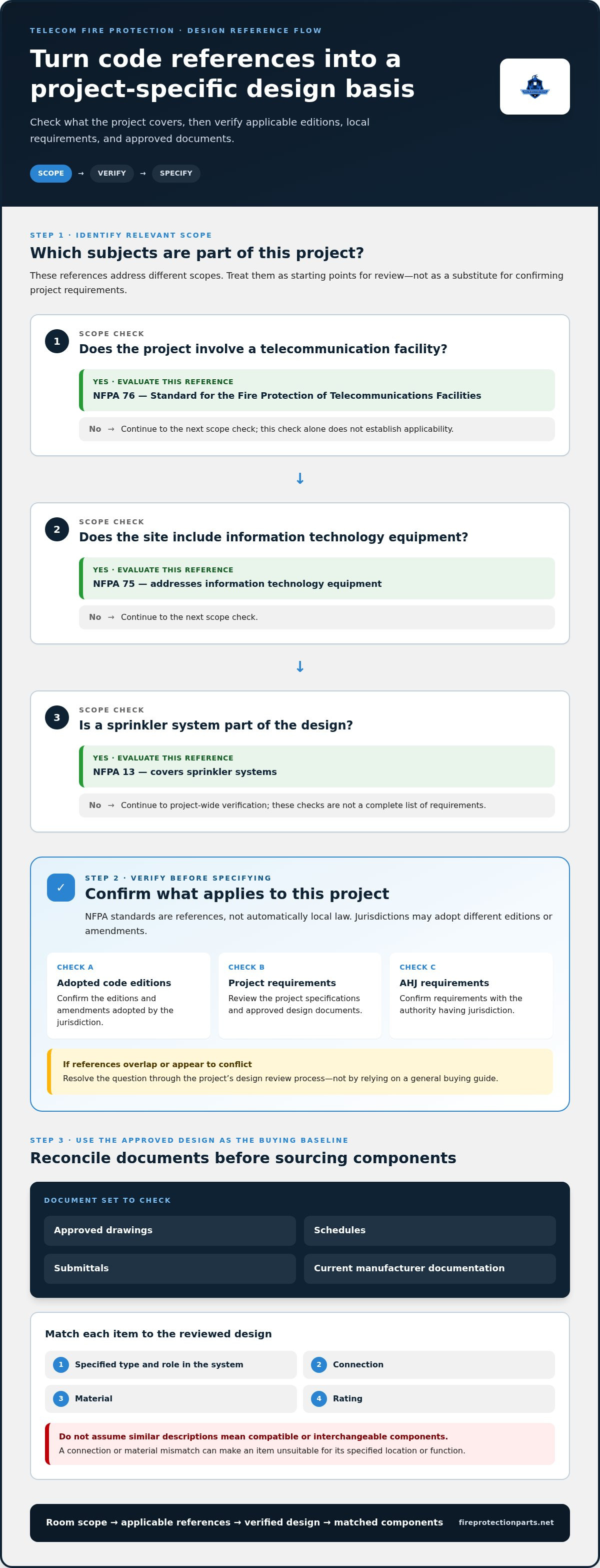
A system specification depends on more than the room’s equipment. The facility’s classification, codes and standards adopted by the jurisdiction, approved design, and authority having jurisdiction (AHJ) all influence project requirements. NFPA standards are references, not automatically local law. Jurisdictions may adopt different editions or amendments, so confirm what applies before using a general guide or code excerpt to make project decisions.
Three references often enter the discussion, but they cover different scopes. NFPA 76: Standard for the Fire Protection of Telecommunications Facilities concerns telecommunication facilities. NFPA 75 addresses information technology equipment, while NFPA 13 covers sprinkler systems. A site with both telecom services and private IT equipment may need its design team to evaluate multiple references. Verify current editions and applicability against the project and local adoption.
Component compliance depends on the approved design and applicable project requirements. An online summary can help identify questions, but it cannot establish that a particular system or component meets project requirements. The responsible design professional and AHJ provide the project-specific interpretation, and procurement should follow the resulting documents.
What should buyers verify in code and project documents?
Build a clear reference set before comparing components. Confirm adopted code editions and amendments, project specifications, and AHJ requirements. Then identify which documents address telecom facilities, IT equipment, sprinklers, and other system elements. If references overlap or appear to conflict, resolve the question through the project’s design review process rather than relying on a general buying guide.
How do design documents control component selection?
Use approved drawings, schedules, submittals, and current manufacturer documentation as the procurement baseline. Match each item to its specified type, connection, material, rating, and role in the system. Similar product descriptions do not prove that components are compatible or interchangeable.
Before ordering, reconcile part details against the documents. A mismatch in connection or material, for example, can make a component unsuitable for its specified location or function, even when its broad product category seems correct.
- Keep the approved schedule and relevant drawing references with the purchase records.
- Compare the manufacturer, model, and part number against the specified item.
- Review material, connection, rating, quantity, and intended system role.
- Submit proposed substitutions for formal review before purchasing them.
This sequence keeps sourcing aligned with the design and helps prevent purchasing from becoming an unapproved design change. For projects with finalized specifications, fire-protection components from Fire Protection Parts support component sourcing, with selection guided by the approved documents and applicable requirements.
Compare fire protection approaches for telecom facilities by risk and impact
No suppression type is universally best for telecom spaces. Each approach involves different trade-offs in how fire is detected and controlled, its possible effects on equipment, room requirements, and system coordination. A fire protection system for telecommunication facilities must be selected through the approved engineering design, based on specific hazards and applicable project requirements.
Use this comparison to frame design discussions, not to select a system on its own. Actual performance and configuration depend on the approved design and current manufacturer documentation.
| Approach | Hazard addressed | Potential equipment impact | Detection dependency | Room conditions and design complexity |
|---|---|---|---|---|
| Water-based sprinklers | Fire controlled through water discharge from sprinkler piping. | Water exposure may affect equipment and lead to cleanup or recovery work. | Individual sprinkler operation responds to heat; alarm and control arrangements depend on system design. | Requires coordinated piping layout and consideration of room use, equipment, and applicable requirements. |
| Preaction sprinklers | Water-based protection where the design uses a detection event to control water admission to piping before sprinkler operation. | Discharge can still expose equipment to water; the arrangement does not remove water-related impacts. | Depends on the specified detection and release sequence as well as sprinkler operation. | Requires coordination among detection, control, and sprinkler components, plus the defined room conditions. |
| Clean-agent systems | Designed to suppress fire in protected enclosed spaces using a clean agent. | May avoid water discharge, but discharge, equipment effects, and restoration needs remain design considerations. | Detection, alarms, and release controls must follow the system design. | Enclosure integrity, occupancy, and post-discharge readiness can affect design and recovery planning. |
| Inert-gas systems | Designed to suppress fire in protected enclosed spaces using an inert gas. | Does not rely on water discharge, but the release and room environment require careful assessment. | Detection and release sequencing are determined by the specified system. | Enclosure integrity, room occupancy, gas distribution, and readiness after discharge can add design coordination. |
When might water-based sprinkler approaches enter the comparison?
Wet systems keep water in the piping. Dry systems use pressurized gas in the piping, with water admitted when the system operates. Preaction adds a detection-controlled step before water enters the piping, according to its design. Equipment sensitivity alone does not determine whether sprinklers are appropriate. Layout, hazards, occupancy, and project requirements matter. Piping and related components must match project documents and applicable approvals.
What distinguishes clean-agent and inert-gas approaches?
Both are considered for enclosed equipment spaces, but neither is automatically superior. Review enclosure integrity, detection and release controls, room occupancy, and plans for post-discharge access and readiness. Named agents, system performance, and use limitations must be evaluated against current manufacturer documentation and the approved design.
Compare these approaches using the same project criteria, then leave final selection to the approved engineering design. This keeps equipment impact and operational needs in view without mistaking a general description for a telecom-ready solution.
Use a project checklist to coordinate telecom system decisions and purchasing
Move from system decisions to purchasing in a controlled sequence. A clear workflow reduces avoidable mismatches between the approved design and the parts ordered. Product category alone cannot establish system compatibility or code compliance. Those depend on project documents, applicable requirements, and reviewed product details.
- Collect project documents. Assemble current drawings, schedules, specifications, the bill of materials, approved manufacturer details, and relevant submittals.
- Identify the system scope. Separate the equipment and areas covered by each system, and note which components are part of the approved design.
- Reconcile specifications. Compare each requested item with the drawings and schedules. Resolve missing or conflicting details through the project’s design review process.
- Source components. Purchase against the reconciled documents, retaining item details and any formal approval for substitutions.
What information belongs in a telecom fire-protection purchase request?
Give purchasing a complete, current package. Include the bill of materials, relevant drawings and schedules, and project-approved manufacturer details. For each line item, record the manufacturer, model, part number, material, connection, rating, and quantity. Include required documentation, delivery coordination needs, and any substitutions that have already been reviewed and approved. Keep sensitive facility-security details out of public order notes and general communications.
This level of detail helps distinguish items that may sound similar but have different specified roles. If a purchase request leaves a connection type or model unresolved, pause that line item for clarification rather than selecting by description alone.
How should buyers handle specialized component categories?
Include CPVC, air compressors, backflow preventers, valves, or seismic bracing only when the project documents call for them. For broader procurement steps, use this sprinkler system components sourcing guide. If a dry-pipe design specifies an air compressor, the dry sprinkler air compressor guide offers related purchasing context. Where the project requires seismic restraint, consult the sprinkler seismic bracing guide.
These references can help organize questions, but they do not replace approved drawings, specifications, or product documentation. For a fire protection system for telecommunication facilities, sourcing should follow the design rather than determine it. Fire Protection Parts provides an online source for fire-protection hardware and system components. Source fire-protection components against the project’s reviewed specifications and requirements.
Source telecom fire-protection components against the approved design
Once the protection approach has been established, procurement should follow the reviewed design, not lead it. Every order for a fire protection system for telecommunication facilities should be tied to project specifications and the approved bill of materials. A component’s category or general description alone does not show that it suits a particular system or telecom application.
Fire Protection Parts is an online source for fire-protection hardware and system components. Its catalog includes categories that may be relevant to a project when they appear in the approved documents. A product’s presence in the catalog does not make it a default choice for every telecom facility.
Which Fire Protection Parts categories may support a specified project?
Project documents may call for Viking Plastics CPVC pipe for fire protection, ASC seismic bracing, air compressors for sprinkler systems, or backflow preventers. The catalog also includes PTR Electric Deluge VXD as a named offering, not as a complete telecom protection system. Match each item to its specified role, manufacturer documentation, and applicable project requirements before purchasing.
- CPVC pipe: If CPVC appears in the project documents, use the Viking CPVC fire sprinkler pipe buyer’s guide for related purchasing context.
- Seismic bracing: Source bracing only when the project requirements call for seismic restraint, and follow the approved design.
- Air compressors and backflow preventers: Treat these as specified system components, matching the requested type and details rather than selecting by category alone.
- PTR Electric Deluge VXD: Consider this named catalog offering only where the approved documents specify the relevant component.
Manufacturer, model, part number, material, connection, rating, and quantity all matter. A similar-sounding description is not proof of compatibility. If a proposed item differs from the bill of materials, treat it as a substitution and obtain the project’s required review before ordering.
How does disciplined sourcing reduce procurement uncertainty?
Compare each order line directly with the approved bill of materials and current manufacturer documentation. Resolve discrepancies in item identity or specified details before purchase, and retain records of reviewed substitutions with the project documents. This keeps decisions traceable and helps prevent purchasing from becoming an informal design change.
Contractors and facility managers can place individual or bulk orders. Either way, use the same document-based checks for every quantity, including repeat orders. Fire Protection Parts provides an online catalog of fire-protection components. Selection remains governed by the approved design and applicable requirements. Browse fire-protection components specified for your project.
Carry the approved design through every order
Procurement discipline should continue after the first order. Keep a project record connecting each purchase to the approved document revision, specified component, and any formally reviewed substitution. If project scope changes, update the record before placing follow-on orders. This creates a clear reference for phased work and future purchasing, while helping prevent informal product swaps from changing the design requirements.
A fire protection system for telecommunication facilities depends on coordinated decisions from design through procurement. Anchor purchasing to approved requirements and make each order traceable to those requirements. This creates a more deliberate handoff between project planning and component sourcing.
Take the next step with the current project documents in hand. Shop fire-protection components specified for your project, using the approved documents to guide selection.
Frequently Asked Questions
Does every telecommunication facility need a dedicated fire suppression system?
No. The need for a dedicated system depends on facility use, hazards, adopted requirements, and project design. A shared building might have a network equipment room beside offices or support spaces, with different occupancy and equipment conditions in each. For a new build or renovation, identify which spaces are included in the fire protection system for telecommunication facilities and have the project design professional and authority having jurisdiction determine applicable requirements.
What is the difference between NFPA 75 and NFPA 76?
NFPA 75 addresses fire protection for information technology equipment; NFPA 76 focuses on telecommunications facilities. A site with both telecom services and private IT functions may require evaluation of both references, depending on scope and local adoption. For example, do not assume the standard used for a corporate server room automatically governs a public telecom facility. Check the adopted editions and project documents, and use the full standards rather than a search snippet.
Can CPVC pipe be used in a telecommunication facility’s fire sprinkler system?
It may be used only if the approved design, applicable requirements, product listings, and manufacturer instructions permit that specific application. A telecom facility label alone does not establish suitability. Compare the specified material and product details with the project documents before ordering, including any limitations in the product documentation. Fire Protection Parts offers Viking Plastics CPVC pipe for fire protection, but its application must follow the project design.
Is a clean-agent system always better than sprinklers for telecom equipment?
No. Neither clean-agent protection nor sprinklers are automatically the right choice for every space. Consider the room’s hazards, occupancy, enclosure and system dependencies, and what recovery could require after an event. For example, equipment sensitivity matters, but it does not settle the decision by itself. The approved engineering design must weigh these conditions against applicable requirements and the facility’s operational priorities.
What information should I have before ordering fire-protection components?
Have the current bill of materials, applicable drawings and schedules, specified manufacturer and model, part numbers, connection details, material, ratings, quantities, and records of reviewed substitutions. Also identify documentation needed for the order and the project revision being used. At delivery, compare received items and paperwork with the order before they enter project inventory. If details do not match, hold the item for resolution rather than assuming it is interchangeable.
Who determines whether a telecom fire-protection system meets code?
The responsible design professional develops the system design against project requirements, while the authority having jurisdiction (AHJ) applies its review or enforcement role as established for that project. The exact process can vary by jurisdiction. For example, the project team may need to document which local code editions and amendments informed the design. A supplier can provide component information, but that information alone does not determine whether the overall system complies.
Can a fire-protection component be substituted if it has similar dimensions?
No. Similar dimensions alone do not establish that a substitute is compatible with or approved for the system. A different item may vary in connection, material, rating, or other characteristics required by the design. Before purchase or installation, compare its documentation with the specified component and submit the proposed change through the project’s formal review process. Keep the decision with the relevant project records so receiving and installation teams can follow the approved choice.

