



Flow Testing Equipment: Understand Kit Types, Parts and Accessories
A flow test kit pairs a pressure gauge with a test cap or nozzle; the cap described for these kits has a 2-1/2-inch NST connection and a 1/4-inch NPT outlet. Hand-held pitot equipment uses a pitot tube to measure water flow, with the listed tube ranging from 0 to 160 PSI. The right flow testing equipment depends on the outlet being tested and the measurements needed.
Choosing flow testing equipment involves more than picking a gauge. Connection size, gauge range, accuracy, and the parts used to direct or measure discharge all affect whether the equipment suits the test. This guide explains common kit types, gauges, caps, nozzles, and accessories, then describes hand-held pitot equipment. Use it to identify components for your testing task and understand how they work together.
Key Takeaways
- Match accessories to the outlet and test conditions so water can be directed and pressure readings captured effectively.
- Compare kit components by their connections, gauge range and accuracy to identify a setup suited to the measurement task.
- Understand how hand-held pitot tools measure discharge, and how that method differs from using a flow meter or test stand.
- Learn how to distinguish measurement equipment from fire-protection system components, including when CPVC pipe is relevant to a project.
Flow test kit accessories
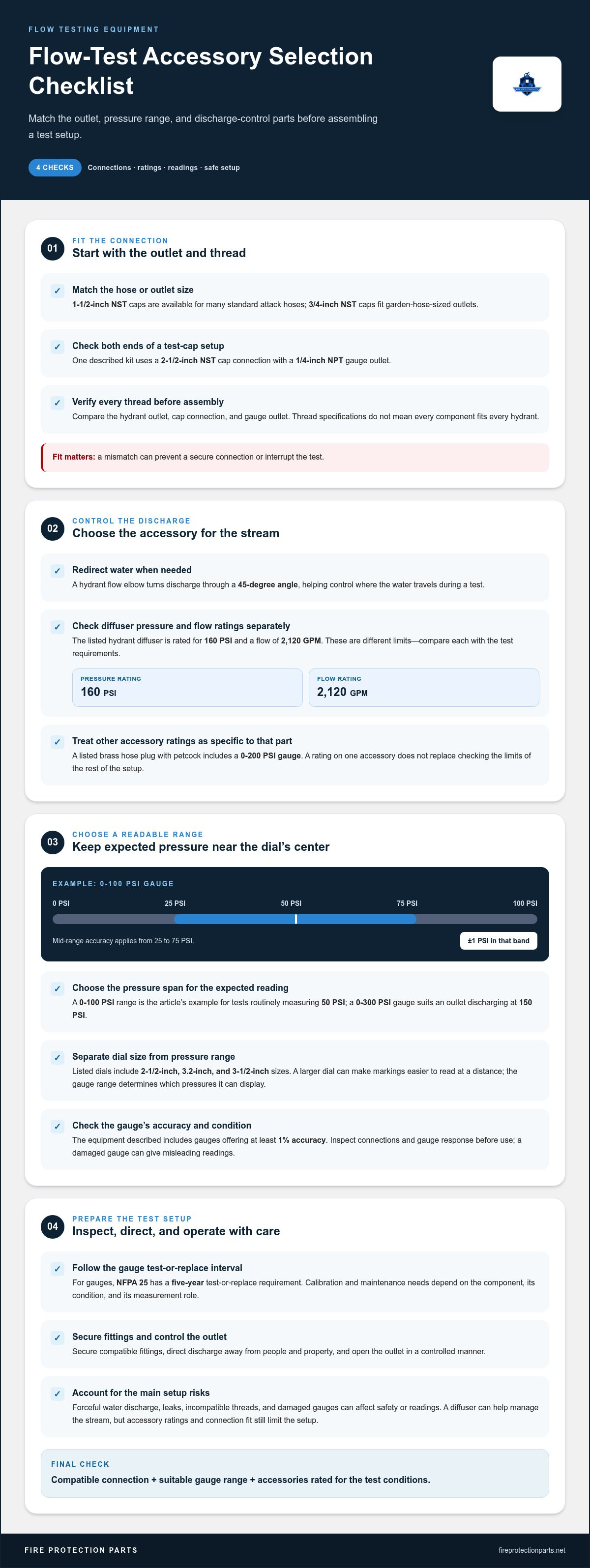
Choose accessories to match the outlet connection and the discharge conditions. Fire hose flow test caps are available in 1-1/2-inch NST for many standard attack hoses, while 3/4-inch NST caps fit garden-hose-sized outlets. A hydrant flow elbow redirects discharge through a 45-degree angle, helping control where water travels during a test.
Diffusers manage the discharge stream, but their ratings matter. The listed hydrant diffuser is rated for 160 PSI and a flow of 2,120 GPM. A brass hose plug with petcock includes a 0-200 PSI gauge. These ratings describe different limits, so compare pressure and flow requirements separately before selecting an accessory.
Gauge range affects how clearly a reading can be interpreted. For a 0-100 PSI gauge with 1% mid-range accuracy, that accuracy applies from 25 to 75 PSI, within plus or minus 1 PSI. A gauge should place expected readings near the dial’s center. For example, use a 0-100 PSI range when tests routinely measure 50 PSI; a 0-300 PSI gauge suits an outlet discharging at 150 PSI.
For gauges, NFPA 25 has a five-year test-or-replace requirement. The equipment described includes gauges offering at least 1% accuracy. Calibration and maintenance needs depend on the component, its condition, and its measurement role; inspect connections and gauge response before use.
There is no single U.S. price for a kit. Cost depends on the gauge, cap, hose connection, diffuser, and other accessories selected. Manufacturers produce gauges, caps, hoses, and flow-control fittings; fire-protection suppliers sell assembled kits and individual components.
For safe operation, secure compatible fittings, direct discharge away from people and property, and open the outlet in a controlled manner. Risks include forceful water discharge, leaks, incompatible threads, and misleading readings from a damaged gauge. A diffuser can help manage the stream, but the setup is still limited by accessory ratings and connection fit.
Flow test kit types and components
A hydrant flow kit commonly combines a pressure gauge with a test cap or nozzle. The cap connects the gauge to the outlet, and the gauge records pressure during testing. Kits vary by connection style, gauge format, and measurement task. Match each part to the hydrant outlet and expected pressure conditions.
Gauge size affects readability, not the pressure range. Listed flow test gauges have 2-1/2-inch, 3.2-inch, and 3-1/2-inch dials. A larger dial can make markings easier to read at a distance, while the gauge’s range determines the pressures it can display. One listed brass cap gauge spans 0-200 PSI.
- Test cap: A described kit includes a 2-1/2-inch cap with National Standard Thread (NST).
- Gauge outlet: The cap has a 1/4-inch National Pipe Thread outlet for connecting a gauge.
- Flow nozzle: Hydrant flow nozzles connect through 2-1/2-inch NST outlets.
Thread specifications identify how parts join, but they do not mean every component fits every hydrant. Compare the hydrant outlet thread, cap connection, and gauge outlet before assembling a kit. A mismatch can prevent a secure connection or interrupt the test. For water testing, choose application-appropriate components and a gauge range suited to expected pressures. For other fluids, consider their compatibility with wetted materials and seals.
To choose equipment for a particular fluid and flow range, identify the fluid, connection type, and expected operating range first. Then match compatible materials and fittings, and select a gauge range that captures the readings the test requires.
Reviewing available flow testing equipment options can help compare kit components and connection types for hydrant work.
A listed double-jacket fire hose has an 800-pound test rating, a detail to consider when selecting equipment for a hydrant test.
Hand-held pitot equipment
A hand-held pitot setup measures water flow by sensing pressure in a moving stream. Its central tool is the pitot tube, positioned in the discharge. A pressure gauge reads the pressure sensed by the tube, helping determine flow when interpreted alongside the nozzle or outlet size.
The listed pitot tube has a pressure range of 0-160 PSI. Flow test kit gauges described for this equipment offer at least 1% accuracy. Range and accuracy describe different things: range is the pressure span the instrument reads, while accuracy describes how close a reading is to the actual pressure.
Use the equipment in a consistent sequence:
- Identify the nozzle or outlet and its opening size, since flow calculations depend on that geometry.
- Connect the pitot tube to its pressure-reading arrangement, keeping fittings secure and the tube clear.
- Position the tube in the discharge stream, with its opening facing the flow as designed.
- Record the pressure reading and the matching outlet details, then interpret them together.
For example, a pressure reading alone doesn’t tell the full story if the nozzle size is unknown. A reading from a 0-160 PSI tube also falls outside its usable range if pressure exceeds that span. Poor alignment, turbulent discharge, or a blocked tube can affect readings, so placement and equipment condition matter.
Hand-held pitot equipment offers a portable way to assess discharge at a hydrant or nozzle. Unlike a flow meter that displays flow directly, pitot readings must be interpreted alongside outlet dimensions. The method also depends on a stable stream and a suitable measurement position. Obstructions, uneven flow, or an unsuitable pressure range can limit the result.
Keep the tube opening clean and inspect its connections before testing. Compare readings using the same outlet details and positioning method. Consistency makes results more meaningful across repeat tests and helps show whether the setup, rather than the water system, may be affecting a measurement.
How do flow meters and flow test stands differ?
A flow meter measures the rate of fluid moving through a system. A flow test stand is an arrangement that supports a component or system during measurement. One is a measuring instrument; the other provides a structured setup for conducting a test.
For example, a meter can provide a flow reading as water passes through its measuring section. A stand organizes the test point, connections, and controls so the equipment being tested operates in a defined arrangement. A stand may include a flow meter, but it is not itself the meter. Its purpose is to hold and connect testing components in a usable configuration.
The practical distinction comes down to what you need to learn. Choose a meter when the task is measuring flow in a line or discharge. Choose a stand when the test requires a stable setup to evaluate a component, such as a pump or valve. A stand organizes connections and operation; the meter provides the flow measurement.
- Measurement: A flow meter measures flow directly using its sensing method.
- Test arrangement: A stand provides a place to connect and operate the equipment being tested.
- Selection: Match the meter to the fluid, flow conditions, and installation point; match the stand to the component and test procedure.
Before choosing, define the test objective and where the reading must be taken. Then consider fluid compatibility, connection requirements, operating conditions, and how results will be recorded. A hydrant discharge measurement, for example, calls for a suitable method at the outlet, while evaluating a component may require a stand that supports the component and its connections.
Neither option automatically replaces the other. A stand may need a separate meter, and a meter alone may not provide the support or connections a component test requires. Compare the equipment against the task, then explore flow testing equipment suited to fire-protection testing.
Fire Protection Parts: Viking Plastics CPVC Pipe for Fire Protection
Fire Protection Parts offers specialized CPVC pipe options for projects requiring reliable fire-protection piping components. Flow testing equipment measures discharge and pressure, a different function from the piping installed in a protection system. Use test results to understand system performance, then identify the components your project needs.
For related system needs, Fire Protection Parts also offers Residential Fire Pump Systems, PTR Electric Deluge VXD, and ASC Seismic Bracing. These are distinct product categories, not substitutes for testing equipment. Choose according to the component required for the project, its design, and its role in the fire-protection system.
For fire-protection components, contact Fire Protection Parts to discuss your needs.
Put Your Testing Plan Into Action
Start by defining what the test must establish and how its results will guide your next decision. A clear objective keeps equipment selection focused on the task. Consider the test location, connection requirements, and how readings will be recorded. This planning helps you choose flow testing equipment suited to the work.
Testing tools and fire-protection system components serve different roles. For infrastructure projects, Fire Protection Parts offers Viking Plastics CPVC Pipe for Fire Protection, Residential Fire Pump Systems, and PTR Electric Deluge VXD. Identify the component your project requires, and keep that selection separate from the equipment used to measure system performance.
Explore the available options and identify the category that fits your test. Explore flow testing equipment as you plan the next step. Clear requirements help keep your decision focused and practical.
Frequently Asked Questions
What is flow testing equipment used for?
Flow testing equipment measures water pressure or discharge during tests of hydrants and fire-protection systems. The readings help technicians assess water movement through an outlet and compare performance under defined conditions. A facility team, for example, may record results before and after system work to identify changes. Accurate interpretation depends on equipment suited to the outlet and records of relevant test conditions.
What types of flow testing equipment are available?
Common types include hydrant test kits, hand-held pitot tools, flow meters, and flow test stands. A hydrant kit supports outlet testing, while a pitot tool measures pressure in a discharge stream. A meter measures flow; a stand organizes a component test setup. For portable hydrant testing, a kit or pitot tool may fit the task, while system-based measurement may call for a meter.
Which manufacturers and suppliers sell flow testing equipment in the United States?
Manufacturers produce gauges, caps, hoses, and flow-control fittings, while fire-protection equipment suppliers sell assembled kits or individual components. Fire Protection Parts offers flow-testing equipment and related fire-protection products.
How often should flow testing equipment be calibrated and maintained?
For gauges, NFPA 25 requires testing or replacement every five years. Calibration and maintenance needs depend on the component, its condition, and its measurement role.

