



High Hazard Fire Suppression Parts: A 2026 Sourcing Guide
A replacement component can look right on a product page and still be wrong for the system it is meant to protect. Sourcing high hazard fire suppression parts starts with the approved system design, not a generic search. In environments with sensitive equipment, flammable materials, or demanding processes, compatibility matters because the wrong part can compromise system readiness.
To identify a suitable component, gather its exact identifier and the project documents that specify its role. Then compare those requirements with the manufacturer’s product information. Product type alone is not enough: system configuration, application, connections, and documented ratings all matter.
This guide explains a repeatable sourcing process, from recording component details to reconciling delivered items against the order. It also covers how specialized hardware, such as the PTR Electric Deluge VXD, fits into a broader range of fire protection components. Fire Protection Parts brings relevant hardware categories together in one online store, where you can browse and compare products against your project requirements.
Key Takeaways
- Start with approved project documents: hazard conditions inform system design, and that design guides component selection.
- Compare high hazard fire suppression parts by exact identification, manufacturer documentation, connection compatibility, and required quantity.
- Separate pre-order checks from receiving checks so you can reconcile delivered parts against the order and project records.
- Different system types serve different functions, so do not assume a component is suitable based on category alone.
- Explore relevant hardware categories, including the PTR Electric Deluge VXD, ASC seismic bracing, and air compressors for sprinkler systems.
What Are High Hazard Fire Suppression Parts, and Where Do They Fit?
High hazard fire suppression parts are not a universal set of components. They are selected for a specific engineered fire protection system, based on the hazard being protected and the system’s approved design. An industrial process, an equipment room, and a space handling combustible materials can each present different protection needs. The label “high hazard” alone does not identify the appropriate parts or suppression method.
A protected hazard is the risk being addressed, a suppression system is the engineered arrangement designed to respond to that risk, and its parts are the individual components selected to perform specified functions. This distinction matters when purchasing. A component that seems suitable by name or appearance may not match the design, connection, or operating requirements in the project documents. Use those documents and current manufacturer information as your references, rather than relying on a broad product category.
Which applications can require specialized suppression?
Industrial processes, equipment spaces, and areas with flammable or combustible materials are examples of settings where a project may require a tailored protection approach. These examples do not automatically call for a particular agent or hardware type. The hazard assessment and approved design establish the approach. Materials present, equipment being protected, and intended system operation can all affect component requirements. A high-risk location alone does not determine which suppression method to use.
Different system categories serve different purposes, and their components are not interchangeable by default. A general overview of a Fire Suppression System can help explain the range of system types and component roles. For a specific project, follow the approved design and applicable product documentation.
How do components support a complete suppression system?
Parts contribute through distinct functions. Control components receive or process system inputs; actuation components initiate a response; and distribution components convey or discharge the suppression medium. Supporting parts connect, position, or maintain elements of the arrangement. The system design determines which components are required and how they work together. Substituting a part based only on a similar description can create a mismatch in its connection, operation, or intended application.
The PTR Electric Deluge VXD is one example of specialized fire protection hardware. Its name alone does not establish whether it suits a particular project. Compare its product information with the project documents and the component’s specified role. Apply the same approach when reviewing valves, piping, sprinklers, or other system hardware. For a broader look at water-based systems, see the sprinkler system components sourcing guide.
Specialized sourcing begins with the system’s documented requirements. Identify the specified component, then compare its details with the applicable product information. This keeps the protected hazard, engineered system, and individual part connected throughout the purchasing process.
How System Type and Hazard Conditions Shape Part Compatibility
Hazard conditions help shape the engineered protection approach, but they do not provide a shopping specification on their own. Approved project documents define which components belong in the system and how they must work together. A part suited to one arrangement may not suit another, even if both systems protect spaces described as high hazard. Use the system type and its documented requirements to narrow the search, then verify the exact component details.
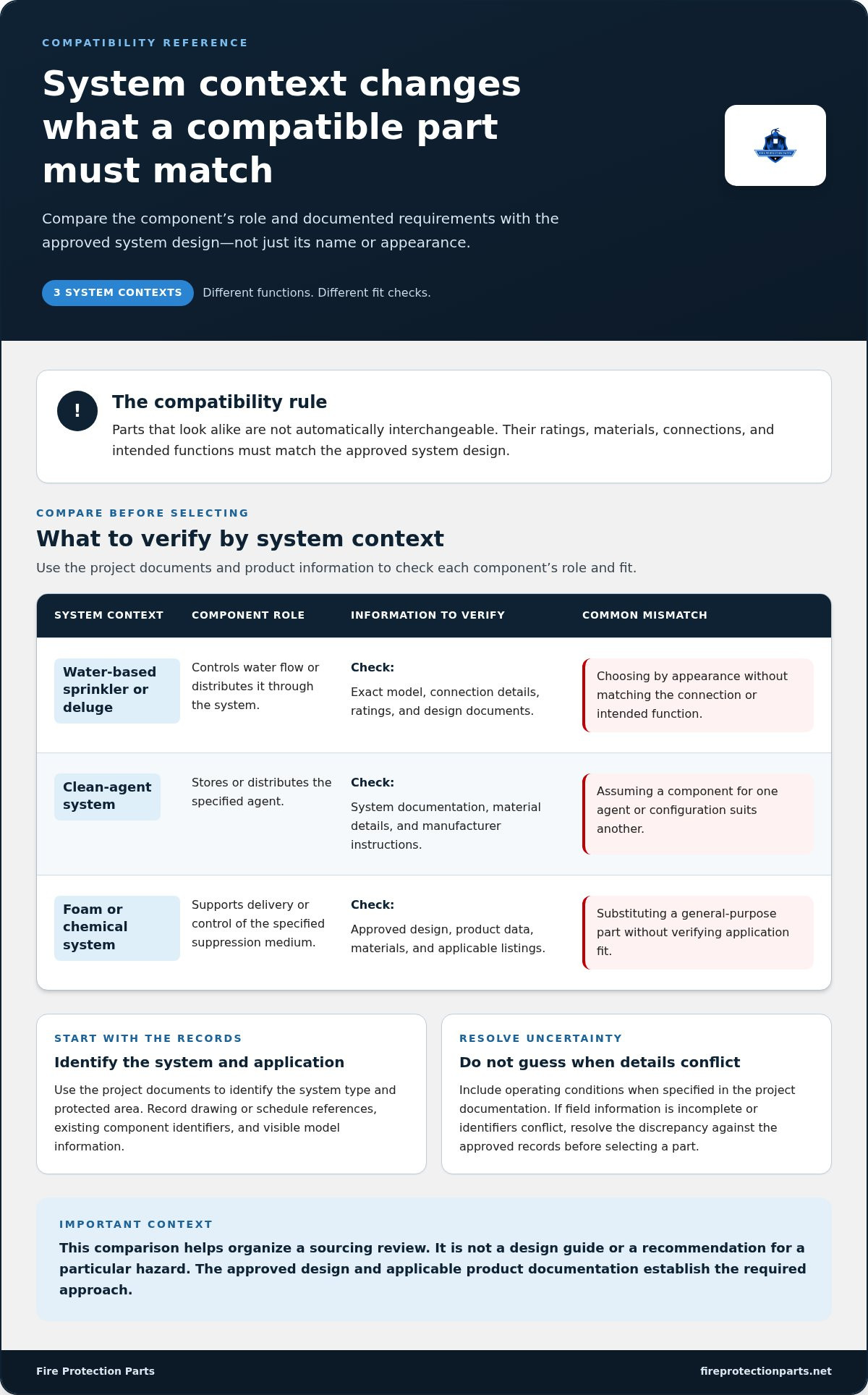
Parts that look alike are not automatically interchangeable. Their ratings, materials, connections, and intended functions must match the approved system design. The table below compares broad system contexts to help organize a sourcing review. It is not a design guide or a recommendation for a particular hazard.
| System context | Component role | Information to verify | Common mismatch |
|---|---|---|---|
| Water-based sprinkler or deluge | Controls water flow or distributes it through the system | Exact model, connection details, ratings, and design documents | Choosing by appearance without matching connection or intended function |
| Clean-agent system | Stores or distributes the specified agent | System documentation, material details, and manufacturer instructions | Assuming a component for one agent or configuration suits another |
| Foam or chemical system | Supports the delivery or control of the specified suppression medium | Approved design, product data, materials, and applicable listings | Substituting a general-purpose part without verifying application fit |
What information identifies the system and application?
Start with the system type and protected area shown in the project documents. Record the drawing or schedule reference, existing component identifiers, and any model information visible on the part. Include operating conditions, such as temperature or exposure, when the project documentation specifies them. If field information is incomplete or identifiers conflict, pause selection and resolve the discrepancy against the approved records instead of guessing.
How do listings, approvals, and manufacturer data affect fit?
Compare the exact model and its documented ratings, materials, connections, and installation instructions with the project requirements. Listing or approval expectations can depend on the system and application, so verify the relevant documentation rather than inferring suitability from a product category. NFPA’s NFPA Codes and Standards for Fire Suppression page provides access to standards. Use the applicable project and manufacturer documents to establish what governs a specific component.
For a focused comparison, check that the part identifier matches the schedule, its documented characteristics meet the specified requirements, and its connections align with the intended assembly. Confirm that the quantity and any related accessories also match the project records. This check helps prevent a visually similar substitute from becoming an undocumented system change.
Once the requirements are clear, browse fire protection hardware and system components with the project details in hand. Comparing products against those details helps narrow the search without treating any category as a universal fit.
How to Compare High Hazard Fire Suppression Parts Before Ordering
A disciplined comparison keeps an order tied to the approved design, not to a product description that only seems close. Before comparing high hazard fire suppression parts, gather the project documents and the identifier for the component being replaced or specified. Focus first on a documented match, complete order details, and suitability for the system.
Use a five-step comparison process
- Identify the required part. Record the manufacturer, model or part identifier, and the drawing, schedule, or other project reference that specifies it.
- Compare technical documents. Review product data and manufacturer instructions against the project requirements. Do not infer a match from a category name.
- Check physical interfaces. Compare size and connection details with the specified component and assembly. Mark missing information for resolution.
- Review ratings and materials. Match documented ratings and construction materials to the project documents and intended application.
- Confirm order completeness. Reconcile the quantity and any stated accessories or configuration details with the project records and product documentation.
Which product details should a buyer compare?
A side-by-side record makes differences easier to catch before ordering. Copy details from project documents and product data rather than filling gaps from memory. If either source omits a detail or gives conflicting information, mark it for verification and resolve the discrepancy before treating the comparison as complete.
| Detail | Project requirement | Product information | Comparison result |
|---|---|---|---|
| Manufacturer and model | As specified | As documented | Match or verify |
| Size and connection | As shown in the design | As stated by manufacturer | Match or verify |
| Rating and material | As required | As documented | Match or verify |
| Accessories or configuration | Only if specified | Only if documented | Match or verify |
How should specialized component categories be evaluated?
Evaluate each item by its documented function, not as a substitute for another category. The PTR Electric Deluge VXD is one product to compare with the project specification and its product information. Do not infer performance details from its name. Air compressors for sprinkler systems, dry pendent sprinklers, and fire protection anti-freeze have distinct roles. Their product documentation and intended system use should guide the comparison.
ASC seismic bracing also calls for design-specific review. Its selection depends on the documented installation and applicable design, so do not treat bracing as a generic accessory or choose it by appearance alone. Keep the relevant project references with the comparison record.
For repair orders, the fire protection repair parts guide offers context for sourcing hardware around system repairs. Whether the need is repair-related or project-driven, a comparison record helps keep identifiers, documentation, connections, and quantities aligned before ordering.
A Practical Checklist for Sourcing and Receiving System Parts
A reliable order starts with traceable project information and ends with a careful receipt check. Use the checklist below to keep high hazard fire suppression parts connected to the approved design, from the first specification review through delivery. Save the completed checklist with the order record so selection decisions and received items can be traced later.
Before placing an order
Complete these checks before submitting an order. If an identifier is unclear, a substitution is proposed, or documents conflict, resolve the discrepancy through the project documentation. Do not fill gaps by guessing.
- ☐ Locate the current approved drawings, schedules, specifications, and relevant revisions.
- ☐ Record the system type, protected location, and project reference for each required component.
- ☐ Capture the exact part identifier, manufacturer, model, and approved specification.
- ☐ Compare manufacturer documentation with project requirements, including documented ratings, materials, and connection details.
- ☐ Confirm the required quantity against the schedule and order records.
- ☐ Record any stated accessories or configuration details, using product documentation rather than assumptions.
- ☐ Flag proposed substitutions, conflicting identifiers, or missing information for resolution before ordering.
If seismic bracing is part of the documented scope, review its project-specific requirements alongside the component details. The seismic bracing guide provides additional context for bracing in sprinkler systems.
When the shipment arrives
Check the delivery against the order before moving items into approved installation materials. Focus on identity, quantity, documentation, and visible condition. If anything differs, set that item aside while the records are reconciled.
- ☐ Match each received item to the order and its exact identifier, including manufacturer and model where shown.
- ☐ Count quantities and note any shortage, overage, or item that does not match the order.
- ☐ Review labels and packaging for readable identification and visible damage.
- ☐ Compare included product documents with the information used for the order.
- ☐ Photograph or record discrepancies in line with project procedures.
- ☐ Keep unverified or mismatched components separate from approved installation materials until the discrepancy is resolved.
- ☐ Retain labels, packaging, product documentation, order records, and receipt notes according to project recordkeeping procedures.
- ☐ Reconcile the final received quantity and item identifiers against the order, then file the completed record.
Preserving labels and paperwork helps maintain traceability after packaging is gone. Use this checklist as part of your sourcing workflow, and browse fire protection parts with the approved project details ready for comparison.
Source High Hazard Fire Suppression Parts with a Compatibility-First Approach
Sourcing high hazard fire suppression parts is most reliable when the approved system design guides each purchasing decision. Identify the component specified in the project documents. Compare its exact identifier and documented characteristics with the manufacturer’s product information, confirm the required quantity, and retain the records used to make the selection. If details conflict or are missing, resolve them through the project documentation before proceeding. A product category or similar appearance is not enough to establish a match.
Product browsing helps locate relevant hardware, but approved project requirements and manufacturer documentation remain the basis for selection. A part’s suitability depends on its intended system and application, not simply on whether it appears to serve a related function.
Which confirmed product categories may support specialized projects?
Fire Protection Parts offers several relevant product categories. The PTR Electric Deluge VXD is one product to compare against project requirements and its product documentation. ASC seismic bracing is a separate hardware category, with selection tied to the documented installation and applicable design. Air compressors for sprinkler systems form another distinct category. None should be assumed to fit every high hazard system or application.
Keep the categories separate as you browse. Bracing, a sprinkler-system air compressor, and a deluge product have different roles. Compare each with the part identified in the project records rather than treating one as a substitute for another. Review product details alongside the required model or identifier, and note any project-specific information needed to establish a match.
What is the next step for a project-ready order?
Before selecting an item, assemble the information that makes comparison practical and traceable:
- Approved project documents: drawings, schedules, specifications, and relevant revisions.
- Exact component details: manufacturer, model or part identifier, system location, and required quantity.
- Selection records: manufacturer documentation and any product details the project requires for verification.
Browse by component category, then compare product details with those records. Treat unknown or conflicting specifications as open items rather than assumptions. Once identifiers, documentation, and quantity align, preserve the product and order records for receiving reconciliation and project traceability.
Fire Protection Parts brings specialized fire protection hardware categories together for online sourcing, with individual and bulk orders available. Keep your approved documents at hand and browse fire protection hardware at Fire Protection Parts to find relevant components for comparison.
Make Your Next Sourcing Decision With Confidence
Use each purchasing decision to build a stronger record for future replacements. Keep the selected part identifiers, manufacturer documents, and project references together so the reasoning behind each choice stays clear as system records are updated. Traceable records support more consistent sourcing of high hazard fire suppression parts over time.
Fire Protection Parts sells fire protection hardware online, including the PTR Electric Deluge VXD and ASC seismic bracing. Browse relevant categories, then use approved project requirements and product documentation to compare components for your system.
Bring your project details into the product search, compare carefully, and keep the order tied to the design. Browse fire protection parts and suppression hardware to find components for your project.
Frequently Asked Questions
What qualifies as a high hazard fire suppression system?
A system may be considered high hazard when it is designed to protect an area with risks that differ from the building’s ordinary occupancy, such as a specialized process or equipment environment. The label alone does not identify the protection method or its components. Project-specific hazard assessment and design establish the system’s scope. For sourcing, use the designation shown in project documents rather than assuming every higher-risk space needs the same equipment.
Are high hazard fire suppression parts interchangeable with standard sprinkler parts?
No, not by default. A part used in a standard sprinkler arrangement may differ from one specified for another system in function, materials, ratings, connection, or documented application. Even components that appear similar can have different requirements. For example, a sprinkler component and a valve serving a deluge arrangement are not interchangeable simply because they connect to water piping. Match the specific part to the design and applicable product documentation.
Can I select a deluge valve based only on the pipe size?
No. Pipe size is only one detail and does not establish that a valve is suitable for the system. The specified model, documented ratings, connection details, and intended system arrangement also matter. Start with the valve identifier and requirements in the approved project records, then compare those details with the manufacturer’s documentation. If the records provide only a pipe size, treat that as incomplete information, not as a basis for selecting a replacement.
What information do I need to order replacement fire suppression parts?
Gather the part’s manufacturer and model or part number, its system location, the project or equipment reference, and the required quantity. A clear photo of the label can help capture identifiers, but it does not replace checking them against project records. Also note relevant product documentation and connection information. This context helps distinguish a component from nearby parts that may look alike but serve a different role.
Do high hazard fire suppression components need to be listed or approved?
That depends on the project requirements, applicable standards, and the component’s role. Do not assume a component is acceptable simply because it belongs to a familiar category or resembles one already in the system. Check the approved documents for applicable listing or approval requirements, then compare the exact product and application with current manufacturer information. If the documentation does not clearly establish a requirement, resolve it through the project’s responsible design process before ordering.
What should I do if the exact part number is missing?
Do not choose a replacement based on appearance or approximate size alone. Check the component label, prior submittals, equipment schedules, drawings, and retained product records for another traceable identifier. Compare those records to establish the component’s role and intended model. If references are incomplete or conflict, pause the purchase and resolve the discrepancy through the project’s approved documentation process. Keep notes on what you checked and what remains unknown.
Can seismic bracing be chosen independently of the sprinkler system design?
No. Seismic bracing selection is connected to the documented sprinkler installation and applicable design, so it should not be treated as a standalone accessory chosen by appearance. Project records establish the relevant configuration and requirements. Review those documents alongside the bracing product information, and do not substitute a different arrangement without an approved basis. Keeping bracing selection tied to the system design helps preserve consistency across the project.

