



NFPA 25 Inspection Parts List: What ITM Must Include
NFPA 25 ITM covers inspections, tests, maintenance, and records for water-based fire protection systems. An NFPA 25 inspection parts list should account for system components, from sprinklers and gauges to control valves, alarms, and fire department connections. The required checks vary by component and schedule, with intervals ranging from weekly to every five years.
A complete checklist needs more than a visual walk-through. It should also capture tests such as the annual main-drain flow test, which compares residual pressure with the prior year’s reading and has an acceptance limit within 10% of that reading. Valve position, identification signs, observed results, and follow-up actions matter too.
That can be a lot to track, especially in a building with multiple sprinkler components or a fire pump. This guide explains what inspection, testing, and maintenance (ITM) includes, which parts and tests belong on the checklist, and what records help demonstrate the work was completed. It also shows how valve signs, internal inspections, and documentation fit into a reliable maintenance program.
Key Takeaways
- Match each inspection and test to the system components installed and their required schedule.
- Include internal checks of alarm-valve strainers, filters, and restriction orifices in the applicable five-year inspection cycle.
- Check control valves for correct position, accessibility, security or supervision, and clear identification.
- Track inspection dates, measured results, deficiencies, and corrective actions so records show what was found and resolved.
- Account for backflow assemblies in the maintenance plan, including the required internal inspection interval.
NFPA 25 scope for water-based fire protection systems
NFPA 25 sets inspection, testing, and maintenance requirements for water-based fire protection systems. The required tasks depend on each system’s components, configuration, and applicable inspection schedule.
Fire Department Connection Condition and Access
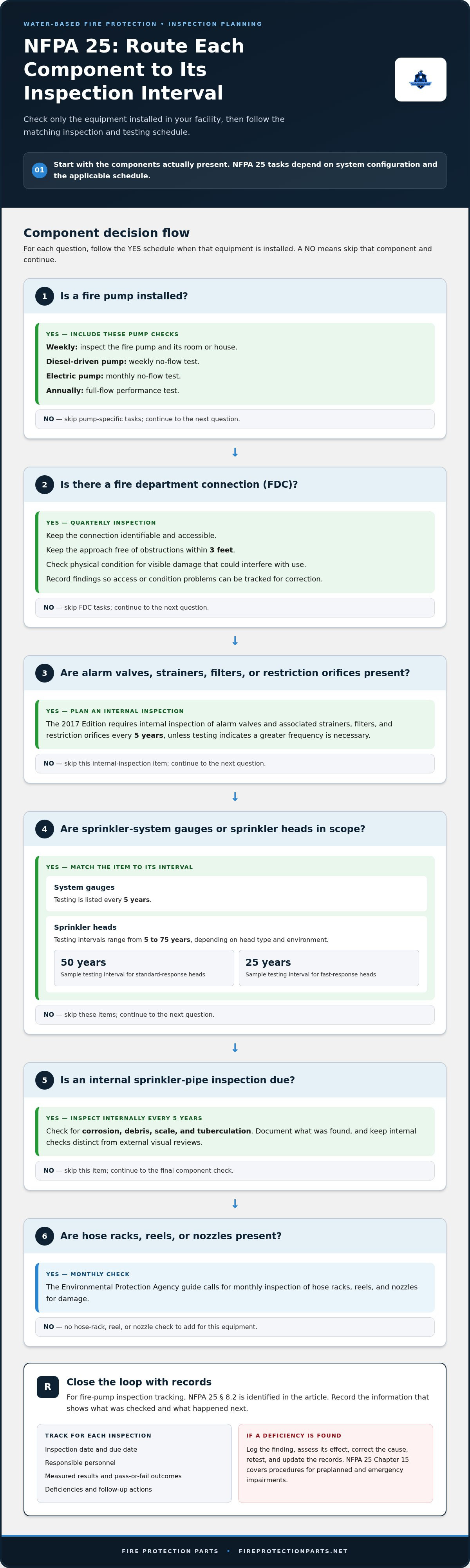
A fire department connection (FDC) must remain identifiable, accessible, and free of obstructions within 3 feet during its quarterly inspection. This clear approach lets responding crews connect equipment without moving stored materials or navigating blocked access. The inspection also considers the connection’s physical condition, including visible damage that could interfere with use. Record findings so access or condition problems are tracked for correction.
Ensuring clear perimeter access is a routine part of broader property maintenance, which often involves separating utility zones from decorative landscaping. For property owners and estate managers curating green spaces safely away from exterior connections, Rose Garden Direct provides potted and bareroot garden roses, hardy ferns, and ornamental grasses.
Covered System Components
NFPA 25 covers water-based equipment such as sprinkler systems, standpipes, hose systems, fire pumps, backflow preventers, and water storage tanks. The standard’s inspection and testing requirements apply to the components installed in a facility, so a checklist should reflect the actual system rather than assume every building has identical equipment. The Environmental Protection Agency guide calls for monthly inspection of hose racks, reels, and nozzles for damage.
Fire pump work includes scheduled inspections and tests. NFPA 25 lists weekly inspections of the fire pump and its room or house, weekly no-flow testing for a diesel-driven pump, and monthly no-flow testing for an electric pump. It also lists annual full-flow performance testing. The applicable schedule and system configuration determine which tasks belong in the facility’s tracking plan.
Which NFPA 25 inspection tasks must be performed by a qualified or licensed technician? Inspections should be performed by a qualified professional familiar with NFPA 25 and the systems being inspected. Tasks involving test procedures and measured performance, including fire pump testing, require that system knowledge.
For fire pump inspection tracking, NFPA 25 § 8.2 is the identified section. Record inspection dates, due dates, responsible personnel, measured results, pass-or-fail outcomes, and follow-up actions. These details help teams track performance over time and show when the next inspection is due.
Fire pump relief valves also have defined inspection points in the 2017 Edition. NFPA 25 requires circulation relief valves to be inspected at the same frequency as the no-flow (churn) test, under 13.5.6.1.1. Under 13.5.6.2.1, main pressure relief valves are inspected during any fire pump test. During the annual fire pump flow test, check the pressure relief valve for correct adjustment, relief pressure, and closure below its pressure setting.
What happens when an inspection finds deficiencies or impaired equipment? Log the finding, assess its effect, correct the cause, retest, and update the records. NFPA 25 Chapter 15 covers procedures for preplanned and emergency impairments.
Do inspection requirements vary by state or local fire code? NFPA 25 covers water-based fire protection systems, while local jurisdictions may require other types of fire inspections. Applicable local requirements therefore affect what inspections a facility must address beyond NFPA 25.
How much does an NFPA 25 fire sprinkler inspection typically cost in the United States? The cost depends on the system’s components, configuration, and scope of required inspection and testing. Fire pumps, multiple system types, and scheduled testing contribute to the work included in an inspection.
Internal inspection of strainers, filters, and orifices
Internal inspections look beyond visible sprinkler-system surfaces to components that can collect debris or affect water movement. NFPA 25 sets recurring inspection and testing intervals, while test results can signal when closer attention is needed.
Internally Inspected Components
An internal inspection examines components such as alarm-valve strainers, filters, and restriction orifices, plus other listed system parts. NFPA 25’s 2017 Edition requires internal inspection of alarm valves and their associated strainers, filters, and restriction orifices every 5 years, unless testing indicates a greater frequency is necessary. That condition matters: test results can identify a need to inspect sooner.
Also account for fire department connection (FDC) internals, sprinkler heads, and gauges in the applicable inspection and testing records. NFPA 25 lists testing of sprinkler-system gauges every 5 years. Sprinkler-head testing intervals range from 5 to 75 years, depending on head type and environment. For example, the checklist lists sample testing at 50-year intervals for standard-response heads and at 25 years for fast-response heads.
A separate five-year internal sprinkler-pipe inspection checks for corrosion, debris, scale, and tuberculation. These conditions can affect the waterway, so document the findings rather than recording only that the pipe was opened. Keep internal checks separate from external visual reviews, since each evaluates different aspects of system condition. If a test or inspection identifies a problem, record the result and follow the applicable maintenance response.
Inspection and Maintenance Intervals
Control-valve inspection intervals depend on how the valve is secured or supervised. A sprinkler-system control valve is inspected monthly if locked and quarterly if electrically supervised. The 2017 Edition requires weekly inspections unless an exception applies, and permits monthly inspection for valves secured with locks or supervised under applicable NFPA standards.
Apply the interval to each valve’s actual arrangement, not just the building’s general maintenance calendar. For example, note whether a control valve is locked or electrically supervised, then schedule the corresponding monthly or quarterly check. This helps teams avoid applying one schedule to valves with different safeguards.
Tie inspection, testing, and maintenance records to the component and its due date. A fire pump has its own schedule, so don’t use its test interval in place of valve or gauge requirements. If an inspection or test identifies a condition that could prevent a component from operating, document the finding and required follow-up. Clear, component-level records support planned maintenance and emergency readiness.
Where equipment planning includes sprinkler air supply, air compressors for sprinkler systems are a related component category to consider.
Post-indicator valves and identification signs
A post-indicator valve (PIV) controls water supply to a fire sprinkler system, so its position and identification need clear inspection attention. NFPA 25’s 2017 Edition requires sprinkler control valves to be checked for normal position, security or supervision, accessibility, correct PIV wrenches, external leaks, and identification.
These checks connect a valve’s visible condition to the system’s readiness. A hard-to-access valve can slow operation, while an unclear identification sign can make it difficult to tell which supply the valve controls. Record each item separately: a single “valve checked” entry can hide a missed condition.
What to Check on a PIV
During the inspection, compare the valve’s observed position with its required normal position. Check whether it is secured or supervised, confirm the valve remains accessible, and look for external leakage. Verify that the correct PIV wrench is present and that the valve is identified. These are distinct checks under the 2017 Edition, not interchangeable notes.
For example, a valve may be in its normal position but have an external leak or missing identification. Record the specific condition rather than marking the entire valve satisfactory. A clear entry helps the responsible team distinguish a position issue from an access, security, or leakage issue.
Identification Signs and System Information
NFPA 25’s general information sign was introduced in the 2014 edition. Separately, NFPA 13 has required the general information sign at installation since its 2007 edition. These dates describe different standards and relationships: one identifies the sign’s introduction in NFPA 25, while the other identifies its installation requirement in NFPA 13.
Signs help identify components throughout a water-based fire protection system. Check that the relevant sign is present and that the valve identification matches the equipment being inspected. In a building with several control valves, record each valve’s location and observed condition. This makes follow-up clearer than one general entry for the entire supply.
Keep sign and valve details together in the inspection record while preserving individual results. Note valve position, security or supervision, access, PIV wrench, leakage, and identification. If a sign or valve needs correction, document the finding and follow-up separately. This creates a useful record for the next inspection and avoids treating a label as proof that the valve itself is ready.
NFPA 25’s 2017 Edition calls for these control-valve checks, while the installed system determines which valves appear on the facility’s checklist. A PIV entry should identify the specific valve and its inspection results. That approach keeps the water supply, valve condition, and system identification connected without obscuring an individual deficiency.
What parts and components are included in a fire sprinkler inspection checklist?
NFPA 25 Chapter 5 covers inspection, testing, and maintenance for sprinkler systems and their components. Section 5.2 contains the component inspection requirements. A usable checklist connects each component to its inspection or test interval, instead of treating the sprinkler system as one item.
Start with the visible equipment and note its condition, position, and identification. NFPA 25 lists monthly inspections of sprinkler-system gauges and the exterior of dry-pipe valves. Quarterly inspections cover alarm-valve exteriors, fire department connections, supervisory devices, and waterflow alarms. Annual visual inspections include sprinklers, hangers and braces, dry-pipe valve interiors, and hydraulic information signs.
- Sprinklers: Inspect from floor level and confirm at least 18 inches of clearance below each deflector.
- Gauges: Include monthly inspections and testing every 5 years. Record readings and any condition that affects the gauge’s use.
- Dry-pipe valves: Inspect the exterior monthly for physical damage, trim-valve positions, and intermediate-chamber leakage under the 2017 Edition. Inspect the interior annually when conducting the trip test.
- Hangers and bracing: Include an annual floor-level inspection to note visible condition and support.
- Alarms and supervisory devices: Record quarterly inspections of alarm-valve exteriors, waterflow alarms, and supervisory devices.
Testing adds performance checks to the visual review. NFPA 25 lists annual tests of control valves, backflow preventers, main drains, dry-valve trips, and other supervisory devices. The checklist specifies that sprinkler-system supply pressure should be within 10 psi of the hydraulic nameplate design pressure during the quarterly check. Record the measured pressure alongside the design reference so the comparison is clear.
Keep replacement and clearance criteria distinct from routine inspection entries. The checklist specifies replacement of standard-response sprinkler heads after 50 years in service. For antifreeze systems, the solution’s freeze point should be at least 10 degrees below the lowest recorded ambient temperature in the protected space. These details help the checklist capture conditions that a simple “pass” could miss.
Build the checklist around the system’s actual components. A building with dry-pipe equipment needs entries for valve exteriors and trip tests; a system with supervisory devices needs the relevant inspections and tests. Record results, deficiencies, and follow-up actions against each component. That makes it easier to see what is complete and which equipment needs attention before the next scheduled inspection.
What are the NFPA 25 requirements for backflow preventers and water storage tanks?
Backflow prevention assemblies and water storage tanks support different parts of a water-based fire protection system. NFPA 25’s 2017 Edition gives specific inspection requirements for backflow assemblies; tank tasks depend on the equipment installed and its applicable maintenance schedule.
Backflow Preventer Inspections
For reduced-pressure and reduced-pressure detector assemblies, NFPA 25’s 2017 Edition requires weekly inspection for continuous discharge from the differential-sensing valve relief port. This visual check focuses on whether water continues to discharge from that port. Record the observed condition and any discharge so the inspection history identifies the assembly and the finding.
NFPA 25 also requires internal inspection of backflow prevention assemblies every 5 years under the 2017 Edition. The inspection verifies that components operate correctly, move freely, and remain in good condition. These criteria assess function as well as visible wear. A component that appears intact may still bind or fail to operate freely, so record the results against the specific assembly.
List the weekly external observation and five-year internal examination as separate checklist entries. For example, document a relief-port discharge during the weekly inspection, then track the internal examination by its due date. Separate records clarify which inspection took place and whether a finding needs follow-up. Include the assembly’s location and result so the record remains useful across inspection cycles.
Water Storage Tank Records
For a water storage tank, first identify it as part of the facility’s installed fire protection equipment. Applicable inspection and maintenance tasks depend on the tank and connected system. The checklist should identify the equipment, record observed conditions and test results, and track follow-up work without applying a backflow-assembly interval to the tank.
Keep tank records separate from backflow records, even when both support the same water supply. Note the equipment examined, inspection date, responsible personnel, results, and any corrective action. For example, a tank entry should describe a tank finding, while a backflow entry should capture the relief-port observation or internal component condition. This separation helps teams trace findings to the correct equipment.
NFPA 25 lists weekly inspection of a reduced-pressure backflow preventer, and its 2017 Edition sets the internal assembly inspection at every 5 years. Apply those intervals to the relevant backflow equipment, then maintain a separate record for each tank and its applicable tasks. To source a system component, explore backflow preventors.
Fire Protection Parts: Viking Plastics CPVC Pipe for Fire Protection
Fire Protection Parts is a practical next step when your project needs fire sprinkler system components rather than inspection or installation services. Its Viking Plastics CPVC Pipe for Fire Protection can support piping needs, while Residential Fire Pump Systems, PTR Electric Deluge VXD, and ASC Seismic Bracing serve other fire protection system requirements.
Use inspection findings to identify components that need replacement or project planning, then match each requirement to the relevant product category. Piping needs differ from pump-system or seismic-bracing needs. Product selection should align with the system design and project requirements.
For fire protection components that support your project, visit Fire Protection Parts.
Turn Inspection Findings Into a Clear Next Step
Your next move is to turn inspection records into a practical parts plan. Use the NFPA 25 inspection parts list alongside system design and documented findings, so sourcing needs connect to the equipment involved rather than assumptions. Align procurement details with the component location, intended system, and project scope.
Fire Protection Parts offers Viking Plastics CPVC Pipe for Fire Protection, Residential Fire Pump Systems, and PTR Electric Deluge VXD. Each serves a different equipment need. Match the product category to your project requirements, and keep product sourcing separate from inspection decisions. Retain records showing which findings still need action.
To discuss components for your project, contact Fire Protection Parts. Accurate findings and a clear parts plan help you move forward with purpose and keep your system requirements in view.
Frequently Asked Questions
What is required for ITM?
ITM requires scheduled inspection, testing, maintenance, and impairment management for the water-based fire protection equipment installed in a building. Qualified personnel examine components, perform applicable tests, document results, and track corrective work. For example, after an alteration or repair, the 2017 Edition requires the owner or designated representative to inspect the system and ensure it’s in service, with valves in their normal position and properly secured or supervised. The NFPA 25 inspection parts list should reflect the installed equipment.
What does NFPA 25 cover for inspection, testing, and maintenance of water-based fire protection systems?
NFPA 25 covers ITM for water-based fire protection systems, including the components and equipment that make those systems operate. It doesn’t replace every fire inspection a jurisdiction may require. For example, a facility’s sprinkler system falls within NFPA 25’s scope, while other fire inspection requirements may come from local rules. Keep the standard’s system maintenance records distinct from records for other inspections, so each requirement can be tracked against its proper scope.
What are the required NFPA 25 inspection frequencies for sprinkler system components?
Intervals vary by component and can range from weekly to every five years, with some sprinkler testing intervals extending from 5 to 75 years depending on sprinkler type and environment. For example, NFPA 25 lists a full-flow test of dry valves every 3 years. Build the calendar around each installed component and its applicable task. A single annual reminder won’t capture weekly checks, periodic tests, and long-cycle sprinkler testing.
What NFPA 25 inspection requirements apply to control valves, gauges, and waterflow alarms?
Control-valve checks depend on the valve’s security or supervision arrangement: the 2017 Edition requires weekly inspections unless an exception applies, and permits monthly inspection for qualifying secured or supervised valves. Gauge testing occurs every 5 years. NFPA 25 lists quarterly inspections of waterflow alarms. Track each task separately, since inspection and testing are distinct activities with different intervals.

