



Seismic Bracing for Fire Sprinklers: 2026 Compliance Guide
Seismic bracing isn't a static lock designed to freeze your pipes in place; it's a dynamic restraint system that must allow for controlled movement to prevent catastrophic failure. If you're feeling the pressure of the January 1, 2026, enforcement deadline for ASCE 7-22 and the 2025 edition of NFPA 13, you aren't alone. Many contractors find the specific requirements for seismic bracing for fire sprinkler systems confusing, especially when failure to comply means a failed inspection or a compromised life safety system. We know that sourcing the right hardware shouldn't be the hardest part of your project.
This guide helps you master the technical requirements and hardware needed to protect your systems while ensuring full compliance. You'll learn exactly which ASC components are necessary to meet the latest codes and how to ensure your system remains functional when it's needed most. We'll walk through the essential hardware, from all-thread rod to specialized sway braces, so you can move forward with professional confidence. By the end of this article, the path to a code-compliant, reliable installation will be clear and manageable.
Key Takeaways
- Understand that seismic bracing functions as a dynamic restraint system designed to manage differential movement and prevent catastrophic pipe ruptures.
- Navigate the updated requirements of the 2025 NFPA 13 and ASCE 7-22 standards to ensure your projects meet 2026 compliance deadlines.
- Identify the critical hardware needed for seismic bracing for fire sprinkler systems, including structural attachments, all-thread rod, and specialized brace members.
- Master essential installation principles such as the "2-inch rule" for clearances and the specific angles required for lateral and longitudinal restraints.
- Secure UL/FM listed ASC components from professional suppliers to ensure every part of your system passes fire marshal inspections with ease.
What is Seismic Bracing for Fire Sprinkler Systems?
Seismic bracing for fire sprinkler systems isn't just an extra layer of hardware; it's a dynamic restraint system designed to minimize differential movement between the building structure and the fire protection piping. While standard hangers are engineered to support gravity loads, seismic braces manage the horizontal and longitudinal forces generated during an earthquake. Without these restraints, the inertia of water-filled pipes can cause them to swing violently, leading to joint failure or impact with other structural elements.
The primary goal is to ensure the fire sprinkler system moves in unison with the building. When ground motion occurs, unbraced systems often experience pipe rupture at the points where they pass through walls or connect to rigid equipment. Bracing prevents this by distributing seismic loads back into the building's primary frame. Whether a system requires this protection depends on its Seismic Design Category (SDC), with categories C, D, E, and F generally requiring rigorous seismic engineering to maintain structural integrity.
The Consequences of Seismic Failure
The most immediate threat of seismic failure is catastrophic water damage. A ruptured main can discharge hundreds of gallons per minute, destroying equipment and inventory long before the water can be shut off. However, the secondary threat is even more severe. Earthquakes frequently trigger fires due to ruptured gas lines or electrical shorts. If the fire suppression system has already failed due to poor bracing, the building is left defenseless against a post-quake blaze.
Insurance providers and fire marshals prioritize these systems for a reason. Non-compliant bracing can lead to the denial of insurance claims following a disaster. From a legal standpoint, failing to adhere to current standards can result in significant liability for property owners and contractors. Ensuring your system remains functional after the initial shock is a matter of life safety and financial survival. It's a choice between a system that fails under pressure and one that stands ready to protect.
Regulatory Oversight: NFPA 13 and ASCE 7
Compliance is governed by a partnership between two major standards that work in tandem. NFPA 13, specifically Chapter 18, provides the technical requirements for the installation of seismic restraints. It dictates how far apart braces must be and what types of components are acceptable. Meanwhile, ASCE 7 establishes the minimum design loads that these systems must withstand based on the geographic location and building type.
These standards ensure that every component, from the brace member to the structural attachment, is tested for performance. While NFPA 13 focuses on the physical installation, the building code points to ASCE 7 to define the intensity of the seismic threat. The Seismic Design Category (SDC) is a classification assigned to a structure based on its occupancy category and the severity of the design earthquake ground motion at the site, as determined by ASCE 7.
Essential Components of a Seismic Restraint System
Building a system that meets NFPA 13 seismic protection requirements requires more than just heavy duty parts. It requires a coordinated assembly where every piece of hardware works in unison. The brace member serves as the backbone of this assembly. Typically, installers use Schedule 40 steel pipe or specialized strut to act as the rigid link between the building and the fire protection system. This member must be capable of resisting both tension and compression forces during a seismic event. If the brace member buckles, the entire restraint system loses its effectiveness.
The connection to the building frame is handled by structural attachments. These components must be robust enough to transfer the massive kinetic energy of a moving seismic bracing for fire sprinkler systems directly into the building's primary structure. At the other end of the brace, sway brace attachments provide the interface with the sprinkler pipe itself. These attachments must grip the pipe securely without causing damage or restricting necessary thermal expansion. In vertical support applications, the quality of your all thread rod is paramount. High grade rod ensures that vertical loads remain stable even when lateral forces are at their peak.
ASC Seismic Bracing Solutions
ASC Engineered Solutions is a leader in the fire protection industry. Their reputation for unwavering reliability makes them a top choice for contractors who cannot afford a failed inspection. ASC components, including lateral sway braces and longitudinal attachments, are designed for fast installation and long term performance. These parts carry UL listings and FM approvals, providing the verified safety that fire marshals demand. Choosing professional ASC seismic bracing hardware eliminates the guesswork from compliance and gives you the peace of mind that the system will hold when it matters most.
Fasteners and Anchors
The bond between your hardware and the building depends entirely on the fasteners. In concrete applications, you'll choose between wedge anchors and screw anchors. Wedge anchors offer high pull out strength, while screw anchors allow for easier installation and closer edge distances. For steel frame construction, beam clamps are the standard. They provide a secure, non-welded connection to I-beams and other structural shapes. You must ensure your fasteners are compatible with the specific structural substrate. A mismatched anchor is a weak link that compromises the entire life safety system. Verify your substrate before you source your hardware.
Lateral vs. Longitudinal Bracing: Key Differences
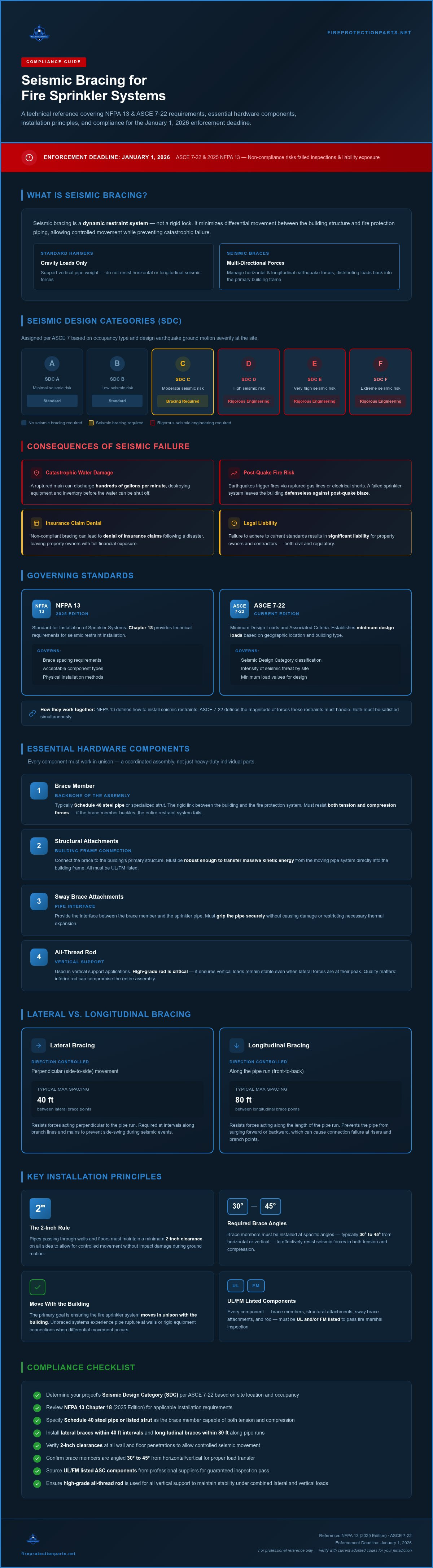
Effective seismic bracing for fire sprinkler systems relies on two distinct types of restraint: lateral and longitudinal. Lateral bracing is designed to prevent movement perpendicular to the pipe. It stops the system from swinging like a pendulum during ground motion, which is the most common cause of impact damage. Longitudinal bracing acts along the axis of the pipe, preventing it from sliding forward or backward through its hangers. Both are required for a code-compliant installation because seismic waves travel in multiple directions simultaneously. For critical areas like system risers and large mains, four-way bracing is the standard. This setup combines lateral and longitudinal restraints to provide the ultimate level of stability, locking the pipe in every horizontal direction at a single point.
Spacing requirements for these braces are not universal; they vary based on the pipe diameter and the seismic loads of the building. NFPA 13 provides strict guidelines to ensure the system remains rigid enough to survive a quake but flexible enough to avoid brittle failure. In general, lateral braces are required at more frequent intervals than longitudinal ones. For example, a main line might require lateral support every 40 feet, while longitudinal support might only be necessary every 80 feet. However, as pipe diameter decreases, these allowable distances shrink. You must consult the specific NFPA tables to ensure your hardware placement provides adequate coverage for your specific layout.
Calculating Brace Spacing
You can't determine brace placement by guesswork. A core concept in seismic engineering is the "Zone of Influence." This refers to the total weight of the water-filled pipe that a single brace is responsible for protecting during an earthquake. If the weight within this zone exceeds the rated capacity of your ASC hardware, the system will fail. You must calculate the forces based on the pipe's schedule and size, ensuring the structural attachment can handle the calculated load. This methodical approach is the only way to pass fire marshal inspections and guarantee the system's performance under stress.
Bracing Flexible Pipe Systems
Installing restraints for thermoplastic systems requires a specialized approach. When working with Viking Plastics CPVC pipe, you must account for the material's flexibility and thermal expansion. Standard steel hangers can cause abrasion if the pipe moves against sharp edges during minor tremors. You should use specialized, smooth-surfaced hangers and braces designed specifically for CPVC. These components allow for natural expansion and contraction while still providing the rigid restraint needed during a seismic event. It's a delicate balance. You're allowing for temperature-driven movement while preventing earthquake-driven failure. Don't compromise the pipe wall by using hardware intended only for steel.
Installation Principles for Seismic Compliance
Installation isn't just about bolting parts to a ceiling; it's about geometry and physics. Every brace must be installed at a specific angle, typically between 30 and 90 degrees from the vertical. As the angle decreases, the brace's ability to resist horizontal loads changes significantly. If you install a brace at a shallow 20-degree angle, you're effectively reducing its load capacity and risking a system failure. Precision matters because the 2026 standards leave no room for error. You must verify the angle of every restraint to ensure it matches the engineering calculations for your specific seismic bracing for fire sprinkler systems.
Maintaining clearance is equally critical for life safety. The "2-inch rule" is a standard requirement for pipes passing through walls, floors, or foundations. This gap allows the building to sway without crushing the pipe. If you pack that space with rigid grout or firestop, you've created a "hard-spot." During an earthquake, that rigid point becomes a fulcrum that can snap the pipe. Every component in your assembly must be "listed" for its specific use case. Using unlisted hardware is a shortcut that fire marshals will not overlook. Listed components have undergone rigorous testing to ensure they won't shear or deform when the building begins to move. This verification is your primary defense against liability and system failure.
Seismic Separation Joints
Buildings aren't always single, rigid blocks. Large structures often feature seismic separation joints that allow different wings to move independently. When your piping crosses these joints, you must use flexible couplings to accommodate that differential movement. Bracing is required on both sides of the joint to ensure the pipe moves with the specific section of the building it's attached to. This is often where you'll find fire protection control valves. Integrating these valves within properly braced sections ensures they remain accessible and functional after the ground stops shaking. Without these flexible connections, the sheer force of the building's movement will tear the system apart at the joints.
Common Installation Errors
The most frequent mistake is mixing listed and non-listed hardware. If you use a standard hardware store bolt to secure a UL-listed ASC brace, the entire assembly loses its rated capacity. You're only as strong as your weakest link. Another common oversight is the bracing of small-diameter branch lines. While focus usually stays on the mains, unrestrained branch lines can whip during a quake, shearing off heads and causing massive water damage. Ensure your plan covers the entire system, not just the largest pipes. Incorrect brace angles are also a major red flag during inspections. A brace that looks right but sits at 25 degrees instead of the required 30 is a code violation that requires immediate remediation. Accuracy in the field is the only way to guarantee performance.
You can buy code-compliant ASC seismic hardware directly from our online store to ensure your installation meets every 2026 standard.
Sourcing Code-Compliant Seismic Hardware
Procuring components for seismic bracing for fire sprinkler systems isn't the same as a standard hardware run. You need parts that are specifically engineered, tested, and listed for seismic service. Buying from specialized fire protection parts online stores ensures that every item in your cart is built for this industry. Before you finalize a purchase, verify that the hardware carries UL listings or FM approvals. These marks aren't just suggestions; they're the proof your fire marshal will look for during the final walkthrough. If a part doesn't have the paperwork to back up its performance, it doesn't belong on your job site.
For large-scale commercial retrofits, bulk sourcing is often the most efficient path to compliance. With the global seismic bracing market projected to grow significantly through 2033, securing your inventory early is a smart move. You must also ensure that secondary components, such as all-thread rod and fasteners, meet specific ASTM standards for strength and ductility. A brittle fastener can snap under the rapid loading of an earthquake, rendering the entire restraint system useless. Don't settle for "close enough" when it comes to material grades. High-quality hardware is the only way to ensure the system remains functional when the ground starts to move.
Why Quality Hardware Matters
Generic hardware lacks the traceable performance data required for life-safety systems. Using a non-rated bolt might save a few cents, but it introduces a point of failure that could lead to a total system collapse. ASC Engineered Solutions simplifies this process by providing pre-engineered components that align with 2026 standards. You also need to consider the environment. Galvanized finishes are essential for high-moisture areas to prevent corrosion, while plain steel may suffice for dry, conditioned spaces. Corrosion is a slow killer of seismic integrity. Choose your finish based on the long-term reality of the job site to ensure the system doesn't degrade over time.
Partnering with Fire Protection Parts
We act as your mission-driven partner in safety. By providing access to a comprehensive inventory of seismic restraints, we help you eliminate the doubt that often comes with complex procurement. Our role is to supply the professional-grade parts you need while you handle the specialized installation. This partnership ensures you have the right components at the right time to keep your project on schedule and fully compliant. Stop searching multiple vendors and get everything you need in one place. Browse our full selection of ASC Seismic Bracing today and secure your system with confidence.
Securing Compliance for 2026 and Beyond
The path to a safe and code-compliant installation is built on technical precision and verified hardware. Effective seismic bracing for fire sprinkler systems is about more than just rigidity; it's about managing dynamic forces to prevent catastrophic failure during ground motion. You now have the roadmap to navigate the updated NFPA 13 and ASCE 7 requirements, from calculating the zone of influence to maintaining critical clearances. By focusing on these principles, you eliminate the risk of system rupture and ensure your projects pass fire marshal inspections without delay.
Don't let sourcing delays or unlisted components compromise your life-safety mission. As an authorized ASC Engineered Solutions retailer, we provide the code-compliant life safety hardware and expert support for fire protection contractors that you need to succeed. When you choose professional-grade parts, you eliminate doubt and gain the peace of mind that your system is ready for the next seismic event. Take the next step in your project with confidence.
Secure Your System with ASC Seismic Bracing Components and ensure your work meets every professional standard. Your commitment to quality today is the ultimate protection for tomorrow.
Frequently Asked Questions
Do all fire sprinkler systems require seismic bracing?
Bracing is not universal; it is mandatory for systems installed in buildings within Seismic Design Categories C, D, E, and F. These categories represent areas with moderate to high seismic risk. If your project is in SDC A or B, bracing is generally not required by NFPA 13. You must verify your building's specific category with a structural engineer to ensure you don't overlook critical safety requirements or fail a fire marshal inspection.
What is the maximum spacing for lateral seismic braces?
The maximum spacing for lateral seismic bracing for fire sprinkler systems is typically 40 feet. However, this distance is a maximum limit and often decreases based on the pipe's diameter and the calculated seismic load. For smaller pipes or high-risk zones, you may need to install braces much closer together. Always consult the specific spacing tables in NFPA 13 Chapter 18 to ensure your hardware placement provides adequate restraint for your specific pipe schedule.
Can I use standard pipe hangers as seismic restraints?
No, standard pipe hangers cannot serve as seismic restraints because they are only designed to support gravity loads. Seismic braces must resist horizontal and longitudinal forces that hangers are not rated to handle. Using a standard hanger in place of a listed seismic brace is a major code violation. You must use specialized hardware, such as ASC sway braces, which are engineered to lock the pipe against multidirectional movement during ground motion and prevent catastrophic rupture.
How do I determine the Seismic Design Category for my building?
You determine the Seismic Design Category (SDC) using ASCE 7 standards, which evaluate the building's geographic location, soil conditions, and occupancy type. This classification is usually provided by the project's structural engineer of record. It's essential to have this category confirmed before you begin sourcing hardware. The SDC dictates whether bracing is required and the specific engineering forces your seismic bracing for fire sprinkler systems must be able to withstand under the latest 2026 codes.
What is the difference between UL listed and FM approved bracing?
Both UL Listing and FM Approval indicate that hardware has passed rigorous safety and performance testing. UL focuses on general safety standards and compliance with NFPA codes, while FM Approvals often involve even stricter testing criteria focused on property loss prevention. Most fire marshals accept either, but some high-risk commercial projects may specifically require FM Approved components. Always check your project specifications to ensure you buy hardware that meets the required listing for your specific local jurisdiction.
Does CPVC fire pipe require different seismic bracing than steel?
Yes, CPVC systems require specialized bracing that accounts for the material's flexibility and potential for abrasion. When using Viking Plastics CPVC pipe, you must use hangers and braces with smooth, rounded edges to prevent the hardware from cutting into the pipe wall during movement. Additionally, the bracing must allow for thermal expansion while still providing rigid seismic restraint. Using hardware designed only for steel can damage the thermoplastic and lead to a compromised life safety system.
Is all-thread rod required for seismic bracing?
All-thread rod is a critical component for many seismic assemblies, particularly for vertical supports and connecting sway braces to structural attachments. It must be high-quality and meet ASTM standards to ensure it doesn't shear under stress. While the rod itself isn't the "brace," it's the essential link that transfers seismic energy from the piping into the building's frame. We provide an extensive inventory of all-thread rod specifically designed for these demanding fire protection applications.
What are the clearance requirements for pipes through walls in seismic zones?
NFPA 13 requires a minimum clearance of 2 inches for pipes passing through walls, floors, or foundations in seismic zones. This gap ensures that the building can sway independently of the fire protection system without crushing the pipe. If the gap is less than 2 inches, you must use a flexible coupling within 1 foot of the wall. Maintaining this clearance is vital to prevent the "hard-spot" failures that lead to catastrophic pipe ruptures during an earthquake event.

