



Seismic Bracing for Fire Sprinklers: 2026 Compliance Guide
Could your fire suppression system withstand a force 50% greater than standard seismic loads? Under the current NFPA 13 standards and ASCE 7 alignment, fire sprinkler systems are classified as life safety components with an Importance Factor of 1.5. This means your seismic bracing for fire sprinkler systems isn't just a recommendation; it's a rigorous engineering requirement designed to ensure protection when it matters most. You know that navigating these evolving codes is often the most stressful part of any commercial installation. Between specific SDS calculations and the updated UL 203A safety factors, the margin for error has disappeared.
We understand that passing a fire marshal inspection requires more than just high-quality parts; it requires a deep understanding of how those components work as a unified assembly. This guide provides the technical clarity you need to master 2026 compliance. You'll learn how to identify compatible ASC seismic bracing hardware for different pipe types, calculate horizontal loads accurately, and source the reliable all-thread rod and swivel attachments necessary for a fail-safe installation. We'll break down the shift toward pre-engineered solutions and show you exactly how to achieve full code compliance without the typical procurement headaches.
Key Takeaways
- Understand why seismic bracing for fire sprinkler systems is critical for maintaining system functionality and protecting structural integrity during seismic events.
- Navigate the updated NFPA 13 Chapter 18 requirements, including the mandatory use of flexible couplings at seismic joints to allow for differential building movement.
- Learn to select compatible hardware, such as ASC Seismic Bracing, that matches specific pipe materials like steel or Viking CPVC.
- Avoid common installation failures by mastering correct brace angles and avoiding over-torqued bolts that can compromise the assembly.
- Streamline your procurement process by sourcing professional-grade, code-compliant components from specialized fire protection retailers.
What is Seismic Bracing for Fire Sprinkler Systems?
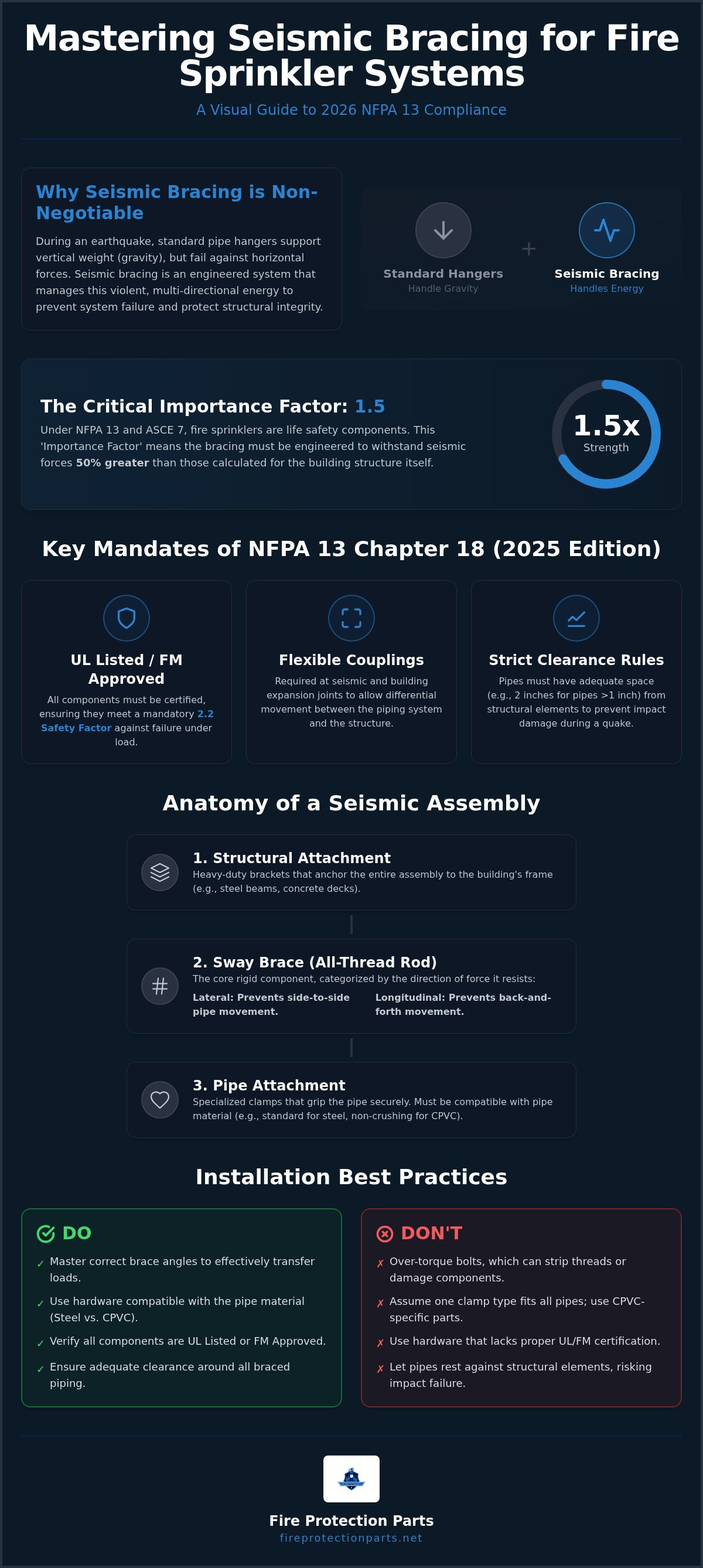
A Fire sprinkler system is designed to control or extinguish fires, but its effectiveness depends entirely on its structural integrity during an emergency. Seismic bracing for fire sprinkler systems is a specialized assembly of engineered components designed to limit the movement of piping during an earthquake. While standard pipe hangers are built to support the weight of the water and pipe, they don't account for the horizontal forces generated by seismic waves. Bracing provides the necessary rigidity and flexibility to prevent joints from snapping or pipes from crashing into the building structure. Standard hangers handle gravity; seismic bracing handles energy.
The 2025 edition of NFPA 13, which governs compliance for 2026 projects, features a major overhaul to align with ASCE 7. This update prioritizes bracing in a wider range of geographic regions because updated seismic maps now classify more areas as high-risk. It's no longer just a West Coast concern. Modern standards require a higher safety factor and site-specific calculations to ensure every component remains functional after the ground stops moving.
The Core Components of a Seismic Assembly
A complete seismic assembly isn't a single part; it's a synergy of hardware designed to work under extreme stress. The system relies on three primary elements:
- Sway braces: These are categorized as either lateral or longitudinal. Lateral braces prevent side-to-side swaying, while longitudinal braces stop the pipe from moving back and forth along its axis.
- Structural attachments: These heavy-duty brackets secure the assembly to the building's frame, such as steel beams or concrete decks.
- Pipe attachments: Specific clamps or adapters are required to grip the pipe. When you're using Viking Plastics CPVC pipe, you must use specialized hardware to ensure the brace doesn't crush the material.
Using All Thread Rod and ASC Seismic Bracing components ensures that each connection point meets the required safety factors. These parts are engineered to withstand the multi-directional forces of a seismic event without failing.
When is Seismic Bracing Mandatory?
The requirement for seismic protection is dictated by the Seismic Design Category (SDC) assigned to a building by a structural engineer. Generally, structures in categories C, D, E, and F must have fully compliant bracing. While categories A and B are often exempt, you should always verify specific project requirements. Some exceptions exist for small diameter piping, typically 1 inch or less, provided the installation has enough clearance to move without hitting other components. You must always consult the Authority Having Jurisdiction (AHJ). Local fire marshals have the final word on compliance and often require verified proof of UL Listing for all bracing hardware.
NFPA 13 Standards and Seismic Requirements
NFPA 13 Chapter 18 is the definitive source for NFPA 13 seismic requirements. In the 2025 edition, which dictates 2026 compliance, the focus has shifted toward site-specific design and higher safety factors. You can't just install hardware and hope it works. Every component used in seismic bracing for fire sprinkler systems must be UL Listed or FM Approved. This ensures the assembly meets the 2.2 safety factor mandated by current standards. This level of verification eliminates doubt. It guarantees that the assembly won't fail under the multi-directional loads of a seismic event.
Rigidity is the enemy of survival during an earthquake. NFPA 13 requires flexible couplings at seismic joints and where pipes cross building expansion joints. This design allows the system to move independently of the structure. Additionally, clearance rules are strict. You must maintain a specific distance between pipes and structural elements to prevent catastrophic impact. Usually, this means a two-inch clearance for pipes larger than one inch. If you lack the right components, you're looking at a failed inspection and a compromised system. For those ready to upgrade, you can order code-compliant bracing hardware online to ensure your project stays on schedule.
Lateral vs. Longitudinal Bracing
Lateral bracing prevents movement perpendicular to the pipe. It keeps the lines from swinging into walls, beams, or other utilities. Longitudinal bracing stops movement along the axis of the pipe. It prevents the pipe from sliding through its hangers and potentially shearing off at a joint. Code dictates maximum spacing for these braces. Typically, this means 40 feet for lateral and 80 feet for longitudinal, though these distances shrink as seismic loads increase. Precision in spacing is non-negotiable for system stability.
Four-Way Bracing for Risers
Vertical piping presents unique challenges in multi-story buildings. Four-way bracing is mandatory for risers to prevent movement in any horizontal direction. This is especially critical where the fire riser room serves as the system's backbone. You must secure the riser at the top and at specific intervals between floors. Proper integration ensures that the vertical supply remains intact even if different floors shift at different frequencies during a tremor.
Selecting the Right Seismic Bracing Hardware
Choosing components for seismic bracing for fire sprinkler systems requires more than checking a box on a spec sheet. Professional installers prioritize ASC Seismic Bracing because it's engineered to meet the rigorous UL 203A standards. These parts are tested at multiple angles, ensuring they don't fail when lateral and longitudinal forces hit simultaneously. You must ensure your hardware exceeds the calculated seismic force for your specific site. With the mandatory safety factor now at 2.2 for all products manufactured after September 2020, settling for unrated or generic hardware is a liability you can't afford.
Structural support relies heavily on all thread rod to connect the pipe assembly to the building's frame. It's the backbone of the seismic assembly. However, the rod alone isn't enough. You must match the rod diameter to the specific load requirements of the NFPA 13 seismic protection requirements. If the rod is too thin or the thread quality is poor, the entire assembly becomes the weak link during a tremor. Quality matters when lives are on the line.
Bracing for CPVC Systems
Installing Viking CPVC fire sprinkler pipe demands a different approach than steel. You can't use standard steel clamps that might gouge or chemically react with the plastic. Specialized ASC clamps for CPVC are designed to distribute pressure evenly. This prevents localized stress points that could lead to fractures during a seismic event. You also need to account for thermal expansion. CPVC moves more than steel as temperatures change, so your bracing must allow for this movement without losing its protective grip.
Essential Seismic Accessories
A complete system often requires accessories that contractors overlook until the inspection fails. These small parts make the difference between a passed inspection and a costly rework. Consider these critical items:
- Rod Stiffeners: These are essential for long runs of allthread rod. They prevent the rod from buckling under compressive loads during an earthquake.
- Seismic Wire: This provides a viable alternative to rigid bracing in tight spaces, though it requires specific tensioning tools for compliance.
- Beam Clamps and Concrete Anchors: These are your structural connection points. They must be rated specifically for seismic loads, not just static weight.
Using the right accessories ensures your system remains compliant and functional. It's about eliminating the doubt before it becomes a real-world failure. Reliable hardware is the only way to guarantee long-term performance.
Installation Best Practices and Inspection Checklist
Precision is the prerequisite for safety. Even the highest quality seismic bracing for fire sprinkler systems will fail if the installation deviates from the manufacturer's specific instructions. One of the most frequent errors in the field is over-torquing bolts. While it's tempting to tighten every fastener to its limit, over-torqued bolts can strip threads or create stress fractures in the brackets. This is especially dangerous when working with CPVC systems, where excessive pressure from a metal clamp can lead to environmental stress cracking. A loose bolt is a failure waiting to happen; an over-tightened one is a fracture risk. Always use a calibrated torque wrench to meet the exact specifications provided by ASC or Viking.
You must also ensure that every brace is attached to a structural element capable of bearing the calculated seismic load. Attaching a heavy-duty sway brace to a light-gauge metal stud or a non-structural partition wall is a direct violation of NFPA 13. The structural attachment must be verified by the project engineer to ensure the building frame can absorb the energy transferred through the bracing assembly during a tremor. If you need to verify your component list before the build begins, you can shop our full selection of seismic bracing hardware to find exactly what your project requires.
Brace Angle and Geometry
The geometry of your installation determines its effectiveness. The angle of the brace rod significantly affects its load-bearing capacity. Per code, rigid bracing should ideally be installed at an angle between 30 and 90 degrees from the vertical. As the angle decreases, the horizontal force the brace can resist also decreases, requiring more frequent brace points. You must also calculate the "zone of influence" for each brace. This is the specific length of pipe that a single brace is designed to protect. If the pipe run exceeds this zone, the system will flex beyond its limits, potentially causing catastrophic joint failure.
Pre-Inspection Checklist for Contractors
Passing a fire marshal inspection requires meticulous attention to detail. Before the AHJ arrives, run through this final checklist to ensure compliance:
- Verify Listings: Confirm every component, from the structural attachment to the pipe clamp, is UL/FM listed for seismic use.
- Clearance Audit: Ensure pipes passing through walls or floors have the required two-inch clearance to prevent impact damage.
- Vendor Verification: Confirm all sprinkler system components online were sourced from a reputable vendor to ensure material traceability.
- Documentation: Take clear, high-resolution photos of all bracing before they are obscured by ceilings or insulation.
Visual documentation is your best defense during the final sign-off. It provides proof of proper installation and component selection, which is vital for long-term liability protection. Clear records eliminate the doubt that often leads to inspection delays.
Sourcing Code-Compliant Seismic Bracing Parts
In life safety, there is no room for compromise. Sourcing professional-grade hardware for seismic bracing for fire sprinkler systems is the only way to ensure your installation meets the 2026 compliance standards. General hardware suppliers often lack the specialized UL Listed and FM Approved components required for high-risk Seismic Design Categories. When you choose a specialized fire protection retailer, you gain more than just parts. You gain material traceability and the assurance that every bracket, rod, and clamp is engineered for the specific stresses of a seismic event. This isn't just about passing an inspection; it's about protecting the building's occupants and assets long after the contractor leaves the site.
Procuring components for large-scale commercial projects requires a methodical approach to avoid delays. Modern logistics mean you can source everything from All Thread Rod to ASC Seismic Bracing from a single, dependable partner. This streamlined procurement reduces the risk of part incompatibility and ensures that your field teams have exactly what they need for each phase of the installation. By centralizing your sourcing, you eliminate the confusion of managing multiple vendors and disparate shipping schedules. Efficiency in the office translates directly to speed on the job site.
The Fire Protection Parts Advantage
Fire Protection Parts operates as a mission-driven partner for contractors across the United States. We provide direct access to high-quality ASC Engineered Solutions hardware, which has become a benchmark for reliability in the industry. Our inventory is managed to ensure the availability of critical components, including specialized attachments for Viking Plastics CPVC Pipe for Fire Protection. You don't have to guess which clamp works with which pipe. Our platform is designed to provide a one-stop-shop experience for pipes, fittings, and seismic restraint hardware. Our team understands the technical requirements of NFPA 13, helping you identify the correct parts for your specific system configuration without the typical guesswork.
Next Steps for Your Project
Before you begin your next installation, review your seismic design documents against current inventory levels. Planning for phased installations often requires ordering bulk allthread and bracing components well in advance of the pipe hanging stage. This proactive approach prevents bottlenecks and ensures your project stays on its 2026 compliance timeline. Whether you're retrofitting an existing facility or starting a new commercial build, the right hardware is the foundation of a safe system. Don't leave your compliance to chance. Shop our full selection of seismic bracing hardware today to secure the components your project demands.
Build for Stability and Compliance in 2026
Achieving full code compliance requires more than just following a checklist. It demands a technical synergy between the pipe, the building structure, and the bracing assembly. You've seen that the 2025 edition of NFPA 13 has raised the bar for safety factors and site-specific engineering. By matching professional-grade ASC hardware to your specific pipe type and adhering to strict brace geometry, you eliminate the risks of system failure and costly inspection delays. Proper installation of seismic bracing for fire sprinkler systems is the final line of defense for life safety during a tremor.
As an authorized retailer of ASC Engineered Solutions, Fire Protection Parts maintains an extensive inventory of UL/FM listed components ready for fast shipping across the United States. We're here to ensure you have the right parts for every lateral, longitudinal, and four-way brace point. Secure Your System with Code-Compliant Seismic Bracing at Fire Protection Parts. Your commitment to excellence ensures that every system you build is ready to protect when it matters most.
Frequently Asked Questions
Is seismic bracing required for all fire sprinkler systems?
Seismic bracing is mandatory for systems in Seismic Design Categories C, D, E, and F. While categories A and B are generally exempt, you should always verify the specific building code requirements for your project. Small diameter piping, typically one inch or less, may also be exempt provided there is enough clearance to prevent impact with the structure. Always consult your project's structural engineer to confirm the SDC before procurement begins.
What is the difference between lateral and longitudinal seismic bracing?
Lateral bracing prevents movement perpendicular to the pipe axis, stopping the system from swaying side to side. Longitudinal bracing stops movement along the axis of the pipe, preventing it from sliding through hangers and shearing at joints. A compliant system uses a combination of both to handle multi-directional forces. Proper spacing for these braces is defined by NFPA 13 based on the calculated seismic load of the building.
Can I use standard pipe hangers for seismic restraint?
You cannot use standard pipe hangers for seismic restraint. Standard hangers are engineered only to support the vertical weight of the pipe and water. They lack the rigidity and multi-directional strength required to resist horizontal seismic loads. Effective seismic bracing for fire sprinkler systems requires specialized, UL Listed assemblies designed to keep the piping intact while the building structure moves during a seismic event. This ensures functionality after the ground stops moving.
How do I know if my building is in a high-risk seismic zone?
Your building's risk level is determined by its assigned Seismic Design Category (SDC), which ranges from A to F. This category is calculated by structural engineers using ASCE 7 maps, local soil conditions, and building occupancy. You can find this information in the project's structural specifications or by consulting the Authority Having Jurisdiction (AHJ). Categories C through F indicate higher risk and mandatory seismic protection to ensure life safety.
What are the specific requirements for bracing CPVC fire sprinkler pipes?
Bracing Viking Plastics CPVC pipe requires specialized hardware to prevent material damage. You must use clamps designed for plastic that distribute pressure evenly and avoid chemical incompatibility. Since CPVC has a higher rate of thermal expansion than steel, the bracing assembly must allow for longitudinal movement without compromising the lateral restraint. Using the wrong metal clamps can lead to localized stress fractures or system failure during an earthquake. Precision in component selection is vital.
Do I need a professional engineer to design my seismic bracing system?
Professional engineering is typically required for the design of seismic restraint systems. NFPA 13 mandates site-specific calculations, including the design spectral response acceleration (SDS), to determine the horizontal force on the piping. While contractors can source code-compliant parts, a licensed PE must often sign off on the bracing plan and calculations to satisfy the fire marshal and ensure the system meets the 1.5 Importance Factor. This verification eliminates doubt during final inspections.
What is an NFPA 13 seismic joint and when is it used?
An NFPA 13 seismic joint is a flexible connection designed to accommodate differential movement between building sections. These joints are mandatory wherever fire sprinkler piping crosses a building expansion joint or where two parts of a structure move independently during an earthquake. By using flexible couplings or specialized loops, the joint prevents the pipe from snapping as the building segments shift in different directions. It's a critical component for maintaining system integrity in complex structures.
Are ASC seismic braces UL listed and FM approved?
Yes, the ASC Seismic Bracing components stocked by Fire Protection Parts are both UL Listed and FM Approved. These ratings are critical for passing inspections and ensuring long-term reliability. All ASC hardware manufactured after September 2020 complies with the updated UL 203A standards, which require testing at multiple angles and a 2.2 safety factor. This verification provides the assurance that your system will perform under extreme stress without compromise. Quality hardware is non-negotiable.

