



Seismic Bracing for Sprinkler Systems: A Comprehensive Guide to Compliance and Safety
Effective seismic protection is not just about making a system rigid; it is the strategic balance of providing flexibility where pipes move and rigidity where they must stay anchored. You likely already know that keeping your fire protection operational during an earthquake is non-negotiable. The complexity of the 2025 NFPA 13 and ASCE 7 requirements often feels like a moving target. Deciphering the nuances of seismic bracing for sprinkler systems shouldn't be a source of uncertainty when lives and property are on the line.
You deserve a clear path to compliance and the confidence that your hardware will hold when it matters most. This guide simplifies the fundamentals of seismic protection to ensure you can meet local fire codes without the guesswork. We will break down the latest horizontal force calculations, specific rules for CPVC piping, and how to select the right UL/FM approved components, such as ASC Seismic Bracing, to keep your system secure. From understanding SDS values to mastering sway brace attachments, you will gain the expertise needed to eliminate doubt and ensure long-term safety.
Key Takeaways
- Understand how seismic bracing for sprinkler systems manages differential movement between building structures and piping to prevent catastrophic failure.
- Navigate NFPA 13 Chapter 18 requirements with a clear grasp of the Force Factor (Fp) to ensure your system meets current bracing strength standards.
- Identify the specific roles of lateral, longitudinal, and four-way braces to create a comprehensive, multi-directional protection strategy.
- Determine if your project requires seismic protection by evaluating the Seismic Design Category and key triggers like the Short Period Design Spectral Response (Ss).
- Simplify procurement by identifying the essential hardware components required for code-compliant assemblies using verified ASC Seismic Bracing.
The Role of Seismic Bracing in Fire Sprinkler System Integrity
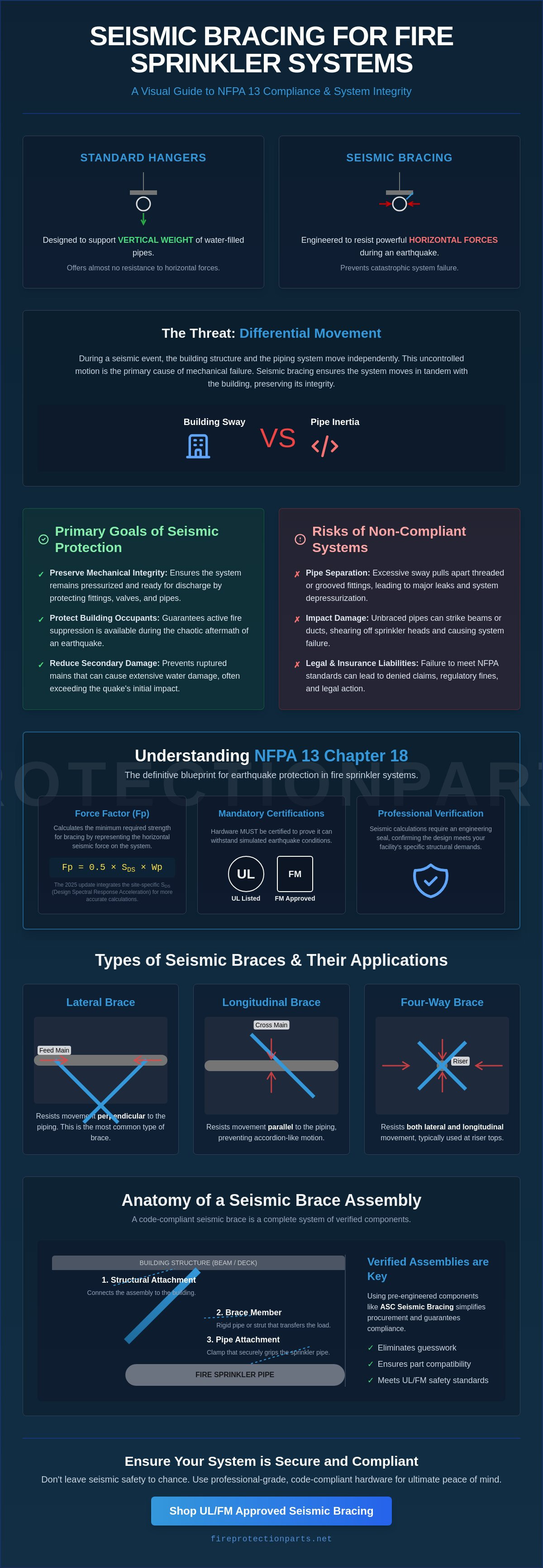
Seismic bracing for sprinkler systems is a specialized assembly of supports engineered to resist earthquake-induced horizontal forces. While standard hangers are designed to support the vertical weight of water-filled pipes, they offer almost no resistance to the lateral and longitudinal energy generated during a seismic event. Without a dedicated bracing strategy, the inertia of the piping system causes it to move independently of the building structure. This phenomenon, known as differential movement, is the primary cause of mechanical failure when the ground starts to shake.
A fire sprinkler system must remain intact to perform its life-saving function. If a building survives the initial tremors but the fire protection fails, the risk of post-earthquake fires becomes a catastrophic threat. Bracing ensures that the system moves in tandem with the building or possesses enough calculated flexibility to withstand the sway without rupturing. It is vital to distinguish between restraint and bracing. Restraint typically limits small-scale movement to prevent rattling or minor shifts during daily operations. Bracing is a more robust engineering requirement designed to distribute and manage massive seismic loads, transferring that energy back into the building's primary structural elements.
Primary Goals of Seismic Protection
The immediate objective of seismic protection is the preservation of the system's mechanical integrity. By minimizing damage to fittings, valves, and pipe lengths, you ensure the system remains pressurized and ready for discharge. This protection directly impacts building occupants, who rely on active fire suppression during the chaotic aftermath of a quake. Additionally, effective bracing reduces the risk of secondary water damage. A single ruptured main can cause extensive property loss within minutes, often exceeding the damage caused by the earthquake itself.
The Risks of Non-Compliant Installations
Non-compliant systems face several critical points of failure that can be avoided with professional-grade hardware. Common risks include:
- Pipe separation: Excessive sway often leads to joints pulling apart at threaded or grooved fittings.
- Impact damage: Unbraced piping can strike adjacent structural beams or HVAC ducts, often shearing off sprinkler heads.
- Legal and insurance liabilities: In high-risk zones, failing to meet NFPA standards can lead to denied insurance claims and significant regulatory fines.
Ensuring your system is equipped with verified components, such as ASC Seismic Bracing, eliminates these vulnerabilities. It provides the peace of mind that your facility is protected by hardware designed to meet the most rigorous safety standards.
Understanding NFPA 13 Standards for Seismic Restraint
NFPA 13 Chapter 18 serves as the definitive blueprint for earthquake protection. Its evolution, particularly in the 2025 edition, reflects decades of seismic data and structural engineering breakthroughs. Adhering to NFPA 13 standards ensures that every component, from the smallest bolt to the largest main, is prepared for dynamic loads. This isn't just about compliance; it's about life safety.
A critical element of these standards is the Force Factor (Fp). This coefficient represents the horizontal seismic force acting on a component. It dictates the minimum strength required for seismic bracing for sprinkler systems. Because seismic activity varies by geography, Fp values are site-specific. You must verify these numbers through local building codes and ASCE 7 data. The 2025 update now integrates the design spectral response acceleration at short periods (SDS), moving away from the simpler weight-based calculations used in previous decades.
Using UL Listed and FM Approved components is mandatory in most jurisdictions. These certifications prove that the hardware has undergone rigorous testing under simulated earthquake conditions. Professional engineering seals on seismic calculations provide an additional layer of verification. They confirm that the design meets the specific structural demands of your facility. Without these approvals, you risk system failure and significant legal exposure.
Flexible Couplings vs. Rigid Bracing
Rigid bracing locks the pipe in place, but buildings move. This is why flexible couplings are required where pipes cross building expansion joints or move between different structural sections. These couplings allow for building drift without snapping the line. In residential settings, Viking CPVC fire sprinkler pipe is often the preferred choice due to its material properties. However, even CPVC requires specific bracing intervals to prevent excessive whipping during a tremor. Balancing these flexible zones with braced rigid zones creates a resilient, cohesive system. You can explore our high-performance fire protection inventory to find the right match for your pipe material.
Horizontal Force Requirements
Calculating the horizontal force acting on a brace requires precision. The calculation considers the total weight of the pipe and the water it carries. Heavier pipes generate more inertia, necessitating stronger bracing. The 'Zone of Influence' is the portion of the system supported by a single brace. By determining the total weight within this zone, engineers can select a brace that exceeds the calculated seismic load. This methodical approach ensures that no single point in the system becomes a weak link during an event.
Types of Seismic Braces and Their Applications
A single brace doesn't protect a building. It only protects a point. To master the seismic design of fire suppression systems, you must understand how different braces work together as a cohesive unit. A compliant system uses a strategic mix of lateral, longitudinal, and four-way bracing. Each type addresses a specific direction of force. Without this variety, the system remains vulnerable to twisting or snapping under stress. Effective seismic bracing for sprinkler systems relies on calculating the correct spacing, which is determined by pipe diameter and local seismic intensity. For a detailed look at specific components, see our fire sprinkler seismic restraint roundup.
Lateral Bracing: Preventing Side-to-Side Sway
Lateral bracing stops side-to-side sway. It's required on all feed and cross mains regardless of their size. NFPA 13 dictates maximum spacing of 40 feet for these supports. You must also place these braces within 6 feet of any pipe end or change in direction. This prevents the whip effect that shears fittings when the building moves. Think of lateral braces as the anchors that keep the pipe run centered along its intended path. If you skip these, the pipe becomes a pendulum that can damage surrounding structural elements.
Longitudinal Bracing: Preventing End-to-End Movement
Longitudinal braces resist forces moving parallel to the axis of the pipe. They prevent the pipe from acting like a battering ram that slides through its hangers during a tremor. These are typically spaced at 80-foot intervals on feed and cross mains. While they provide necessary rigidity, they must be installed carefully to allow for thermal expansion and contraction. Over-restraining a long run without considering temperature changes can lead to stress fractures. Proper longitudinal seismic bracing for sprinkler systems ensures the entire line stays in place without buckling under its own weight or inertia.
Four-Way Bracing for Risers
Risers require four-way bracing because they are the vertical backbone of your fire protection. This hardware prevents horizontal movement in any direction simultaneously. You'll typically find them at the top of the riser and at specific vertical intervals to manage the immense weight of the vertical water column. Because risers carry the most water and are often the heaviest components, the structural attachment points must be verified for high loads. If a riser fails, the entire system loses its water supply. Using heavy-duty attachments ensures the riser remains functional even during severe ground motion.
Determining if Your Sprinkler System Requires Seismic Bracing
Determining the necessity for seismic bracing for sprinkler systems starts with the project structural engineer. They assign a Seismic Design Category (SDC) to the building. This classification, ranging from A to F, is based on the building's occupancy and the severity of potential ground motion at the site. If your project is in a high-risk area, bracing isn't a suggestion; it's a legal requirement. You must know your SDC before purchasing any hardware.
The 'Short Period Design Spectral Response' (Ss) acts as the primary trigger for these requirements. When Ss exceeds specific thresholds defined in ASCE 7, seismic protection becomes mandatory. Additionally, fire protection systems carry a Component Importance Factor (Ip) of 1.5. This designation reflects their critical role in life safety. It means these systems must remain operational even after a design-level earthquake. You're designing for 150% of the standard seismic force to ensure the system doesn't fail when it's needed most.
Seismic Design Categories (SDC) A-F
The SDC scale provides a clear framework for your requirements. It allows you to quickly identify the level of protection your facility needs. Categories include:
- SDC A and B: These categories represent the lowest risk. Generally, no seismic bracing is required for fire protection systems in these zones.
- SDC C: This is a transition zone. Bracing is often required for larger pipes, typically those 2 inches and larger, or for systems located near critical life-safety exits.
- SDC D, E, and F: These are high-seismic zones. Full seismic bracing and restraint are mandatory for almost all system components to prevent catastrophic failure.
The 12-Inch Rule and Other Exemptions
Not every pipe in a high-risk zone needs a brace. The "12-inch rule" is a common exemption used to save on labor and material costs. If a pipe is supported by hangers less than 12 inches long from the top of the pipe to the structural attachment, it's often exempt. The logic is simple. Short hangers don't allow enough pendulum motion to cause damage during a tremor. They keep the pipe moving in unison with the structure.
Small-diameter piping also sees specific exemptions. In many cases, 1-inch and smaller piping don't require seismic bracing for sprinkler systems if they are installed with specific flexible connections. However, you must always consult your local Authority Having Jurisdiction (AHJ). They have the final power to override standard exemptions based on local soil conditions or building use. If you're ready to secure your system, you can buy code-compliant ASC Seismic Bracing here to ensure your project passes inspection without delay.
Essential Hardware for Code-Compliant Seismic Bracing
Understanding the math and engineering codes is only the first step. You need the physical hardware that translates those requirements into real-world protection. A code-compliant assembly for seismic bracing for sprinkler systems is a three-part chain. It consists of the service pipe attachment, the brace member, and the structural attachment. If one link in this chain fails, the entire system is at risk. Using a matched set of ASC Seismic Bracing components ensures that every part of the assembly is engineered to work together under extreme stress.
Don't mix and match manufacturers for your bracing components. This is a common mistake that can void your UL listing. Manufacturers test their seismic assemblies as complete units. Substituting a structural bracket from one brand with a pipe clamp from another creates an unverified assembly. This makes inspections difficult and introduces unnecessary risk. All Thread Rod also plays a supporting role. While it provides the vertical support for the system, it works alongside seismic braces to maintain stability when ground motion starts. Keeping these components uniform across your project eliminates doubt and ensures a faster approval process.
Core Bracing Components
Sway brace attachments are the clamps that grip the sprinkler pipe. They are designed to hold the pipe firmly without causing damage to the pipe wall. Structural attachments are the brackets that anchor the assembly to the building's steel beams, concrete decks, or wood trusses. The brace member itself is usually a length of Schedule 40 steel pipe. It acts as the rigid link that transfers seismic energy from the sprinkler system into the building's primary structure. Each of these parts must be sized correctly for the specific pipe they are protecting.
Sourcing Reliable Fire Protection Parts
Procurement shouldn't be a gamble when lives are on the line. Buying from a specialized fire protection parts online store ensures you get hardware with the right certifications. You must verify the UL and FM markings on every seismic component before installation. These markings are your guarantee that the hardware has passed rigorous testing protocols. Don't settle for generic alternatives that lack the necessary documentation. Secure your project with verified ASC Seismic Bracing hardware to ensure your system is safe, durable, and fully compliant with all local fire codes.
Securing Your Fire Protection Against Seismic Events
Building a resilient fire protection system requires moving beyond basic installation to a specialized understanding of dynamic forces. You've learned that effective seismic bracing for sprinkler systems relies on a dual strategy. You must provide calculated flexibility where buildings drift and absolute rigidity where pipes must remain anchored. By correctly identifying your Seismic Design Category and adhering to the latest NFPA 13 standards, you eliminate the risks of pipe separation and impact damage during a tremor.
Quality hardware is the final piece of the compliance puzzle. Using verified, matched components from a single manufacturer ensures your system passes inspection and performs during the most critical moments. As an authorized distributor of ASC Engineered Solutions, we provide the expert technical support and comprehensive inventory required to meet strict fire codes. We focus on eliminating doubt so you can focus on the safety of your facility.
Shop UL-Listed Seismic Bracing and Hardware at Fire Protection Parts to find every NFPA-compliant component your project demands. With the right equipment and a clear understanding of seismic requirements, you can protect your facility and its occupants with absolute confidence.
Frequently Asked Questions
Is seismic bracing required for residential sprinkler systems?
Yes, requirements for residential systems depend on the specific NFPA standard and the local Seismic Design Category. While NFPA 13D often has fewer requirements for one- and two-family dwellings, multi-family buildings under NFPA 13R must follow specific bracing rules if the project is in a high-risk zone. Always verify the local building code to ensure your residential fire protection remains operational during an earthquake. Professional engineering guidance is essential for these zones.
What is the difference between a sway brace and a pipe hanger?
A pipe hanger is designed to support the vertical weight of the water-filled pipe, while a sway brace is engineered to resist horizontal seismic forces. Standard hangers offer no protection against the lateral or longitudinal movement caused by ground motion. Effective seismic bracing for sprinkler systems requires dedicated hardware that transfers these massive dynamic loads back into the building's primary structural elements. This prevents the piping from swinging independently of the structure.
Can I use standard pipe clamps for seismic bracing?
You cannot use standard pipe clamps for seismic bracing. Standard clamps are not rated to handle the dynamic, multi-directional forces generated during a seismic event. Only use UL Listed and FM Approved sway brace attachments. These specialized components have undergone rigorous testing to ensure they won't slip or fail when subjected to the specific horizontal force factors required by NFPA 13. Using unrated hardware is a critical safety violation that endangers the entire facility.
How far apart should seismic braces be installed on a main line?
Maximum spacing depends on the direction of the brace and the pipe diameter. Lateral braces are typically installed at intervals no greater than 40 feet on feed and cross mains. Longitudinal braces, which resist forces parallel to the pipe, are usually required every 80 feet. These distances are maximums; specific engineering calculations or high-intensity seismic zones may require more frequent bracing to maintain system integrity. Always consult your project's seismic design documents for precise placement.
What is the 12-inch rule in seismic bracing for sprinklers?
The 12-inch rule states that seismic bracing is often not required for piping supported by hangers that are less than 12 inches long. This measurement is taken from the top of the pipe to the structural attachment point. Short hangers limit the pendulum effect, allowing the pipe to move in unison with the building. However, this exemption has specific limits regarding pipe size and location that your local authority must approve before installation begins.
Does CPVC piping require different seismic bracing than steel?
CPVC piping requires specific bracing considerations because it is more flexible than steel. While the general principles of seismic bracing for sprinkler systems apply, CPVC systems often require shorter bracing intervals to prevent excessive whipping. It's essential to use hardware specifically listed for use with CPVC to avoid chemical incompatibility or physical damage to the pipe wall. Always verify that your bracing hardware is compatible with Viking Plastics CPVC for a safe installation.
What certifications should I look for when buying seismic hardware?
Look for UL Listing and FM Approval on all seismic hardware. These certifications guarantee that the components have been tested against standardized seismic loads and meet the safety criteria established by NFPA 13. Installing uncertified hardware puts your system at risk of failure and can lead to rejected inspections or denied insurance claims following a seismic event. These markings provide the verified assurance that your fire protection system is built to last through severe tremors.
Can I mix seismic components from different manufacturers?
You should never mix seismic components from different manufacturers within a single brace assembly. Manufacturers test their service pipe attachments, brace members, and structural attachments as a complete, cohesive system. Combining parts from different brands creates an unverified assembly that voids the UL listing. To ensure full compliance and performance, source all components for a specific brace from a single trusted manufacturer like ASC Engineered Solutions. This practice eliminates doubt during the final inspection process.

