



Viking CPVC Fire Sprinkler Pipe: The Professional Buyer’s Guide for 2026
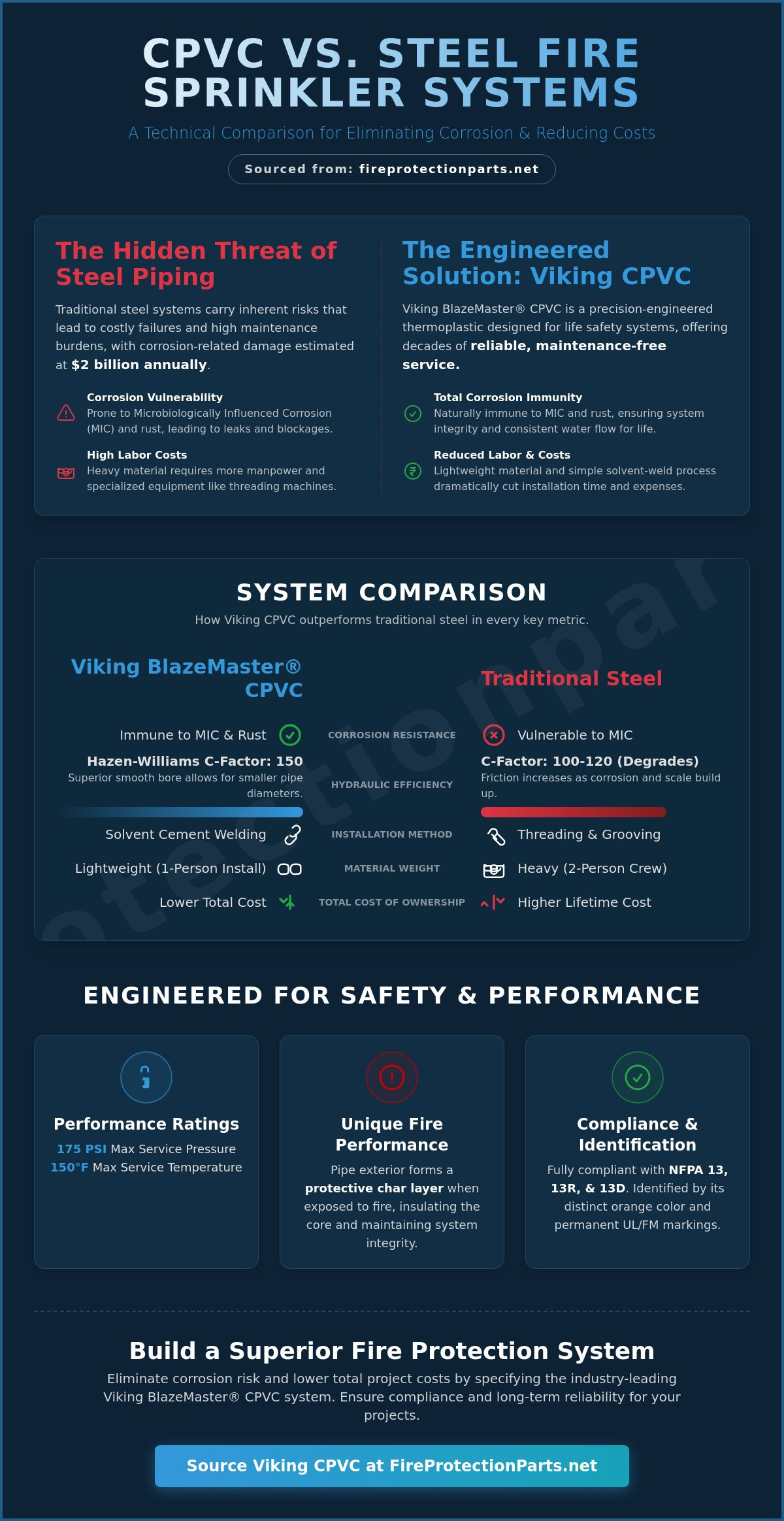
Traditional steel piping is failing the fire protection industry, costing an estimated $2 billion annually in corrosion related damage. You've likely dealt with the headaches of Microbiologically Influenced Corrosion (MIC) or the high labor costs associated with heavy, threaded steel. It's a risk your projects can't afford. Specifying a Viking CPVC fire sprinkler pipe system is a strategic move to eliminate these vulnerabilities. This isn't just a plastic pipe; it's a precision engineered suppression technology designed to provide decades of maintenance free service.
You know that adherence to strict NFPA standards is non negotiable for safety and liability. With the 2025 editions of NFPA 13, 13R, and 13D now active, and the 2026 edition of NFPA 25 introducing more frequent inspection requirements, your choice of materials matters more than ever. This guide provides the technical mastery you need to source Viking BlazeMaster systems correctly. We'll break down the latest June 2026 pricing updates, verify pressure ratings, and ensure your system remains 100% compliant. You'll gain the professional assurance that your fire protection system is built to last without compromise.
Key Takeaways
- Understand the "complete system" mandate to prevent catastrophic failures through proper BlazeMaster solvent cement welding.
- Discover how the superior hydraulic efficiency of Viking CPVC fire sprinkler pipe allows for smaller pipe diameters and reduced material costs.
- Identify the specific Light Hazard Occupancies where CPVC is permitted under NFPA 13 and 13R standards.
- Calculate labor savings by leveraging the significant weight advantages of CPVC over traditional threaded steel.
- Optimize your procurement strategy for 10ft and 15ft lengths to ensure safe handling and efficient inventory management.
What is Viking CPVC Fire Sprinkler Pipe?
Chlorinated polyvinyl chloride (CPVC) is a high performance thermoplastic produced by the chlorination of polyvinyl chloride resin. In the context of fire protection, Viking CPVC fire sprinkler pipe represents a specialized evolution of this material. Through a long standing partnership with BlazeMaster, Viking provides a piping solution engineered specifically for the rigors of life safety systems. Unlike standard plastics, this material is designed to remain structural under intense heat, ensuring water reaches the fire when every second counts.
It's vital to distinguish between plumbing grade CPVC and fire rated systems. While they may look similar to an untrained eye, the chemical composition of Viking BlazeMaster pipe is optimized for fire suppression. It features superior hydraulic smoothness, boasting a Hazen-Williams C-factor of 150. This is significantly higher than the C-factor of 100 to 120 typically found in aged steel pipes. Higher smoothness means less friction loss; this often allows engineers to specify smaller pipe diameters without sacrificing system performance or safety margins.
The Science of Fire-Rated Thermoplastics
When exposed to flame, Viking CPVC doesn't melt or drip like common plastics. Instead, it undergoes a process called "charring." The exterior of the pipe forms a carbonaceous char layer that acts as a thermal insulator. This protects the core of the pipe and the water inside, maintaining system integrity during the critical early stages of fire growth. This protection is backed by rigorous performance specifications:
- Pressure Rating: Rated for a continuous service pressure of 175 PSI.
- Temperature Rating: Maintains performance at temperatures up to 150°F.
- Corrosion Resistance: Naturally immune to Microbiologically Influenced Corrosion (MIC), which is a leading cause of leaks and blockages in metal systems.
Identifying Genuine Viking BlazeMaster Pipe
Safety depends on using verified components. Genuine Viking CPVC fire sprinkler pipe is easily identified by its distinctive orange color. This color coding is an industry standard designed to prevent the accidental installation of non fire rated plumbing pipes in a sprinkler system. If the pipe isn't orange, it isn't rated for fire protection.
Beyond the color, look for specific permanent markings on the pipe wall. Each length must feature the Viking and BlazeMaster branding alongside UL listings, FM approvals, and relevant ASTM standards. These markers serve as your guarantee of quality and compliance. Using unverified or mixed brand components is a risk that compromises the entire suppression network and may void manufacturer warranties.
CPVC vs. Metal: Why Viking Systems are Dominating Residential Fire Protection
Viking CPVC fire sprinkler pipe has fundamentally changed how contractors approach residential and light hazard projects. Historically, Schedule 40 black steel was the industry standard, but it carries a hidden burden: the corrosion clock. From the moment water enters a metal system, oxidation and Microbiologically Influenced Corrosion (MIC) begin to degrade the pipe walls. Viking CPVC eliminates this risk entirely. It's a non-corrosive solution that ensures the system's internal diameter remains clear and unobstructed for its entire service life.
When Comparing CPVC to steel pipe, the Total Cost of Ownership (TCO) in 2026 favors thermoplastic systems. While material costs across the construction industry continue to fluctuate, the long-term savings on maintenance and the absence of expensive chemical treatments make CPVC the more economical choice. You aren't just buying pipe; you're investing in a system that won't require a full-scale replacement due to pinhole leaks in twenty years. For reliable project planning, sourcing Viking Plastics CPVC Pipe provides the professional assurance that your margins are protected from future service calls.
The Labor Advantage
Installation efficiency is where the Viking CPVC fire sprinkler pipe truly outperforms metal. Steel requires heavy threading machines, oily cutting fluids, and often a two-man crew to handle the weight of overhead runs. CPVC is lightweight and uses a solvent cement welding process. This allows a single technician to manage many residential 13D installations, significantly reducing man-hours. Project turnaround times are faster, allowing you to move from rough-in to final inspection with fewer logistical bottlenecks. There's no need for on-site welding or specialized heavy equipment, which keeps the job site cleaner and safer.
Hydraulic Performance Comparison
Hydraulic efficiency is a critical factor in system design. The Hazen-Williams C-factor measures the smoothness of a pipe's interior; steel typically carries a rating of 120, which can drop as the pipe ages and scales. Viking CPVC maintains a consistent C-factor of 150. This superior smoothness results in lower friction loss, which often has a cascading effect on your system design:
- Smaller Diameters: You can often achieve required flow rates using smaller, less expensive pipe sizes.
- Pump Requirements: Lower friction loss can reduce the demand on Residential Fire Pump Systems, potentially allowing for smaller, more cost-effective units.
- Water Supply: Systems can operate effectively even in areas with lower municipal water pressure.
This hydraulic consistency ensures that the calculations performed during the design phase remain accurate decades later. Unlike metal, which pits and narrows over time, Viking CPVC provides a predictable, high-performance flow for the life of the building.
The "Complete System" Approach: Pipes, Fittings, and Solvent Cement
Achieving a 100% reliable fire suppression network requires more than just high quality pipe. It demands a "complete system" approach where every component is engineered to work in unison. When you specify Viking CPVC fire sprinkler pipe, you are committing to a matched set of pipes, fittings, and solvent cements. Mixing brands is a critical error. Incompatible resins or chemical additives in different CPVC lines can lead to environmental stress cracking or joint failure. Adhering to NFPA 13 installation standards means respecting the manufacturer’s listed system components. This isn't just about warranty protection; it’s about ensuring the system performs under the extreme pressure of a fire event.
System compatibility extends to the fire sprinkler heads and escutcheons used during the final trim. Viking ensures that their CPVC components are chemically compatible with the lubricants and materials used in their own sprinkler heads. This eliminates the risk of chemical leaching that can weaken the thermoplastic over time. By using a single source for your suppression needs, you remove the guesswork and provide the professional assurance that the system will remain structural for decades.
Solvent Cement: More Than Just Glue
Solvent cement doesn't simply stick two pieces of plastic together. It's a chemical welding process. The cement temporarily softens the top layer of the Viking CPVC fire sprinkler pipe and the fitting, allowing the polymer chains to fuse into a single, monolithic joint. Once the solvent evaporates, the joint becomes the strongest part of the system. In 2026, industry standards continue to emphasize the use of BlazeMaster solvent cement to maintain the system's listing.
Contractors must account for environmental factors when managing cure times. Humidity and ambient temperature directly impact how quickly a joint reaches full strength. While one-step solvent cements have streamlined the process, following the specific set and cure tables provided by Viking is mandatory. Rushing the pressure test before the chemical weld has fully cured is a leading cause of preventable leaks during system commissioning.
Viking Fittings and Specialized Adapters
Transitioning from metal supply lines to CPVC requires precision. Viking offers specialized brass threaded adapters that provide a robust connection point without the risk of over-tightening or cracking the thermoplastic. These adapters are essential when connecting to backflow preventors or metal risers. For residential 13D and 13R projects, Viking provides unique fitting geometries, such as low-profile tees and elbows, designed to fit within tight floor joists and wall cavities.
Designers working in high-risk zones should look for the latest 2026 fitting enhancements. These components are engineered for enhanced durability in seismic regions. When paired with ASC Seismic Bracing, these fittings ensure the suppression system remains operational after a seismic event. This methodical approach to component selection ensures that your procurement meets the highest standards of safety and compliance.
Compliance and Installation Standards: NFPA 13, 13R, and 13D
Compliance isn't optional; it's the foundation of life safety. Viking CPVC fire sprinkler pipe is listed for specific applications across the 2025 editions of NFPA 13, 13R, and 13D. Under NFPA 13, CPVC use is restricted to Light Hazard occupancies. These include environments like offices, schools, and hospitals where the fuel load is relatively low. For multi-family residential buildings up to four stories, NFPA 13R provides the specific installation framework. Finally, NFPA 13D governs one and two-family dwellings. Each standard has unique hydraulic and placement requirements that you must follow to ensure the system performs as intended. To secure compliant components for your next project, purchase Viking Plastics CPVC Pipe for Fire Protection from a trusted distributor.
High risk zones require additional safeguards. In seismic areas, the flexibility of thermoplastic is a distinct advantage, but it must be supported by proper hardware. Utilizing ASC Seismic Bracing alongside your Viking pipe ensures the system withstands ground movement without fracturing. This combination meets the rigorous demands of modern building codes while providing peace of mind for facility managers and homeowners alike. Following these standards eliminates doubt and ensures your installation remains structural during an emergency.
Homeowners and facility managers looking to complement their fire safety systems with reliable climate solutions can learn more about Ultra Air Heating and Cooling for professional HVAC services in Southwest Florida.
Installation Best Practices
Precision during the rough-in stage prevents long term system failure. Support and hanger spacing are critical. You must follow the manufacturer’s specific distance requirements to prevent pipe sag, which can trap air or lead to mechanical stress. Thermal expansion is another factor. CPVC expands and contracts more than steel. Incorporating expansion loops or offsets allows the pipe to move without putting pressure on fittings. Additionally, protect your inventory from UV degradation. Store pipes indoors or under opaque covers until they are ready for installation to maintain their structural integrity.
Common Installation Errors to Avoid
Small mistakes lead to catastrophic results in fire protection. Chemical incompatibility is a primary threat. Never use petroleum based thread sealants or certain cutting oils, as they can cause the CPVC to crack. Always verify that your ancillary materials are on the "system compatible" list. Improper pipe preparation is another frequent issue. You must debur and bevel the pipe ends to ensure a smooth flow and a proper chemical weld. Finally, never "dry-fit" connections. A joint that looks secure without solvent cement will fail immediately under pressure.
Sourcing Viking CPVC Pipe for New Construction and Repairs
Efficiency in fire protection depends on a reliable supply chain. Managing your inventory of Viking CPVC fire sprinkler pipe requires a dual strategy. For new construction, bulk orders of 15ft lengths maximize coverage and reduce the number of joints. For repairs or retrofits in existing structures, 10ft lengths are often more manageable in confined spaces. With the scheduled June 26, 2026 price increase approaching, verifying your current stock levels for BlazeMaster products is a critical financial move. Planning your procurement now prevents project delays and protects your bottom line from rising material costs. It ensures you have the necessary volume to complete your projects without unexpected overhead spikes.
Reliable parts sourcing is a cross-industry standard; for example, ELart, UAB provides specialized retail distribution for the automotive sector, ensuring that technical components are available when and where they are required.
Shipping logistics for thermoplastic piping require specialized care. Unlike steel, CPVC must be protected from impact and extreme temperatures during transit to prevent micro-fractures. Sourcing from a specialized e-commerce partner ensures that your materials are handled by professionals who understand these requirements. This expert oversight guarantees that every length of pipe arrives ready for immediate installation, maintaining the structural integrity discussed in previous sections. Handling 15ft lengths requires specific rack configurations to prevent bowing, while 10ft lengths offer the agility needed for tight urban job sites. Professional handling eliminates the risk of receiving damaged goods that could fail during a pressure test.
Procurement for Contractors
Streamlining your workflow means more than just ordering pipe. Successful contractors achieve better results by bundling their Viking CPVC fire sprinkler pipe with the correct CPVC fire protection fittings. This ensures that every component is part of the same listed system, a requirement for 100% compliance. When you source your entire suppression network from one provider, you gain access to technical support that understands how these parts interact. This reduces the risk of ordering incompatible hardware and ensures all items arrive with the necessary UL and FM certifications. It's a methodical approach that simplifies your inventory management and strengthens your project's safety profile.
The Fire Protection Parts Advantage
Speed is essential when a system is down or a deadline is looming. We focus on an expert curation of code-compliant Viking components to eliminate the guesswork. You get direct access to fire protection parts and hardware for both emergency repairs and large scale installations. Fast shipping is our standard because we know that a delayed delivery can halt an entire construction site. We act as your mission-driven partner, providing the professional assurance that your life safety systems are built with the highest quality materials available in 2026. This no-nonsense approach to business ensures you have the right parts at the right time, allowing you to focus on the technical excellence of your installation.
Secure Your Project with Professional Grade Suppression
Choosing Viking CPVC fire sprinkler pipe is an investment in long term reliability and safety. You've seen how this precision engineered technology eliminates the multi billion dollar threat of corrosion while streamlining installation through superior hydraulic performance. By adhering to the latest NFPA standards and following the "complete system" approach, you ensure your suppression network remains structural for the life of the building. It's about more than just meeting code; it's about providing the professional assurance that the system will perform when it matters most.
Don't leave your project requirements to chance or risk using incompatible components. As an Authorized Viking Distributor, we provide the NFPA Code Compliant Components you need to maintain 100% system integrity. We offer Fast Shipping Across the United States to help you meet tight construction deadlines and stay ahead of upcoming industry price adjustments. Shop the Full Line of Viking BlazeMaster CPVC Pipe and Fittings today to secure the high performance materials your clients deserve. Build with the expert confidence that only genuine Viking products can provide.
Frequently Asked Questions
Can Viking CPVC pipe be used in ordinary hazard environments?
No, Viking CPVC pipe is strictly listed for Light Hazard occupancies as defined by NFPA 13, 13R, and 13D standards. It isn't permitted for Ordinary Hazard environments like warehouses or manufacturing facilities where fuel loads are significantly higher. Always verify the occupancy classification of your project before procurement to ensure the material meets local building codes and safety requirements for the specific hazard level.
How long does it take for CPVC solvent cement to cure before pressure testing?
Cure times depend on the pipe diameter, ambient temperature, and humidity levels at the job site. While some joints may set in minutes, a full pressure test usually requires waiting between 1 and 24 hours. You must consult the specific cure time tables provided by Viking to avoid joint failure. Rushing this process compromises the chemical weld and leads to preventable leaks during system commissioning.
Is Viking BlazeMaster pipe compatible with other brands of CPVC fittings?
No, you should never mix Viking BlazeMaster components with other CPVC brands. Viking utilizes a "complete system" approach where the pipe, fittings, and solvent cement are tested together as a single unit. Mixing brands voids the UL listing and manufacturer warranty. To maintain 100% system integrity, ensure every component in your suppressive network is a genuine Viking product sourced from an authorized distributor.
What is the maximum temperature rating for Viking CPVC fire sprinkler pipe?
The maximum continuous service rating for Viking CPVC fire sprinkler pipe is 175 psi at 150°F. This rating ensures the system maintains structural integrity under the high pressure and heat common in fire suppression scenarios. Exceeding these limits can lead to material deformation or system failure. This makes it a reliable choice for the Light Hazard environments discussed throughout this guide where safety is the priority.
Can I paint CPVC fire sprinkler pipes to match the ceiling?
Yes, you can paint Viking CPVC, but you must use only water-based latex paint. Never use oil-based paints, primers, or certain spray paints, as the chemicals in these products can attack the thermoplastic and cause stress cracking. Ensure the pipe is clean and dry before application. Proper paint selection preserves the pipe's longevity while allowing the suppression system to blend seamlessly into the building's interior design.
How do I identify chemical incompatibility with CPVC piping?
You must consult the FBC System Compatible Program list to verify that any material coming into contact with the pipe is safe. Chemical incompatibility often manifests as environmental stress cracking or softening of the pipe wall. Common culprits include certain thread sealants, firestops, and even some dish soaps used for leak detection. Using only approved ancillary products is the only way to eliminate this risk entirely.
What is the life expectancy of a Viking CPVC fire sprinkler system?
A correctly installed Viking CPVC system has a design life expectancy of 50 years. Because the material is naturally immune to the corrosion that destroys metal pipes, it avoids the "corrosion clock" associated with black steel. Regular maintenance according to NFPA 25 standards will ensure the system remains operational for the entire lifespan of the structure without the need for costly and disruptive pipe replacements.
Do I need special tools to cut and install Viking CPVC pipe?
You don't need heavy machinery like threading equipment, but specific hand tools are required for a professional installation. Use a plastic pipe cutter or a fine-tooth saw for clean cuts. Crucially, you must use a deburring and chamfering tool to remove burrs and create a bevel on the pipe end. This ensures the solvent cement is distributed evenly, creating a monolithic, leak-proof joint that lasts.

