



ASC Seismic Bracing: 2026 Fire Sprinkler Sourcing Guide
A single tremor can turn a code-compliant fire sprinkler system into a massive liability if your structural attachments aren't engineered for the specific seismic load. You already understand that NFPA 13 compliance is about more than just checking boxes for an inspector. It's about the unwavering certainty that life-safety systems will remain functional when the ground moves. However, finding the exact ASC seismic bracing part numbers and navigating the 2025 NFPA 13 overhauls for horizontal force calculations can quickly become a bottleneck in your procurement process. You need hardware that eliminates doubt and ensures the structural integrity of every connection without compromise.
This 2026 sourcing guide will help you master the technical requirements and procurement of ASC seismic bracing to ensure 100% code compliance in high-risk seismic zones. You'll learn how to identify the necessary structural and pipe attachments while streamlining your supply chain to avoid project delays. We will examine the latest alignment between fire protection standards and ASCE/SEI 7 building codes, providing a clear roadmap for selecting the right swivel attachments and clamps for any building material. By the end of this guide, you'll have the expert confidence to source components that protect both your reputation and the buildings you service.
Key Takeaways
- Identify the essential components of the three-part seismic system to meet updated 2025 NFPA 13 horizontal force requirements.
- Eliminate the risk of system failure by choosing UL-listed ASC seismic bracing over generic hardware that lacks verified load ratings.
- Implement a step-by-step selection framework to match bracing orientation with specific pipe materials like steel or Viking CPVC.
- Accelerate your project timeline by leveraging e-commerce sourcing for "just-in-time" delivery of critical seismic components.
What is ASC Seismic Bracing and Why is it Critical in 2026?
ASC seismic bracing is a system of lateral and longitudinal restraints engineered to keep fire sprinkler piping intact during seismic events. In the current 2026 landscape, ASC Engineered Solutions represents the unified strength of the Anvil and Smith-Cooper merger. This consolidation has created a single engineering powerhouse that provides contractors with a streamlined, reliable catalog of components. The primary mission of this hardware is to eliminate differential movement. When the ground shakes, a building's structure and its fire suppression system move at different frequencies. Without professional bracing, this variance shears pipes and ruptures fittings, rendering the system useless when it's needed most. ASC seismic bracing is a code-mandated safety system for high-risk zones that ensures your fire protection remains operational during and after a tremor.
The Legal and Safety Mandate: NFPA 13 Compliance
NFPA 13 dictates strict requirements for sway bracing to protect life and property. Every ASC seismic bracing component undergoes rigorous testing to meet UL and FM Global standards. These listings provide the professional assurance that your installation will perform under extreme stress. If you choose non-compliant bracing, you risk more than just a failed inspection. A system rupture during a minor tremor can cause catastrophic water damage, even if no fire occurs. By utilizing these components, you apply foundational earthquake engineering principles to your piping layout. This ensures the system stays securely attached to the building's primary structure, maintaining the "unwavering reliability" that facility managers demand.
Seismic Design Categories (SDC) Explained
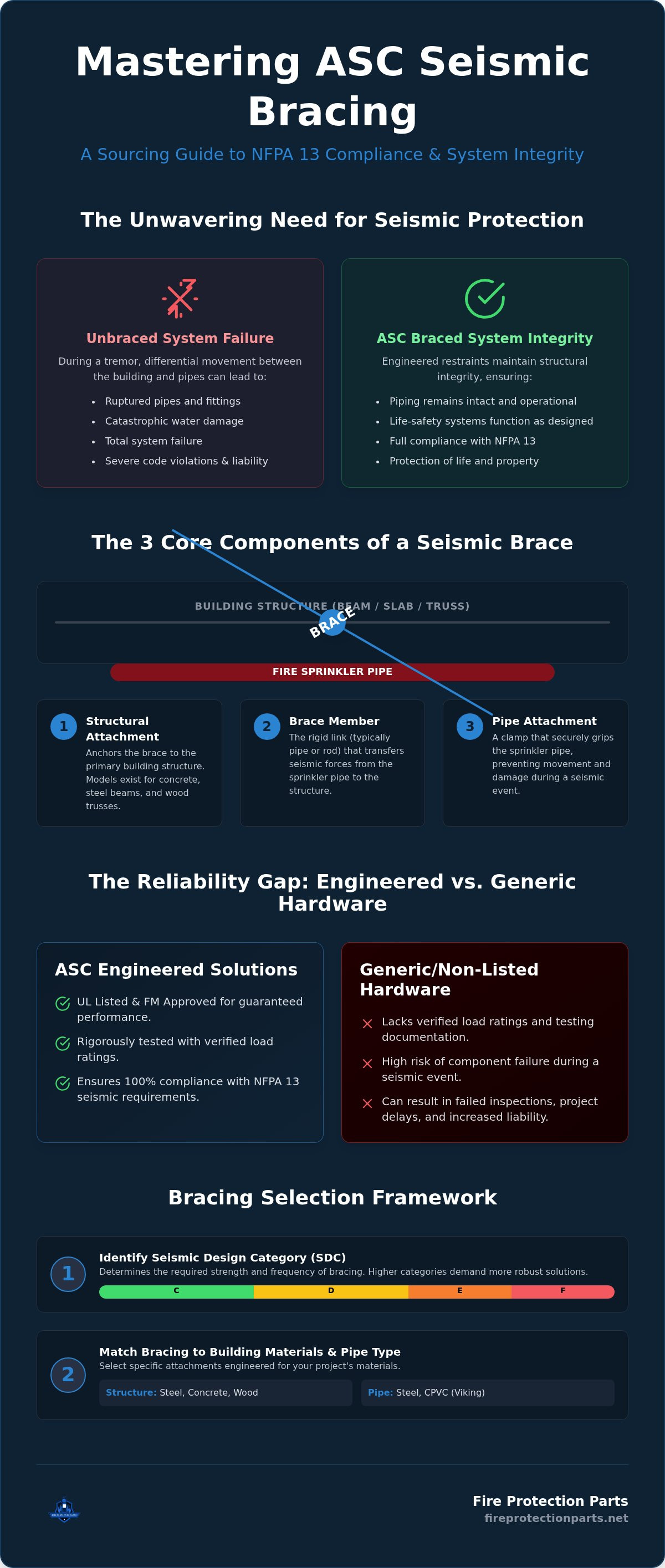
Your project's Seismic Design Category (SDC) dictates the frequency and strength of your bracing requirements. Categories range from SDC C to SDC F, with each step representing an increase in potential seismic force and complexity. While some low-risk zones might technically qualify for bracing exemptions, the 2026 updated seismic zone maps have expanded the areas where robust protection is now a necessity. ASC solutions eliminate the doubt associated with borderline exemptions. It's often safer to install a verified brace than to risk the structural integrity of the system on a calculation that might not meet future code revisions. Proper bracing frequency is calculated based on the specific horizontal force acting on the pipe, and using a unified system makes these calculations far more predictable for your design team.
Key Components of an ASC Seismic Bracing System
Every ASC seismic bracing installation relies on a cohesive three-part assembly to ensure system survival. This chain begins with the structural attachment, connects through a brace member, and terminates at the pipe attachment. This modularity allows for precision engineering across diverse building types. Using components from a single, unified source eliminates the risk of mismatched load ratings. It simplifies the mixed-material challenge by providing hardware that bridges the gap between different substrates. When you select your components, you aren't just buying steel; you're investing in a verified load path that has been tested to perform under extreme seismic stress.
Material choice is a critical factor for long-term reliability. Standard carbon steel is the industry baseline for most dry, interior environments. However, for corrosive areas or outdoor exposures, galvanized options are mandatory to prevent structural degradation over time. ASC Engineered Solutions provides these variations without sacrificing the UL listings or FM approvals required for code compliance. Choosing the right finish ensures that your safety system won't fail due to environmental wear before a seismic event even occurs.
Structural Attachments for Every Building Type
Structural attachments serve as the anchors of your entire fire protection system. Whether you're securing to I-beams, wood trusses, or concrete slabs, ASC provides universal attachments designed for maximum grip. Beam clamps and concrete anchors must be sized to handle the specific horizontal forces identified in your hydraulic and seismic design. Research from the NIST Earthquake Engineering Group emphasizes that structural connection integrity is the most frequent point of failure during a tremor. Don't guess on all-thread rod sizing. Ensure your rod diameter and length match the seismic load requirements for each specific span to maintain a rigid connection to the building skeleton.
Pipe Attachments: Lateral and Longitudinal Restraints
This is the point where the brace meets the fire suppression line. Lateral bracing prevents side-to-side movement of the mains, while longitudinal bracing stops the pipe from shifting along its axis. For systems utilizing Viking CPVC fire sprinkler pipe, specialized clamps are essential. These attachments provide the necessary restraint without over-compressing or damaging the thermoplastic material. ASC also offers specialized clamps for small-diameter branch lines, which often require unique restraint configurations to meet NFPA 13 standards. You can find the full catalog of ASC seismic bracing components ready for immediate shipment to keep your project on schedule.
ASC Engineered Solutions vs. Generic Bracing: The Reliability Gap
Generic hardware store solutions often look identical to professional-grade components. However, for a life-safety system, appearance is irrelevant. What matters is the engineering behind the metal. ASC seismic bracing provides a verified load path that generic alternatives can't match. These components are specifically designed to meet the rigorous acceleration standards mentioned in NFPA 13, ensuring they don't deform or fail during a seismic event. ASC load ratings are verified through rigorous laboratory testing. This professional assurance means your system is built on data, not assumptions.
Inspectors and fire marshals prioritize systems they can verify quickly. ASC markings are stamped directly onto the hardware, allowing for immediate confirmation of UL listing and FM approval. This visibility eliminates the "reliability gap" that causes project delays during final sign-offs. When a marshal sees the ASC logo, they know the component meets the required safety thresholds for the specific seismic design category. This transparency streamlines the approval process and builds trust with local authorities.
Installation Efficiency and Labor Savings
Time is a finite resource on any job site. ASC Engineered Solutions designs its hardware to minimize the man-hours required for every brace. One of the most effective features is the visual break-off bolt. These bolts are designed to snap their heads off once the required torque is reached. This innovation eliminates the need for specialized torque wrenches and provides a permanent visual indicator for inspectors. It's a simple solution that removes the risk of under-tightening or over-stressing the attachment.
Universal designs also help reduce total part counts. Instead of carrying dozens of site-specific brackets, a few versatile ASC components can handle multiple attachment scenarios. This streamlined approach allows you to source your sprinkler system components online with higher accuracy and less waste. Fewer parts mean fewer errors during the installation process, keeping your crew focused on the task at hand.
Long-Term Durability and Corrosion Resistance
A seismic brace is a "set it and forget it" component. It must remain structurally sound for the 50+ year lifespan of the building. ASC offers various finishing options to meet environmental demands:
- Electro-galvanized: Ideal for standard interior applications where humidity is controlled.
- Hot-dipped galvanized: Necessary for high-moisture or outdoor environments to prevent oxidation.
Seismic events aren't the only threat to system integrity. Constant building vibration and mechanical wear can loosen inferior hardware over time. ASC components are tested for vibration resistance, ensuring that connections remain tight and secure over decades of service. This commitment to longevity provides the peace of mind that your protection remains intact long after the initial installation is complete.
Selection Framework: Choosing the Right ASC Bracing
Sourcing the correct ASC seismic bracing isn't a matter of guesswork; it's a methodical engineering process. A single weak link in the load path can compromise the entire fire suppression system during an earthquake. To ensure 100% code compliance and structural integrity, follow this four-step selection framework for every project. This approach eliminates procurement errors and ensures that the hardware you order matches the specific demands of your job site.
- Step 1: Identify the pipe material. Steel piping and CPVC require different attachment methods. While steel can handle high-torque clamps, CPVC necessitates specialized restraints that protect the pipe wall from damage while maintaining a secure grip.
- Step 2: Determine brace orientation. You must account for both lateral and longitudinal forces. Lateral braces resist side-to-side motion, while longitudinal braces prevent the pipe from shifting along its axis. Most systems require a combination of both.
- Step 3: Match the structural attachment. Your connection to the building skeleton must be compatible with the substrate. Whether you're anchoring to a concrete slab, a steel I-beam, or a wood truss, ASC provides specific hardware designed for that material's unique pull-out strength.
- Step 4: Calculate the required load. Use the latest ASCE 7 seismic coefficients to determine the horizontal force acting on your piping. This calculation dictates the spacing and size of your bracing components.
Sizing the Brace Member
The brace member is the bridge between your pipe and the building structure. For most heavy-duty applications, Schedule 40 pipe serves as a rigid brace member. However, you must respect length limitations and L/r (slenderness) ratios to prevent the brace from buckling under compression. In tight plenum spaces where rigid pipe won't fit, cable bracing offers a flexible, high-strength alternative. Additionally, all thread rod is frequently used for vertical supports and must be sized correctly to handle the anticipated seismic loads without bending.
Common Mistakes in Seismic Sourcing
One of the most frequent errors is undersizing the structural anchor. Even the strongest ASC seismic bracing clamp will fail if the bolt connecting it to the concrete slab isn't rated for the calculated load. Another critical mistake is mixing non-listed hardware with ASC components. This breaks the "reliability gap" and can lead to a failed inspection, as the system's load rating is no longer verified. Finally, don't forget the four-way bracing required at the top of risers. This configuration is essential to stabilize the vertical portion of the system against multi-directional movement. To avoid these pitfalls, you can order your project-ready seismic kits today and ensure every component is engineered for the task.
Sourcing ASC Seismic Bracing from Fire Protection Parts
Fire Protection Parts serves as a mission-driven partner for contractors who value speed and engineering certainty. Traditional supply houses often struggle with slow-moving inventory and opaque lead times. This bottleneck delays projects and complicates submittals. By choosing a dedicated online retailer, you gain access to real-time inventory data. You can confirm availability for ASC seismic bracing before you place an order. This transparency is vital for "just-in-time" procurement strategies that keep your labor force productive and your project on schedule.
Finding the exact ASC part number for a complex submittal shouldn't be a hurdle. Our technical support team assists in identifying the specific structural and pipe attachments required for your seismic design category. This expert guidance eliminates the risk of ordering incorrect hardware that might fail an inspection. We also function as a one-stop shop for fire protection parts online. You can source your bracing alongside complementary components like all-thread rod and Viking CPVC pipe, ensuring all your materials arrive in a single, coordinated shipment.
Streamlining Contractor Procurement
Large-scale commercial projects demand centralized sourcing to maintain consistency across multiple job sites. Bulk ordering through our platform simplifies your logistics and reduces administrative overhead. We ensure that every component arrives with the necessary UL listings and FM certifications required by the Authority Having Jurisdiction (AHJ). This methodical approach to documentation prevents delays during the final inspection phase. You can manage your entire procurement cycle from a single portal, reducing the time spent on manual tracking and follow-up calls.
Reliability and Peace of Mind
We eliminate the "supply house wait" that often plagues specialized seismic components. Our nationwide shipping ensures your hardware reaches the job site quickly, regardless of your location. We use professional-grade packaging to protect galvanized finishes from scratches and structural abrasions during transit. This attention to detail preserves the corrosion resistance and aesthetic quality of your ASC seismic bracing. You don't have to compromise on safety or delivery speed to meet your project goals. Browse our full inventory of ASC Seismic Bracing today to secure the hardware your next project requires.
Secure Your Fire Protection Systems with Confidence
Mastering seismic safety in 2026 requires more than just installing hardware. It demands a commitment to engineering excellence and strict adherence to NFPA 13 standards. You've learned that the right structural attachments and pipe restraints are the difference between a system that fails and one that stands firm during a tremor. By following a methodical selection framework and avoiding the reliability gap of generic parts, you ensure your project meets the highest professional standards for long-term performance.
Fire Protection Parts is your mission-driven partner in this process. As an authorized retailer of ASC Engineered Solutions, we specialize in NFPA 13 compliant hardware designed for the most demanding seismic zones. We eliminate the traditional supply house wait with fast nationwide shipping for bulk contractor orders, providing you with the peace of mind that your materials will arrive on time and exactly as specified.
Don't leave your system's integrity to chance. Shop ASC Seismic Bracing and Fire Protection Components Now to secure your job site with professional-grade solutions. Your commitment to safety today ensures a protected future for every facility you build.
Frequently Asked Questions
Does NFPA 13 require seismic bracing for all fire sprinkler systems?
NFPA 13 doesn't require seismic bracing for every system. The mandate is based on the Seismic Design Category (SDC) assigned to the building. While low-risk zones in SDC A or B are often exempt, systems in SDC C through F must have verified bracing. Factors like pipe diameter and building height also influence these requirements. Always consult the 2025 edition of NFPA 13 to verify if your specific project falls under a confirmed exemption.
Can I use ASC seismic bracing with CPVC pipe systems?
You can use ASC seismic bracing with CPVC systems, provided you select the correct pipe attachments. Specialized clamps are engineered to secure thermoplastic pipe without damaging the material's surface or compromising its pressure rating. It's essential to use hardware specifically listed for use with CPVC, such as those compatible with Viking Plastics CPVC pipe. This ensures the system remains flexible enough to survive a tremor while staying securely anchored to the structure.
What is the difference between a lateral and a longitudinal seismic brace?
Lateral braces prevent the sprinkler pipe from moving side-to-side, perpendicular to the run of the pipe. Longitudinal braces stop the pipe from shifting back and forth along its own axis. A complete seismic bracing plan uses both types to stabilize the system against multi-directional forces. NFPA 13 specifies the maximum intervals for each brace type based on the pipe size and the horizontal force calculations for your specific seismic zone.
How do I know if my ASC structural attachment is installed to the correct torque?
ASC Engineered Solutions uses visual break-off bolts on many structural attachments to eliminate installation doubt. These bolts are designed so the head snaps off once the specific torque is achieved. This provides an immediate visual indicator for both the installer and the inspector that the connection is secure. If your specific component doesn't feature break-off bolts, you must use a calibrated torque wrench to meet the manufacturer's torque specifications provided in the technical data sheet.
Are ASC seismic components UL listed and FM approved?
Yes, ASC seismic components are cULus Listed and FM Approved. These certifications ensure that every clamp, attachment, and brace member has undergone rigorous laboratory testing to verify its load-carrying capacity. Using listed components is a mandatory requirement for NFPA 13 compliance and is the only way to guarantee the structural integrity of the system. Inspectors will look for these specific markings on the hardware during the final sign-off to verify the installation meets safety standards.
What building materials can ASC structural attachments be used with?
ASC structural attachments are engineered for compatibility with all major building materials, including steel beams, concrete slabs, and wood trusses. There are universal attachments available that adapt to various substrates, as well as specialized anchors designed for maximum pull-out strength in specific materials. It's critical to match the attachment to the building skeleton to ensure the load path remains intact. Choosing the wrong anchor for the material can lead to connection failure during a seismic event.
How often should seismic bracing be inspected after installation?
While Fire Protection Parts doesn't provide inspection services, NFPA 25 outlines the requirements for maintaining fire suppression systems. Seismic bracing should be visually inspected annually from the floor to ensure components aren't loose, damaged, or corroded. A more detailed physical inspection is often required during the five-year internal pipe check. Regular oversight ensures that building vibrations or environmental factors haven't compromised the integrity of your ASC seismic bracing over time.
Where can I buy ASC Engineered Solutions parts online for quick delivery?
You can buy a full range of ASC Engineered Solutions hardware directly from Fire Protection Parts. We maintain an extensive online inventory to provide contractors with a reliable alternative to slow-moving traditional supply houses. Our platform offers real-time availability and fast nationwide shipping to keep your project on schedule. Whether you need individual clamps or bulk orders for a large commercial project, we provide the code-compliant components you need for immediate site delivery.

