



Backflow Preventors: Safeguard Your Water and Protect Lives
Could the wrong backflow assembly expose a potable water system to contamination, even if the connection size fits? Size matters, but it is only one selection criterion. The hazard classification and system design help determine the required protection. Choosing carefully is central to why backflow preventors: safeguard your water, protect lives.
When comparing reduced-pressure and double-check assemblies, focus first on the protection type required for the application. Then compare valve arrangement, connection configuration, and size to narrow the product choices.
This guide explains how backflow can threaten potable water and how common assembly types differ. Use the hazard classification, application, and project configuration to compare products, and include testing and maintenance in the protection plan. These steps help you narrow your options to hardware that aligns with the system requirements.
Key Takeaways
- Understand how pressure changes can reverse water flow and put potable supplies at risk.
- Compare reduced-pressure and double-check assemblies by their protection designs and intended applications.
- Use assembly type and configuration to narrow backflow preventor options for plumbing and fire protection systems.
- Follow a practical selection sequence: start with project documents and hazard classification, then match the specified assembly before comparing size and configuration.
- Choosing suitable hardware and planning for testing and maintenance are both part of how backflow preventors: safeguard your water, protect lives.
Why Backflow Preventors Matter for Safe Water and Fire Protection
A backflow preventor helps keep unwanted reverse flow from contaminating potable water. Water normally moves from the supply toward plumbing fixtures or connected systems. When pressure changes, flow can reverse, potentially drawing or pushing water from a connected system back toward the drinking-water supply. The risk depends on what is in that system and how the connection is designed.
Backflow risk can arise in ordinary plumbing as well as fire protection. For example, a hose submerged in a bucket of cleaning solution creates a path for contaminated water to enter a supply if pressure drops and no effective protection blocks reverse flow. In a sprinkler system, potential concerns may include water that has remained in the piping, system materials, or additives used for a particular project. These are possible hazards, not assumptions about every system.
The principle behind backflow preventors: safeguard your water, protect lives is straightforward: protect the potable supply from a connected source that could carry unwanted substances. A backflow prevention device uses a mechanical arrangement to help stop reverse flow, but the appropriate protection depends on the hazard classification, system design, and applicable local requirements. Project documents and local rules guide selection; a general explanation cannot replace them.
What causes backflow in a water system?
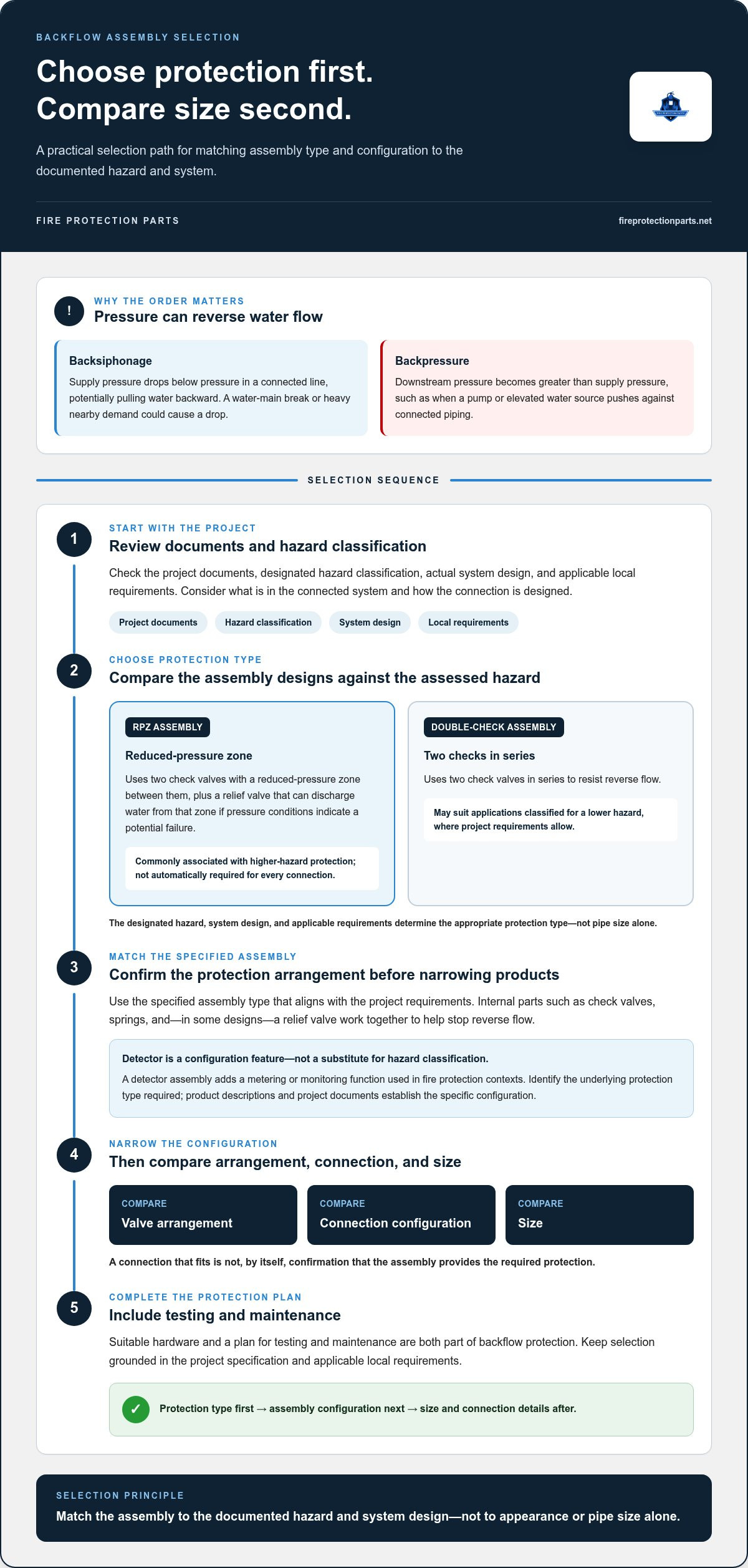
Two pressure conditions can cause reverse flow. Backsiphonage occurs when supply pressure drops below the pressure in a connected line. A water-main break or heavy nearby demand could cause a pressure drop, allowing water to be pulled backward through an unprotected connection. Backpressure occurs when pressure downstream becomes greater than the supply pressure, such as when a pump or elevated water source pushes against the connected piping.
Why potable-water protection matters in fire protection systems
A sprinkler system can connect directly to a building’s water supply, so the connection must account for possible reverse flow. System contents and project conditions matter: piping may hold stagnant water, and some systems may use additives such as antifreeze. The hazard assessment should reflect the actual system and designated classification, not a blanket assumption about all sprinkler water.
Backflow prevention protects the potable supply from reverse contamination; ordinary flow control simply directs water through a system. Match the assembly to the documented hazard and system design, then account for applicable local requirements. This keeps selection grounded in project criteria rather than pipe size or a familiar product type alone.
How Backflow Preventor Assemblies Work and Differ
Backflow assemblies create a one-way barrier using internal parts such as check valves, springs, and, in some designs, a relief valve. These components respond to flow and pressure conditions to help stop water from moving backward through the connection. Assembly types differ in their protection mechanisms and intended applications. A device that fits the pipe is not automatically suitable for the hazard.
Think of the assembly as a coordinated safeguard, not a single shutoff. Its internal components must perform as designed, and the system must use a type suited to its protection requirements. In practice, backflow preventors: safeguard your water, protect lives when the protection design matches the documented hazard and system, not just the product’s appearance.
Reduced-pressure-zone assemblies versus double-check assemblies
A reduced-pressure-zone (RPZ) assembly uses two check valves with a reduced-pressure zone between them and a relief valve. If pressure conditions indicate a potential failure, the relief valve can discharge water from that zone. This design is commonly associated with higher-hazard protection, but an RPZ is not automatically required for every connection. A double-check assembly uses two check valves in series to resist reverse flow and may suit applications classified for a lower hazard, where project requirements allow.
RPZ assembly: Uses check valves and a relief valve; commonly used for higher-hazard protection. Selection depends on the designated hazard, system design, and applicable requirements.
Double-check assembly: Uses two check valves in series; may be specified for applications with a lower assessed hazard. Confirm that this protection type matches the project requirements.
These descriptions are a comparison, not a substitute for the project specification. Hazard classification and local requirements determine the appropriate type. Nominal size and connection details come after that decision.
What detector assemblies add to the selection
A detector assembly combines a backflow protection arrangement with a metering or monitoring function used in fire protection contexts. That added function can help identify water movement through the system, while the underlying protection comes from the selected assembly type, such as reduced-pressure or double-check. The product description and project documents establish the specific configuration, so do not assume all detector assemblies share identical components.
Detector features support monitoring, but they do not replace hazard classification. Treat “detector” as a configuration feature, then identify the underlying protection type required for the system.
Where vacuum breakers fit
Vacuum breakers are a distinct category of backflow protection, not another name for an RPZ or double-check assembly. They are designed for particular system arrangements, so they should not be treated as interchangeable options. Review the connection conditions and specified protection requirements before considering this category. The appropriate choice depends on the system design and the type of reverse-flow risk addressed by the project.
Once the required assembly type is clear, compare product descriptions for application, size, materials, and connection configuration. Use the backflow preventor collection to compare assemblies by their stated types and configurations for plumbing or fire protection projects.
Compare Backflow Preventors in the Collection by Type and Configuration
Once project documents identify the required assembly type, compare products by their stated application and physical configuration. Product names can signal useful differences, but they do not establish that one assembly is better than another or suitable for every system. Check each listing against the project specification, especially for nominal size, valve arrangement, end connections, and material.
The examples below show reduced-pressure and double-check designs, including detector configurations and products described for fire protection. Use them as starting points for matching documented requirements. Backflow preventors: safeguard your water, protect lives when the selected assembly aligns with the project’s specified protection and configuration.
When an RPZ product may fit the project brief
The Wilkins RPZ Backflow Preventer Valve Assembly is identified for commercial and industrial applications. Its listed nominal sizes run from three-quarter inch through two inches. Use that range to narrow options only after the project calls for a reduced-pressure assembly. Then compare the exact size and connection configuration in the product listing with the drawings and specifications.
Another collection example is the 3-inch Reduced Pressure Backflow Preventer Valve Ductile Iron Assembly. Its name identifies a three-inch size and ductile iron construction. It is distinct from the Wilkins RPZ size range, not an automatic substitute. Confirm that the project documents specify the same assembly type and that the listed connection and other product details fit the system.
When a double-check or detector assembly is specified
For double-check options, compare the product description with the required system use rather than relying on the assembly name alone. The 350AST Double Check Backflow Preventer Valve Double Detector Assembly with OS&Y Valves identifies both a double-check protection type and a detector configuration with OS&Y valves. Review its listing for the stated application and configuration before treating it as a match.
The Series 2000SS Stainless Steel Double Check Valve Assembly is identified for fire protection systems, while the Ames 5000SS Fire System Backflow Preventer with OS&Y Valve is listed in three-, four-, and six-inch variants. These examples differ in their stated product descriptions and configurations. Compare them against the specified assembly type and system application. Do not assume that a shared “double-check” designation means their sizes, materials, or valve arrangements are interchangeable.
- Match assembly type: Confirm whether the specification calls for reduced-pressure or double-check protection, and whether a detector configuration is required.
- Match the physical details: Verify nominal size, end connections, valve arrangement, and material in the product listing.
- Match the application: Compare the product’s stated system use with the project documents and applicable local requirements.
This comparison helps narrow choices; it is not a performance ranking. Keep the project specification as your reference and verify each selected product detail before finalizing the match.
How to Choose the Right Backflow Preventor for Your Project
A reliable selection process follows project requirements in order. Start with the approved documents and designated hazard classification, then identify the specified protection type. Compare size and physical configuration only after those decisions. This sequence helps prevent a common mismatch: choosing a device that fits the pipe but does not meet the system’s protection requirements.
Five checks before comparing product listings
Use this checklist to turn project documents into clear product criteria. Keep the specification, drawings, and applicable local requirements in view as you compare options.
- Confirm the project basis. Review the project documents and record the system application and designated hazard classification. Use the specified protection type as your starting point, not a product’s size or name.
- Identify the required assembly. Note whether the documents call for a reduced-pressure, double-check, detector, or other specified assembly. Do not assume that assemblies sharing a general category are interchangeable.
- Record nominal size and connection details. Capture the specified size and end connection type. Similar sizes may have different connection configurations, so compare listing details with the plans.
- Check the valve arrangement and physical fit. Confirm whether the design specifies OS&Y valves or another arrangement, then account for available space and the intended system layout. A configuration mismatch can matter even when the assembly type and nominal size appear correct.
- Verify product-specific information. Compare the listed material, stated application, and any required listing or certification with the approved submittals. Check these details on the individual product information instead of inferring them from a broad category.
Common purchasing mistakes that can delay a project
Size alone is not a complete selection criterion. An assembly with the specified nominal size could still have the wrong protection type, end connections, valve arrangement, or material. Likewise, not every RPZ or double-check assembly is suited to every hazard classification. Match the documented requirement first, then narrow product options using configuration details.
Keep the roles of project documents, product information, and local requirements distinct. An online description helps compare stated product features, but it does not replace approved plans or determine which device local authorities require. Have the responsible project professional confirm the applicable code, authority, and testing requirements for the project location. Requirements can differ, so avoid treating a general rule as universal.
This sequence supports the goal behind backflow preventors: safeguard your water, protect lives: select hardware that aligns with the hazard, system design, and documented requirements. With your criteria in hand, compare backflow preventors for your project by assembly type, size, application, and configuration.
Source Backflow Preventors with a Clear, Compliance-Focused Next Step
A sound purchase follows a clear sequence: confirm the hazard classification, identify the assembly specified for the system, match its size and configuration, then verify the individual product details. Keep approved project documents at the center of the comparison. Product descriptions help you assess options, but they do not replace project approvals or applicable local requirements.
Selection is only part of protecting a system. Backflow assemblies contain moving mechanical components, so plan testing and maintenance under applicable rules and project procedures. Establish who is responsible for that work and how records will be managed as part of the project plan. Requirements vary by location and system, so follow the relevant authority’s requirements rather than assuming one schedule applies everywhere.
For related project context, review guidance on fire protection system repair parts and sprinkler system component sourcing. These resources help frame parts selection within the wider needs of system work.
What to prepare before placing an order
Gather the approved drawings and submittals, required assembly type, nominal size, and connection details. Keep specified materials and any required product listing or certification criteria with your comparison notes. Have the applicable jurisdictional requirements available too, so you can evaluate product information against the project’s criteria rather than a general product category.
- Project basis: Approved drawings, system application, and specified assembly type.
- Product match: Nominal size, end connections, valve arrangement, material, and stated application.
- Ongoing plan: Applicable testing and maintenance requirements, along with project procedures for completing and documenting them.
Browse backflow preventors for your application
Use collection categories and individual product descriptions to narrow assembly options by type, application, size, and configuration. Compare those details directly with approved project requirements, including connection and valve arrangements. If a detail is part of the specification, verify it in the product information before placing the order. This final check helps align the selected hardware with the design and reduce avoidable mismatches.
Backflow preventors: safeguard your water, protect lives when choices reflect the hazard and project requirements and are supported by a practical testing and maintenance plan. Browse backflow preventors to compare available products for your application.
Carry Your Water-Protection Plan Through to the Next Step
A well-chosen assembly is one part of a dependable protection plan. Keep the selection tied to approved project documents through procurement, installation planning, and ongoing care. Clear records of the specified assembly and product configuration help keep decisions consistent as project details move between teams.
Make backflow preventors: safeguard your water, protect lives more than a purchasing principle. Include the selected equipment in project documentation and maintenance planning, and align testing requirements with applicable rules and procedures. That continuity supports protection beyond the initial product choice.
Ready to compare options for your project? Browse the backflow preventor collection and use your project documents to guide selection. With a clear specification and a plan for ongoing care, you can move forward with greater confidence.
Frequently Asked Questions
What is a backflow preventor and what does it protect?
A backflow preventor is a mechanical device that helps keep water from flowing backward into a potable-water supply. It protects drinking water from possible contaminants carried through connected plumbing or fire protection piping. For example, water in a line serving equipment or a hose connection may not be suitable for drinking. The goal behind “backflow preventors: safeguard your water, protect lives” is to keep that water from reversing into the supply.
What is the difference between an RPZ and a double-check assembly?
An RPZ assembly uses two check valves and a relief valve that can discharge water if pressure conditions indicate a problem in the reduced-pressure zone. A double-check assembly relies on two check valves in series and does not have an equivalent relief-valve design. Neither type is a universal choice. The project’s hazard classification and requirements determine which protection design is appropriate for the connection.
Can a double-check assembly be used on a fire sprinkler system?
Yes, a double-check assembly can be specified for some fire sprinkler systems, but suitability depends on the system’s hazard classification and applicable project requirements. Fire protection products can differ in stated applications, valve arrangements, and configurations, so the assembly category alone is not enough to establish a match. Compare project documents with individual product details and applicable local requirements before selecting one.
How do I know what size backflow preventor I need?
Use the nominal size specified in the approved plans or submittals, then verify that the product’s connections and configuration also match. Pipe size alone does not confirm compatibility: end connections, valve arrangement, available space, and material may also affect selection. For example, two assemblies with the same nominal size may have different connection configurations. Use the project specification as your reference, not a visual estimate.
Do backflow preventors need annual testing?
Testable backflow assemblies are commonly tested annually, but the required interval and tester qualifications depend on applicable local rules. Confirm the schedule for the specific system and location rather than assuming one requirement applies everywhere. Keep test records with the system’s maintenance documents, and distinguish a performance test from routine observation or upkeep. Testing and maintenance help identify mechanical issues that may affect an assembly’s operation.
What is a double detector check assembly used for?
A double detector check assembly combines double-check backflow protection with a metering or monitoring function. It is used in fire protection contexts where that configuration is specified, helping monitor water movement through the system. The detector function does not change the assembly’s underlying protection type or determine whether double-check protection fits a project’s hazard classification. Verify the stated application and configuration in the product information and project documents.
Are backflow preventors required on fire protection systems?
Requirements depend on the jurisdiction, system design, hazard classification, and applicable project documents. Fire protection systems connected to potable water may require backflow protection, but the required assembly type and conditions are not identical everywhere. Review the approved plans and requirements set by the relevant authority for the project location. This avoids treating a general explanation as a substitute for local rules or a project-specific specification.

