



Dry Pendent Sprinkler Heads: The Complete 2026 Guide to Freeze Protection
A dry pendent sprinkler isn't just a longer version of a standard head; it's a precision-engineered thermal barrier where a single quarter-inch measurement error can lead to a catastrophic system freeze. You likely understand the high stakes of protecting cold storage or unheated areas. The fear of a burst pipe during a deep freeze isn't just about the repair cost. It's about the compromise of your entire safety infrastructure and the potential for system failure when you need it most.
This guide ensures you achieve zero-risk freeze protection by teaching you exactly how to select, measure, and maintain dry pendent sprinkler heads according to the updated 2026 standards. With the 2026 edition of NFPA 25 now requiring annual internal inspections for all dry valves, staying compliant requires more than just a visual check. We'll break down the critical "A" dimension for accurate ordering, navigate the newest fast-response mandates for older dwelling units, and clarify how these components interface with your specific system to eliminate any doubt about your facility's safety.
Key Takeaways
- Understand how the internal yoke and spring-loaded seal keep water in heated zones to prevent catastrophic pipe bursts.
- Identify the specific K-factors and response profiles necessary to meet 2026 life safety and hydraulic standards.
- Master the "A" dimension measurement to ensure your dry pendent sprinkler heads are ordered with the precise barrel length required.
- Prepare for the latest NFPA 25 mandates, including new annual internal valve inspection requirements and 10-year testing intervals.
What is a Dry Pendent Sprinkler Head and Why is it Critical?
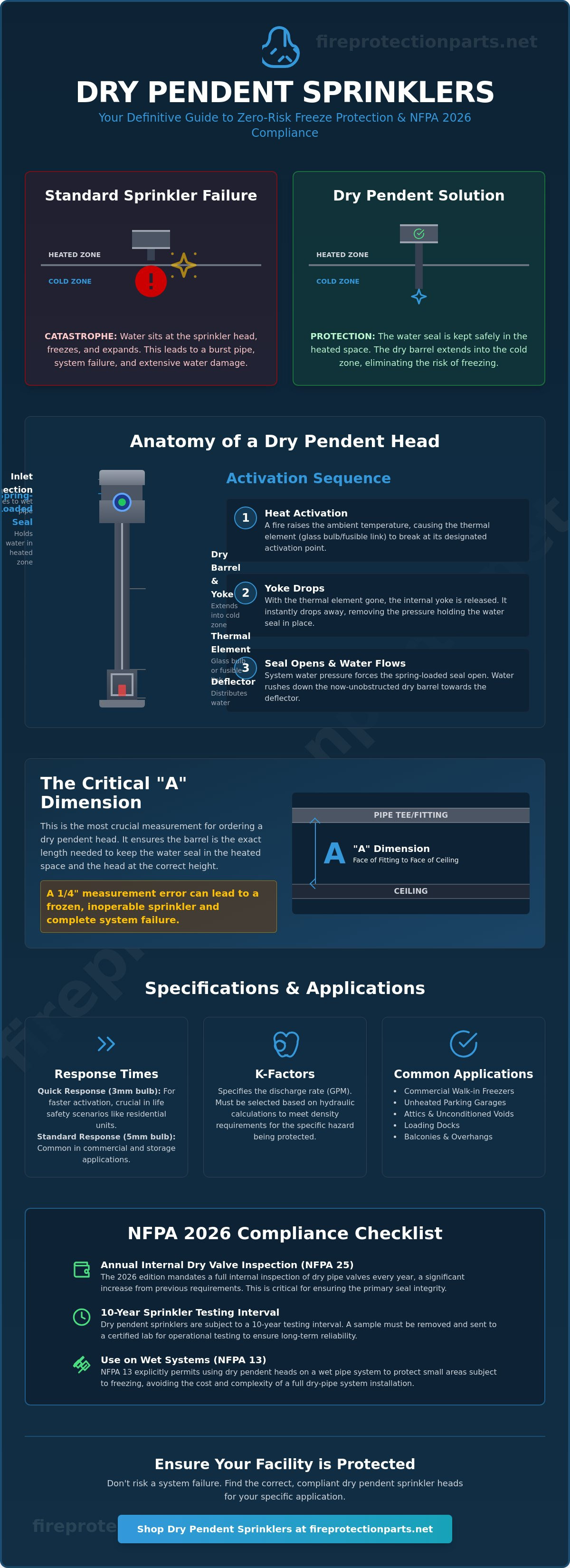
A fire sprinkler is the first line of defense against property loss, but standard equipment fails when temperatures drop below freezing. This is where dry pendent sprinkler heads become essential. Unlike a standard head that holds water directly at the orifice, a dry pendent features a specialized, integrated dry barrel. This design allows the actual water seal to remain in a heated area, while the sprinkler head itself extends into a freezing environment.
The "seal at the top" concept is the core of this technology. An internal yoke and a spring-loaded seal keep water safely tucked away in the warm piping. When a fire occurs and the thermal element activates, the internal mechanism drops away. Gravity and water pressure then push the water through the barrel to the deflector. It's a mechanical solution to a thermal problem. You'll commonly find these installed in unheated attics, parking garages, and commercial walk-in freezers where traditional wet systems would simply burst.
Dry Pendent vs. Standard Pendent: The Physical Differences
The most obvious difference is the outer barrel casing. A standard pendent is compact and lightweight. In contrast, dry pendent sprinkler heads are significantly heavier and larger because of the rigid steel or brass outer tube and the internal assembly. This extra weight is a critical factor for installation planning. You can't just swap one for the other; the piping must support the added mass of the barrel.
Standard heads fail in the cold because water sits right behind the glass bulb. When that water freezes, it expands. This expansion either creates an ice plug that prevents the system from flowing or, more likely, it ruptures the pipe or the head itself. The dry barrel eliminates this risk by keeping the "wet" portion of the system behind a thermal barrier of air or insulation.
When to Use Dry Pendents on Wet Pipe Systems
One of the most efficient ways to use these components is to protect a small cold zone within a larger heated facility. For example, a warehouse might have a massive wet pipe system, but it also contains a small commercial freezer. Rather than installing a complex dry-pipe system with air compressors and dedicated valves, you can install dry pendent heads directly onto the wet system. The barrel passes through the freezer ceiling, keeping the water in the heated warehouse space.
NFPA 13 provides specific allowances for these "small areas subject to freezing." It's a cost-effective strategy that avoids the high maintenance and installation expenses of a full dry-pipe setup. By using a dry pendent in this way, you maintain the simplicity of a wet system while ensuring zero-risk freeze protection for your most vulnerable zones.
How Dry Barrel Sprinklers Prevent System Failure
The mechanical reliability of dry pendent sprinkler heads depends on a sequence that must remain flawless over decades of dormancy. It starts at the thermal element. Whether it's a glass bulb or a fusible link, this component is the only thing holding back the internal assembly. When temperatures reach the activation point, the element shatters or melts. This allows the internal yoke to drop instantly.
The yoke is a rigid rod that extends the full length of the barrel. It applies constant pressure to a spring-loaded seal located at the very top of the head, where it connects to the water supply. Once the yoke falls, that seal is no longer held in place. Water pressure from the main line forces the seal open, allowing water to rush down the barrel. This design ensures that water only enters the freezing zone when it's needed for suppression.
For this to work, the barrel must remain free of water until the moment of activation. According to NFPA installation requirements, maintaining this dry state is what prevents internal ice plugs. If water leaks past the top seal prematurely, it will freeze in the cold zone. This creates a solid block of ice that renders the sprinkler useless during a fire. Maintaining this air-to-water seal at the pipe connection point is the most critical function of the entire assembly.
The Anatomy of a Dry Pendent Head
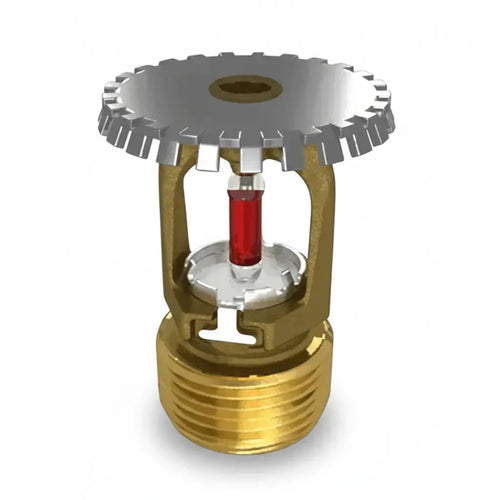
The core components are built for longevity. The glass bulb is usually 3mm for Quick Response or 5mm for Standard Response models. An outer sleeve protects the internal yoke from dust and debris that could cause mechanical binding over time. At the top, the inlet connection typically uses standard NPT threads, ensuring compatibility with your existing pipe fittings. If you're looking to replace an aging or recalled unit, you can find high-quality dry pendent sprinklers that meet current safety benchmarks.
Thermal Isolation and Condensation Management
The barrel acts as a thermal break. It stops the warmth of the wet pipe from escaping into the cold room and prevents the cold from reaching the water supply. A "Dry Sprinkler Boot" is often required at the ceiling penetration. This flexible seal stops warm, moist air from the heated space above from leaking into the cold area. Without this boot, condensation forms inside the barrel. This moisture can freeze, creating internal corrosion or ice that blocks dry pendent sprinkler heads from dropping their internal yoke properly during a fire event.
Key Specifications: K-Factors, Response Times, and Finishes
Choosing the right dry pendent sprinkler heads is a matter of hydraulic precision and code compliance. You cannot simply select a head based on its appearance. You must match the specific flow characteristics and activation speeds dictated by your system's original design. A look into the history and applications of dry sprinklers shows how these specifications evolved to meet increasingly complex fire challenges in cold environments. Every detail on the spec sheet, from the orifice size to the bulb color, represents a verified safety requirement.
Temperature ratings are color-coded for fast identification. An orange or red bulb, rated between 135°F and 155°F, is standard for most environments. However, unheated attics or areas near heat sources may require green or blue bulbs, rated for 200°F to 286°F, to prevent accidental activation. While safety is the priority, aesthetics also play a role in commercial spaces. Standard brass is common for utility areas, but chrome and white finishes provide a clean look for offices and retail ceilings. These coatings are applied by the manufacturer to ensure they don't interfere with the thermal activation of the bulb.
Standard vs. Quick Response Dry Pendents
Quick Response (QR) sprinklers use a 3mm glass bulb, while Standard Response (SR) models use a thicker 5mm bulb. The 2026 edition of NFPA 25 mandates that dwelling unit sprinklers in service for 50 years or more must be replaced with fast-response models or undergo representative testing. This shift highlights the life-safety benefits of dry pendent sprinkler heads that activate early in a fire's development. This faster response can also reduce the total water demand on the system, potentially allowing for more efficient pipe sizing.
Understanding K-Factor and Flow Requirements
The relationship between pressure and flow is mathematical. If you install a head with the wrong K-factor, you risk either under-suppressing a fire or over-taxing your water supply. Common options include 5.6 for light hazards, 8.0 for large orifice requirements, and 11.2 for high-challenge storage environments. It is vital that your replacement head matches the original fire sprinkler head identification. You should check the deflector or the frame for the Sprinkler Identification Number (SIN) to ensure an exact match before ordering parts. For facilities with high ceilings, a larger K-factor is often necessary to deliver the heavy water droplets required to penetrate a rising fire plume.
The Critical "A" Dimension: How to Measure and Install Correctly
Precision is the only acceptable standard when ordering dry pendent sprinkler heads. Unlike standard heads that you can adjust with a simple turn of a wrench, dry pendents are custom-manufactured to a specific length. This length is defined as the "A" dimension. It represents the distance from the face of the sprinkler fitting (the tee) to the finished surface of the ceiling. If this measurement is off, the entire freeze-protection strategy fails. Close enough isn't good enough; it's a recipe for a burst pipe or a non-compliant system.
The "Cold-Clearance" rule is the technical reason for this precision. The internal water seal must stay deep enough within the heated space to prevent "cold conduction." If the barrel is too short, the seal sits too close to the freezing zone. Even if the room above is heated, the metal barrel can conduct enough cold to freeze the water at the seal. This creates an ice plug that prevents the sprinkler from ever discharging. Conversely, a barrel that is too long will protrude past the ceiling, violating NFPA 13 clearance rules and ruining the architectural finish. Ensure your next project is protected by sourcing precision-measured dry pendent sprinklers from our expert-vetted inventory.
5 Steps to Measuring Your Dry Pendent Length
- Identify the fitting face: Locate the center-line of the branch line and measure from the actual face of the tee fitting where the head will thread in.
- Measure to the finished ceiling: Determine the exact distance to the bottom of the finished ceiling. If the ceiling isn't installed yet, you must account for the planned thickness of the drywall or tile.
- Account for the escutcheon: Different escutcheons have different "play." Recessed escutcheons often allow for 1/2 inch of adjustment, while sleeve-and-skirt models offer more. However, you must order based on the center of that adjustment range.
- Check manufacturer increments: Most manufacturers, such as Viking or Reliable, produce barrels in 1/4 inch or 1/2 inch increments. Always round to the nearest listed size according to the manufacturer’s specific order form.
- Verify the SIN: Cross-reference your measurement with the Sprinkler Identification Number (SIN) of the existing head if you're performing a replacement. This ensures the K-factor and response time match the physical length.
Common Installation Pitfalls to Avoid
Overtightening is the most frequent cause of mechanical damage. Because the barrel contains a long internal yoke, excessive torque can twist or crack the internal assembly. This damage isn't always visible, but it can prevent the seal from dropping when the bulb shatters. Another critical error is failing to seal the ceiling penetration. This creates a "chimney effect" where warm, moist air from the heated space leaks into the cold zone. This moisture then condenses and freezes on the sprinkler head, leading to corrosion or ice buildup that blocks the deflector.
Finally, never install dry pendent sprinkler heads into a "dead-end" pipe where water can settle and remain stagnant. Water in these dead-ends is more prone to freezing if the "A" dimension is slightly short. The 2026 edition of NFPA 25 also mandates that any missing or damaged escutcheons must be replaced with listed components from the original assembly. You cannot use generic covers; they must be verified for that specific dry head to maintain the fire rating and thermal performance.
Sourcing and Maintaining Your Dry Pendent Sprinkler System
Procuring fire protection components requires a zero-compromise approach. Sourcing from a specialized fire protection store ensures that every component meets rigorous UL/FM standards. General hardware distributors often lack the technical expertise to verify if their stock is current or part of an active recall. For instance, the 2026 edition of NFPA 25 mandates that property owners be notified in writing if recalled Star or Globe dry sprinklers are found in service. A dedicated partner helps you avoid these liabilities before they reach your ceiling.
Reliability doesn't end at the point of sale. You must maintain a sprinkler cabinet on-site with spare heads and the correct wrench. This allows for immediate replacement after a mechanical impact or a localized fire event. Without spares, your facility remains unprotected and non-compliant until a new order arrives. Safety isn't a suggestion; it's a requirement that demands constant readiness.
Buying Dry Pendent Sprinklers Online
When purchasing dry pendent sprinkler heads online, verify that the units are factory-tested and brand-new. Old stock may have degraded seals or outdated SINs that no longer match modern hydraulic designs. If your project utilizes a Viking CPVC fire sprinkler pipe system, ensure the dry pendent's inlet threads and barrel materials are compatible with CPVC adapters. This integration provides a robust solution for residential and light hazard environments where freeze protection is paramount.
Long-Term Reliability and Inspection
The 2026 edition of NFPA 25 introduces stricter oversight for dry systems, including proposed annual internal inspections for dry valves. For the heads themselves, you must perform annual visual inspections. Look for these critical signs of failure:
- Corrosion: Any green or white oxidation on the barrel or deflector suggests moisture penetration.
- Fluid Loss: A glass bulb that is partially empty or has lost its distinct color will not activate at the correct temperature.
- Ice Buildup: Frost or ice on the exterior indicates a failed ceiling seal or a leak at the top water seal.
Dry sprinklers must be tested or replaced every 10 years to verify the internal yoke and seal still function perfectly. If your system protects a high-risk cold storage area, don't wait for a failure to occur. High-impact finishes like polyester or Electroless Nickel PTFE can extend the life of dry pendent sprinkler heads in corrosive settings. Protect your facility with confidence. Browse our full selection of dry pendent sprinkler heads to find the exact specifications for your freeze-protection needs.
Secure Your Facility Against Winter Failure
Ensuring your fire protection system survives a deep freeze requires more than just high-quality hardware. It demands absolute precision in measuring the "A" dimension to maintain a functional thermal barrier. Staying ahead of the 2026 NFPA 25 inspection mandates is the only way to guarantee that your safety infrastructure won't fail when the temperature drops. A single measurement error or a neglected 10-year testing cycle can lead to catastrophic property damage and system-wide failure.
By investing in the right dry pendent sprinkler heads, you provide your facility with unwavering reliability. We carry code-compliant parts from trusted industry leaders like Viking and offer the expert support you need to verify technical specifications. Our team understands the urgency of facility maintenance. We provide fast shipping for all repairs to ensure your building never sits vulnerable to the elements. Don't leave your freeze protection to chance. Take the final step in securing your infrastructure and providing true peace of mind for your operation.
Shop Professional-Grade Dry Pendent Sprinklers
Frequently Asked Questions
Can I use a dry pendent sprinkler on a standard wet pipe system?
Yes, you can install these components on a wet system to protect localized cold zones. This is a common strategy for protecting walk-in freezers or unheated loading docks located within a larger, heated facility. The design keeps the water in the warm piping while the dry barrel extends into the freezing area, providing protection without the need for a full dry-pipe system.
What is the "A" dimension on a dry sprinkler?
The "A" dimension is the specific measurement from the face of the sprinkler fitting to the finished surface of the ceiling. This is the most critical specification for ordering dry pendent sprinkler heads because it determines the custom length of the barrel. Manufacturers use this figure to ensure the internal water seal remains safely positioned within the heated space to prevent freezing.
How often do dry pendent sprinkler heads need to be replaced?
NFPA 25 requires that dry sprinklers be replaced or laboratory tested every 10 years to ensure the internal seals haven't degraded. Additionally, the 2026 edition of NFPA 25 mandates that dwelling unit sprinklers in service for 50 years or more must be replaced with fast-response models. You should also replace any head immediately if it shows signs of corrosion, mechanical damage, or fluid loss in the glass bulb.
Are dry pendent sprinklers available in different K-factors?
Yes, these heads are available in a variety of K-factors, including 5.6, 8.0, and 11.2, to meet different hydraulic design requirements. While the 5.6 K-factor is standard for light hazard areas, larger orifice options like the 11.2 K-factor are used for high-challenge storage environments. Always verify the Sprinkler Identification Number (SIN) to ensure the replacement part matches the original flow specifications.
Do dry pendent sprinklers require a special escutcheon?
Yes, you must use the specific escutcheon assembly that the manufacturer listed for that particular head. The 2026 edition of NFPA 25 requires that missing or damaged escutcheons for recessed, flush, and concealed sprinklers be replaced with components from the original assembly. Using generic covers is a code violation and can prevent the sprinkler from activating correctly during a fire.
What happens if I install a dry pendent with the wrong barrel length?
Installing the wrong barrel length creates a serious risk of system failure or non-compliance. If the barrel is too short, the internal seal sits too close to the freezing zone, which can lead to ice plugs that block water flow. If the barrel is too long, the head will protrude too far from the ceiling, potentially violating NFPA 13 clearance rules and disrupting the intended spray pattern.
Can dry pendent heads be installed horizontally?
No, standard dry pendent sprinkler heads are engineered only for vertical installation in the downward position. The internal yoke and seal mechanism rely on this orientation to function correctly during activation. If your application requires a horizontal discharge in a freezing environment, you must specifically source a dry sidewall sprinkler designed and listed for that purpose.
Why is there a boot or seal required around the dry pendent barrel?
The boot or seal prevents warm, moist air from the heated space from leaking into the cold area through the ceiling opening. Without this barrier, condensation will form and freeze on the cold barrel surface. This ice buildup can cause external corrosion or, more dangerously, it can migrate into the internal mechanism and prevent the sprinkler from releasing water when the thermal element shatters.

