



Fire Riser Room Essentials: A Comprehensive Compliance Checklist for 2026
Your fire riser room is far more than just a storage space for pipes and valves; it is the active nerve center of your building's entire life safety system. You likely understand the pressure of keeping this critical area compliant, especially when local fire marshal requirements seem to shift with every new code cycle. Failing an inspection because of a missing component or an outdated maintenance log isn't just an administrative setback. It's a risk to your property and its occupants that you simply can't afford to take.
We're here to help you eliminate that doubt through professional assurance and technical expertise. This guide provides a comprehensive checklist to help you master the design, hardware requirements, and maintenance protocols for your fire riser room in 2026. We will examine the latest NFPA 14 and 25 standards alongside local code trends to ensure your facility remains a model of safety. From sourcing code-compliant hardware to understanding specific access dimensions, you'll gain the clarity needed for total system reliability and peace of mind.
Key Takeaways
- Understand how the fire riser room serves as the nerve center for your building's fire suppression, linking municipal water to your sprinkler network.
- Master the 2026 design standards, including the "9 square feet per valve" rule and essential space planning for NFPA 13 compliance.
- Identify the critical UL-listed hardware needed for system integrity, including backflow preventors and specialized air compressors for sprinkler systems.
- Differentiate between routine visual inspections and professional testing to ensure your system remains operationally ready for any emergency.
- Learn why sourcing specialized components like PTR Electric Deluge valves ensures long-term reliability over generic hardware store alternatives.
Understanding the Fire Riser Room: The Nerve Center of Building Safety
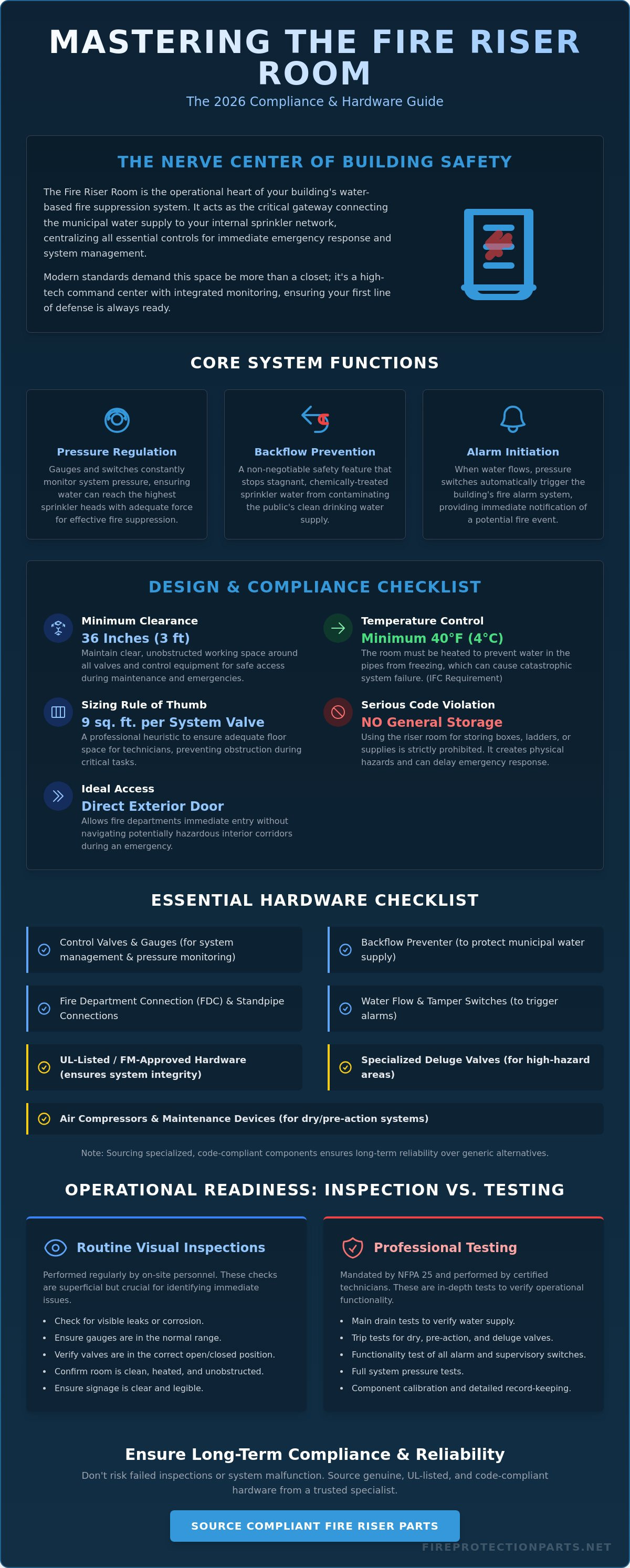
The fire riser room is the operational heart of any water-based fire suppression system. It serves as the primary gateway where the municipal water supply enters the building and transitions into a life-saving network. This isn't just a utility closet; it's a high-stakes command center designed to protect lives and property. By centralizing valves, gauges, and controls, the room allows for precise management of water flow during an emergency. Safety starts with a clear understanding of how this space functions as the building's first line of defense.
In 2026, the definition of a compliant fire riser room has expanded to meet higher technical standards. We're seeing a rapid shift toward integrated smart monitoring systems. Modern rooms now incorporate sensors that provide real-time pressure data and immediate tamper alerts. This evolution moves the industry from reactive maintenance to proactive protection. It ensures that when a fire occurs, the system's response is both immediate and verified. A dedicated, well-organized space is no longer a luxury. It's a code-mandated necessity for any commercial or multi-family residential structure.
Primary Functions of the Riser Room
- Pressure Regulation: Gauges and switches monitor the system to ensure adequate force is available to reach the highest sprinkler heads. Consistent pressure is vital for system reliability.
- Backflow Prevention: This is a non-negotiable safety feature. It stops stagnant or chemically treated sprinkler water from siphoning back into the city's clean drinking supply.
- Alarm Initiation: When water begins to flow through the pipes, pressure switches trigger the building's fire alarm. This hub is often integrated with a Standpipe (firefighting) system, providing essential hose connections for manual firefighting efforts.
Who Accesses the Riser Room?
Accessibility is a core requirement of the International Fire Code. Fire department personnel need immediate entry during a crisis to manage water flow or shut down the system after a fire is suppressed. Seconds matter, so clear signage and unobstructed access are mandatory. Beyond emergencies, certified fire inspectors visit for mandated testing. They verify that every component, from the pressure gauge to the alarm switch, functions under stress. Finally, maintenance contractors use this space for critical hardware upgrades. Whether they're installing new seismic bracing or replacing a deluge valve, they need a workspace that meets modern code requirements for clearance and lighting.
Compliance and Code Requirements for Fire Riser Room Design
Design compliance is the foundation of system reliability. While NFPA 13 provides the national framework for installation, the 2021 International Fire Code 901.4.7 sets the baseline for sizing and accessibility. Ignoring these standards leads to failed inspections and costly retrofits. In 2026, many jurisdictions are moving toward even more prescriptive requirements. For instance, the Sacramento Metropolitan Fire District now mandates that new commercial fire control rooms have a minimum dimension of 5 feet and at least 35 square feet of usable area. Professional designers often utilize the "9 square feet per system valve" rule of thumb. This heuristic ensures enough floor space for technicians to perform complex maintenance tasks without physical obstruction.
Space and Access Standards
Clearance is a matter of safety and functionality. A fire riser room must provide at least 36 inches of clear working space around all valves and control equipment. Access doors should ideally open directly to the building exterior. This configuration allows the fire department to enter the room immediately without navigating through smoke-filled interior hallways. If interior access is the only option, the path must be clearly marked and completely unobstructed. You must never use this room for general storage. Stacking boxes, ladders, or cleaning supplies near valves is a serious code violation. It creates a physical hazard that can delay emergency response by several critical minutes.
Environmental Controls and Safety
Protecting the hardware from environmental stress is a core requirement of the International Building Code. The IFC requires these rooms to maintain a minimum temperature of 40°F (4°C) at all times. If the temperature drops below freezing, you risk pipe bursts and total system failure. Permanent lighting is another non-negotiable requirement. Technicians and responders can't rely on handheld flashlights during a crisis. You must also install emergency lighting to provide visibility if the building loses primary power. This ensures the nerve center remains functional even in the worst-case scenario.
Clear communication saves lives during a high-stress event. Every fire riser room needs permanent, high-contrast signage on the entry door for rapid identification. Inside the room, every major component must be clearly labeled with durable tags. Use standardized signage for the "Main Control Valve," "Drain," and "Test Valve" to eliminate confusion. If your room is missing these critical identifiers or needs hardware updates, you can find code-compliant fire protection signage and parts to bring your facility into full compliance. Verification of these granular details ensures your system remains compliant and ready for action.
The Essential Hardware Checklist: Core Riser Components
Hardware quality is the non-negotiable foundation of building protection. Every piece of equipment within your fire riser room must meet rigorous industry standards to ensure it performs under extreme conditions. There's no room for compromise here. You must prioritize components that are UL-listed and FM-approved. These certifications provide the professional assurance that your system will function exactly as designed when every second counts. Using inferior, non-certified parts isn't just a code violation; it's a gamble with your facility's safety.
A reliable system requires a methodical approach to sourcing. High-impact components like backflow preventors and seismic bracing form the structural backbone of the riser. When you're replacing worn hardware or outfitting a new build, you need a partner that understands these technical demands. Sourcing from specialized retailers ensures you receive parts engineered for longevity and total adherence to 2026 standards.
Control Valves and Backflow Preventers
The os&y valve serves as the visual guardian of your suppression system. Because the stem moves out of the handle when the valve is open, inspectors can verify the water supply status at a glance. It's the primary shut-off point for the entire building. Beyond the OS&Y, all fire protection control valves must be electronically supervised. If a valve is accidentally closed, your monitoring panel should receive an immediate tamper signal. This layer of protection prevents human error from disabling your fire defense.
Backflow preventors are equally critical for environmental safety. These assemblies prevent stagnant, pressurized sprinkler water from entering the municipal drinking supply. Without a functioning backflow preventor, your building risks contaminating the public water system. These heavy-duty units require regular verification to ensure the internal check valves remain seated and functional under pressure.
Monitoring and Initiation Hardware
Precision monitoring turns a passive pipe network into an active response system. Water flow switches detect movement within the pipes, while pressure switches monitor for drops that indicate a sprinkler head has deployed. In high-hazard environments, electric deluge valve fire suppression systems provide the rapid response needed to control intense fires. These systems rely on PTR Electric Deluge VXD technology to flood a protected area instantly upon detection. This level of automation is essential for specialized industrial or chemical storage zones.
Don't overlook the importance of accurate pressure gauges. You need to distinguish between the incoming supply pressure and the internal system pressure at all times. For dry systems, maintaining the correct air-to-water ratio is vital. Reliable air compressors for sprinkler systems ensure that dry pipes remain pressurized with air, preventing water from entering until a fire is detected. Supporting these components with ASC seismic bracing ensures the entire fire riser room remains intact during a tectonic event, maintaining system integrity when it's needed most.
Operational Readiness: A Maintenance and Inspection Checklist
Operational readiness is a continuous commitment to building safety. It's not enough to build a compliant fire riser room; you must maintain it with disciplined precision. A perfectly designed system provides zero protection if a valve is seized or a switch fails during a crisis. You must distinguish between the simple visual checks performed by facility staff and the technical testing required from certified professionals. This clarity eliminates doubt and ensures your suppression system remains a reliable shield for your property.
Older systems often face unique challenges that require extra vigilance. Internal pipe corrosion and mineral buildup can restrict water flow over time without showing external symptoms. In regions with harsh winters, failing to maintain the 40°F minimum temperature remains a leading cause of catastrophic pipe bursts. Documentation is your primary defense against liability. A permanent, updated inspection log proves your adherence to the latest NFPA 25 standards and provides a clear roadmap for necessary hardware upgrades. Verification is the only path to total system reliability.
Weekly and Monthly Visual Tasks
Routine visual inspections are the first line of defense against system failure. These tasks don't require specialized tools, but they do require a no-nonsense approach to facility management. Every month, you should verify the following:
- Valve Positioning: Ensure all control valves are in their correct positions. A closed main valve renders the entire system useless.
- Environmental Stability: Check that the room temperature stays above 40°F. Frozen pipes are an avoidable disaster.
- Clearance and Access: Confirm the room is free of debris, storage boxes, or equipment. Technicians need immediate, unobstructed access to every component.
- Gauge Integrity: Look for physical damage or leaking fluid in system gauges.
Annual Professional Testing
Technical testing goes beyond what the eye can see. Once a year, a certified professional must perform a deep-dive analysis of the hardware's mechanical performance. This includes main drain testing to verify that the municipal water supply still provides the required pressure for your building's height and occupancy type. Technicians will also perform functional testing on tamper switches and flow switches to ensure the alarm system communicates correctly with the fire department.
Calibration is another critical aspect of annual maintenance. Over time, pressure gauges can drift, providing inaccurate data that masks underlying system issues. Professionals will calibrate or replace these units to maintain data integrity. If your inspection reveals worn components or outdated hardware, don't wait for a failed inspection to take action. You can find everything from replacement gauges to specialized fire riser maintenance parts to keep your system in peak operational condition. Proactive replacement is always more cost-effective than emergency repairs.
Sourcing Reliable Fire Riser Parts for Long-Term Compliance
Your fire riser room is only as strong as its weakest component. Sourcing hardware from a general big-box store is a gamble that professional facility managers don't take. These outlets rarely carry the UL-listed and FM-approved equipment required for life-safety systems. Specialized fire protection retailers provide the professional assurance that every fitting and valve is engineered for high-pressure applications. When you choose established brands like Viking or ASC, you're investing in verified reliability. This commitment to quality eliminates the doubt that often accompanies complex safety inspections.
Standardization is a strategic advantage for any building owner. When your system utilizes consistent, high-quality hardware, future repairs become significantly more manageable. You won't have to hunt for obscure fittings or worry about compatibility issues between different manufacturers. A standardized approach ensures that maintenance contractors can work quickly and efficiently, reducing the downtime of your fire suppression system. It’s about making the right choice now to ensure long-term performance and ease of operation.
Why Quality Components Prevent System Failure
Using "budget" valves or uncertified components in a life-safety system is a dangerous compromise. These parts are more likely to leak, seize, or fail under the mechanical stress of a fire event. High-quality fire protection parts online offer the durability needed to withstand decades of pressurized dormancy. Every replacement part must meet current NFPA 13 and local code requirements to remain compliant. Verification of these standards during the procurement process ensures that your system functions exactly as designed when every second counts. Don't risk your facility's safety on unverified hardware.
Procurement for Facility Managers and Contractors
Efficiency is vital when managing a large facility. Sourcing your components from a single, specialized provider simplifies the supply chain and reduces administrative overhead. Whether you need ASC Seismic Bracing to meet new 2026 requirements or Viking Plastics CPVC Pipe for Fire Protection, a mission-driven partner can provide everything in one place. You can use technical identification guides to find exact matches for legacy hardware, ensuring that new parts integrate seamlessly with your existing fire riser room setup.
Expert support is a critical part of the procurement path. Selecting the right air compressors for sprinkler systems or the correct backflow preventors requires technical knowledge that general vendors don't possess. A dedicated fire protection partner acts as a dependable guide, helping you navigate complex safety requirements with confidence. This professional assistance ensures you make a compliant choice the first time, protecting your budget and your building's occupants. By focusing on quality and expert verification, you turn a complex procurement task into a manageable process that guarantees long-term safety.
Securing Your Building's Future with Compliance Excellence
Maintaining a compliant fire riser room is a continuous commitment to excellence and safety. By adhering to the latest 2026 design standards and prioritizing UL-listed and FM-approved hardware, you eliminate the risks associated with failed inspections and catastrophic system malfunctions. Consistent maintenance and documented inspections ensure that your property remains protected and ready for any emergency event. We understand that sourcing specialized components requires technical precision and professional trust.
Our team is here to provide expert-led sourcing for contractors and facility managers, offering fast shipping on critical suppression parts to keep your projects on schedule. Don't leave your building's safety to chance with unverified hardware. Browse Code-Compliant Fire Riser Components at Fire Protection Parts today to secure the high-quality hardware your system requires. You've taken the first step toward total system reliability; now let's work together to ensure your facility remains a model of professional safety and compliance.
Frequently Asked Questions
What is the minimum size for a fire riser room?
The minimum size depends on local jurisdiction, but a common rule of thumb is providing at least 9 square feet of working space around each system valve. This ensures technicians have enough room for critical maintenance and hardware repairs. Specific areas like Sacramento now require 35 square feet for new commercial buildings. Always verify dimensional requirements with your local fire marshal to ensure total compliance.
Does a fire riser room need to be fire-rated?
Most building codes require these rooms to have a specific fire-resistance rating, typically 1-hour or 2-hour. The exact requirement depends on your building's construction type and whether the room houses a fire pump. This rating protects the nerve center of your suppression system from external fire threats. Maintaining this barrier is essential for system reliability during a high-heat event.
Can I store building maintenance supplies in the fire riser room?
You cannot store building maintenance supplies, boxes, or equipment in the fire riser room. NFPA standards and local fire codes strictly prohibit using this space for storage to ensure emergency responders have immediate, unobstructed access. Keeping the room clear eliminates physical hazards that could delay a crisis response. A dedicated, empty space is a non-negotiable requirement for passing your annual fire inspection.
Is a floor drain required in a fire riser room?
A floor drain is an essential requirement for any compliant fire riser room. It manages water discharge during mandatory system testing, such as the main drain test, and handles potential leaks from pressurized components. Without proper drainage, testing becomes a flood risk that can damage the building’s infrastructure. Ensure your drain is clear and functional to support ongoing operational readiness.
What temperature should a fire riser room be maintained at?
You must maintain a minimum temperature of 40°F (4.4°C) in the room at all times. This heating requirement prevents water-filled pipes from freezing and bursting during the winter months. A pipe burst in the riser room can disable your entire suppression system and cause extensive water damage. Reliable environmental controls are a critical component of long-term system integrity and peace of mind.
Who is authorized to enter and work in the fire riser room?
Only qualified personnel are authorized to enter and work in the room. This includes certified fire sprinkler contractors, building engineers, and fire department officials. Restricting access prevents accidental tampering with control valves or monitoring switches. It’s a best practice to keep the room locked and maintain a strict log of every professional who performs inspections or hardware repairs.

