



Seismic Bracing for Fire Sprinklers: 2026 Compliance Guide
Did you know that over half of all building-related monetary losses following an earthquake result from non-structural system failures like ruptured fire lines? Most contractors and facility managers feel the mounting pressure of shifting safety codes. It's frustrating to juggle the specific demands of ASCE 7-22 while ensuring your seismic bracing for fire sprinkler systems meets the strict criteria of NFPA 13. When you add the unique expansion and support needs of CPVC into the mix, the risk of a compliance error or a physical pipe failure becomes a significant concern.
This 2026 compliance guide simplifies those complexities. You'll learn how to navigate the current regulatory landscape and identify the exact ASC hardware required to keep your suppression systems secure in high-risk zones. We'll break down the critical differences between lateral and longitudinal bracing, explain the updated rules for pipe ends and turns, and show you how to source code-compliant components for your next project. Protecting your building starts with making a choice that leaves no room for doubt. It's about ensuring your fire protection remains functional when it's needed most.
Key Takeaways
- Learn the core objectives of NFPA 13 and how to maintain system functionality after a significant seismic event.
- Understand how ASCE 7 Seismic Design Categories and horizontal force factors dictate the specific bracing requirements for your building.
- Identify the material-specific challenges of bracing Viking Plastics CPVC to avoid environmental stress cracking and structural failure.
- Discover the essential ASC hardware components, from sway braces to all-thread rods, needed for a complete seismic bracing for fire sprinkler systems.
- Simplify your procurement process by learning how to build a fully compliant seismic kit using professional sourcing guides.
Seismic Bracing Fundamentals & NFPA 13 Compliance
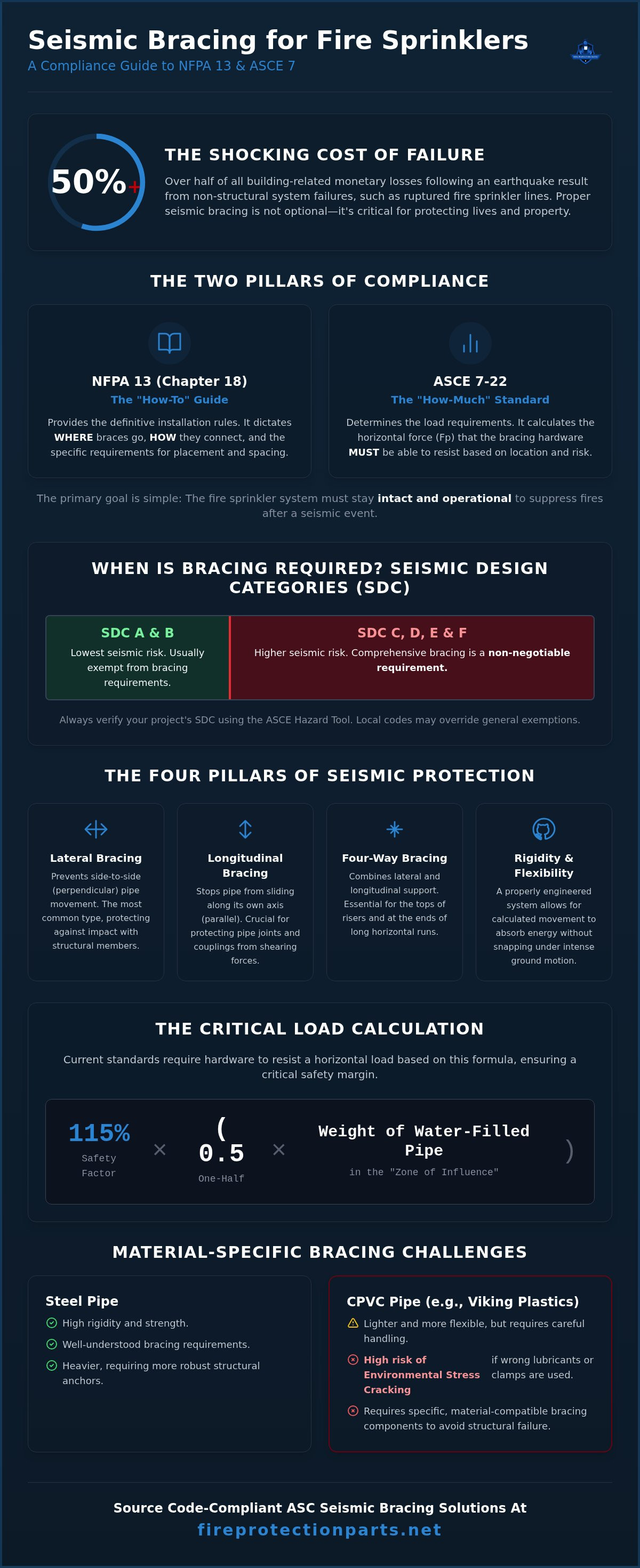
Seismic bracing for fire sprinkler systems isn't just about adding extra hangers. It is an engineered network of supports designed to prevent differential movement between the piping and the building structure. When an earthquake strikes, the building moves at a different frequency than the water-filled pipes. Without proper bracing, this mismatch leads to sheared fittings and catastrophic leaks. The primary goal is simple: the fire sprinkler system must stay intact and operational to suppress potential fires following the event.
NFPA 13, Chapter 18, serves as the definitive standard for these installations. It dictates where braces go and how they connect. While NFPA 13 provides the installation rules, ASCE 7 determines the load requirements. This standard calculates the horizontal force factors that your hardware must resist based on the building's location and occupancy type. Current calculations for braces are based on 115% of one-half the weight of the water-filled piping. This represents a significant increase from previous standards and requires more robust hardware selection.
The Four Pillars of Seismic Protection
Effective seismic protection relies on four distinct strategies. Lateral bracing prevents side-to-side movement, which is the most common cause of impact damage against structural members. Longitudinal bracing stops the pipe from sliding along its own axis, protecting joints and couplings. For the tops of risers and long horizontal runs, four-way bracing is essential to provide stability in all directions. True safety requires a balance between rigidity and flexibility. If a system is too "stiff," it cannot absorb energy. It will snap under the intense pressure of ground motion. Modern engineering favors components that allow for calculated movement while keeping the system anchored.
When is Seismic Bracing Required?
Requirements depend heavily on the Seismic Design Category (SDC), ranging from A to F. Buildings in SDC C, D, E, or F almost always require comprehensive seismic bracing for fire sprinkler systems. However, exemptions do exist for specific scenarios. For instance, small-diameter pipes often don't require bracing if they are installed in a way that limits their movement naturally.
The "12-inch rule" is a critical factor for contractors. If the distance from the structural attachment to the center of the pipe is 12 inches or less, the hanger itself may provide enough lateral restraint to meet code. This exemption applies to individual hangers and trapeze supports, but it requires precise measurement. Always verify your SDC before skipping hardware; a mistake here can lead to a failed inspection or, worse, a failed system.
Determining Seismic Design Requirements (ASCE 7)
Safety compliance begins long before a single brace is clamped to a pipe. While NFPA 13 provides the installation roadmap, ASCE 7 serves as the foundation for the engineering math. The Engineer of Record (EOR) is responsible for providing the seismic parameters for a project, but procurement specialists and contractors must understand these requirements to avoid costly rework. It's common for local building codes to override general exemptions, especially in regions with updated geological surveys. Understanding the horizontal force factor (Fp) is the only way to guarantee the hardware you install will hold during a tremor.
Seismic Design Categories (SDC) Explained
Every building is assigned a Seismic Design Category (SDC) ranging from A to F. Categories A and B represent the lowest risk and are usually exempt from seismic bracing. However, once a project moves into SDC C, D, E, or F, seismic bracing for fire sprinkler systems becomes a non-negotiable requirement. You can determine the SDC for a specific project site using the ASCE Hazard Tool. This tool provides site-specific data that dictates whether you need standard support or an engineered seismic solution. Never guess the SDC; a single-letter difference can change the entire scope of NFPA 13 seismic requirements for your facility.
Calculating Force Distribution
Calculating the load on a brace requires understanding the "Zone of Influence." This is the specific length of piping that a single brace must stabilize. You must calculate the total weight of the water-filled pipe within this zone to determine the stress on the hardware. Current standards require the horizontal load calculation to be based on 115% of one-half the weight of the water-filled piping. This ensures a safety margin that prevents hardware failure during peak ground acceleration. The Fp force factor is the primary metric for selecting brace load ratings. It simplifies the complex physics of an earthquake into a single number that helps you choose the right ASC seismic bracing for the job. If you're managing a complex layout, using a professional sourcing guide ensures your components meet these calculated force demands without compromise.
Key Components: Sway Braces, Pipe Clamps, and All-Thread Rod
A compliant system is only as strong as its weakest connection. Building a reliable network of seismic bracing for fire sprinkler systems requires a coordinated assembly of hardware that works in unison to resist massive horizontal forces. The structural attachment serves as the anchor point, connecting the brace to the building's primary structure. This component must be robust enough to handle the full load transferred from the piping during an earthquake. If this connection fails, the entire bracing strategy is compromised.
The bracing pipe acts as the rigid member that spans the gap between the building and the fire line. Most installers use Schedule 40 steel pipe for this member because it provides the necessary rigidity to prevent buckling under pressure. The pipe attachment clamp then grips the sprinkler line, transferring the seismic energy into the brace. For vertical stability, using high-quality all thread rod is mandatory. These rods maintain system alignment and provide the tensile strength needed to keep the suppression system suspended while the building is in motion.
Lateral and Longitudinal Sway Braces
Lateral and longitudinal loads place different stresses on a pipe, requiring specialized clamp designs. Lateral braces focus on side-to-side stability, while longitudinal braces prevent the pipe from shifting along its axis. ASC Engineered Solutions offers hardware engineered for these specific multi-directional forces. It is critical to match your hardware's load rating to the calculated horizontal force factor (Fp) for your project. Using an undersized brace creates a point of failure that can lead to system rupture when the ground starts to move.
Structural Attachments and Fasteners
The choice of fastener depends entirely on the mounting surface. Concrete anchors must be listed for cracked concrete applications to comply with modern safety standards. Steel beam attachments require heavy-duty clamps that won't slip or vibrate loose. Standard hangers are designed for gravity loads only. They are never an acceptable substitute for dedicated seismic bracing hardware. To ensure a perfect installation, many ASC components utilize torque-off bolts. These provide a visual confirmation that the fastener has reached the correct tension, giving you peace of mind that the system is secure and ready for inspection.
CPVC vs. Steel: Material-Specific Bracing Challenges
IPS steel pipe is the traditional benchmark for rigidity. It resists bending, but its weight adds significant mass to the seismic load. In contrast, Viking Plastics CPVC is lightweight and flexible. This flexibility allows the pipe to absorb some energy, but it requires a specialized approach to seismic bracing for fire sprinkler systems. If you treat CPVC like steel, you risk creating stress points that lead to system failure. Safety is non-negotiable. You must account for the specific physical properties of the material to ensure long-term reliability.
Avoiding Environmental Stress Cracking (ESC)
Environmental Stress Cracking (ESC) is a primary threat when mixing metal hardware with thermoplastic piping. Many standard steel braces are coated in cutting oils or rust inhibitors that are chemically incompatible with CPVC. These chemicals can migrate into the pipe wall, causing it to become brittle and eventually shatter under pressure. Using specialized Viking Plastics CPVC pipe for fire protection requires hardware that is verified as plastic-safe. This usually means using braces with specific powder coatings or liners that prevent direct chemical contact. Never assume a standard clamp is safe for a CPVC line.
Managing Flex and Thermal Movement
CPVC moves differently. It expands and contracts significantly more than steel as temperatures fluctuate. A seismic brace that is clamped too tightly acts as a fixed point, preventing the pipe from sliding. This restriction forces the stress into the nearest elbow or tee, often resulting in a snapped joint. Bracing must allow for longitudinal expansion without stressing these joints. Over-tightening a seismic clamp on CPVC doesn't just restrict movement; it creates a localized stress concentration. This can lead to catastrophic failure during a surge or a tremor.
Managing flex requires a balance. While steel systems rely on flexible couplings to handle movement, CPVC systems use the inherent flexibility of the material itself. However, this movement must be controlled. Your seismic restraints must be spaced to allow for natural expansion while preventing the lateral whipping motion that occurs during ground acceleration. Surge protection is also necessary to prevent the water hammer effect from driving the pipe into structural members. Ensure your project remains compliant by selecting ASC seismic bracing for CPVC systems today.
Sourcing Code-Compliant ASC Seismic Bracing Solutions
Procurement of seismic bracing for fire sprinkler systems is a critical step that requires technical precision. ASC Engineered Solutions stands as the industry leader, providing components that meet the rigorous demands of modern safety codes. When you are responsible for the integrity of a life-safety system, you can't afford to wait on multiple vendors or settle for unlisted hardware. Streamlining your workflow means sourcing your all-thread, braces, and fire protection parts online from a single, dependable partner. This approach eliminates the risk of component mismatch and ensures every piece of the assembly is designed to work together under extreme stress.
Verification is the cornerstone of professional installation. Every piece of seismic hardware must carry a UL Listing or FM Approval to be accepted by the Authority Having Jurisdiction (AHJ). These certifications prove the hardware has undergone rigorous testing to confirm it can withstand the calculated horizontal force factors. To build a complete, compliant kit, you can follow a sprinkler system components online guide. These resources help you identify exactly which clamps, rods, and anchors are required for your specific Seismic Design Category, removing the guesswork from complex orders.
Why Professionals Choose ASC Bracing
ASC hardware is engineered for the reality of the job site. It features a "no-guess" installation process, often utilizing torque-off bolts that provide a visual indicator of proper tension. This feature alone significantly reduces inspection failures and installation time. These braces are uniquely compatible with both traditional steel and modern Viking Plastics CPVC systems, offering a versatile solution for any project. ASC also provides comprehensive load data. This transparency simplifies the Engineer of Record (EOR) approval process, as the performance specs are readily available and verified.
Procurement Checklist for Seismic Zones
- Verify the Seismic Design Category (SDC) provided by the EOR before placing an order.
- Confirm the pipe material (IPS Steel vs. Viking Plastics CPVC) to ensure clamp compatibility and prevent chemical damage.
- Match structural attachments to the building material, such as concrete anchors for masonry or beam clamps for steel.
- Ensure all thread rod diameters and bracing pipe schedules meet the minimum requirements for the calculated load zones.
Selecting the right vendor is as important as selecting the right hardware. A reliable partner ensures your inventory is ready when the project demands it. You can shop ASC Seismic Bracing and Fire Protection Parts here to guarantee your system meets 2026 compliance standards without compromise.
Securing Your System for the Long Term
Achieving full compliance with NFPA 13 and ASCE 7 is about more than just passing a final inspection. It is about ensuring life safety and operational continuity when the ground begins to move. You now have the knowledge to navigate Seismic Design Categories and the technical foresight to choose seismic bracing for fire sprinkler systems that respects the unique physical properties of Viking Plastics CPVC. By selecting components that match your project's calculated horizontal force factors, you eliminate the dangerous guesswork that leads to catastrophic pipe failure.
As an authorized retailer of ASC Engineered Solutions, Fire Protection Parts offers the professional assurance you need for high-risk zones. We specialize in providing the exact sway braces, specialized clamps, and all-thread rods required for 2026 standards. Our team provides expert technical support to help you source the right components for both traditional steel and modern thermoplastic systems. Don't leave your building's protection to chance. Browse Code-Compliant ASC Seismic Bracing Hardware to secure your project today. You can move forward with the confidence that your installation is built to last and ready for any challenge.
Frequently Asked Questions
When is seismic bracing required for fire sprinkler systems?
Seismic bracing for fire sprinkler systems is mandatory for any project classified under Seismic Design Categories C, D, E, or F. These designations are determined by the building's location, soil type, and occupancy importance. While categories A and B are generally exempt, it's vital to verify local building codes. In high-risk zones, bracing is essential to prevent pipes from impacting structural members or shearing during an earthquake. Always consult your Engineer of Record for site-specific requirements.
What is the difference between lateral and longitudinal seismic bracing?
Lateral bracing prevents the pipe from moving side-to-side, which is the most common cause of impact damage during a tremor. Longitudinal bracing stops the pipe from shifting along its own axis, protecting joints and elbows from pulling apart. A compliant system requires both types of restraints at specific intervals to ensure stability in all horizontal directions. ASC Engineered Solutions provides specialized clamps designed to handle the unique stresses associated with both lateral and longitudinal force loads.
Can I use standard pipe hangers for seismic restraint?
Standard pipe hangers are designed only to support the vertical weight of the water-filled pipe and aren't a substitute for seismic hardware. They lack the rigidity and load ratings required to resist horizontal forces. NFPA 13 requires dedicated seismic bracing components that are UL Listed or FM Approved for seismic applications. Using standard hangers in place of listed sway braces will result in inspection failure and creates a significant risk of system collapse during a seismic event.
Is seismic bracing required for CPVC fire sprinkler systems?
Yes, seismic bracing for fire sprinkler systems is required for CPVC installations in high-risk categories, but the hardware must be listed for thermoplastic use. Viking Plastics CPVC is more flexible than steel, requiring specialized supports that prevent localized stress. You must also ensure the bracing components are chemically compatible with the pipe. Using non-compatible hardware can lead to environmental stress cracking, which compromises the integrity of the fire suppression system during an earthquake.
What is a Seismic Design Category (SDC) and how do I find mine?
A Seismic Design Category (SDC) is a classification from A to F that represents the expected severity of ground motion at a specific building site. It accounts for ground acceleration, soil properties, and the building's occupancy type. You can find your project's SDC by using the ASCE Hazard Tool or by reviewing the structural documents provided by the Engineer of Record. Knowing your SDC is the first step in determining the necessary load ratings for your hardware.
Are there any exemptions for seismic bracing in NFPA 13?
NFPA 13 provides several exemptions, the most common being the "12-inch rule." If the distance from the structural attachment to the center of the pipe is 12 inches or less, the hanger may provide enough lateral restraint. Additionally, small-diameter pipes in specific low-risk occupancy types may be exempt. However, these exemptions are highly technical and depend on the Seismic Design Category. Don't assume an exemption applies without verifying the current NFPA 13 standards for your project.
What is Environmental Stress Cracking (ESC) in CPVC seismic applications?
Environmental Stress Cracking (ESC) is a localized failure in CPVC caused by exposure to incompatible chemicals, such as certain oils or coatings on metal braces. These substances migrate into the pipe material, making it brittle and prone to shattering under pressure. To prevent this, professionals use specialized Viking Plastics CPVC pipe for fire protection with ASC hardware verified as plastic-safe. This ensures the system remains flexible and durable without the risk of chemical degradation over time.
How far apart should seismic braces be spaced on a sprinkler line?
Spacing is determined by the calculated capacity of the bracing components rather than a fixed distance. While the industry once relied on 40-foot and 80-foot intervals, NFPA 13 now requires calculations based on the "Zone of Influence" and the horizontal force factor. You must account for the pipe's diameter and the weight of the water it carries. Always consult the load tables provided by ASC Engineered Solutions to ensure your brace spacing meets the specific safety requirements.

