



Viking CPVC Pipe Specifications: The Complete 2026 Technical Guide
A single incompatible thread sealant can compromise an entire fire suppression system before the first pressure test even begins. In the high-stakes world of fire protection, there's no room for guesswork or outdated manuals. You understand that precision isn't just a preference; it's a life-safety requirement. Accessing the correct Viking cpvc pipe specifications is the only way to ensure your design meets the 2025 edition of NFPA 13 while maintaining long-term chemical compatibility.
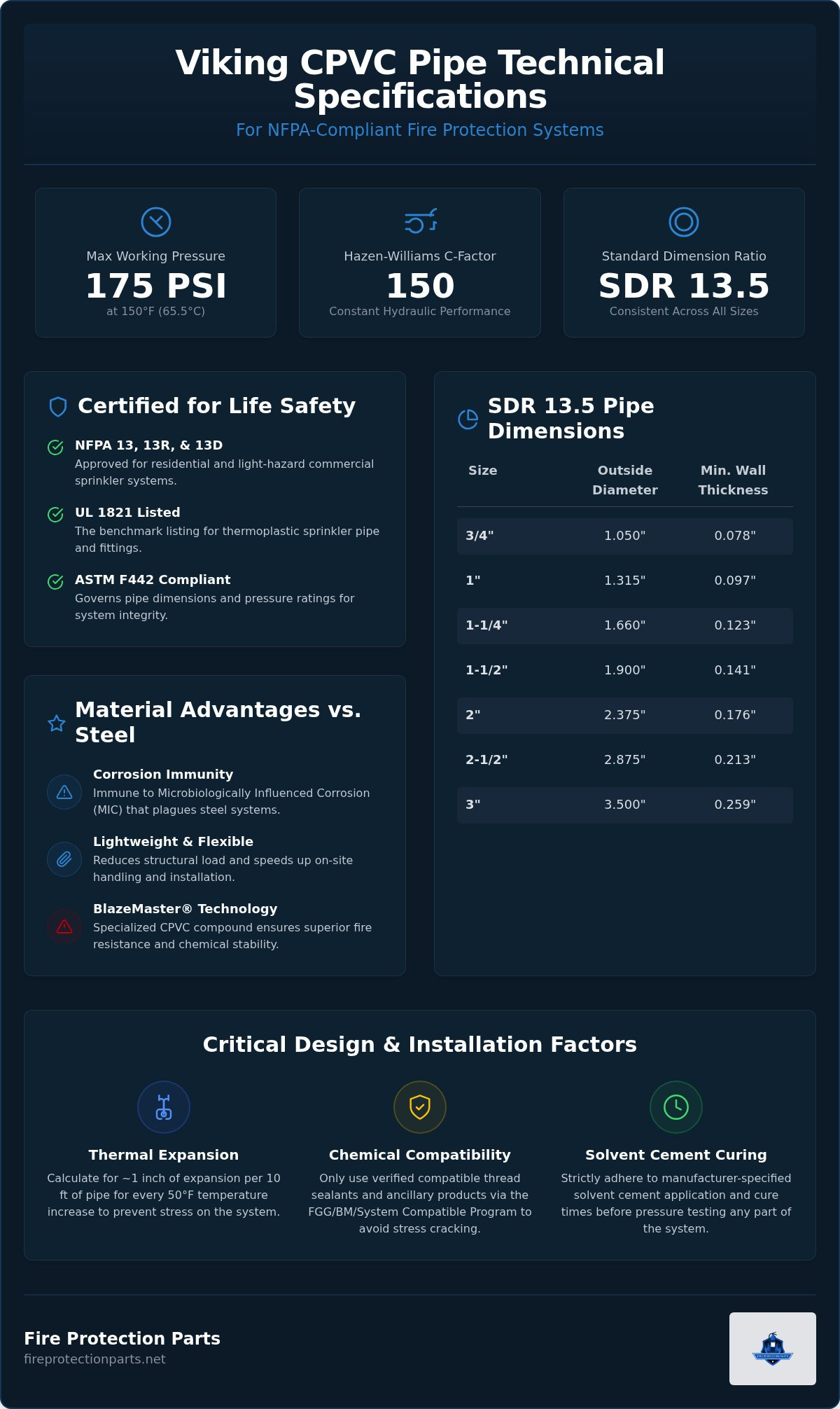
This guide provides the precise technical data you need to secure your project, including the 175 PSI maximum working pressure at 150°F and the constant 150 Hazen-Williams C-factor. We'll help you eliminate the risk of stress cracking by identifying verified materials through the FGG/BM System Compatible Program. You'll gain access to exact SDR 13.5 ratings and hydraulic advantages that ensure your next installation is code-perfect. We'll examine pipe dimensions ranging from 3/4" to 3", current solvent cure times for 2026, and the critical thermal expansion calculations required for a reliable, professional result.
Key Takeaways
- Verify your system design against the latest NFPA 13, 13R, and 13D standards to ensure full compliance for residential and light-hazard applications.
- Access comprehensive Viking cpvc pipe specifications including SDR 13.5 dimensions and the 175 PSI maximum working pressure rating at 150°F.
- Calculate thermal expansion and friction loss accurately using the constant Hazen-Williams C-factor of 150 for superior hydraulic performance and reduced material costs.
- Implement strict installation protocols regarding solvent cement cure times and chemical compatibility to eliminate the risk of stress cracking and system failure.
- Reduce project delays by sourcing genuine Viking components from a reliable stockist that offers flexible shipping options for full-length and pre-cut pipes.
Understanding Viking Plastics CPVC Pipe Standards and Listings
Viking Plastics CPVC Pipe isn't a standard plumbing material. It's a high-performance thermoplastic engineered specifically for wet-pipe fire sprinkler systems. Reliability in fire protection starts with verification. To ensure life safety, every component must meet rigorous standards before it's installed behind a ceiling or wall. Understanding the Viking cpvc pipe specifications begins with recognizing its compliance with ASTM F442. This standard governs the dimensions and pressure ratings of the piping, ensuring it handles the stresses of a pressurized system without compromise.
The product carries the UL 1821 listing, which is the benchmark for residential and light-hazard commercial applications. It's fully approved for use under NFPA 13, 13D, and 13R frameworks. These approvals mean the pipe is tested to maintain its integrity during a fire event. It provides the professional assurance that contractors need when signing off on a complex project. Using a listed system eliminates the doubt associated with generic materials and ensures your installation is code-perfect.
The BlazeMaster® Technology Connection
Viking partners with BlazeMaster to utilize their specialized CPVC compound. This partnership ensures the pipe offers superior fire resistance and remains chemically stable over decades of service. In commercial settings, the "Light Hazard" classification is critical. It applies to environments like offices, schools, and hotels where the fuel load is relatively low. The SDR 13.5 ratio is the outside diameter of the pipe divided by the wall thickness; this specific ratio provides the optimal balance of physical strength and hydraulic flow for fire suppression.
Standard Dimension Ratio (SDR) and Pressure Ratings
A consistent SDR 13.5 rating across all diameters provides predictable performance for system designers. Viking CPVC is rated for a maximum working pressure of 175 psi at 150°F. This is a critical data point for hydraulic calculations and system pressure testing. While metallic pipes often suffer from internal corrosion and scaling that reduces flow over time, CPVC remains smooth and efficient. Designers must understand how temperature affects these Viking cpvc pipe specifications. As temperatures increase, the pressure-bearing capacity of any thermoplastic changes. While metallic pipes handle extreme heat differently, Viking CPVC is engineered to stay resilient within the specific temperature and pressure ranges required by UL standards for light-hazard fire scenarios.
Physical and Thermal Specifications for Viking CPVC Systems
Viking CPVC offers a distinct physical advantage over traditional metallic systems. It's significantly lighter than Schedule 40 steel. This reduces the structural load on the building and makes on-site handling much faster for your crew. Corrosion is another non-issue. These pipes are immune to Microbiologically Influenced Corrosion (MIC), a common failure point in steel sprinkler systems. By choosing materials that don't rust or pit, you ensure the system remains operational for its entire design life. Reliability is built into the material itself.
Dimensional Data for Contractors
Precise measurements are the foundation of a code-compliant layout. Viking CPVC follows SDR 13.5 standards, providing consistency across all diameters. Standard 15-foot lengths make transportation manageable while minimizing the number of joints required. These Viking cpvc pipe specifications adhere to strict ASTM D2846 tolerances. Refer to the data below for planning your runs:
- 3/4 inch: Outside Diameter 1.050", Min Wall 0.078"
- 1 inch: Outside Diameter 1.315", Min Wall 0.097"
- 1-1/4 inch: Outside Diameter 1.660", Min Wall 0.123"
- 1-1/2 inch: Outside Diameter 1.900", Min Wall 0.141"
- 2 inch: Outside Diameter 2.375", Min Wall 0.176"
- 2-1/2 inch: Outside Diameter 2.875", Min Wall 0.213"
- 3 inch: Outside Diameter 3.500", Min Wall 0.259"
Accurate dimensions allow for precise hydraulic calculations and tight fitment in residential or light-hazard commercial spaces. If you need to source these materials quickly to meet a tight deadline, you can find the complete range of Viking CPVC pipe and fittings ready for immediate shipment.
Thermal Performance and Fire Resistance
Thermal movement is a critical design factor. Viking CPVC expands roughly 1 inch per 100 feet for every 25°F change in temperature. You must account for this using expansion loops or offsets to prevent stress on the fittings. In a fire event, the pipe doesn't simply melt. It undergoes a "charring" process. This sacrificial carbon layer acts as an insulator, protecting the water-filled interior and maintaining system pressure when it's needed most. The material meets ASTM E84 requirements with a Flame Spread rating of 25 and a Smoke Development rating of 50. These Viking cpvc pipe specifications confirm the pipe won't contribute significantly to fire growth or toxic smoke during an emergency.
Hydraulic Performance: Friction Loss and Flow Characteristics
Hydraulic efficiency is the silent advantage of thermoplastic systems. In fire protection, every pound of pressure counts. The Viking cpvc pipe specifications highlight a Hazen-Williams C-factor of 150. Compare this to the standard 120 assigned to new black steel pipe. This difference isn't just a technicality; it's a measure of internal smoothness. A higher C-factor means water encounters significantly less resistance. As a result, you can often specify smaller pipe diameters without sacrificing flow. This reduces material costs and simplifies installation in tight residential or light-hazard spaces.
C-Factor Comparison: CPVC vs. Steel
The smoother internal surface of Viking CPVC reduces the demand on your water supply. When designing residential fire pump systems, this efficiency allows for more consistent pressure delivery at the sprinkler head. Because the pipe wall is smoother, the pump doesn't have to work as hard to overcome friction. This often leads to lower energy consumption and less wear on the pump over time.
Consider these typical friction loss values (PSI per 100 feet) for 1-inch pipe to see the impact of these Viking cpvc pipe specifications:
- Flow: 10 GPM | CPVC: 0.51 | Steel: 1.05
- Flow: 20 GPM | CPVC: 1.84 | Steel: 3.75
- Flow: 30 GPM | CPVC: 3.88 | Steel: 7.92
The data shows that steel pipe creates nearly double the friction loss of CPVC at these common flow rates. For system designers, this means NFPA hydraulic calculations are more favorable. It can often eliminate the need for oversized pumps or larger mains, providing a direct cost-saving benefit to the project.
Long-Term Hydraulic Reliability
Steel systems inevitably degrade. Scaling, pitting, and internal corrosion reduce the internal diameter and increase surface roughness. This is known as "C-factor decay." A steel system that starts at 120 might drop to 100 or lower after just 20 years of service. Viking CPVC maintains its constant 150 C-factor for its entire service life, typically 50 years or more.
Because the pipe doesn't scale, the hydraulic performance you design today is the same performance the building will have decades from now. This reliability minimizes the long-term maintenance needs of the system. When you source your sprinkler system components online, choosing Viking CPVC ensures that your calculations remain accurate for the life of the building. It's a choice that prioritizes long-term safety and operational excellence without the compromise of metallic corrosion.
Installation Requirements and Chemical Compatibility Specs
Success in fire protection isn't just about the pipe; it's about the connection. Even the most robust system fails if the joints aren't properly welded or if the material is exposed to incompatible chemicals. Adhering to Viking cpvc pipe specifications during the installation phase is the only way to guarantee system integrity. This process requires specialized CPVC fire protection fittings and a disciplined approach to solvent welding. There's no room for shortcuts when lives are on the line.
Solvent Welding and Cure Time Specifications
Viking systems typically utilize a one-step or two-step solvent welding process. Before assembly, you must deburr and bevel every pipe end. This ensures the fitting doesn't scrape the cement off the pipe wall, which would create a weak joint. You must use solvent cements that meet ASTM F493 standards. Cure times are not suggestions; they are critical safety benchmarks that vary based on ambient temperature and pipe diameter. For a 1 inch pipe at temperatures between 60°F and 100°F, the minimum cure time is one hour before you conduct a pressure test at 225 PSI. If the temperature drops below 40°F, that window extends significantly to 48 hours or more.
- 60°F to 100°F: 1 hour cure (up to 1" pipe)
- 40°F to 59°F: 4 hour cure (up to 1" pipe)
- Below 40°F: 48 hour minimum cure period
Chemical Compatibility and System Integrity
Environmental Stress Cracking (ESC) is a primary cause of premature system failure. This occurs when CPVC comes into contact with incompatible chemicals found in common construction products. You must verify every material that touches the pipe through the Lubrizol FGG/BM/CZ™ System Compatibility Program. Using the wrong thread sealant or leak detector can weaken the thermoplastic structure, leading to leaks months after the installation is complete. Avoid the "Never Use" list to maintain the Viking cpvc pipe specifications and your warranty:
- Petroleum-based oils and greases
- Antimicrobial pipe linings (often found in metallic pipes)
- Non-approved firestops and caulks
- Solder flux or hydrocarbon-based leak detectors
Verification is your best defense against system failure. When sourcing fire protection parts online, always cross-reference the manufacturer's compatibility list. If you need to verify a specific component or require immediate stock for a repair, you can buy Viking CPVC and compatible fittings from a trusted authorized retailer to ensure your system remains code-compliant and safe.
Sourcing Viking CPVC Pipe and Fittings at Fire Protection Parts
Finding a reliable supplier is as critical as the installation itself. When OEM lead times threaten your project schedule, you need a partner who understands the urgency of fire safety. Fire Protection Parts maintains a deep inventory of Viking Plastics CPVC, ensuring you have access to the exact materials required by your design. We don't just sell pipe; we provide the assurance that your order aligns with the Viking cpvc pipe specifications you've calculated for your system. Our mission is to eliminate the doubt from your procurement process through professional expertise and a commitment to quality.
Why Order Viking CPVC from Fire Protection Parts?
We specialize in parts for NFPA 13D and 13R residential and light-hazard commercial systems. Our team understands the nuances of these codes and can help you navigate the procurement of a single-source solution. We stock everything from full-length 15-foot pipes to a complete range of tees, elbows, and adapters. Beyond piping, we provide essential components like seismic bracing for sprinkler systems to ensure your installation meets all local and national safety requirements. Our competitive pricing for bulk contractor orders helps you manage project costs without compromising on compliance.
Ordering Process and Technical Support
Our online store is designed for speed and accuracy. You can easily filter by pipe size and SDR rating to find exactly what you need. We understand that shipping long lengths of piping requires specialized care. We utilize strict shipping protocols to protect fragile materials and ensure they arrive at your job site in perfect condition. We ship directly to locations across the United States, keeping your crew moving and your project on track. Whether you need full-length pipes or pre-cut sections to simplify shipping, we have the logistical capability to deliver.
Don't guess when it comes to life safety. Before you finalize your purchase, our experts are available to verify your order against your specific Viking cpvc pipe specifications. It's better to confirm the details now than to face a code violation later. We act as your dependable guide, providing the technical support you need to make a safe and compliant choice. Choose a partner that values excellence and stays ahead of industry standards to protect your reputation and your clients.
Securing Your Next Installation with Precision
Precision in fire protection isn't just a technical standard; it's the foundation of life safety. By mastering the Viking cpvc pipe specifications, you've equipped yourself to design systems that offer superior hydraulic flow and long-term chemical resilience. You now have the verified data to navigate SDR 13.5 requirements and temperature-rated pressure limits with total professional confidence. This expertise ensures that every joint and fitting contributes to a system that performs perfectly when it's needed most.
Don't let long lead times or unverified inventory stall your progress on-site. As an authorized Viking brand retailer, Fire Protection Parts maintains a deep, NFPA code-compliant inventory ready for immediate deployment. We provide the peace of mind that comes with fast nationwide jobsite shipping to keep your projects on schedule and your clients protected. You can Order Viking CPVC Pipe and Fittings Online today to secure the high-performance materials your next project demands. Your commitment to excellence deserves a partner that values reliability as much as you do. Build with confidence and protect with the best.
Frequently Asked Questions
What is the maximum pressure rating for Viking CPVC pipe?
The maximum working pressure for Viking CPVC pipe is 175 PSI when the temperature is maintained at 150°F. This rating is consistent across all pipe diameters from 3/4 inch to 3 inches. These Viking cpvc pipe specifications ensure the system handles the high-pressure demands of NFPA 13, 13D, and 13R installations. Always verify your system's operating conditions against these UL-listed limits to maintain structural integrity and professional compliance.
Can Viking CPVC be used in outdoor fire sprinkler systems?
Viking CPVC is primarily designed for indoor use because long-term exposure to direct sunlight can degrade the thermoplastic material over time. If you must use it in an outdoor application, the pipe requires protection from UV radiation through painting with water-based latex paint or physical shielding. It's also vital to ensure the system is protected from freezing. Don't leave the pipe exposed to the elements during the construction phase for extended periods.
Is Viking CPVC pipe compatible with antifreeze solutions?
You can use antifreeze in Viking CPVC systems, but it must be a factory-mixed, chemically compatible solution. Only use glycerin-based antifreeze that's specifically listed for fire protection systems. Using unapproved glycol-based solutions or automotive antifreeze can cause chemical degradation and lead to system failure. Always cross-reference the FGG/BM System Compatible Program before introducing any chemical additives into your wet-pipe network to ensure the safety of the installation.
What SDR rating is required for Viking fire sprinkler pipe?
All Viking fire sprinkler piping is manufactured to a Standard Dimension Ratio (SDR) of 13.5. This specific ratio ensures that the wall thickness is proportional to the pipe's diameter, providing consistent pressure-bearing capabilities across the entire product line. These Viking cpvc pipe specifications align with ASTM F442, which is the industry standard for CPVC materials used in fire suppression. Maintaining this SDR rating is essential for calculating hydraulic friction loss accurately.
How long does Viking CPVC pipe take to cure before pressure testing?
Cure times vary significantly based on ambient temperature and pipe diameter. For a standard 1 inch pipe installed in temperatures between 60°F and 100°F, you must allow at least one hour before pressure testing at 225 PSI. If the temperature is below 40°F, the required cure time can extend to 48 hours or more. Rushing this process compromises the solvent weld and can lead to joint failure. Always follow the manufacturer's specific cure chart.
What are the temperature limits for Viking CPVC fire sprinkler systems?
The system is rated for a maximum internal water temperature of 150°F at its full pressure rating. While CPVC is highly resistant to heat, exceeding this limit can reduce the pipe's pressure-carrying capacity. It's also important to consider the ambient temperature of the installation space. Ensure the pipe isn't installed in areas where it will be subjected to constant heat from industrial equipment, as this can impact the long-term performance of the thermoplastic.
Can I mix Viking CPVC with other brands of CPVC pipe?
It's best practice to use a unified system of Viking pipe and fittings to ensure full compliance with UL and FM listings. While Viking CPVC uses the BlazeMaster compound, mixing brands can complicate your warranty and the inspection process. To maintain the integrity of your Viking cpvc pipe specifications, source all tees, elbows, and adapters from the same authorized retailer. This single-source approach eliminates compatibility doubts and ensures every component is designed to work together.
Does Viking CPVC require special hangers or seismic bracing?
Yes, the hangers and bracing used must be compatible with CPVC to prevent physical damage or chemical degradation. You should avoid hangers with sharp edges that could gouge the pipe or those coated with incompatible oils. For projects in earthquake-prone areas, use ASC seismic bracing, which is specifically designed to secure fire sprinkler systems. Proper support prevents excessive stress on joints and accounts for the thermal expansion and contraction characteristics of the material.

