



Air Compressor for Dry Sprinkler System Requirements: 2026 Compliance Guide
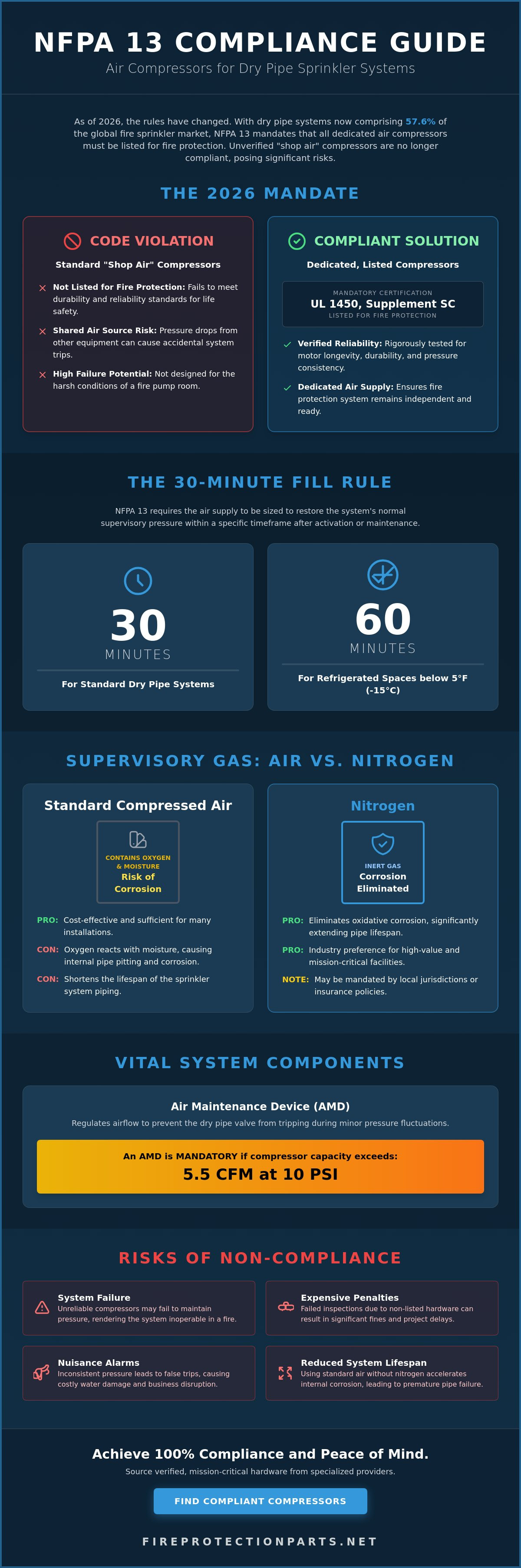
In 2026, using a standard "shop air" compressor for your fire protection system isn't just a maintenance risk. It's a code violation. With dry pipe systems now representing 57.6% of the global fire sprinkler market, the 2025 edition of NFPA 13 has introduced a critical shift. Every dedicated air compressor for dry sprinkler system requirements must now be listed for fire protection under UL 1450, Supplement SC. Relying on unverified equipment puts your facility at risk of system failure and expensive regulatory penalties.
It's natural to feel frustrated by evolving safety standards or the headache of nuisance alarms caused by inconsistent pressure. You need a solution that offers unwavering reliability and professional assurance. This guide provides the expert confidence you need to master the latest NFPA 13 standards and size a code-compliant compressor correctly. We'll break down the mandatory 30 minute fill rule, explain the requirements for refrigerated spaces, and show you how to choose listed components that reduce maintenance costs and provide total peace of mind.
Key Takeaways
- Understand why the latest standards mandate that every air compressor for dry sprinkler system requirements must be UL 1450 listed for fire protection.
- Master the sizing formulas needed to satisfy the 30-minute fill rule and ensure your system restores pressure within code-mandated timelines.
- Compare oil-less and lubricated systems to determine which configuration provides the highest reliability for your specific facility environment.
- Identify critical accessories like air maintenance devices and pressure switches that are vital for preventing nuisance trips and system failures.
- Learn how to source verified, mission-critical hardware from specialized providers to achieve 100% compliance and professional peace of mind.
The Critical Role of Supervisory Air in Dry Pipe Systems
Dry pipe sprinkler systems are the primary defense for structures where temperatures drop below freezing. In unheated environments like parking garages, warehouses, and attics, water filled pipes would burst. Instead of water, these pipes are filled with pressurized air or nitrogen. This supervisory gas acts as a barrier, holding back the water supply at a specialized dry pipe valve located in a heated area of the building.
The relationship between air and water pressure is a delicate mechanical balance. Most dry pipe valves operate on a pressure differential, often a 5:1 or 6:1 ratio. This means a relatively small amount of air pressure can hold back significantly higher water pressure. If a sprinkler head activates or a leak occurs, the air escapes. Once the air pressure drops below a specific threshold, the valve "trips," allowing water to flood the system and discharge through the open heads. Relying on a shared "shop air" source for this task is a dangerous gamble. If tools or machinery drain the shared tank, your fire protection system could trip accidentally, causing massive water damage and system downtime. A dedicated air compressor for dry sprinkler system requirements ensures that your safety infrastructure remains independent and reliable.
How Supervisory Pressure Prevents Accidental Discharge
Supervisory pressure serves as the 'safety lock' of a dry system by providing the constant force necessary to keep the dry pipe valve closed against incoming water pressure. Maintaining this pressure is a constant battle against minor leaks and temperature fluctuations. If the pressure isn't maintained, you face the risk of a nuisance trip. These accidental activations don't just create a mess; they require a professional reset and can lead to internal pipe corrosion. Consistent, regulated air supply is the only way to eliminate these operational doubts.
Air vs. Nitrogen: Which Supervisory Gas is Right?
While standard air is the traditional choice, nitrogen is becoming the industry preference for high-value facilities. Oxygen in standard compressed air reacts with moisture to cause "pitting" and internal corrosion. Nitrogen is an inert gas that eliminates this chemical reaction, significantly extending the lifespan of your piping.
- Standard Air: Cost-effective and sufficient for many basic installations.
- Nitrogen Generators: Superior for mission-critical facilities where corrosion mitigation is a priority.
- Code Compliance: While NFPA 13 allows both, specific local jurisdictions or high-risk insurance policies may mandate nitrogen to ensure long-term system integrity.
NFPA 13 Requirements for 2026 Compliance
The 2025 edition of NFPA 13 has fundamentally shifted the landscape for facility managers and contractors. Previously, the code was somewhat ambiguous regarding the specific listing of air supply components. As of the current cycle, any air compressor for dry sprinkler system requirements must be listed for fire protection service. This isn't a mere suggestion. It's a mandatory safety standard designed to ensure the compressor survives the harsh conditions of a fire pump room or unheated attic. The primary benchmark for this verification is UL 1450, Supplement SC, which evaluates equipment specifically for fire sprinkler use.
Compliance also hinges on strict performance metrics. According to the updated NFPA 13 Requirements, the air supply must be capable of restoring the system's normal supervisory pressure within 30 minutes. If you're protecting refrigerated spaces kept below 5°F, the code extends this window to 60 minutes to account for air density and temperature variables. Additionally, if your compressor's capacity exceeds 5.5 CFM at 10 PSI, an Air Maintenance Device (AMD) is required. This device regulates the air flow and prevents the dry pipe valve from tripping during minor pressure fluctuations. When upgrading your facility, choosing certified air compressors for sprinkler systems ensures you meet these rigorous standards without the risk of a failed inspection.
The 'Listed' Requirement: Why Shop Compressors Fail Code
Standard hardware store compressors aren't designed for the 100% reliability required in life safety applications. A UL 1450 listed unit undergoes rigorous testing for durability, motor longevity, and pressure consistency. Non-listed "band-aid" solutions are no longer acceptable for new installations or major retrofits. To verify a unit's status, always check the manufacturer's nameplate for the specific UL 1450 Supplement SC certification. If that mark isn't present, the unit doesn't meet the current code.
Installation Standards: Mounting and Electrical
Proper installation is as critical as the hardware itself. NFPA 70 requires these compressors to be on a dedicated electrical circuit to prevent accidental power loss from other equipment. Furthermore, mounting must be secure. Using vibration-dampening pads prevents pipe fatigue and joint leaks over time. Every installation must also include a check valve between the compressor and the air maintenance device to prevent water from backing up into the compressor tank if the system trips.
Sizing Your Compressor: The 30-Minute Fill Rule
Precise sizing is the difference between a compliant system and an inspection failure. To meet the NFPA 13 Requirements for 2026 Compliance, your air supply must restore normal pressure within 30 minutes. This ensures the system is ready for operation quickly after a trip or maintenance. If you're protecting a freezer or cold storage area where temperatures dip below 5°F, the code extends this window to 60 minutes. This extra time accounts for the slower pressure recovery in extreme cold.
Choosing between a 1/2 HP and a 1 HP unit depends on Cubic Feet per Minute (CFM) output, not just the motor size. A larger motor doesn't always mean a faster fill if the pump isn't sized for the volume. You must match the compressor's CFM at the system's required supervisory pressure to satisfy the air compressor for dry sprinkler system requirements. If your compressor's capacity exceeds 5.5 CFM at 10 PSI, an air maintenance device is no longer optional; it's a code requirement. This device prevents a high-capacity compressor from overwhelming the dry valve during a fire event.
Step-by-Step System Volume Calculation
Calculating the total capacity in gallons involves measuring every foot of pipe in the system. You'll need to use pipe schedules to determine the internal volume per linear foot. For instance, Schedule 40 steel has different internal dimensions than Viking CPVC fire sprinkler pipe. Mistakes here are costly. Underestimating volume leads to a compressor that can't meet the 30-minute mark. Overestimating results in unnecessary equipment costs and potential vibration issues. Don't forget to include the volume of fittings and the air space within the dry pipe valve itself to get an accurate total.
Managing Multi-Valve Systems with One Compressor
One compressor can serve multiple dry pipe valves, but the sizing logic changes. NFPA 13 mandates that the compressor must be sized based on the single largest system it serves. It doesn't need to fill all systems simultaneously within 30 minutes, just the largest one. However, you must install an individual air maintenance device (AMD) for each valve. This setup allows for independent pressure regulation. It ensures that a leak in one zone doesn't compromise the supervisory pressure of the entire facility. This methodical approach provides the professional assurance that your system will perform when it matters most.
Selection Criteria: Oil-Less vs. Lubricated Systems
Selecting the right hardware requires more than just meeting the basic air compressor for dry sprinkler system requirements. You must decide between oil-less and lubricated technology. While lubricated compressors are common in industrial workshops, they're rarely the right choice for fire protection. Oil-less compressors have become the industry standard because they deliver clean, oil-free air. This is vital for the longevity of your system. Oil mist from a lubricated unit can travel through the piping, causing rubber gaskets and seals to degrade prematurely. This leads to slow leaks and the very nuisance trips you're trying to avoid.
Modern fire protection often integrates with advanced electronics, such as the PTR Electric Deluge VXD. These pre-action and deluge systems rely on precise supervisory air to monitor system integrity. Clean air from an oil-less compressor ensures that sensitive electronic sensors and solenoid valves remain free of contaminants. When you're protecting high-value assets, this level of professional assurance is non-negotiable. Secure your facility with UL-listed air compressors for sprinkler systems designed for maximum durability and zero contamination.
The Case for Oil-Less Compressors
Oil-less units are purpose-built for the intermittent use patterns typical of fire sprinkler systems. Unlike shop compressors that run constantly, a fire compressor only activates to maintain supervisory pressure. Oil-less designs don't require oil level monitoring or frequent filter changes, which reduces your long-term maintenance burden. They're also significantly quieter. In residential buildings or office complexes, a quiet unit with a low decibel rating prevents complaints while still providing unwavering protection. Most high-quality fire compressors operate between 60 and 70 decibels, making them suitable for installation near occupied spaces.
Cold Storage and High-Moisture Environments
Environmental factors dictate specific compressor configurations. In refrigerated warehouses or freezers where temperatures stay below 5°F, moisture is your greatest enemy. Standard compressed air contains water vapor that can freeze into ice plugs, blocking the flow of air and causing system failure. For these applications, you must use a specialized compressor paired with an air dryer.
- Desiccant Dryers: These remove moisture to a very low dew point, preventing ice formation in sub-zero piping.
- Fill Time Adjustments: Remember that cold air is denser. NFPA 13 allows a 60-minute fill time for these environments to ensure the compressor isn't overstressed while attempting to reach supervisory pressure.
- Corrosion Control: In high-moisture areas, consider using nitrogen to further inhibit internal pipe corrosion.
Sourcing Code-Compliant Compressors and Hardware
Sourcing your equipment from a specialized fire protection retailer is the final step in securing your facility. Standard industrial suppliers often lack the technical expertise to distinguish between a general-use pump and a unit that meets the air compressor for dry sprinkler system requirements. Professional-grade hardware isn't just about a label; it's about the verification of performance under pressure. These systems are engineered specifically to interface with fire protection components, ensuring that your supervisory air supply remains independent and reliable when it matters most.
Beyond the compressor itself, your system's reliability depends on high-quality accessories. A UL-listed pressure switch is essential for monitoring supervisory air levels and triggering the compressor when needed. Air Maintenance Devices (AMDs) must be precisely calibrated to prevent the dry valve from accidental activation. Even the flexible hoses used for connections should be rated for fire protection use to prevent vibration leaks. Every part of the assembly must reflect the same commitment to excellence and adherence to standards to provide true peace of mind.
Evaluating Manufacturer Specifications
When reviewing technical data sheets, pay close attention to the CFM rating at specific PSI levels. A compressor might boast a high CFM at 10 PSI, but its performance could drop significantly at the 40 PSI typically required for supervisory pressure. Integrated systems often come pre-assembled with the AMD and pressure switch, which simplifies the procurement process and reduces installation errors. Modular systems offer more flexibility for complex layouts but require careful matching of components. Professional-grade hardware usually includes a robust warranty and technical support, providing the professional assurance that your investment is protected for the long term.
Ready to Upgrade Your System?
If your current facility relies on a non-compliant setup, the transition to a listed system is a priority for safety and insurance purposes. The process begins with a thorough volume calculation of your existing piping, accounting for materials like Viking Plastics CPVC or steel. Once you've determined the required CFM to meet the 30-minute fill rule, you can select a unit that fits your footprint and electrical capacity. Selecting the right air compressor for dry sprinkler system requirements involves more than just checking a price tag; it's about ensuring the longevity of your life safety system. If you have questions about specific configurations, technical experts can guide you through the selection process. Browse our selection of UL-listed air compressors to find the reliable components your system demands.
Before commissioning your new air supply, use this final checklist:
- Verify the UL 1450 Supplement SC listing on the manufacturer's nameplate.
- Confirm the unit is on a dedicated electrical circuit per NFPA 70.
- Ensure a check valve is installed to prevent water backflow into the compressor.
- Test the 30-minute fill time on the largest system zone.
- Check for air leaks at all joints and flexible hose connections.
Secure Your Facility with Code-Compliant Air Supply
Compliance is more than a legal hurdle. It's a commitment to the unwavering reliability of your fire protection infrastructure. By prioritizing UL 1450 Listed Compressors and mastering the 30-minute fill rule, you eliminate the risks that come with unverified equipment. We've explored how proper sizing and oil-less technology provide the professional assurance needed to prevent nuisance trips and system failures. These choices protect your property and ensure your safety systems remain ready for action.
Mastering the current air compressor for dry sprinkler system requirements ensures your facility stays ahead of evolving safety standards. You now have the expert confidence to select NFPA 13 Compliant Hardware that reduces maintenance costs and simplifies procurement. Our team provides expert technical support for sizing to ensure you find the perfect fit for your specific system volume. Don't settle for "good enough" when it comes to life safety components. Choose hardware that offers the longevity and strength your facility deserves.
Shop Code-Compliant Air Compressors for Dry Systems today to secure your facility with verified, high-performance equipment. You're now equipped to make a safe and compliant choice for your building's future.
Frequently Asked Questions
Does an air compressor for a dry sprinkler system have to be UL listed?
Yes, any dedicated compressor for a dry pipe system must be listed for fire protection service according to the 2025 edition of NFPA 13. This requirement specifically mandates verification under UL 1450, Supplement SC. This standard ensures the motor and internal components are tested for the unique reliability demands of life safety infrastructure, providing the professional assurance that the unit will perform during a fire event.
What is the 30-minute fill rule in NFPA 13?
The 30-minute fill rule is a performance standard requiring the air supply to restore normal supervisory pressure to the largest system within 30 minutes. This ensures that the system is ready for operation quickly after maintenance or a trip. For refrigerated spaces kept at temperatures below 5°F, the code allows for an extended 60-minute fill time to account for air density changes in extreme cold.
Can I use a standard shop compressor for my dry pipe system?
No, you cannot use a standard shop compressor because it does not meet the air compressor for dry sprinkler system requirements established by current safety codes. These units lack the mandatory UL 1450 listing and aren't built for the 100% reliability required in fire protection. Using unlisted "shop air" equipment will lead to failed inspections and increases the risk of system failure during an emergency.
What happens if my air compressor fails?
If the compressor fails, supervisory air pressure will slowly drop due to minor leaks or temperature changes. Once the pressure falls below the dry pipe valve's differential threshold, the valve will trip and flood the system with water. In unheated areas, this leads to frozen pipes and extensive water damage. Maintaining a listed, reliable compressor is the only way to prevent these costly nuisance trips.
How often should I drain the moisture from my fire system compressor?
You should drain moisture from the tank weekly or install an automatic tank drain to ensure the air compressor for dry sprinkler system requirements are consistently met. Accumulated water reduces the available air volume in the tank and can lead to internal corrosion. In cold environments, excess moisture can freeze into ice plugs, which blocks supervisory air and causes the system to malfunction.
Is an Air Maintenance Device (AMD) required for all dry systems?
An Air Maintenance Device is required if the air supply has a capacity greater than 5.5 CFM at 10 PSI. Even when not strictly mandated by capacity, installing an AMD is a professional best practice. It regulates the airflow into the system and prevents the dry pipe valve from accidentally tripping during the compressor's normal cycling. This adds an essential layer of protection and system stability.
Can I use one air compressor for multiple dry pipe valves?
Yes, a single compressor can serve multiple dry pipe valves if it's sized to fill the largest single system within the required 30-minute window. However, NFPA 13 requires that each individual system must have its own dedicated Air Maintenance Device. This configuration ensures that a pressure drop or leak in one zone doesn't compromise the supervisory air pressure of the entire facility.
Why is my air compressor running more frequently than usual?
Frequent cycling usually indicates a leak in the sprinkler piping or a failing pressure switch. You should check the system for audible leaks, particularly at joints, fittings, or flexible hose connections. If the piping is secure, the compressor's check valve or pressure switch may be worn and require replacement. Addressing these issues immediately eliminates doubt and prevents premature wear on your compressor motor.

