



Backflow Preventers for Fire Protection: 2026 Buyer’s Guide
A single non-compliant valve can contaminate a city's drinking water and trigger an immediate facility shutdown. It's a high-stakes reality that demands absolute precision. You're likely frustrated by the technical gap between DCV and RPZ requirements or worried that a long lead time on a critical part will lead to a failed inspection. Choosing the right backflow preventers for fire protection shouldn't feel like a gamble with your facility's safety.
We understand the pressure to maintain a system that's both functional and fully compliant with evolving standards. This 2026 guide ensures you master the technical and regulatory landscape to maintain total potable water safety. You'll learn how to identify the correct assembly for your specific hazard level and ensure every device is UL/FM listed for reliable performance. We also break down how these units integrate with Viking Plastics CPVC or steel piping. From the July 1, 2026, California certification mandates to the latest NFPA 25 internal inspection overhauls, we provide the expert clarity you need to eliminate doubt and secure your infrastructure.
Key Takeaways
- Identify whether your facility requires a Double Check Valve (DCV) or a Reduced Pressure Zone (RPZ) assembly based on your specific hazard classification.
- Ensure your backflow preventers for fire protection are UL/FM listed and properly sized to maintain the hydraulic integrity of your system risers.
- Learn how to integrate backflow assemblies with Viking CPVC piping and air maintenance devices to create a cohesive, code-compliant fire system.
- Navigate the 2026 regulatory landscape, including new certification mandates and updated NFPA 25 internal inspection requirements.
- Prioritize durability by selecting high-performance materials like epoxy-coated ductile iron or stainless steel to prevent corrosion and premature failure.
What is a Backflow Preventer for Fire Protection?
A backflow prevention device in a fire protection context is a specialized mechanical valve assembly. It serves one critical purpose: preventing stagnant, potentially contaminated water within a fire sprinkler system from flowing backward into the public potable water supply. While standard plumbing backflow devices handle domestic needs, backflow preventers for fire protection are engineered for high-flow capacity and extreme reliability. They ensure that the water intended for life safety doesn't become a public health hazard.
Fire sprinkler systems are considered high-risk cross-connections. Water often sits in these pipes for years, leading to biological growth, mineral buildup, and stagnation. When systems utilize chemical additives or antifreeze for fire protection, the risk profile escalates significantly. Without a verified assembly in place, a sudden drop in municipal pressure could pull these toxins into the drinking water line. These devices are mandated by NFPA 13 and NFPA 24 standards to protect the integrity of municipal infrastructure.
The Risk of Cross-Connection Contamination
Contamination occurs through two primary mechanisms: backpressure and backsiphonage. Backpressure happens when the pressure within the fire system exceeds the municipal supply pressure, often due to a fire pump or thermal expansion. Backsiphonage occurs when a water main break or heavy firefighting activity nearby creates a vacuum, pulling water out of the building. These events are unpredictable and can happen in seconds.
The 1997 Charlotte-Mecklenburg incident remains a stark warning for the industry. In that case, petroleum-based fire retardants entered the public water supply during a fire event, highlighting the catastrophic potential of backflow. Local water authorities categorize these risks as either non-health or health hazards. This designation is vital because it dictates whether you can use a Double Check Valve (DCV) or if you require a more robust Reduced Pressure Zone (RPZ) assembly to manage high-hazard risks.
Regulatory Standards: NFPA and Local Water Authorities
NFPA 13 and NFPA 24 provide the framework for installation, but the local Authority Having Jurisdiction (AHJ) holds the final word on which hardware is acceptable. It's common for water departments to have stricter requirements than the national fire codes. Every component you install must carry UL (Underwriters Laboratories) and FM (Factory Mutual) listings to ensure it can withstand the hydraulic demands of a fire event without failing.
As we move through 2026, regulatory focus has shifted toward electronic oversight and constant verification. Modern codes now emphasize the use of tamper switches and integrated monitoring to ensure valves remain in the open position. It's no longer enough to have the hardware installed; it must be supervised to guarantee it performs when lives are on the line. Choosing backflow preventers for fire protection that include these monitoring capabilities is now a standard requirement for most commercial and industrial projects.
Comparing DCV vs. RPZ: Which Assembly Do You Need?
Selecting backflow preventers for fire protection requires a clear understanding of your system's hazard level. The choice between a Double Check Valve (DCV) and a Reduced Pressure Zone (RPZ) assembly impacts both your legal compliance and your system's hydraulic design. It's a decision that leaves no room for error. You must balance the need for water safety with the physical demands of your suppression system.
Double Check Valve Assemblies (DCV/DCDA)
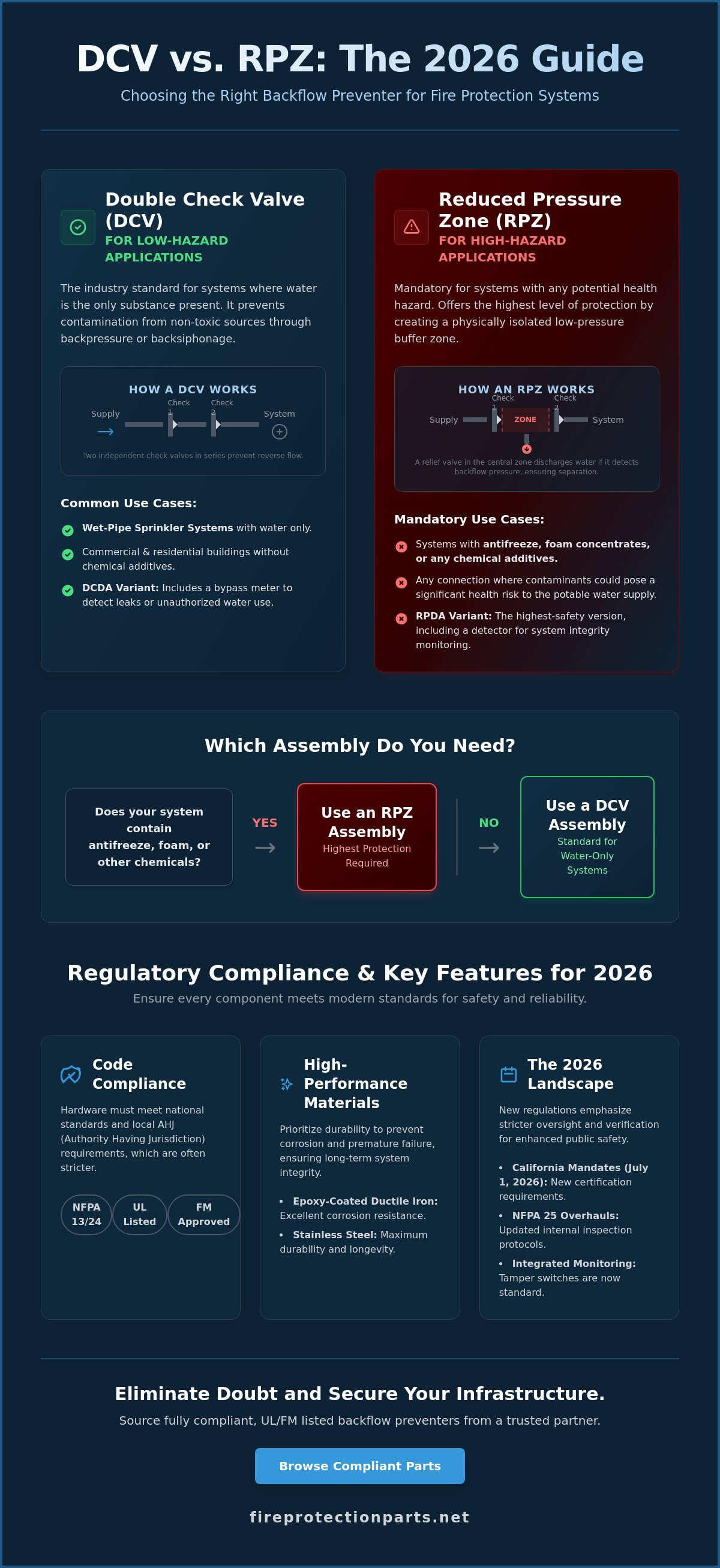
Double Check Valve Assemblies (DCV) are the workhorse of the industry for "Low Hazard" applications. These systems typically contain only water without any chemical additives. In fire service, you'll often see the Double Check Detector Assembly (DCDA) variant. This version includes a bypass meter designed to detect unauthorized water use or minor leaks. It's an essential feature for identifying issues before they compromise your system. DCDAs are the standard choice for most residential and commercial wet-pipe systems where the water remains non-toxic.
Reduced Pressure Zone Assemblies (RPZ/RPDA)
If your system incorporates antifreeze for fire protection, foam concentrates, or other chemicals, an RPZ is mandatory. These assemblies provide the highest level of safety by utilizing a hydraulic relief valve between two independent check valves. If a pressure fluctuation occurs, the relief valve discharges water to the atmosphere, physically preventing any contaminated fluid from re-entering the main line. For fire protection, the Reduced Pressure Detector Assembly (RPDA) provides this same fail-safe protection while allowing for leak monitoring via a bypass meter.
You must account for the physical and hydraulic requirements of these devices. RPZ assemblies generally cause a higher pressure drop than DCV models. This friction loss can be significant, sometimes requiring adjustments to your pump specifications or pipe sizing to maintain the necessary pressure at the sprinkler heads. Additionally, RPZs must be installed with a drain capable of handling the relief valve's full discharge. Consult the NFPA guidelines on backflow preventers to ensure your selection of backflow preventers for fire protection matches your system's specific hazard profile.
Whether you're protecting a high-hazard industrial site or a standard commercial office, the integrity of your water supply is paramount. Selecting the correct assembly ensures you meet local codes and keep the public safe. If you're ready to secure your system, you can find a wide range of UL/FM listed backflow preventors designed for long-term reliability and professional performance.
Key Features to Evaluate When Buying Backflow Preventers
Procuring backflow preventers for fire protection requires more than just checking a box for code compliance. You need a device that minimizes lifecycle costs and simplifies long-term maintenance. Use this checklist to prioritize features that offer unwavering reliability and professional performance. Choosing the right hardware now prevents costly retrofits and inspection failures later.
Body material is your first line of defense against system degradation. Ductile iron with a fused epoxy coating is the industry standard for strength and durability. It's a robust choice for most commercial applications. However, stainless steel bodies offer superior corrosion resistance. If your facility is in a coastal area or deals with aggressive water chemistry, stainless steel prevents the internal pitting that often leads to check valve failure. Match the assembly size specifically to your system riser; most commercial projects utilize 4", 6", or 8" units to ensure the flow capacity meets your hydraulic calculations.
Prioritize ease of maintenance to reduce future labor costs. Look for assemblies with top-entry access. This design allows for quick check valve replacement or internal cleaning without removing the entire device from the line. It turns a complex repair into a manageable task. For shut-off valves, you'll typically choose between OS&Y (Outside Screw and Yoke) and Butterfly valves. OS&Y valves provide an immediate visual confirmation of the valve's position, while Butterfly valves offer a more compact footprint for tight spaces.
Tamper Switches and Monitoring
A fire protection system is only effective if the water supply remains open. This is why fire protection valves must be electronically supervised. Pre-wired tamper switches are the most reliable choice because they're factory-installed and tested for seamless integration with your building’s fire alarm control panel. While field-installed options exist, they often require more labor and are prone to alignment issues. Ensure your selected device is fully compatible with your monitoring system to maintain 24/7 oversight and compliance.
Space Constraints and Installation Orientation
Riser rooms are rarely spacious. When space is at a premium, "N-Pattern" or "Z-Pattern" configurations are essential. These compact designs significantly reduce the horizontal footprint of the assembly. You must also verify the installation orientation before purchase. Not all backflow preventers for fire protection are rated for both vertical and horizontal use. Installing a horizontal-only unit in a vertical orientation is a violation of its UL listing and will result in a failed inspection. Always plan for adequate clearance to ensure technicians have enough room for mandatory annual testing and internal inspections.
- Verify UL/FM listing for fire service applications.
- Select epoxy-coated ductile iron or stainless steel for longevity.
- Confirm the assembly matches the riser size (4", 6", or 8").
- Choose top-entry access to simplify future maintenance.
- Ensure integrated tamper switches for electronic monitoring.
- Check orientation ratings (Horizontal vs. Vertical) against your site plan.
System Integration: Beyond the Backflow Valve
A backflow preventer is a critical component, but it doesn't operate in isolation. It's the interface between the municipal supply and your internal suppression network. For a truly resilient system, you must consider how backflow preventers for fire protection integrate with the surrounding infrastructure. This includes the piping, pressure management devices, and structural supports that ensure the valve remains functional during a fire or seismic event. Precision in these connections is the difference between a system that passes inspection and one that fails when it's needed most.
Compatibility with CPVC Systems
In residential and light commercial settings, you'll often connect the backflow assembly to Viking CPVC fire sprinkler pipe. This transition requires technical accuracy. Most backflow bodies feature flanged or grooved ends. These must match the CPVC adapters perfectly to prevent leaks and maintain hydraulic integrity. Using the correct solvent, such as FS5 One Step Cement, is non-negotiable for secure, code-compliant fittings at the riser. This ensures the chemical bond is strong enough to withstand the high-flow pressures required for fire suppression. Proper alignment during this phase prevents mechanical stress on the CPVC joints, ensuring long-term reliability.
Air Maintenance in Dry and Pre-Action Systems
Dry and pre-action systems introduce additional complexities that impact the backflow assembly. The AMD-1 Air Maintenance Device is vital here. It regulates the air pressure within the system, preventing the false trips that can send water rushing against the backflow check valves unexpectedly. Without consistent air supply, you risk water hammer. This hydraulic shock can damage internal valve components and lead to premature failure. Sourcing reliable air compressors for your sprinkler system ensures the pressure differential across the backflow assembly remains stable and protected from sudden surges.
Protection also means securing the physical assembly against environmental risks. Integrating ASC Seismic Bracing is a standard requirement in many jurisdictions. It protects the riser and backflow assembly from structural shifts during an earthquake, preventing the rigid piping from snapping under stress. Finally, don't overlook the professional finish. Using the correct escutcheons and cover plates provides a clean look and protects the wall penetrations where the system enters the building. A professional installation reflects the reliability of the safety components within and ensures all parts are accessible for future service.
Ready to build a fully integrated system? You can source everything from Viking CPVC pipe to air maintenance devices at Fire Protection Parts to ensure your backflow assembly is supported by high-quality, code-compliant components.
Why Source Your Backflow Parts from Fire Protection Parts?
Securing the right components for a fire suppression system is a mission-critical task. You can't afford delays or hardware that fails to meet local AHJ standards. Fire Protection Parts serves as a dedicated partner, providing an extensive inventory of code-compliant backflow preventers for fire protection and the repair kits needed to keep them operational. We bridge the gap between complex regulatory requirements and physical procurement, ensuring you have the exact hardware required for 2026 compliance. Our focus is on providing peace of mind through professional expertise and unwavering reliability.
Our catalog is a comprehensive one-stop shop. Whether you need CPVC pipe for fire protection, specialized deluge valves, or ASC seismic bracing, we maintain stock from the industry's most trusted brands. We prioritize fast shipping and competitive pricing on Viking and ASC Engineered Solutions products because we know that project timelines are non-negotiable. We position ourselves not just as a vendor but as a protector, ensuring that every part you order meets the highest standards of strength and longevity.
Contractors and facility managers face a changing landscape in 2026. With new mandates such as the California State Water Resources Control Board (SWRCB) certification for testers and updated NFPA 25 internal inspection cycles, staying compliant is more demanding than ever. We provide the expert support you need to navigate these updates. Our team understands the technical nuances of forward flow testing and the specific requirements for high-hazard RPZ installations. We act as a seasoned guide through the procurement process, helping you eliminate doubt and move quickly from a identified need to a functional remedy.
The Convenience of a Professional Online Store
Finding the right parts shouldn't be a struggle. Our professional online store features detailed filters for size, material, and specific UL/FM listings. With access to over 20,000 products, including CCP White Cover Plates and essential repair accessories, you can build project-specific kits in minutes. This methodical approach to procurement saves time and respects your schedule. You can quickly find the exact ductile iron or stainless steel assembly that matches your system's riser dimensions without wading through irrelevant jargon.
Ready to Secure Your System?
Compromising on water safety isn't an option. Now that you understand the technical distinctions between DCV and RPZ assemblies, it's time to finalize your system design. Review your specific hazard level and select the appropriate hardware to ensure long-term performance and potable water protection. Don't wait for an inspection failure to address aging or non-compliant valves. Take a no-nonsense approach to your facility's safety by choosing parts that offer no compromise on quality.
Shop the full collection of backflow preventers and fire protection parts here.
Secure Your Water Supply with Professional Certainty
Compliance isn't a one-time event; it's an ongoing commitment to safety. You now have the technical blueprint to differentiate between DCV and RPZ assemblies based on your facility's specific hazard profile. By prioritizing UL/FM listed hardware and epoxy-coated materials, you eliminate the risk of premature failure and avoid the frustration of failed inspections. Integrating the right backflow preventers for fire protection with your existing risers ensures your system remains a cohesive barrier against contamination.
Fire Protection Parts acts as your mission-driven partner in this process. We provide specialized support for contractors navigating the latest NFPA requirements and maintain over 20,000 products in stock to keep your projects moving. Every component we offer is selected for its strength and professional reliability. Don't leave your potable water safety to chance or settle for long lead times on critical safety parts. You have the expert knowledge required to make the right choice; now take the step to secure your system with unwavering confidence.
Browse All Code-Compliant Fire Protection Parts
Frequently Asked Questions
Is a backflow preventer required for all fire sprinkler systems?
No, the requirement depends on your local water authority or health department rather than the NFPA. If your jurisdiction identifies a potential cross-connection risk to the public potable water supply, they will mandate the installation. Most commercial and industrial systems require them to prevent stagnant water, biological growth, or chemical additives from re-entering the municipal main during pressure fluctuations.
What is the difference between a DCV and an RPZ in fire protection?
The primary difference is the level of hazard protection provided to the water supply. A Double Check Valve (DCV) is for low-hazard systems containing only water. A Reduced Pressure Zone (RPZ) assembly is for high-hazard systems using antifreeze or chemicals. RPZs include a hydraulic relief valve that discharges water if a check valve fails, providing a physical air gap that a DCV lacks.
How often do fire system backflow preventers need to be tested?
You must conduct an annual forward flow test and a performance test by a certified professional to meet legal requirements. According to the 2023 Edition of NFPA 25, Reduced Pressure (RP) assemblies also require a weekly visual inspection. Internal inspections are generally required every five years to ensure the integrity of internal springs and seals, though proposed 2026 updates may refine this language.
Can I install a backflow preventer vertically?
Only if the specific model is UL/FM listed for vertical orientation. Many backflow preventers for fire protection are designed strictly for horizontal use. Installing a horizontal-only valve vertically will cause the internal components to wear unevenly and lead to an immediate inspection failure. Always verify the manufacturer’s orientation ratings and AHJ approval before finalizing your riser room layout to ensure compliance.
What is a DCDA (Double Check Detector Assembly) used for?
A DCDA is used to detect unauthorized water use or leaks in a fire suppression system. It features a main valve assembly paired with a smaller bypass meter. This bypass tracks low-flow water movement that might otherwise go unnoticed. It is a standard requirement for many municipal water authorities to ensure the fire line isn't being used for domestic purposes or irrigation.
Do I need a tamper switch on my backflow preventer valves?
Yes, fire protection codes require that all shut-off valves on the backflow assembly be electronically supervised. A tamper switch alerts the fire alarm control panel if a valve is partially or fully closed. This ensures the water supply remains available for suppression at all times. Pre-wired switches are preferred for their reliability and ease of integration during the initial procurement process.
Why do RPZ backflow preventers leak water from the relief valve?
Discharge from the relief valve usually indicates a pressure fluctuation or a fouled check valve. If the pressure between the two checks drops below the supply pressure, the relief valve opens to prevent potential backflow. While minor "spitting" can occur during supply pressure changes, a steady stream often means debris is trapped in the first check, requiring an internal inspection and cleaning.
Are Viking CPVC pipes compatible with all backflow preventer brands?
Viking Plastics CPVC is compatible with any UL/FM listed backflow preventer that uses standard flanged or grooved connections. You must use the correct adapters and FS5 One Step Cement to ensure a secure transition at the riser. While the pipe is versatile, the hydraulic design must account for the specific pressure drop created by your chosen backflow preventers for fire protection.

