



Commercial Fire Extinguisher Types: The 2026 Procurement & Compliance Guide
A single compliance oversight during a fire marshal walkthrough can cost your business up to $16,550 in OSHA fines per instance. It's a steep price for a simple mistake. Selecting the correct commercial fire extinguisher types is about more than just avoiding penalties. It's about ensuring your suppression chemistry matches the specific fuel sources in your environment. You shouldn't have to guess whether a standard dry chemical unit will ruin your server room or if a Class K unit is mandatory for your breakroom.
We know that keeping up with evolving NFPA 10 standards often feels like a moving target. This guide will help you master the complexities of fire classes and suppression agents to ensure your facility remains safe, compliant, and fully protected. We'll break down classes A through K, explain the 2026 shift toward electronic monitoring, and provide a clear checklist for environment-specific hardware procurement. You'll gain the expert confidence needed to make the right choice for your building's safety and long-term performance.
Key Takeaways
- Learn how to identify the correct commercial fire extinguisher types based on specific fuel hazards to ensure full code compliance and safety.
- Understand the suppression chemistry behind different agents to protect sensitive electronics and high-value assets from unnecessary collateral damage.
- Follow 2026 installation protocols for mounting heights and seismic bracing to guarantee your facility passes every fire marshal inspection.
- Use our environment-specific selection guide to balance general ABC coverage with specialized protection for server closets and industrial spaces.
- Simplify your procurement by prioritizing UL-listed hardware and code-compliant components that meet the latest NFPA 10 standards.
Fire Classes A through K: Identifying Commercial Hazards
The most critical rule in fire safety is simple: the fuel determines the class. You can't fight a grease fire with water any more than you can use a dry chemical powder on a delicate server rack without expecting total equipment loss. Choosing the right commercial fire extinguisher types starts with a thorough audit of what's actually burning in your facility. Understanding the standardized Fire extinguisher classifications is the first step toward building a code-compliant safety plan that protects both lives and property.
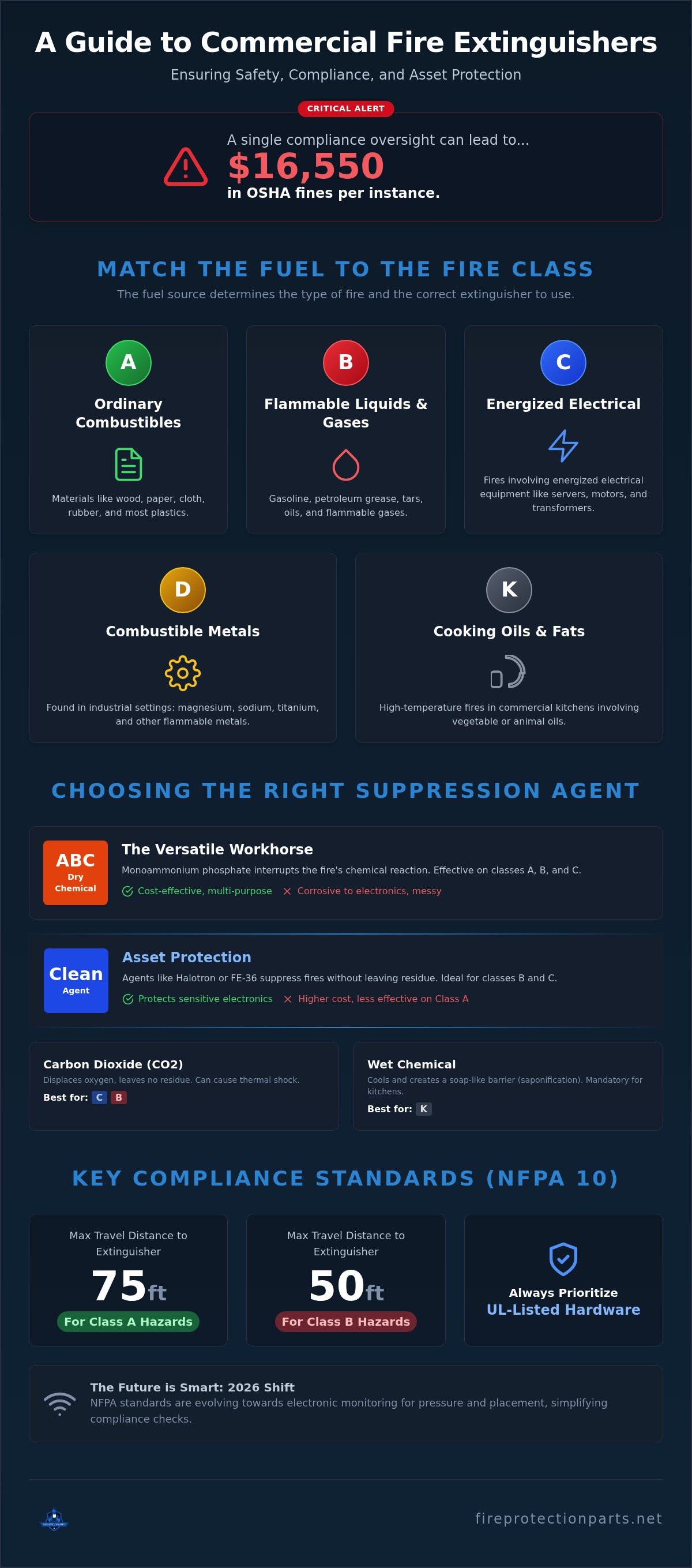
Class A hazards are universal. These involve ordinary combustibles like wood, paper, cloth, and many plastics found in every office or retail space. Class B fires involve flammable liquids and gases such as petroleum greases, tars, and oils. Class C fires are particularly tricky because they involve energized electrical equipment. If the power source is cut, a Class C fire often becomes a Class A or B fire, but while energized, you need a non-conductive agent to prevent operator electrocution.
Why Multi-Class (ABC) Extinguishers are the Commercial Standard
Monoammonium phosphate is the workhorse of the industry. It's the primary agent in ABC dry chemical units. This chemical blankets Class A fuels to prevent re-ignition and interrupts the chemical chain reaction of Class B and C fires. It's versatile and cost-effective for mixed-use environments. However, ABC units have limitations. The acidic powder is corrosive to sensitive electronics and can leave a residue that's difficult to clean in food-service areas.
Placement depends on occupancy hazard levels. Light Hazard areas, like classrooms or offices, have low amounts of combustibles. High Hazard areas, such as woodworking shops or vehicle repair bays, contain high volumes of flammable materials. NFPA 10 requires different travel distances and unit capacities based on these designations. For instance, the maximum travel distance to a Class A extinguisher is 75 feet, while Class B hazards require a shorter 50-foot distance.
Specialty Classes: When Standard Units Fail
Standard commercial fire extinguisher types often fail when facing specialty hazards. Class D fires involve combustible metals like magnesium, sodium, or titanium often found in industrial machine shops. These fires react violently with water and require dry powder agents (not to be confused with dry chemical) that smother the metal and absorb heat without causing an explosion.
Class K fires are the primary threat in commercial kitchens. These involve high-temperature cooking oils and fats. Using a standard Class A water unit on a Class K fire is a recipe for disaster. The water evaporates instantly, creating a "splash effect" that carries flaming oil across the room. Class K extinguishers use wet chemical agents that turn the oil into a non-flammable soap through a process called saponification. This cools the oil and prevents re-flash, making it mandatory for any facility with a commercial cooking line.
Commercial Extinguishing Agents: Suppression Chemistry Explained
Understanding commercial fire extinguisher types requires looking inside the canister at the chemistry of suppression. Every extinguishing agent is designed to attack at least one side of the fire triangle: fuel, heat, or oxygen. Choosing the wrong agent doesn't just fail to put out the fire; it can cause catastrophic damage to your facility's infrastructure. Adhering to OSHA fire protection standards means selecting an agent that is chemically compatible with the specific hazards of your workspace.
Water and foam agents remain the primary choice for Class A fires involving common combustibles. Water cools the fuel below its ignition point, while foam creates a physical barrier that smothers the oxygen supply. In contrast, dry chemical agents, like monoammonium phosphate, work by interrupting the chemical chain reaction of the fire itself. These are highly effective but leave a corrosive, abrasive powder behind. For energized electrical equipment, Carbon Dioxide (CO2) is often preferred. It displaces oxygen and leaves zero residue, though its extreme cold can occasionally cause thermal shock to delicate components.
The Rise of Clean Agents in 2026 Commercial Spaces
Modern commercial environments, particularly data centers and server rooms, have moved away from traditional dry chemicals. The risk of powder infiltrating circuit boards is too high. Clean agents like Halotron and FE-36 provide a solution that protects high-value assets. Halotron is a non-conductive, volatile liquid that leaves no residue. While CO2 is effective, Halotron offers a better discharge range and won't cause the same level of thermal shock to sensitive electronics. It's an essential investment for any facility housing mission-critical hardware. When planning your layout, ensuring you have the right fire protection hardware for these specialized units is a key step in professional procurement.
Wet Chemical Suppression for Commercial Kitchens
Commercial kitchens require a unique chemical approach known as saponification. When a Class K wet chemical agent is discharged onto burning cooking oil, it reacts with the fats to create a thick, soapy foam. This foam layer serves two purposes: it seals off the oxygen and cools the oil to prevent a re-flash. These extinguishers are specifically engineered to complement automatic hood suppression systems. Unlike dry units, wet chemical canisters require specific maintenance to ensure the discharge nozzles remain clear of grease buildup and the liquid agent remains at the proper pH level for effective fire suppression.
Selecting Extinguishers for Specific Commercial Environments
Choosing the right commercial fire extinguisher types depends entirely on the specific hazards present in each room of your facility. A generic approach often leads to failed inspections or, worse, equipment failure during a crisis. You must match the suppression hardware to the environment's fuel load and the value of the assets being protected. The goal is to provide enough fire-fighting power without introducing unnecessary risks to the occupants or the infrastructure.
In standard office buildings, the strategy involves balancing widespread ABC dry chemical coverage with specialized CO2 units for server closets. While ABC units handle common combustibles, the non-conductive CO2 agent prevents the destruction of expensive IT hardware. Healthcare environments present even more specific challenges. MRI suites require non-magnetic, MR-conditional extinguishers. Using a standard steel canister near a powerful magnetic field is a severe safety risk that can lead to projectile accidents.
Industrial settings like warehouses and manufacturing plants demand high-capacity protection. For logistics centers with high-piled pallet storage, 10 lb or 20 lb units are often required to manage the potential fire volume. Manufacturing floors must also account for combustible dust or chemical storage. These areas often require specialized Class D units for metal fires or high-flow extinguishers that can knock down a fire before it reaches volatile stock or flammable chemicals.
Mechanical Rooms and Fire Riser Room Requirements
Mechanical rooms house the critical infrastructure that keeps your building operational. Protecting the heart of your fire suppression system is paramount. You should ensure your sprinkler system components online are protected by strategically placed extinguishers in fire pump and riser rooms. Boiler rooms and electrical vaults should have dedicated CO2 or clean agent units placed near the entrance to allow for safe suppression without entering a confined, energized space.
Retail and Public Assembly Spaces
Public spaces require a focus on accessibility and travel distance. NFPA 10 mandates a maximum travel distance of 75 feet for Class A units in these environments. Clear visibility is non-negotiable. Every unit must be accompanied by high-visibility signage that patrons can identify instantly during an emergency. In high-traffic retail zones where vandalism is a concern, we recommend using alarmed cabinets. These protect the equipment from tampering while ensuring it remains immediately available for use by staff or emergency responders.
Installation, Mounting, and Maintenance Standards for 2026
Procurement is only the first step toward safety. Proper installation of your commercial fire extinguisher types ensures they remain accessible, functional, and legal. NFPA 10 and ADA standards dictate exactly how these units must sit on your walls. For extinguishers weighing 40 lbs or less, the top of the unit must be no more than 5 feet from the floor. Heavier units over 40 lbs are capped at a maximum height of 3.5 feet. Don't forget the 4-inch rule. The bottom of every extinguisher must sit at least 4 inches above the floor to prevent moisture damage and ensure visibility.
ADA compliance adds another layer of complexity to your layout. In corridors and walkways, any object mounted between 27 and 80 inches high cannot protrude more than 4 inches from the wall. This requirement often necessitates recessed cabinets rather than simple wall brackets. If your facility is located in a high-risk zone, standard brackets aren't enough. You need specialized restraints. Just as you prioritize seismic bracing for sprinkler systems, your extinguishers must remain secured during a tremor to prevent them from becoming projectiles or falling out of reach.
Brackets, Cabinets, and Signage Requirements
Wall type matters. A heavy 20 lb ABC unit requires a heavy-duty bracket anchored into studs, not just drywall. Recessed cabinets offer a clean, architectural look and satisfy ADA protrusion limits in tight hallways. Every installation must include high-visibility signage mounted above the unit. This ensures that even in a smoke-filled room, the location of the suppression hardware is obvious. Choosing the right mounting hardware is a critical part of your commercial fire extinguisher types strategy.
Hydrostatic Testing and Recharge Logistics
Compliance involves a strict, documented timeline. The 2026 NFPA 10 update now recognizes electronic monitoring as an alternative to manual monthly visual inspections. However, annual professional certifications remain mandatory. Beyond the yearly check, dry chemical units require a 6-year internal examination and a 12-year hydrostatic test to verify cylinder integrity. CO2 units require hydrostatic testing every 5 years. If a unit is discharged or loses pressure, you must decide between a recharge or a full replacement. For smaller 5 lb units, replacement is often more efficient. For larger, specialized canisters, professional recharging is the standard. Keeping accurate, punched maintenance tags is the only way to survive a fire marshal audit without fines.
Ready to upgrade your facility's safety hardware? Browse our full inventory of code-compliant components at Fire Protection Parts today.
Sourcing Reliable Fire Protection Hardware and Parts
Procurement is the final pillar of a robust safety strategy. Selecting the right commercial fire extinguisher types is only effective if the hardware supporting them meets the same rigorous standards. You can't afford to install unverified components when lives and property are on the line. Adherence to UL-listing and code-compliant manufacturing is the only way to guarantee that your equipment will perform under pressure. Professional contractors understand that a fire safety system is only as strong as its weakest fitting. This is why specialized e-commerce has become the preferred choice for modern procurement. It eliminates the guesswork and provides a direct line to hardware that satisfies the 2026 NFPA updates.
Integrating your extinguishers into a broader suppression strategy requires a methodical approach. It isn't enough to have the correct canister; you must ensure the mounting hardware, cabinets, and adjacent sprinkler components are fully compatible. A mismatch in threading or a bracket that can't support the weight of a 20 lb unit creates a dangerous point of failure. By centralizing your sourcing, you ensure that every piece of equipment works in unison. This creates a cohesive safety net where portable units and fixed suppression systems provide total facility protection without compromise.
Beyond the Canister: Essential Suppression Hardware
Maintaining compliance means staying ahead of daily wear and tear. Cabinets get dented in high-traffic retail zones, and mounting brackets can loosen in industrial environments. Finding fire protection parts online allows you to source exact replacements without the delays of traditional wholesale channels. Modern systems also rely on high-performance materials for their broader infrastructure. For those upgrading their suppression networks, Viking CPVC fire sprinkler pipe offers a corrosion-resistant solution that complements your portable protection units and ensures long-term reliability.
Contractor Procurement for Bulk Commercial Projects
Large-scale facility upgrades demand an efficient supply chain. Managing bulk orders for multiple commercial fire extinguisher types requires a partner that understands the urgency of construction deadlines. Lead times for specialty clean agents or seismic-rated hardware can derail a project if not managed by experts. We focus on streamlining this process, ensuring that every component arrives on-site ready for a fire marshal's inspection. Professional assurance comes from knowing your hardware is sourced from a mission-driven partner committed to excellence. Browse our full catalog of fire protection parts and safety equipment at Fire Protection Parts.
Future-Proof Your Fire Safety Strategy
Mastering the selection of commercial fire extinguisher types is the difference between a minor incident and a total loss. You've learned that the fuel source must dictate the suppression agent and that 2026 compliance requires a meticulous approach to mounting heights and seismic stability. Whether you're protecting a high-traffic retail space or a sensitive data center, your hardware must meet the latest NFPA 10 standards to ensure both safety and legal protection. Professional procurement is about more than just checking a box; it's about building a resilient environment.
Don't leave your facility's safety to chance or unverified vendors. As an authorized retailer for industry-leading fire safety brands, we provide a comprehensive stock of NFPA-compliant components and expert support for commercial contractors and facility managers. We're here to help you eliminate doubt and secure your infrastructure with hardware built for longevity and performance. Shop Code-Compliant Fire Extinguishers and Safety Parts at Fire Protection Parts today. You've done the work to understand the requirements, now it's time to equip your building with the protection it deserves.
Frequently Asked Questions
What is the most common type of fire extinguisher for commercial buildings?
The ABC dry chemical unit is the most prevalent of all commercial fire extinguisher types. It's the industry standard because it uses monoammonium phosphate to suppress the three most frequent fire classes found in offices and retail spaces: ordinary combustibles, flammable liquids, and energized electrical equipment. This versatility makes it the primary choice for general-purpose protection in mixed-use environments.
How many fire extinguishers does OSHA require in a commercial office?
OSHA requirements are based on travel distance rather than a flat count per square foot. For Class A hazards common in offices, you must provide an extinguisher every 75 feet of travel distance. If your office contains Class B hazards, such as a fuel storage area, the travel distance drops to 50 feet. You should consult your local fire code for specific density requirements based on your building's occupancy level.
Can I use an ABC fire extinguisher in a commercial kitchen?
You shouldn't rely on a standard ABC unit for a commercial kitchen's cooking line. NFPA 10 mandates Class K wet chemical extinguishers for fires involving vegetable oils and animal fats. While an ABC unit might be placed near a kitchen exit for general hazards, only Class K units are designed to handle high-temperature grease fires without causing a dangerous splash effect or re-ignition.
What is the difference between a dry chemical and a clean agent extinguisher?
The primary difference lies in the post-discharge residue and potential for collateral damage. Dry chemical units discharge a fine, corrosive powder that can destroy electronics and requires extensive professional cleanup. Clean agents use gas or volatile liquids that evaporate completely upon discharge. They leave zero residue behind, making them the preferred choice for protecting high-value assets and sensitive technology.
How often do commercial fire extinguishers need to be inspected by a professional?
Professional maintenance must occur at least once every 12 months. While building owners are responsible for monthly visual checks, a certified technician must perform a thorough annual examination of the unit's mechanical parts, seals, and extinguishing agent. Keep in mind that certain commercial fire extinguisher types also require 6-year internal inspections and 5 or 12-year hydrostatic testing to verify cylinder integrity.
What are the mounting height requirements for commercial fire extinguishers?
Mounting heights depend strictly on the weight of the unit. If the extinguisher weighs 40 lbs or less, the top of the canister can be no higher than 5 feet from the floor. For units over 40 lbs, the maximum height is 3.5 feet. Regardless of weight, the bottom of the extinguisher must be at least 4 inches off the floor to prevent moisture damage and ensure visibility.
Do I need a special fire extinguisher for my server room or data center?
Yes, you should use a clean agent or CO2 extinguisher for server rooms. Standard dry chemicals will ruin circuit boards and cause permanent hardware failure even if the fire is small. Clean agents effectively suppress energized electrical fires without leaving conductive or abrasive residue on your mission-critical equipment. This ensures you can resume operations quickly after the fire is extinguished.
What does the UL rating on a commercial fire extinguisher mean?
A UL rating measures the relative extinguishing effectiveness of the unit based on standardized tests. The number before the "A" represents the equivalent of 1.25 gallons of water, while the number before the "B" indicates the approximate square footage of a fire a professional can expect to extinguish. The "C" indicates the agent is non-conductive and safe for use on energized electrical equipment.

