



Fire Protection Fittings and Accessories: The Professional Sourcing Guide for 2026
Your fire suppression system is only as reliable as its smallest component. A single incompatible coupling or a non-compliant valve cap can compromise an entire facility's safety. You've likely felt the pressure of an upcoming inspection while wondering if your current fire protection fittings and accessories truly meet the updated 2026 NFPA standards. It's a valid concern. With hose valve inspections now required quarterly and new mandates for pressure-rated caps, the margin for error has disappeared.
You deserve a system that functions without doubt. We understand the frustration of navigating material compatibility between CPVC and steel or searching for specific seismic bracing that meets code. This guide will help you master the technical requirements and sourcing criteria for every critical fitting and accessory in your fire suppression system. We'll examine everything from anti-freeze solutions to backflow preventors, providing a clear roadmap for sourcing reliable components that ensure long-term system integrity and total compliance.
Key Takeaways
- Identify the distinct roles of grooved and threaded connections to eliminate structural vulnerabilities in high-pressure systems.
- Discover how to protect dry pipe and pre-action systems using specialized air compressors and ASC seismic bracing for maximum environmental resilience.
- Learn to verify material compatibility between legacy pipes and new fire protection fittings and accessories using a professional sourcing checklist.
- Streamline your procurement by identifying direct sources for industry-leading components from brands like Viking and PTR.
The Critical Role of Fittings in Fire Suppression Integrity
System integrity relies on the strength of its connections. While pipe runs cover the distance, fire protection fittings and accessories manage the pressure, direction, and structural stability of the entire network. In high pressure suppression systems, fittings are the primary failure points. They endure the brunt of hydraulic shock during pump activation and must maintain a leak proof seal under extreme thermal stress. If a single coupling fails, the system's ability to deliver water or suppression agents vanishes instantly.
Understanding the distinction between structural support and fluid transport is vital for long term reliability. Fluid transport components, such as elbows and tees, must facilitate laminar flow without excessive friction loss. Structural components, including ASC Seismic Bracing, ensure the system stays attached to the building during an earthquake or structural shift. Both must work in unison to prevent catastrophic mechanical failure. For a deeper look at the terminology used in the field, consult this firefighting equipment glossary to ensure your team is aligned on technical specifications.
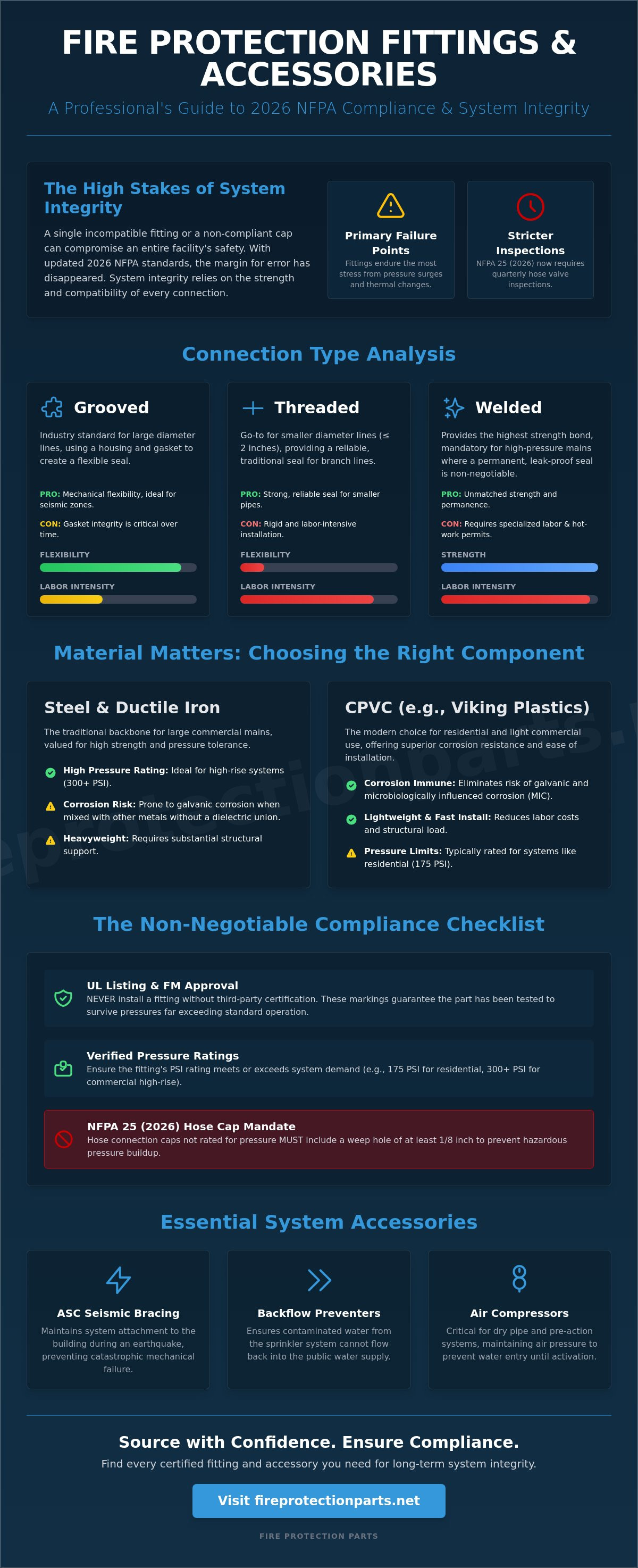
The 2026 outlook for NFPA requirements emphasizes verified pressure ratings more than ever. For instance, the 2026 edition of NFPA 25 now mandates that hose connection caps not rated for pressure must include a weep hole of at least 1/8 inch. This prevents hazardous pressure buildup behind the cap. When sourcing materials, you'll primarily choose between ductile iron, carbon steel, and CPVC. While steel remains a staple for large commercial mains, Viking Plastics CPVC Pipe offers superior corrosion resistance and ease of installation for residential and light commercial environments.
Pressure Ratings and UL/FM Certification
Insurance compliance hinges on third party verification. You should never install a fitting that lacks UL Listing or FM Approval. These certifications guarantee the part has been tested to survive pressures far exceeding standard operating levels. You can identify these markings directly on the physical fitting; they are typically embossed into the metal or printed on the CPVC surface. Standard residential systems often require fittings rated for 175 psi, while commercial high rise systems frequently demand 300 psi or higher to handle the vertical head pressure.
Material Compatibility and Corrosion Resistance
Mixing incompatible metals is a recipe for system failure. When you connect copper to steel without a proper dielectric union, you trigger galvanic corrosion that eats through the pipe wall. This is a major reason why modern fire protection fittings and accessories often feature specialized galvanized or epoxy coatings. For environments prone to microbiologically influenced corrosion (MIC), using Viking Plastics CPVC eliminates the risk of metal degradation entirely. Always verify the 'Schedule' rating of your fittings to ensure the wall thickness matches your piping environment and pressure requirements.
Types of Fire Protection Fittings: Material and Connection Analysis
The method used to join pipes determines how well a system handles vibration, pressure surges, and thermal changes. Selecting the right fire protection fittings and accessories requires a deep understanding of connection mechanics. Grooved fittings have become the industry standard for large diameter lines because they offer mechanical flexibility. These fittings use a housing and a gasket to create a seal, allowing for slight angular deflection. This movement is critical in seismic zones where rigid systems might snap under the stress of structural shifts. In contrast, threaded fittings remain the go-to for smaller diameter lines. They provide a reliable, traditional seal for branch lines where pipe diameters are two inches or less, though they require more intensive labor during installation.
Welded connections provide the highest strength but require specialized labor and hot-work permits. These are typically mandatory for high-pressure mains where a permanent, leak-proof bond is non-negotiable. For many modern projects, however, the shift toward non-metallic materials is changing the procurement landscape. Choosing the wrong connection type for your specific environment can lead to premature failure or expensive retrofits during your next inspection cycle.
CPVC Fittings for Modern Systems
Using Viking CPVC fire sprinkler pipe fittings has become the preferred choice for residential builds and corrosion-heavy environments. These components are lightweight and immune to the scaling that frequently plagues metal systems. To ensure a leak-proof joint, you must use proper solvent cement techniques. This is not a simple glue; it is a chemical weld that fuses the fitting and pipe into a single, continuous piece. You must also account for thermal expansion during the design phase. CPVC expands more than steel, so using loops or offsets is necessary to prevent excessive stress on the fire protection fittings and accessories when temperatures fluctuate.
Transition Fittings: Bridging Material Gaps
Connecting different materials is where most system leaks occur. When you need to connect CPVC to a steel riser, you cannot simply thread them together without considering the physical properties of each material. Transition fittings are engineered to bridge this gap safely by managing different expansion rates and thread patterns. Adhering to NFPA standards ensures that these transitions maintain the required system pressure ratings. A common mistake is failing to use dielectric unions when connecting copper to steel. Without these, electrochemical reactions cause rapid localized corrosion that can lead to pinhole leaks. If you are planning a system retrofit, you can find high-quality fire protection components specifically designed for these complex material transitions to ensure long-term reliability.
Essential Fire Suppression Accessories for Specialized Environments
Beyond basic pipe runs, specialized environments demand a higher tier of fire protection fittings and accessories to counter environmental threats. Systems installed in regions prone to freezing or seismic activity can't rely on standard hardware alone. Without the right accessories, your system risks mechanical failure before a fire even starts. For instance, a dry pipe system without a dedicated air compressor will quickly lose the supervisory pressure needed to hold back the water supply, leading to accidental tripping and potential water damage. It's a risk that professional contractors simply don't take.
Seismic activity presents a unique challenge for fire suppression. Rigid piping is prone to snapping when a building sways during a tremor. ASC Seismic Bracing provides the necessary flexibility and support to ensure that your life safety systems remain intact during and after an earthquake. This specialized hardware is a mandatory requirement in high-risk zones, where building codes prioritize the continued operation of fire sprinklers during structural shifts. Relying on inferior structural supports is a gamble with both property and lives.
Municipal safety is another critical factor in system design. Backflow preventors are essential accessories that stop stagnant system water from re-entering the public drinking supply. These components are strictly regulated and must be inspected to ensure they function properly under pressure. Organizations like the National Fire Sprinkler Association provide extensive resources on how these specialized components integrate into broader safety standards. When you source fire protection fittings and accessories, you must account for these environmental and regulatory variables to ensure total system reliability.
ASC Seismic Bracing and Structural Supports
Identifying high-risk seismic zones is the first step in protecting your infrastructure. Installation requires a combination of all-thread rods and sway braces to manage both lateral and longitudinal forces. Lateral bracing prevents the pipe from swinging side-to-side, while longitudinal bracing stops the pipe from moving back and forth along its axis. Using ASC hardware ensures that these structural supports meet the rigorous testing standards required for 2026 compliance. Proper spacing of these braces is vital to prevent the system from becoming a liability during a seismic event.
Monitoring and Maintenance Accessories
Accurate monitoring starts with high-quality pressure gauges. It's vital to select a gauge with a range that places your normal operating pressure in the middle third of the scale for maximum accuracy. Beyond pressure, code compliance requires clear identification. Identification signs and tags must be used to label every control valve and test connection, ensuring emergency responders can navigate the system quickly. Finally, every facility should maintain a spare sprinkler head cabinet. This cabinet doesn't just store heads; it must also contain the specific wrenches required for installation to ensure rapid restoration after a system activation.
Sourcing Fittings and Accessories for System Repairs
System repairs present a unique challenge that new installations don't. You're often walking into a mechanical room and facing decades of legacy hardware. Identifying the correct fire protection fittings and accessories for a retrofit requires precision and a systematic approach. If you guess the thread pitch or material grade, you risk a catastrophic leak during the next hydrostatic test. Sourcing from a general hardware retailer is a common mistake. These outlets rarely stock the UL listed or FM approved components required for life safety systems. You need a partner that understands the difference between a standard plumbing elbow and a pressure rated fire fitting.
Navigating lead times is another critical factor in repair logistics. When a system is tagged out of service, every hour counts. Critical components like backflow preventors or specialized air compressors aren't always available on a shelf at your local supply house. Planning for repairs involves more than just identifying the leak; it requires securing a reliable supply chain that can deliver certified parts quickly. Don't wait until the system is compromised to find a dependable source for high quality fire protection components that meet current safety codes.
Identifying Replacement Parts
Successful sourcing starts with accurate identification. Look for manufacturer logos and model numbers embossed directly on the fitting. Brands like Viking and ASC are typically easy to identify, which simplifies finding an exact match. You must measure thread types and pipe diameters with a caliper to avoid ordering errors. When you find localized corrosion, you must decide whether to replace a single fitting or an entire pipe section. If you see signs of microbiologically influenced corrosion (MIC), replacing the fitting is only a temporary fix. You'll likely need to replace the surrounding piping to prevent a repeat failure.
The Procurement Checklist for Contractors
Before you finalize any purchase, verify that the parts align with the specific system design. A part rated for an NFPA 13D residential system might not be suitable for an NFPA 13 commercial application. Use this checklist to ensure a smooth installation:
- Compliance: Verify the fitting matches the pressure rating of the existing system.
- Hardware: Ensure grooved couplings include the correct EPDM or silicone gaskets.
- Documentation: Keep all manufacturer certification sheets. The Authority Having Jurisdiction (AHJ) will often require these during the final inspection to prove the system remains compliant.
Ensuring you have the right fire protection fittings and accessories on hand before the technician arrives on site reduces labor costs and prevents system downtime.
Why Fire Protection Parts is the Professional Choice for 2026
Selecting a supplier is as critical as selecting the hardware itself. You need a partner that understands the high stakes of life safety and the nuances of 2026 regulatory updates. Fire Protection Parts serves as a specialized bridge between manufacturers and contractors. We don't just move boxes. We provide the technical expertise required to ensure every component integrates perfectly into your system. Whether you're installing Viking Plastics CPVC Pipe for a residential complex or securing a commercial riser with ASC Seismic Bracing, our role is to eliminate the doubt that often accompanies complex procurement.
Our focus remains exclusively on fire suppression. This specialization means our team speaks your language and understands the urgency of a system down scenario. We've curated a comprehensive inventory that addresses the specific pain points mentioned throughout this guide, from finding the right anti-freeze for unheated areas to sourcing high-performance air compressors for dry systems. By choosing a partner dedicated solely to this industry, you gain access to a level of professional assurance that general retailers simply can't match.
The Advantage of Specialized E-commerce
Speed defines the repair industry. When a component fails, you can't afford to wait weeks for a replacement. Our e-commerce platform is built for efficiency, offering fast shipping on critical fire protection fittings and accessories to minimize system downtime. We've streamlined the procurement process for both small-scale repairs and large-scale commercial projects. Every component we ship comes with accessible technical documentation and spec sheets. This ensures your team has the data needed for a correct installation and your records are ready for the next fire marshal visit.
Your Partner in Compliance
Compliance isn't optional. It's the foundation of your professional reputation. We vet every fitting for UL Listing and FM Approval before it ever reaches our shelves. This rigorous selection process gives you peace of mind, knowing that the hardware you install will perform under pressure. We specialize in sourcing those hard-to-find items that often stall a project, such as deluge accessories or specific seismic supports. You don't have to manage the 2026 NFPA changes alone. Browse our full catalog of fire protection fittings and accessories today and secure the components your system requires for long-term reliability.
Securing Your System for 2026 and Beyond
A high-performance fire suppression system is the sum of its parts. By mastering material compatibility and prioritizing connection flexibility, you eliminate the weak links that lead to mechanical failure. You now understand that specialized environments require more than just standard pipe; they demand engineered solutions like seismic bracing and reliable pressure monitoring to remain code compliant. Sourcing fire protection fittings and accessories should never involve guesswork. It requires a commitment to verified standards and a partner who understands the high stakes of life safety.
Fire Protection Parts provides the professional assurance you need. As an authorized distributor for Viking and ASC Engineered Solutions, we offer only UL Listed and FM Approved components. Our team delivers expert technical support to help you navigate complex NFPA compliance requirements with confidence. Don't leave your facility's safety to chance. Shop Code-Compliant Fire Protection Fittings and Accessories today. You have the knowledge to build a more resilient system. We are here to help you finish the job with excellence.
Frequently Asked Questions
What is the difference between UL Listed and FM Approved fittings?
UL Listed components have been tested by Underwriters Laboratories to meet specific safety and performance standards for their category. FM Approved fittings meet the rigorous property loss prevention standards set by FM Global, an insurance-driven organization. While both signify high quality, many commercial insurance policies require FM Approved parts to minimize risk. Using components with both certifications provides the highest level of professional assurance for your facility.
Can I use standard plumbing CPVC fittings for a fire sprinkler system?
No, you cannot use standard plumbing CPVC for fire protection. Fire rated components, such as Viking Plastics CPVC Pipe and fittings, are engineered to withstand significantly higher temperatures and pressures than domestic plumbing parts. Specialized fire CPVC contains unique compounds that prevent melting or bursting during a fire event. Using non-rated plumbing parts will result in immediate inspection failure and system compromise.
When is seismic bracing required for a fire protection system?
Seismic bracing is mandatory for systems installed in buildings located in Seismic Design Categories C, D, E, or F. It is also required for certain pipe diameters regardless of location to prevent the system from breaking during structural shifts. Using ASC Seismic Bracing ensures your system remains intact and operational after an earthquake. Local building codes and NFPA 13 provide the specific spacing and load requirements for your region.
How do I choose the right anti-freeze for my wet pipe system?
You must use a factory-premixed anti-freeze solution that is UL Listed specifically for fire protection use. Never use automotive or standard plumbing anti-freeze, as these can be flammable or damage system seals. It is vital to verify that the solution is compatible with your pipe material, especially when using CPVC. Always check the manufacturer's data sheets to ensure the mixture provides adequate freeze protection for your local climate.
What are the most common causes of fitting failure in fire systems?
The most frequent causes of failure include galvanic corrosion from mixing incompatible metals and improper solvent cement application on non-metallic lines. Excessive mechanical stress from inadequate structural support also leads to leaks at connection points. Choosing high-quality fire protection fittings and accessories with verified pressure ratings prevents these issues. Regular inspections often reveal these vulnerabilities before they lead to a catastrophic system breach.
Do I need a special air compressor for my dry pipe sprinkler system?
Yes, dry pipe systems require a dedicated air compressor designed to maintain supervisory pressure. These units must be able to restore the system's air pressure within 30 minutes to comply with NFPA standards. Unlike general-purpose compressors, these are built for the specific duty cycles and reliability needs of a life safety system. A properly sized compressor prevents the dry valve from accidental tripping and causing water damage.
What is a transition fitting and when should I use one?
A transition fitting is a specialized component used to join two different piping materials, such as connecting CPVC branch lines to a steel main. You must use them to manage the different thermal expansion rates and thread patterns of various materials. These fittings often include specialized gaskets or dielectric properties to prevent leaks and corrosion. They are essential whenever your system layout requires a change in material or connection type.
How often should fire system accessories like gauges be replaced?
NFPA 25 requires that pressure gauges be replaced or tested for accuracy every five years. If a gauge is not within 3 percent of the full scale when compared to a calibrated reference, it must be replaced. You should also install new fire protection fittings and accessories like gauges if you notice moisture inside the dial or if the needle fails to return to zero. Accurate monitoring is the only way to verify your system is ready for an emergency.

