

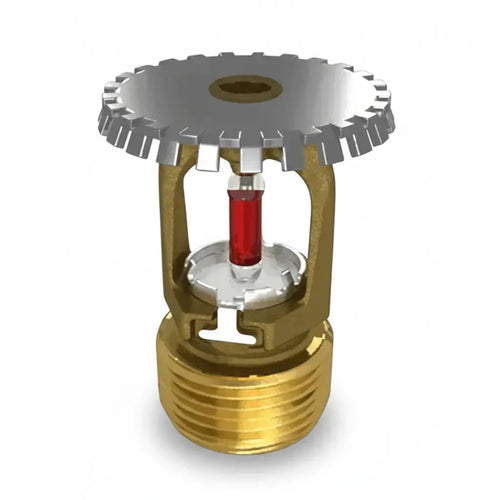


Fire Sprinkler Seismic Restraint: A Roundup of Essential Hardware & Compliance
A single loose brace can turn an entire life-safety system into a liability during an earthquake. Seismic compliance isn't just about adding a brace; it's about building a certified, engineered load-path from the pipe to the structure. When you're managing a project, the complexity of fire sprinkler seismic restraint requirements can feel overwhelming. Between the shift to Sds-based calculations in the 2025 edition of NFPA 13 and the nuances of the 2024 International Building Code, there's no room for guesswork or compromise.
You likely agree that the risk of an inspection failure or a system collapse is a burden no contractor wants to carry. We understand the frustration of hunting for UL listed and FM approved hardware that meets these rigorous new standards. This article will help you master the specific hardware components and NFPA mandates required to protect your infrastructure. We'll provide a clear list of necessary seismic parts, explain the difference between lateral and longitudinal bracing, and point you toward reliable ASC seismic bracing solutions that ensure your project stays on schedule and fully compliant.
Key Takeaways
- Discover how specialized hardware minimizes differential movement to maintain water supply and prevent pipe breakage during a seismic event.
- Identify the three essential components of a fire sprinkler seismic restraint system, ensuring your structural and pipe attachments form a certified load-path.
- Master the strategic application of lateral and longitudinal bracing to protect your system from both side-to-side sway and the telescoping effects of long pipe runs.
- Secure peace of mind by sourcing UL Listed and FM Approved hardware from trusted brands like ASC Engineered Solutions to avoid AHJ rejection.
- Simplify your procurement by combining your seismic bracing needs with your CPVC piping and sprinkler head orders for a more efficient project timeline.
Understanding the Role of Seismic Restraints in Fire Protection
Seismic events don't just shake buildings; they tear apart rigid infrastructure. A fire sprinkler seismic restraint is specialized hardware designed to minimize differential movement between a building's structure and its fire protection system. Without these restraints, the independent movement of the pipe and the ceiling can lead to catastrophic shearing. The primary goal is simple. We must prevent pipe breakage to ensure the water supply remains intact during and after a seismic event. If the piping fails, the entire fire safety strategy collapses.
Standard hangers and supports are built to handle gravity. They keep the pipe up, but they don't stop it from swinging. During an earthquake, horizontal forces can exceed the weight of the pipe itself. Standard hangers often fail under these lateral loads, leading to snapped fittings and flooded facilities. Relying on basic supports for seismic protection is a gamble that professional contractors can't afford to take.
Compliance requires a clear understanding of the relationship between NFPA 13, ASCE 7, and local building codes. In a general fire sprinkler system overview, you'll see that systems are designed for stability. However, seismic protection adds a layer of engineered load-path requirements. The 2025 edition of NFPA 13 now aligns with ASCE 7-22, moving away from simplified coefficients toward precise calculations based on the building's specific location and spectral response acceleration.
NFPA 13 Seismic Requirements and Standards
Chapter 18 of the 2025 NFPA 13 standard dictates how we secure these systems. A critical concept here is the Zone of Influence. This refers to the specific section and weight of water-filled pipe that a single brace is responsible for protecting. Brace spacing isn't arbitrary; it's a calculated response to mass and force. The standard also mandates the use of flexible couplings and specific clearance around piping. These features allow the system to move and flex without impacting structural elements, preventing the rigid breaks that cause system failure.
Seismic Design Categories (SDC) Explained
Your project's Seismic Design Category (SDC) determines your level of restraint. These categories range from A to F. SDC A and B typically represent low-risk areas where fire sprinkler seismic restraint might be exempt. However, once you reach SDC C through F, bracing becomes strictly mandatory. The Authority Having Jurisdiction (AHJ) uses the building's occupancy and geographical risk to verify the SDC. Never guess your category. A mistake here leads to inspection failure and expensive retrofits that delay project completion.
Essential Hardware Roundup: Components of a Seismic Bracing System
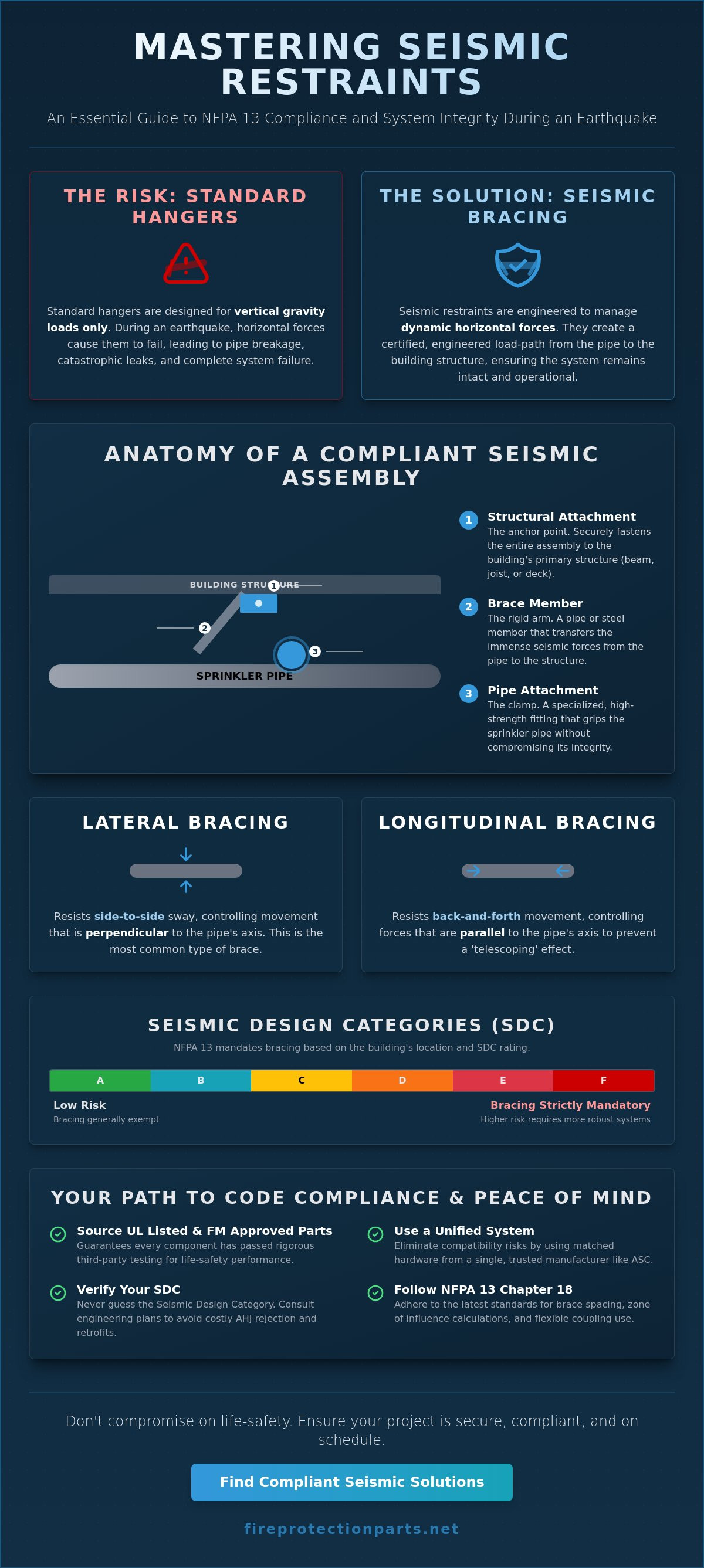
Building a compliant assembly requires more than just picking parts off a shelf. A complete fire sprinkler seismic restraint assembly consists of three critical points: the structural attachment, the brace member, and the pipe attachment. These components must work in unison to create a continuous load path from the piping to the building's skeleton. To ensure unwavering reliability, we recommend using matched components from a single manufacturer like ASC Engineered Solutions. Using a unified system eliminates the risk of mismatched tolerances that often lead to field failures during an earthquake.
Seismic hardware is fundamentally different from standard pipe clamps or hangers. While a standard hanger is designed to manage the vertical force of gravity, seismic restraints are engineered to manage dynamic horizontal energy. This is why high-strength materials like ductile iron and carbon steel dominate the market. They provide the necessary durability and ductility to resist the horizontal forces described in NFPA 13 seismic requirements. If you're looking to streamline your next project, you can find a full range of ASC Seismic Bracing components designed for rapid installation and total code compliance.
Sway Brace Attachments and Pipe Clamps
Lateral sway braces are designed to resist movement perpendicular to the pipe. In contrast, longitudinal braces control movement along the pipe's axis to prevent the "telescoping" effect of long pipe runs. Modern hardware often features break-away bolts or nuts. These provide a visual confirmation of proper torque, which significantly reduces labor costs for contractors and simplifies the process for inspectors. It's a no-nonsense way to guarantee a secure connection every time.
Structural Attachments and Adapters
The connection to the building is the anchor of the entire system. Whether you're using beam clamps for steel structures or expansion anchors for concrete, the attachment must be rated to handle the calculated horizontal force (Fp). Universal swivel attachments are particularly valuable in complex retrofits. They allow for brace angles between 30 and 90 degrees, providing the flexibility needed to navigate crowded ceiling spaces without sacrificing structural integrity.
Support Hardware: All Thread Rod and Hangers
The all thread rod acts as the backbone for vertical support, but it plays a specific role in seismic zones too. When rods exceed certain lengths, they can buckle under the upward pressure generated during a seismic event. This is where rod stiffeners become essential. By integrating these stiffeners with your existing clevis hangers, you create a robust system that stays put when the ground moves. Professional-grade rod and hangers ensure that your fire sprinkler seismic restraint system remains a single, cohesive unit under stress.
Lateral vs. Longitudinal Bracing: Strategic Application
Lateral and longitudinal bracing serve two distinct but equally vital roles in a fire sprinkler seismic restraint strategy. Lateral bracing acts as the primary defense against side-to-side sway, securing branch lines and mains perpendicular to the pipe's run. Longitudinal bracing, meanwhile, addresses the axial energy that causes long pipe runs to telescope or move back and forth along their length. Understanding the Evolution of Seismic Design helps explain why these two vectors must be managed independently to prevent system failure during a tremor.
Code requirements for spacing are precise. Lateral braces are typically required at maximum intervals of 40 feet, while longitudinal braces can be spaced up to 80 feet apart. These distances aren't arbitrary; they're based on the pipe's ability to resist bending and the brace's capacity to absorb horizontal force. For riser systems, "4-Way" bracing is mandatory. This specialized assembly combines lateral and longitudinal components to control movement in every direction simultaneously, anchoring the vertical supply line to the building's core.
Lateral Bracing Placement and Dynamics
Requirements for placement go beyond simple measurements. You must install a lateral brace within 6 feet of the end of a main and at the top of every riser. Calculating the Zone of Influence (ZOI) for each brace is the only way to ensure compliance. The ZOI accounts for the total weight of the water-filled pipe that a single restraint must manage. A common field mistake is orienting the brace at an inefficient angle. To maintain maximum load capacity, always ensure the brace is installed within the manufacturer's tested range, typically between 30 and 90 degrees from the vertical plane.
Longitudinal Bracing for Main Runs
Longitudinal braces are critical for large-diameter piping where the mass of the water creates significant momentum. NFPA 13 requires these braces to prevent the pipe from sliding through its standard hangers during a seismic event. When a pipe changes direction at an elbow or tee, the force dynamics shift. In these scenarios, a brace on one run might provide offset bracing for the adjacent run, provided the connection is within code-mandated distances. You must also account for flexible couplings. While these couplings allow for necessary movement, they can increase the demand on longitudinal restraints to keep the system aligned under stress.
Sourcing Code-Compliant Parts: UL Listing and FM Approval
Safety in fire protection isn't an accident; it's a result of rigorous testing. When selecting a fire sprinkler seismic restraint, you'll encounter two primary certifications: UL Listing and FM Approval. While UL focuses on safety and performance testing to established national standards, FM Approvals are driven by property loss prevention and insurance requirements. Both certifications signify that a component has been pushed to its limits and passed. Using generic, non-certified hardware is a recipe for project delays. Authorities Having Jurisdiction (AHJs) will often reject 'generic' bracing because it lacks the verified data needed to prove it can withstand a seismic event.
Reading a submittal sheet correctly is the only way to ensure your hardware matches the engineer's load requirements. These sheets provide specific horizontal design load ratings that change based on the angle of the brace. For example, a brace installed at a 45-degree angle will have a different capacity than one at 90 degrees. If you skip this verification, you risk installing a system that looks right but fails under pressure. Don't compromise your project's integrity by mixing and matching components from different manufacturers. Systems are tested as a complete assembly; using a structural attachment from one brand and a pipe clamp from another voids the listing. To get it right the first time, you can buy ASC Seismic Bracing through our online store.
The Criticality of UL/FM Load Ratings
Load ratings are not static numbers. They are dynamic values influenced by the installation angle and the physical properties of the brace member. A key technical metric is the "least radius of gyration," which determines the slenderness ratio of the brace. To prevent buckling during a tremor, NFPA 13 requires this ratio to stay below 300. UL testing ensures performance under cyclic seismic loading by subjecting the hardware to repeated, high-intensity stresses that mimic the actual movement of the ground. This verification gives you the confidence that your system won't just hold up once, but will remain functional throughout the entire duration of an earthquake.
Verification Checklist for Procurement
Before any hardware arrives on-site, establish a verification process. Check for embossed manufacturer marks on every structural and pipe attachment to confirm authenticity. You must also ensure the finish-whether it's pre-galvanized, hot-dipped galvanized, or painted-meets the environmental requirements of the facility. Finally, verify that every piece of hardware matches the specific horizontal force (Fp) calculations provided by the fire protection engineer. This methodical approach eliminates doubt and ensures your fire sprinkler seismic restraint installation passes inspection without a hitch.
Procuring Reliable Seismic Restraint Solutions from Fire Protection Parts
Successfully meeting fire sprinkler seismic restraint requirements requires a procurement partner who understands the high stakes of life safety. We know that project delays often stem from fragmented supply chains and backordered components. By choosing Fire Protection Parts as your primary source for ASC Seismic Bracing, you gain access to a streamlined inventory designed for professional contractors. We specialize in providing the heavy-duty hardware that satisfies both the engineering specifications and the rigorous demands of the AHJ.
Sourcing all your sprinkler components from a single vendor provides a distinct advantage in project management. When you bundle your seismic hardware with CPVC pipe, residential fire pumps, or dry pendent sprinklers, you ensure that every part of the system is designed to work together. This holistic approach eliminates the compatibility risks that often arise when mixing components from multiple suppliers. It also simplifies your documentation process, as you can manage all your submittals and technical data through one reliable channel.
Our online store is built for speed and precision. You can quickly search for specific Tolco-style part numbers or browse categories to find the exact universal swivel attachments and pipe clamps required for your load-path calculations. If you're managing a complex procurement list for a large-scale commercial retrofit, our team provides the expert support needed to verify that your order aligns with your seismic design category. We don't just sell parts; we provide the professional assurance that your system is built to last.
ASC Engineered Solutions and Seismic Innovation
We carry an extensive inventory of ASC/Tolco-style hardware because it represents the gold standard in seismic innovation. These components are engineered for ease of installation, featuring visual verification tools like break-away bolts that guarantee proper torque without specialized equipment. Our commitment to stocking code-compliant parts means you won't have to wait weeks for critical attachments. We prioritize immediate shipping for our seismic bracing inventory to keep your project on schedule and your facility protected.
Streamlining Your Fire Safety Project
Efficiency is the cornerstone of a successful installation. For large-scale commercial seismic retrofits, we offer robust support for bulk ordering to ensure you have every brace and rod stiffener needed for the entire job site. You can access technical data sheets and UL/FM submittals directly through our platform, allowing you to provide the necessary proof of compliance to inspectors instantly. Don't leave your system's integrity to chance. Browse our full selection of Seismic Bracing and Hardware today to secure the high-impact components your project demands.
Build a Defensible Life-Safety System
Protecting a facility requires more than a checklist; it demands a commitment to engineering excellence. You now understand that a compliant fire sprinkler seismic restraint strategy relies on a verified load-path, matched UL/FM hardware, and precise bracing intervals. By distinguishing between lateral and longitudinal forces and following the updated 2025 NFPA 13 standards, you eliminate the guesswork that leads to inspection failure and system collapse. This methodical approach ensures that your infrastructure is prepared for the dynamic energy of a seismic event.
Don't leave your project's compliance to chance. As an authorized distributor of ASC Engineered Solutions, Fire Protection Parts provides the professional-grade hardware you need to meet the most rigorous safety codes. We offer expert technical support to help you navigate complex NFPA requirements and ensure fast shipping on all critical fire safety components. Secure Your System with Code-Compliant Seismic Bracing and gain the peace of mind that comes from using industry-leading protection. Your commitment to excellence today ensures your system remains standing when it matters most.
Frequently Asked Questions
What is the difference between a sway brace and a seismic restraint?
A sway brace is a specific component used to resist horizontal movement, while "seismic restraint" refers to the entire category of hardware and design features. While all sway braces are seismic restraints, not all restraints are sway braces. For instance, flexible couplings and pipe clearances also act as restraints by allowing controlled movement without pipe breakage.
When is seismic bracing required for fire sprinkler systems according to NFPA 13?
Seismic bracing is mandatory for systems located in Seismic Design Categories (SDC) C, D, E, and F. The 2025 edition of NFPA 13 uses the design spectral response acceleration (Sds) to determine these requirements. If your building is in a high-risk zone, you must install an engineered bracing system to protect the life-safety infrastructure and ensure the system remains functional after an earthquake.
Can I use standard pipe clamps for seismic bracing?
You cannot use standard pipe clamps for seismic applications because they aren't rated for horizontal loads. A code-compliant fire sprinkler seismic restraint requires hardware that has undergone cyclic testing and carries a UL Listing or FM Approval. Standard clamps are designed for vertical gravity loads only and will likely fail during the side-to-side shaking of an earthquake.
What is a 4-way brace and where is it required?
A 4-way brace is an assembly that provides both lateral and longitudinal restraint at a single point, typically required for risers. NFPA 13 mandates these at the top of risers and at specific intervals on long vertical runs. They prevent the riser from swaying in any horizontal direction, which protects the critical connection between the underground supply and the overhead piping system.
Do I need seismic bracing for residential fire sprinkler systems (NFPA 13D)?
Most one- and two-family residential systems installed under NFPA 13D don't require seismic bracing. However, multi-family dwellings or hotels falling under NFPA 13R must follow more stringent requirements. If you're using Viking Plastics CPVC pipe in these larger residential structures, you must verify the Seismic Design Category with your local building department to ensure full compliance and safety.
How do I calculate the spacing for seismic braces?
Spacing is determined by the weight of the water-filled pipe and the capacity of the brace, with maximum intervals of 40 feet for lateral and 80 feet for longitudinal braces. You must calculate the "Zone of Influence" to ensure the total load doesn't exceed the brace's rated capacity at its installed angle. Professional submittal sheets are used to verify these distances and ensure the load path is secure.
What are rod stiffeners and when are they necessary in seismic zones?
Rod stiffeners are steel angles or channels clamped to all-thread rods to increase their rigidity and prevent buckling. They're necessary when the vertical support rod is long enough to exceed the slenderness ratio limits during an upward seismic surge. Adding these stiffeners ensures your fire sprinkler seismic restraint remains stable and keeps the piping from jumping out of its hangers during intense ground movement.
Why is FM Approval important for seismic hardware?
FM Approval is critical because it signifies the hardware has passed the property-protection standards of FM Global, which often exceed minimum NFPA requirements. These standards ensure a higher level of reliability for high-value commercial and industrial facilities. For many large-scale projects, using FM Approved hardware is a non-negotiable requirement for insurance compliance and long-term risk mitigation.

