

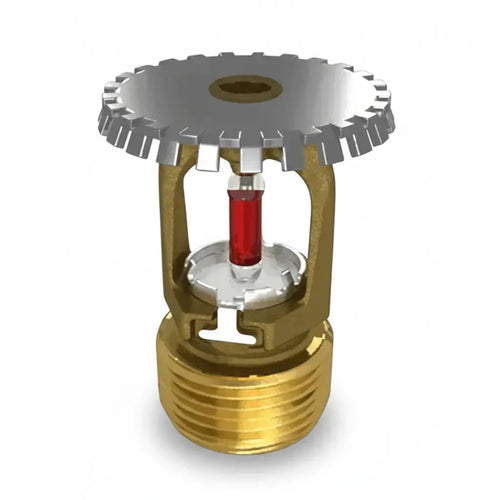


Grooved Fire Protection Fittings: The 2026 Professional Buyer’s Guide
Did you know that utilizing grooved fire protection fittings can reduce your on-site labor costs by 30% to 50% compared to traditional welding? In a high-stakes environment where safety is non-negotiable, the pressure to deliver a reliable, zero-leak system under tight deadlines is constant. You are likely dealing with the headache of rising labor expenses and the ongoing confusion over evolving UL/FM compliance requirements.
This 2026 professional buyer's guide is designed to eliminate that uncertainty. We will help you master the technical nuances of grooved piping systems to ensure faster installation, full NFPA compliance, and long-term suppression reliability. You will gain the expert confidence needed to make procurement decisions that protect both your budget and your building's occupants. Our goal is to provide total peace of mind through professional expertise.
We will examine the critical 2025 NFPA 13 updates, the performance standards of UL 213, and why ASTM A536 ductile iron remains the gold standard for durability. From choosing between rigid and flexible couplings to understanding the latest IoT-integrated monitoring trends, this guide provides the functional remedies you need for a modern fire suppression strategy.
Key Takeaways
- Learn the mechanical differences between rigid and flexible housings to ensure your configuration handles system movement correctly.
- Discover how to use mechanical tees and reducers to create efficient branch lines without the need for complex welding.
- Master the verification of UL Listing and FM Approval for grooved fire protection fittings to eliminate compliance risks during final inspections.
- Gain the expertise to interpret manufacturer submittal sheets and pressure ratings for high-stakes industrial environments.
- Understand how modular grooved designs simplify future system modifications, ensuring your infrastructure remains adaptable and reliable.
The Evolution of Fire Protection: Why Grooved Fittings Are the New Standard
Traditional fire sprinkler installation once required the grueling process of threading heavy steel or managing dangerous welding arcs. Today, the industry has pivoted toward a more efficient mechanical solution. A grooved fitting works by utilizing a roll or cut groove on the pipe end, which is then encased in a mechanical coupling housing. This shift from welding to mechanical joining isn't just about convenience. It's about maintaining a competitive edge in a market where labor is scarce and safety standards are tighter than ever.
The technology, pioneered by the originator of the grooved pipe couplings joining system, has become the standard for wet pipe, dry pipe, and deluge systems. By choosing grooved fire protection fittings, contractors can avoid the complexities of traditional pipe joining while ensuring a system that meets modern seismic and pressure requirements. These components provide a modular approach to fire suppression, allowing for quick adjustments as building layouts evolve.
Speed and Labor Savings in System Assembly
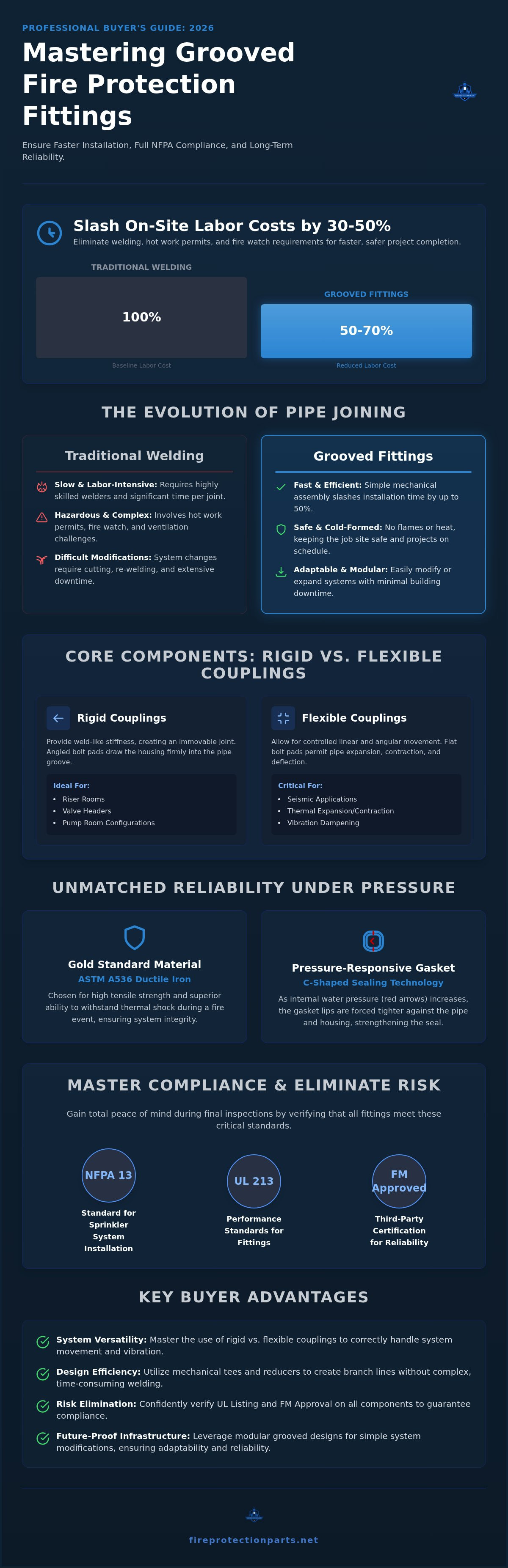
In 2026, labor remains the most significant variable in any project's budget. Grooved systems can slash installation time by up to 50%. This efficiency comes primarily from eliminating hot work permits. You no longer need to clear a floor or post a fire watch just to join two pipes. It's a cold process that keeps the job site safe and the project on schedule.
Maintenance is equally streamlined. If a system needs a repair, you don't have to cut and re-weld. You simply unbolt the coupling. This minimizes building downtime, which is critical for facility managers who can't afford to have their fire suppression offline for days. Furthermore, the visual verification feature allows inspectors to confirm a secure joint by checking that the bolt pads are properly seated. It removes the guesswork from the assembly process and ensures a reliable installation every time.
Reliability Under High-Pressure Conditions
Reliability is the heartbeat of fire protection. These fittings aren't just fast; they are incredibly strong. Most housings are manufactured from ASTM A536 ductile iron. This material is chosen for its high tensile strength and its ability to withstand the thermal shock of a fire event without compromising the system's integrity.
The real magic happens inside the housing where the coupling and gasket work in tandem to create a permanent, leak-proof seal. A pressure-responsive gasket is a specialized C-shaped seal designed so that increasing internal water pressure actually forces the gasket lips tighter against the pipe and the coupling housing. This ensures that as the demand on the system grows, the integrity of the joint increases. It's a functional remedy for the risks of high-pressure environments, providing the peace of mind that your fire suppression system will perform exactly when it's needed most.
Understanding the Core Components: Rigid vs. Flexible Grooved Couplings
Selecting the right grooved fire protection fittings is a critical technical decision. It's not just a matter of preference. The choice between rigid and flexible designs determines how your system responds to pressure, vibration, and environmental shifts. According to NFPA 13, specific applications require one over the other to maintain system integrity. You can identify a rigid coupling on the job site by its angled bolt pads. These pads draw the housing into the pipe groove to create a firm, immovable joint. In contrast, flexible couplings often feature flat bolt pads, allowing for a calculated degree of movement.
Regardless of the type, proper gasket lubrication is essential for long-term performance. Without it, the EPDM gasket can pinch during the assembly process. This leads to immediate leaks or premature failure. High-quality grooved fire protection fittings are designed to provide a zero-leak seal, but they rely on correct installation techniques to succeed. Ensuring your team understands these nuances eliminates doubt during the final pressure test.
Rigid Couplings: When Stability is Paramount
Rigid couplings provide weld-like stiffness for your piping network. They are the preferred choice for riser rooms, valve headers, and pump room configurations where precise alignment is mandatory. By gripping the pipe ends tightly, they eliminate sagging in long horizontal runs. This stability ensures that heavy system components remain exactly where they were installed, preventing unwanted stress on connected equipment. It's the standard solution for maintaining a professional, orderly mechanical room.
Flexible Couplings: Managing Seismic and Thermal Movement
Flexible couplings act as the functional remedy for systems subject to external stress. They allow for angular deflection and axial displacement without compromising the seal. This flexibility is vital for absorbing the intense vibrations generated by fire pumps. In high-earthquake zones, these joints are indispensable. They must be integrated with seismic bracing for sprinkler systems to allow the pipes to move with the building's structure rather than snapping under tension. If you are designing for a complex layout, you can view our full inventory to find the right balance of rigid and flexible components for your project.
Beyond the Coupling: Mechanical Tees, Reducers, and Flange Adapters
While couplings provide the primary connection, the modular nature of grooved fire protection fittings allows for highly complex building layouts. You don't need a welder to create a branch or a transition. Instead, you use a series of specialized components designed for speed and precision. This versatility is why professionals prioritize sprinkler system components online when planning new builds or retrofits. By utilizing a modular inventory, you can adapt to on-site changes without waiting for custom fabrication.
The transition between different pipe materials and standards is a common pain point. High-quality grooved fire protection fittings solve this by providing a reliable interface between steel, flanged equipment, and even specialized plastics. Having these components on hand ensures that the physical attributes of your system remain consistent, regardless of the complexity of the design.
Mechanical Tees: Simplifying Branch Lines
Mechanical tees have revolutionized how we branch off main lines. In the past, you'd have to perform a 'fish-mouth' weld, which is labor-intensive and prone to error. With a mechanical tee, you simply cut a hole in the pipe, place the housing, and tighten the bolts. This hole-cut method is perfect for adding new sprinkler heads to an existing system without a full teardown. You can choose between threaded outlets for smaller drops or grooved outlets for larger branch lines, depending on your hydraulic requirements.
Concentric vs. Eccentric Reducers
Managing pipe size transitions is about more than just fitting pieces together. It's about fluid dynamics. Concentric reducers are the standard for vertical risers where gravity helps prevent air entrapment. However, horizontal lines require eccentric reducers to keep the top of the pipe level. This prevents air pockets from forming, which could cause corrosion or system delays. NFPA 20 requires eccentric reducers to be installed with the flat side on top when used in fire pump suction lines to prevent air from entering the pump casing.
Grooved Flange Adapters: Bridging the Gap
Bridging the gap between different piping standards is often the most confusing part of procurement. Grooved flange adapters allow you to connect your steel system directly to flanged valves, pumps, and other heavy equipment. These components must match ANSI/ASME bolt patterns to ensure a secure fit. This is also where you manage the transition to other materials, such as Viking CPVC fire sprinkler pipe, using specialized adapters that maintain the integrity of the entire suppression network.
Selection Guide: Code-Compliant Grooved Products
Selecting grooved fire protection fittings is a matter of legal and operational survival. Using non-listed fittings in a life-safety system is a gamble you cannot afford to take. Insurance providers and local authorities will reject any installation that lacks verifiable certification. This rejection leads to costly project delays and significant liability. To avoid these risks, you must develop a rigorous procurement framework that prioritizes documented performance over initial cost savings.
When you source fire protection parts online, you must prioritize specialists who provide full manufacturer submittal sheets. These documents are your primary tool for verifying pressure ratings. In 2026, standard grooved couplings are often rated for 300 PSI, but high-rise or industrial configurations may require components rated for 500 PSI or higher. Always match the fitting's rated working pressure to the maximum potential pressure of your specific system. To ensure your project remains on schedule and fully compliant, browse our UL/FM certified grooved products to find components that meet these rigorous standards.
Material Grades and Corrosion Resistance
ASTM A536 Ductile Iron is the industry standard for grooved fittings because of its exceptional tensile strength and durability. It provides the structural integrity needed to withstand the hydrostatic pressure and thermal shock of a fire event. You must also consider the pipe preparation method. Roll-grooving is the standard for most sprinkler piping, but you must ensure your fittings are compatible if your project utilizes cut-grooved heavy-wall pipe. Corrosion protection is the final variable in material selection. While standard orange paint is sufficient for most indoor wet systems, galvanized or epoxy coatings are necessary for high-moisture environments or outdoor installations to prevent premature system degradation.
Certification Standards: UL Listing and FM Approval
UL Listing is non-negotiable for insurance compliance and adherence to local building codes. It serves as verified proof that the component has passed rigorous testing specifically for fire protection service. FM Approval provides an additional layer of professional assurance, particularly in high-hazard industrial settings where property loss prevention is the primary goal. Beyond the housing, you must verify that the fitting gaskets are compatible with your system's environmental conditions. Check that your gasket selection aligns with your fire sprinkler head temperature ratings to ensure the seal remains effective under the expected thermal load of your facility.
Optimizing Your System with Grooved Products from Fire Protection Parts
Mastering the technical complexities of fire suppression requires more than just engineering knowledge. It requires access to reliable, high-performance hardware that you can trust when the pressure rises. Fire Protection Parts offers a comprehensive collection of 91+ grooved fire protection fittings designed specifically for steel sprinkler systems. By sourcing your couplings, mechanical tees, and reducers from a single trusted vendor, you eliminate the risk of component mismatch. This unified approach streamlines your procurement and ensures that every part of your suppressive network adheres to the same rigorous quality standards.
Our modular designs are built to accommodate future system modifications with total ease. As building requirements change or retail spaces are remodeled, the ability to quickly unbolt and reconfigure your piping is a significant operational advantage. You don't have to deal with the extensive downtime or safety hazards associated with cutting and welding. Instead, you can browse our Grooved Products Collection to find the exact components needed to keep your project moving forward. We focus on providing the physical attributes and performance you need to maintain a zero-leak environment.
Standout Products for Commercial and Residential Use
We provide specialized solutions tailored to every environment. For overhead installations in large commercial warehouses, our lightweight rigid couplings are a favorite among contractors. They reduce physical strain during assembly while providing the stiffness required for long, straight pipe runs. In retail and office spaces where tenant improvements are frequent, our mechanical tees allow for rapid system expansions. You can add new drops for sprinkler heads in a fraction of the time it takes with traditional methods. For riser rooms and pump stations, our durable flange adapters provide the rugged connectivity needed to bridge the gap between your grooved network and flanged equipment.
Why Sourcing from Fire Protection Parts Ensures Compliance
We act as your mission-driven partner in safety. Our commitment to providing only code-compliant, professional-grade hardware means you never have to doubt the integrity of your suppressive system. Every item in our inventory is selected for its strength and longevity. We understand that identifying the correct grooved fire protection fittings for your specific pipe schedule can be a challenge. That's why we offer expert support to guide you through the technical details, ensuring your selection meets all current NFPA requirements. Don't leave your building's safety to chance. Shop our complete Grooved Products collection today to secure the reliability and peace of mind your project deserves.
Build a Future-Ready Fire Suppression Infrastructure
Transitioning to a mechanical joining system is the most effective way to combat rising labor costs while maintaining strict code compliance. You've seen how the right choice between rigid and flexible couplings can prevent system fatigue and how modular components like mechanical tees simplify complex retrofits. These technical decisions are the foundation of a reliable, zero-leak fire protection strategy. By mastering these nuances, you ensure your suppression network is built for long-term performance and ease of maintenance.
Choosing high-quality grooved fire protection fittings ensures your system remains adaptable for decades. We provide the professional-grade hardware required to eliminate doubt on the job site. With over 90 specialized products in stock, our inventory features UL Listed and FM Approved components designed for maximum safety. Our ductile iron construction guarantees structural integrity in the most demanding environments, giving you total peace of mind during every inspection. It's time to invest in a solution that prioritizes both speed and safety.
Secure Your System: Shop Professional Grooved Fittings
Taking the right steps today protects your building and its occupants for years to come. We are here to help you build with confidence and professional assurance.
Frequently Asked Questions
What is the difference between a rigid and a flexible grooved coupling?
Rigid couplings create a stiff joint that prevents any angular or axial movement, making them ideal for long straight runs and riser rooms where stability is mandatory. Flexible couplings allow for a specific degree of deflection and displacement. This flexibility is essential for absorbing seismic shifts and fire pump vibrations. You can distinguish them by their bolt pads; angled pads typically indicate a rigid design, while flat pads are found on flexible versions.
Can I reuse grooved couplings and gaskets if I relocate a pipe?
You can often reuse the ductile iron housings if they show no signs of deformation, cracking, or corrosion. However, you should always replace the EPDM gaskets when relocating or reassembling a joint. Gaskets take a set over time and may not provide a zero-leak seal once disturbed. Reusing old gaskets in grooved fire protection fittings is a risk that could lead to system failure during a high-pressure event.
Do grooved fire protection fittings require a specific type of pipe?
These fittings are primarily designed for use with carbon steel or galvanized steel pipe. The pipe ends must be prepared with either a roll groove or a cut groove that matches the fitting's specifications. While steel is the industry standard, specialized adapters allow for transitions to other materials like CPVC. Always verify that your pipe schedule and material are compatible with the specific coupling housing to prevent galvanic corrosion or joint failure.
Are grooved fittings UL Listed and FM Approved for fire sprinklers?
Most professional-grade grooved fire protection fittings are both UL Listed and FM Approved. These certifications are non-negotiable for insurance compliance and adherence to NFPA standards. UL Listing confirms the product has passed rigorous safety testing for fire service under UL 213. FM Approval indicates the component meets the high loss-prevention standards required for industrial environments. Always check the manufacturer's submittal sheets to verify these listings before procurement.
How do I know if I need a roll groove or a cut groove for my fittings?
Your choice depends on the wall thickness of your pipe. Roll-grooving is the most common method for Schedule 10 and Schedule 40 steel pipe because it displaces the material without removing it, maintaining pipe strength. Cut-grooving is reserved for heavy-wall pipe where removing material won't compromise structural integrity. Using a roll-groove fitting on a cut-grooved pipe can lead to improper seating and eventual leaks, so always match the tool to the pipe schedule.
Can I mix different brands of grooved fittings and couplings in one system?
Mixing different brands of couplings and fittings within a single system is generally discouraged by manufacturers and authorities. While many components appear similar, subtle differences in housing dimensions and gasket profiles can compromise the joint's integrity. To ensure full NFPA compliance and maintain your warranty, it's best to source all components from a single trusted vendor. This consistency eliminates technical doubt and ensures every joint performs exactly as engineered.
What is the pressure rating for standard ductile iron grooved fittings?
Standard ductile iron fittings for fire protection are typically rated for a working pressure of 300 PSI. This is sufficient for the majority of commercial and residential sprinkler systems. However, high-rise buildings and industrial facilities often require high-pressure ratings of 500 PSI or more to handle increased hydrostatic demands. Always consult the submittal data for the specific fitting to ensure it can handle the maximum potential pressure of your suppression system without risk of rupture.
Do grooved fittings require special tools for installation?
You will need a dedicated grooving tool, either manual or power-driven, to prepare the pipe ends according to ANSI/AWWA C606 standards. Once the pipe is grooved, the actual assembly only requires standard hand tools like a socket wrench or an impact driver to tighten the bolts. This simplicity is a major driver of the 30% to 50% labor savings compared to welding. No specialized welding rigs or hot work permits are necessary for a standard installation.

