



How to Choose Antifreeze for Wet Pipe Systems: 2026 Guide
Pouring the wrong chemical into a fire sprinkler line doesn't just invite pipe damage; it can turn a life-safety system into an active flammability hazard. If you are trying to figure out how to choose antifreeze for wet pipe system installations or retrofits, the stakes couldn't be higher. Between NFPA mandates banning field-mixed legacy fluids and the genuine risk of chemical incompatibility degrading CPVC piping, you cannot afford any guesswork.
You already know that any zone dropping below 40°F requires dependable freeze protection, but sorting through strict UL 2901 listings and local AHJ expectations can feel daunting. This guide shows you how to select a code-compliant, factory-premixed solution that matches your local design temperatures and safeguards your pipe metallurgy. We cover certified formulations, hydraulic volume rules, and the exact testing framework needed to keep your system safe and compliant.
Key Takeaways
- Understand mandatory NFPA 13 and NFPA 25 requirements governing factory-premixed, UL 2901-listed fire suppression fluids.
- Discover how to choose antifreeze for wet pipe system layouts by evaluating local minimum temperatures against product freeze ratings.
- Ensure complete chemical compatibility across metallic systems and CPVC piping to stop stress cracking or gasket degradation.
- Master accurate pipe volume calculation methods and flushing protocols to prevent dilution during system refilling.
- Learn the required annual testing benchmarks using calibrated digital refractometers to maintain AHJ compliance.
Understanding Wet Pipe Freeze Protection: Why Antifreeze Selection Matters
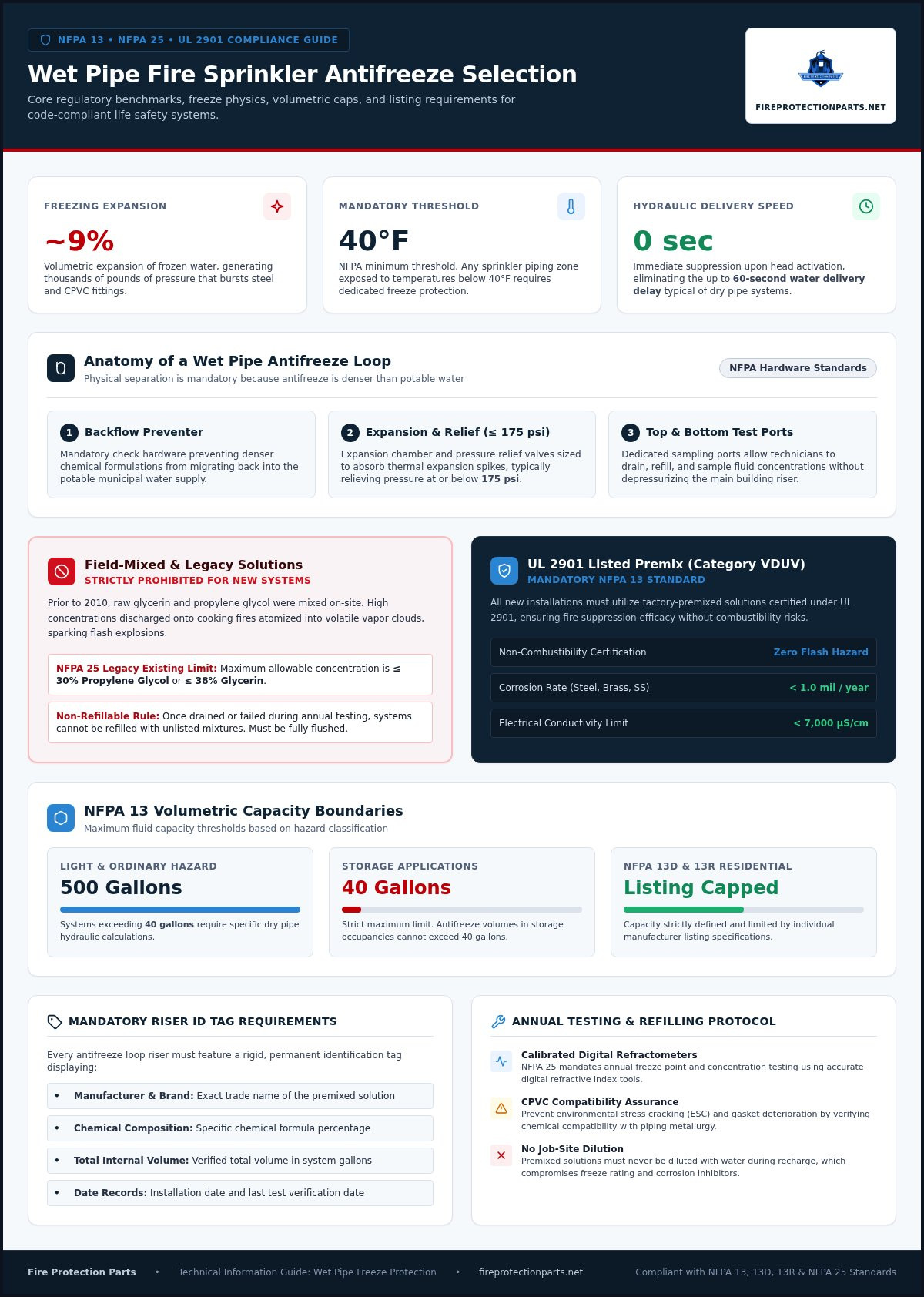
Water expands by roughly 9% when it freezes. Inside a closed network of steel or CPVC pipe, that expansion generates thousands of pounds of pressure, splitting fittings and causing immediate building flooding upon thaw. NFPA standards mandate that any space dropping below the critical threshold of 40°F must have dedicated freeze protection. Understanding fire sprinkler system mechanics clarifies why an antifreeze loop is often the most dependable defense. Unlike dry systems that introduce up to a 60-second water delivery delay while air vents through open heads, a charged antifreeze loop delivers immediate hydraulic suppression without freezing.
The Mechanics of Antifreeze Loops in Wet Pipe Systems
An antifreeze system isn't simply standard piping filled with chemicals; it relies on precise physical separation. Because antifreeze solution is denser than potable water, piping configurations must use drops and trapped loops to prevent chemical migration into the main supply lines. Code requires dedicated hardware to safeguard this boundary:
- Backflow preventers: Prevent the chemical solution from contaminating potable municipal lines.
- Expansion chambers and relief valves: Accommodate thermal expansion without causing extreme pressure spikes, typically relieving at 175 psi or lower.
- Dedicated fill and test ports: Allow technicians to drain, fill, and sample fluids at the top and bottom of the loop without depressurizing the building riser.
The Fire Safety Hazard of Legacy Unlisted Mixtures
Understanding how to choose antifreeze for wet pipe system compliance requires recognizing why legacy formulas disappeared. Prior to 2010, contractors mixed bulk raw glycerin or propylene glycol directly on job sites. In severe incidents between 2009 and 2010, high-concentration solutions discharged from sprinkler heads directly onto cooking fires. Instead of suppressing the flames, the atomized fluid ignited into volatile vapor clouds, sparking flash explosions. Today, safety codes forbid on-site chemical mixing entirely. System owners must deploy factory-premixed, UL-listed solutions engineered to suppress fire instantly rather than fueling it.
NFPA Standards and UL 2901: Mandatory Regulatory Compliance Criteria
Regulatory compliance is no longer a grey area. NFPA 13 mandates that all new antifreeze installations use factory-premixed solutions certified under UL 2901 (Category VDUV). In existing facilities, NFPA 25 allows legacy unlisted solutions to remain only if annual testing verifies concentrations stay at or below 30% propylene glycol or 38% glycerin by volume. Once an existing fluid fails testing or the system gets drained for maintenance, you cannot refill it with unlisted chemical mixtures. You must flush the line and recharge it with a listed formulation. Installing non-compliant chemicals exposes building owners to denied insurance claims, severe civil liability, and immediate AHJ failure citations.
NFPA 13, 13D, and 13R System Requirements
Occupancy classifications dictate design boundaries. In commercial NFPA 13 designs, standard UL-listed solutions can protect Light Hazard and Ordinary Hazard occupancies up to 500 gallons, though systems over 40 gallons require specific dry pipe hydraulic calculations. Storage occupancies remain strictly capped at 40 gallons. For residential applications under NFPA 13D and 13R, system capacity is similarly capped under manufacturer listings. Every system riser must display a permanent, rigid identification tag indicating:
- The solution manufacturer and brand name
- The specific chemical composition
- Total internal system fluid volume
- Date of installation and last test verification
What UL 2901 Listing Validates
Understanding how to choose antifreeze for wet pipe system layouts means recognizing what the testing standard actually guarantees. Meeting UL 2901 certification standards ensures three non-negotiable safety benchmarks:
- Non-combustibility: Discharged droplets cannot atomize into flammable vapor clouds over a fire source.
- Corrosion control: The chemistry maintains metal loss under 1.0 mil per year across carbon steel, brass, and stainless steel, while maintaining electrical conductivity below 7,000 µS/cm to halt galvanic deterioration.
- Plumbing compatibility: Solutions pass health effect criteria to prevent cross-contamination hazards in municipal backflow setups.
Sourcing factory-sealed fluids from trusted distributors like Fire Protection Parts gives contractors direct verification that every drum meets these strict UL criteria before it reaches the job site.
Core Technical Criteria: How to Choose the Correct Antifreeze Solution
Selecting the right fluid requires evaluating job site metallurgy against thermal realities. When contractors evaluate how to choose antifreeze for wet pipe system designs, they cannot simply pick the fluid with the lowest freeze rating on the shelf. You must assess chemical compatibility with pipe polymers, verify historical low temperatures, and account for hydraulic friction penalties. Following established NFPA guidelines on listed antifreeze solutions ensures you balance environmental extremes against system longevity.
Piping Material Compatibility: CPVC vs. Metallic Systems
Thermoplastic pipe is exceptionally vulnerable to chemical stress cracking if exposed to incompatible glycols or plasticizers. When designing systems with materials like Viking CPVC fire sprinkler pipe, verify that the antifreeze holds formal manufacturer system compatibility approval, such as the FBC System Compatible program. Metallic systems present different risks. While carbon steel handles standard formulations, galvanized steel requires caution. Standard UL 2901 baseline testing excludes galvanized piping; only specific products with supplemental ASTM G71 testing, such as Lubrizol freezemaster, carry listings for direct contact with zinc coatings.
Thermal Ratings and Lowest Expected Ambient Temperatures
Never confuse freeze point with minimum operating temperature. Freeze point marks where crystals begin forming; minimum operating temperature is the lowest point the fluid can flow without impeding sprinkler discharge. Tyco LFP operates down to -10°F, while Tyco LFP+ reaches -25°F. Cross-reference local NOAA historical weather records to determine your regional design temperature. If system volume exceeds 40 gallons, fluid viscosity increases head loss. NFPA 13 requires using the Darcy-Weisbach equation rather than Hazen-Williams for these larger systems to model viscous drag accurately.
Why Factory-Premixed Solutions Are Mandatory
Field dilution is strictly forbidden for valid reasons. Tap water introduces calcium, minerals, and bacteria that degrade corrosion inhibitor packages. Factory blending guarantees exact chemical proportions, ensuring dependable refractive index readings and continuous protection. Quality solutions also include specialized inhibitors that keep metal degradation below 1.0 mil per year, preserving internal pipe integrity over decades.
Implementation and Maintenance: Calculating Volume, Filling, and Testing
Transitioning an existing loop to a listed formulation demands disciplined field execution. Knowing how to choose antifreeze for wet pipe system compliance is only half the battle; improper volume estimates or sloppy filling protocols can dilute chemistry, leaving lines vulnerable to freeze damage. Precision during installation and rigorous post-commissioning maintenance ensure your system performs flawlessly under freezing conditions.
Calculating System Volume and Fluid Requirements
Order accuracy depends on calculating internal pipe volume down to the gallon. Sum the linear footage of each run, factoring in standard Schedule 40 steel capacity ratings: 1-inch pipe holds 0.045 gal/ft, 1¼-inch holds 0.078 gal/ft, 1½-inch holds 0.106 gal/ft, and 2-inch holds 0.174 gal/ft. Add 10% to the total calculation to account for valve bodies, drop nipples, and attached expansion chambers. Before pumping new solution into an older network, inspect critical fire protection parts online to replace deteriorating valve gaskets and aged trim components that could fail under pressure.
Flushing, Commissioning, and Eliminating Air Traps
Never mix new UL 2901 formulations with lingering legacy chemicals. Flush the entire loop with clean water until discharge runs clear, stripping out loose rust, scale, and degraded glycerin. Once drained, pump premixed solution into the system from the lowest drain connection upward. This positive-displacement technique forces trapped air toward the high points. Open the highest automatic air bleeder or inspector test valve, closing it only when pure, bubble-free fluid flows steadily. Trapped air pockets cause localized corrosion and trigger false pressure spikes during temperature swings.
Annual NFPA 25 Testing and Refractometer Protocols
NFPA 25 mandates annual fluid verification before the freezing season begins. Technicians must draw test samples from the supply connection and the most hydraulically remote outlet. Test procedures require strict adherence to manufacturer specifications:
- Use raw Refractive Index: Measure raw Refractive Index (RI) with a calibrated digital refractometer featuring automatic temperature compensation. Never use the Brix scale, which is calibrated for sugar solutions and produces misleading results on engineered fire glycols.
- Address dilution immediately: If readings deviate from the listed baseline, municipal supply water has leaked past the check valve. You must locate the leak, repair the backflow hardware, drain the diluted solution, and fully recharge the loop.
To keep maintenance projects running on schedule, order compliant antifreeze and trim hardware directly from Fire Protection Parts.
Procuring Code-Compliant Antifreeze and Fire Suppression Hardware
Winterization deadlines leave no room for supply chain delays. When sudden sub-freezing forecasts approach, scrambling to find verified UL 2901 chemistry often leads to project backlogs or dangerous shortcuts. Mastering how to choose antifreeze for wet pipe system protection requires partnering with distributors that stock fully certified inventory ready for immediate shipment. Securing both the fluid and its supporting trim hardware ahead of cold snaps protects assets and ensures uninterrupted code compliance.
Essential Hardware for Antifreeze Loop Maintenance
Pouring listed fluid into an incomplete assembly creates serious operating risks. A code-compliant antifreeze loop demands specific peripheral components working in tandem to protect potable water supplies and control expansion pressures. Key hardware includes:
- Backflow preventers: Reduced Pressure Zone (RPZ) assemblies are essential to prevent cross-contamination between chemical loops and potable domestic supply mains.
- Dedicated test and drain trim: Strategically positioned sampling valves at system high and low points facilitate mandatory annual refractometer draws.
- Riser identification tags: Heavy-duty, stamped metal or rigid plastic signage displaying fluid brand, concentration, volume, and service date.
Sourcing matched sprinkler system components online guarantees that every valve, gasket, and fitting meets system pressure and chemical compatibility ratings.
Streamlining Component Procurement for Contractors and Facilities
Traditional wholesale supply houses often carry sporadic stock of specialized fire protection fluids, forcing contractors to wait weeks for factory dropships. Direct e-commerce fulfillment eliminates those regional bottlenecks. Ordering factory-sealed drums, pails, and compatible trim online gives facility managers transparent access to certified supplies exactly when needed. Explore dependable supplies at Fire Protection Parts for all your winterization equipment, from UL-listed antifreeze solutions to code-mandated backflow assemblies.
Secure Your Fire Suppression Systems Before the First Freeze
Freezing temperatures leave no margin for error in life-safety infrastructure. Mastering how to choose antifreeze for wet pipe system installations protects your property against burst pipes while eliminating dangerous combustion risks. Always specify factory-premixed, UL 2901-listed solutions, verify chemical compatibility with your pipe metallurgy, and confirm precise volume calculations before winter arrives.
Preparing your facility doesn't have to be complicated. With an extensive catalog of code-compliant parts from leading safety brands, getting the right hardware delivered to your job site is straightforward. Order code-compliant freeze protection hardware and components at Fire Protection Parts to take advantage of direct e-commerce ordering with fast national shipping across the United States. Equip your loops with certified valves, fittings, and listed antifreeze so you can face severe winter weather with total confidence.
Frequently Asked Questions
Can I use automotive antifreeze in my wet pipe fire sprinkler system?
No. Automotive antifreeze uses toxic ethylene glycol and unlisted additives that present serious environmental, health, and fire hazards. During a fire, automotive coolant atomizes into an explosive vapor cloud rather than suppressing flames. It also dissolves standard rubber gaskets and rapidly corrodes brass sprinkler components. Fire protection systems legally require non-toxic, factory-premixed formulations certified under UL 2901 to guarantee combustion safety and material compatibility.
What is the difference between propylene glycol and glycerin antifreeze solutions?
Historically, glycerin was derived from fats and permitted in CPVC systems, while propylene glycol served metallic networks. Modern UL 2901 formulations use proprietary chemistry instead of raw chemicals. Understanding how to choose antifreeze for wet pipe system installations requires evaluating viscosity and thermal limits rather than just the base chemical. Propylene glycol generally provides lower freeze ratings, while glycerin exhibits different friction characteristics during hydraulic calculation runs.
Why does NFPA require factory-premixed antifreeze instead of field-diluted solutions?
Field mixing introduces human error, hard water minerals, and dangerous concentration variances. Too much water leaves lines vulnerable to freezing and pipe bursts. Too much concentrate turns the fluid into combustible fuel that ignites during sprinkler activation. Factory blending guarantees exact chemical proportions, balanced corrosion inhibitors, and predictable refractometer readings. This eliminates guesswork, ensuring your wet loop performs as intended without creating catastrophic property hazards.
Is antifreeze required in all unheated areas protected by fire sprinklers?
Antifreeze is required only if the unheated space cannot maintain 40°F and is protected by a wet system loop. NFPA standards allow alternative freeze protection methods, including dry pipe valves, preaction systems, or listed self-regulating heat tracing. However, antifreeze loops remain the most practical, cost-effective option for small unheated overhangs, loading docks, and exterior canopies because they eliminate the water delivery delays inherent in dry valves.
How often must fire sprinkler antifreeze be tested under NFPA 25?
NFPA 25 mandates annual antifreeze testing prior to the onset of freezing weather. Technicians must draw fluid samples from the system supply connection and the most remote branch outlet. Testing requires measuring raw Refractive Index or specific gravity using a calibrated digital refractometer featuring automatic temperature compensation. If testing reveals chemical breakdown or dilution from the water supply, the loop must be drained, flushed, and recharged immediately.
What happens if non-listed antifreeze is discovered in an existing wet sprinkler system?
Under NFPA 25, legacy unlisted fluid can remain only if annual testing verifies concentrations stay at or below 30% propylene glycol or 38% glycerin. If concentrations drift outside these parameters, or if the loop is ever drained for repairs, you cannot refill it with unlisted chemical mixtures. Technicians must completely flush the system and recharge it with a UL 2901 listed solution to prevent AHJ non-compliance citations.
Will fire sprinkler antifreeze damage CPVC plastic piping systems?
Incompatible chemicals will trigger environmental stress cracking, resulting in brittle pipe failures and sudden building floods. When evaluating how to choose antifreeze for wet pipe system projects using CPVC, confirm that the fluid holds formal manufacturer compatibility approval, such as the FBC System Compatible program. Never pour unlisted glycols or automotive additives into thermoplastic lines; rely strictly on certified, factory-premixed solutions tested for plastic pipe compatibility.

