



Seismic Bracing for Fire Sprinkler Systems: A Comprehensive Hardware & Installation Guide
Could a single overlooked component like an all thread rod be the weak link that causes a fire protection system to fail during a tremor? In high-risk zones, seismic bracing for fire sprinkler systems is the only thing standing between a secure facility and a total system collapse. It's understandable if you feel overwhelmed by the recent alignment of the 2025 NFPA 13 with ASCE 7-22 standards. You aren't alone in the struggle to source specific ASC seismic bracing hardware or figuring out how to calculate new horizontal loads based on Sds values.
We've designed this guide to eliminate that uncertainty and provide a clear path to compliance. You'll master the essentials of seismic restraint, from understanding the updated 25-foot interval rules for risers to selecting the right components for branch line restraints. We provide a complete list of required hardware and a detailed look at the installation process for lateral and longitudinal braces. By the end, you'll have the professional confidence to source UL/FM-certified parts that ensure your system remains immovable when it matters most. Safety is about precision. This guide ensures you have it.
Key Takeaways
- Learn how to select high-performance hardware, including ASC bracing and all thread rod, to ensure every link in your restraint system meets strict UL/FM standards.
- Understand how to determine if your project requires seismic bracing for fire sprinkler systems by identifying your Seismic Design Category and evaluating pipe diameters.
- Master the step-by-step installation sequence, from verifying brace intervals on approved shop drawings to applying precise torque to structural attachments.
- Gain professional assurance by learning why sourcing verified components from specialized fire protection experts is safer than relying on generic industrial suppliers.
Understanding Seismic Bracing for Fire Sprinkler Systems
Seismic bracing for fire sprinkler systems is a specialized network of hardware engineered to keep life-safety infrastructure anchored to a building's structure during an earthquake. This isn't just about preventing property damage. The primary goal is to ensure the fire sprinkler system remains fully functional after the ground stops shaking. Seismic events frequently trigger secondary disasters like gas leaks or electrical shorts that lead to fires. If the piping ruptures or the hangers fail during the initial tremor, the building loses its primary line of defense exactly when it's needed most.
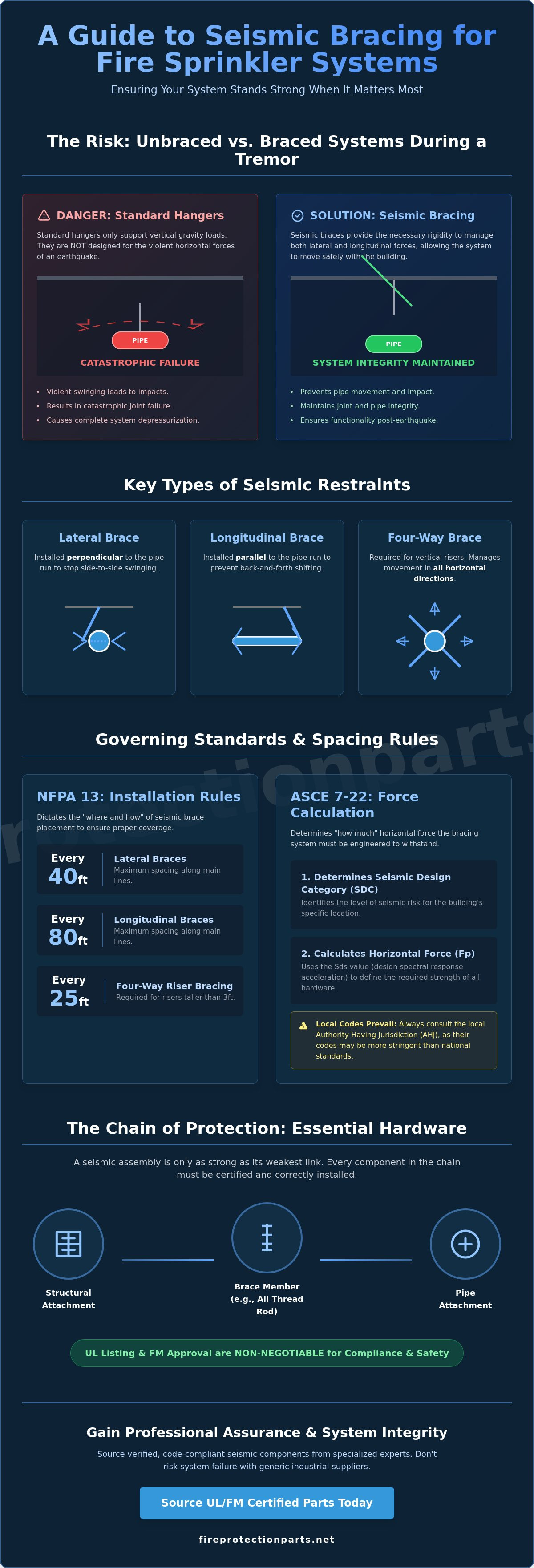
Standard pipe hangers are designed to support vertical gravity loads. They do an excellent job of holding up the dead weight of water-filled pipes under normal conditions. However, they're not built to withstand the violent horizontal forces of an earthquake. Without proper bracing, pipes can swing like a pendulum, crashing into structural beams, HVAC ducts, or other utilities. This impact often leads to catastrophic joint failure and system depressurization. Seismic braces provide the necessary rigidity to move in unison with the building while managing both lateral and longitudinal forces.
Flexibility is just as critical as rigidity in seismic design. When a building is composed of different structural sections, those sections may move at different rates during a quake. Seismic separation assemblies are used where pipes cross building expansion joints. These assemblies allow for differential movement, preventing the pipe from snapping as the building flexes. Balancing this controlled movement with firm restraint is the hallmark of a professionally designed system.
Lateral vs. Longitudinal Bracing: What is the Difference?
Effective restraint requires protection from movement in all horizontal directions. Lateral braces are installed perpendicular to the pipe run. Their job is to stop the pipe from swinging side-to-side. Longitudinal braces are installed parallel to the pipe run to prevent it from shifting back and forth. For vertical risers, four-way bracing is required. These specialized restraints manage movement in every horizontal direction simultaneously. Per the 2025 edition of NFPA 13, risers longer than 3 feet must have four-way bracing, with additional sets installed every 25 feet for taller systems.
Key Governing Standards: NFPA 13 and ASCE 7
Compliance is driven by two primary standards. NFPA 13 dictates the specific installation requirements, such as placing lateral braces every 40 feet and longitudinal braces every 80 feet along main lines. Meanwhile, ASCE 7-22 provides the methodology for calculating the Seismic Design Category and the "Force Factor" (Fp). This calculation uses the design spectral response acceleration (Sds) to determine exactly how much horizontal force the hardware must withstand. You should always consult your local Authority Having Jurisdiction (AHJ). In high-risk zones like California or the Pacific Northwest, local building codes often override national standards with even more stringent requirements for seismic bracing for fire sprinkler systems.
Essential Hardware: From ASC Bracing to All Thread Rod
A seismic assembly is only as strong as its weakest point. This chain of protection includes the structural attachment, the brace member itself, and the pipe attachment. If any single component shears or pulls free, the entire system is compromised. In high-vibration environments, adhering to NFPA 13 seismic requirements is not just a suggestion; it's a safety mandate. UL Listing and FM Approval are non-negotiable for insurance and code compliance. These marks provide the professional assurance that your hardware will perform exactly as rated when a seismic event occurs.
The Versatility of All Thread Rod in Seismic Support
All thread rod serves a critical role in seismic bracing for fire sprinkler systems. It provides the adjustable length necessary to bridge the gap between the pipe and the building structure, especially in facilities with high ceilings or complex plenum spaces. Industry standards typically dictate 3/8-inch or 1/2-inch rods for residential and light commercial applications. However, rod length introduces a risk of buckling. When a rod acts as a compression member, it can bend under the weight of a shifting system. Rod stiffeners solve this problem by clamping onto the rod to increase its rigidity and prevent failure.
ASC Seismic Bracing and Specialized Pipe Clamps
ASC Engineered Solutions has become a preferred choice for contractors due to their focus on installation efficiency. Their ASC seismic bracing components are built for maximum durability and ease of use in the field. Swivel attachments are particularly useful in these systems. They allow the brace to be positioned at various angles, typically between 30 and 90 degrees from vertical. This versatility ensures that you can find a solid anchor point even when the ideal path is blocked by HVAC ductwork or electrical trays.
The final piece of the puzzle is the structural attachment. You must match the hardware to the building material. This involves selecting beam clamps for steel, concrete anchors for masonry, or wood lag screws for timber frames. To ensure longevity, always choose zinc-plated or galvanized finishes. Fire riser rooms are notoriously prone to humidity, which can lead to rust and thread failure. You can browse our selection of seismic components to find hardware that balances high-impact strength with corrosion resistance. Using verified parts eliminates the guesswork and keeps your project on schedule.
How to Determine if Your Project Requires Seismic Bracing
Determining if your building needs seismic bracing for fire sprinkler systems isn't a matter of intuition. It follows a strict workflow that begins at the project's structural cover sheet. You don't want to over-engineer a low-risk system, but you can't afford to under-protect a high-risk one. This decision process relies on the building's location, its intended use, and the specific geometry of the pipe runs. Understanding Seismic Bracing Requirements is the first step toward avoiding costly installation errors or failed inspections.
The first step is identifying your Seismic Design Category (SDC), which is a classification from A to F. Once you've established the SDC, you must check the pipe diameters. While larger mains almost always require restraint, NFPA 13 provides specific exemptions for smaller pipes under certain conditions. You also need to evaluate the "Short Hanger" rule. If a pipe is hung very close to the ceiling, the structural attachment itself may provide enough stability to waive additional bracing. Finally, always consult the Engineer of Record (EOR) to confirm the Force Factor (Fp) requirements. This value determines the load your hardware must withstand.
Seismic Design Categories (SDC) Explained
Your SDC tells you the level of risk the building faces. Categories A and B are generally considered low risk. In these zones, seismic bracing is rarely required unless the building owner specifies it for extra protection. Category C is the transition zone. This is where specific fire protection components may begin requiring restraint based on the building's occupancy and the pipe's importance. If your project falls into SDC D, E, or F, it's in a high-risk zone. In these areas, comprehensive seismic bracing is mandatory for all life safety systems to ensure they remain functional during and after a significant event.
Common Exemptions You Should Know
Code allows for several exemptions to keep installations manageable. One of the most common is the "12-inch rule." If a pipe is supported by hangers that are less than 12 inches long from the top of the pipe to the structural attachment, it's often exempt from lateral bracing. The logic is that a shorter hanger doesn't allow for the same pendulum-like swinging motion as a long rod. Small pipe diameters also enjoy some leniency. In residential NFPA 13D systems, 1-inch and 1.25-inch Viking CPVC fire sprinkler pipe often avoids complex bracing requirements because the system's overall mass is lower.
Don't assume an exemption applies to every part of your project. These allowances often vanish when you're working in high-value equipment rooms, hospitals, or critical life safety infrastructure. In these environments, the goal shifts from "preventing collapse" to "ensuring immediate operation." Even if a pipe is small or the hanger is short, the Authority Having Jurisdiction (AHJ) might still require full restraint to protect sensitive equipment below. Reliability is the priority when failure isn't an option.
How to Install Seismic Restraints: A Step-by-Step Overview
Installing seismic bracing for fire sprinkler systems requires a methodical approach that prioritizes structural integrity at every connection point. Precision during this phase is the only way to ensure the system performs as designed when the ground moves. Don't guess on the layout. Always verify the brace locations against the approved shop drawings before you begin drilling. These drawings specify exact intervals that account for the weight of the water-filled pipe and the building's specific seismic risk.
Once you've confirmed the layout, follow these steps for a compliant installation:
- Prepare the structural attachment: Whether you're drilling into concrete or attaching beam clamps to steel, you must follow the manufacturer's torque specifications. Over-tightening can strip threads, while under-tightening leads to premature failure.
- Measure and cut the brace member: Use either a pipe or all thread rod as the brace member. Ensure the length is cut to accommodate the specific angle required by the design.
- Secure the pipe attachment: Install the lateral or longitudinal clamp onto the sprinkler pipe. If your hardware uses break-away bolt heads, tighten them until the hex head snaps off. This provides a visual indicator that the correct torque has been reached.
- Perform a final inspection: Check that every nut is tight and that no braces are interfering with other trades. Braces must not be blocked by HVAC ducts or electrical trays, as this can cause the system to bind during a tremor.
To get started with the right components, you can order code-compliant seismic hardware here to ensure your project stays on schedule and meets all safety standards.
Setting the Correct Brace Angle
The angle of the brace member significantly impacts its load-carrying capacity. A 45-degree angle is generally considered the most efficient for distributing horizontal forces into the building structure. If the angle is steeper or shallower, you must account for the "Angle Factor" (calculated as 1/sinθ). Steeper angles increase the load on the hardware, which may require larger rod diameters or heavier pipe. Use a digital level or a protractor to verify that every brace is within the tolerance allowed by the Engineer of Record.
Integrating All Thread Rod and Stiffeners
Rod stiffeners must be installed whenever the rod length exceeds the manufacturer's unbraced length limit to prevent buckling under compression. These stiffener clamps are usually required within 6 inches of each end of the rod to provide maximum stability. Before commissioning the system, perform a visual check to ensure the rod is perfectly straight. It shouldn't be under any pre-existing tension or bent by other utility lines. Without a final inspection, even the best seismic bracing for fire sprinkler systems might fail if the secondary supports are compromised.
Sourcing Code-Compliant Components for System Repairs
Buying hardware for seismic bracing for fire sprinkler systems requires more than a trip to a local industrial supplier. Generic nuts and bolts don't carry the UL Listing or FM Approval required for life-safety systems. When you source from a specialized fire protection store, you're buying verified performance. You're also ensuring that the components are compatible with specific pipe types. You must match the seismic clamp to the correct pipe standard, whether it's Iron Pipe Size (IPS) or Copper Tube Size (CTS). Using the wrong clamp size on a Viking CPVC run isn't just a minor error; it's a code violation that could lead to a system failure during a tremor.
Documentation is another critical factor in the procurement process. A fire marshal won't sign off on a project without the proper submittals. Specialized suppliers provide these technical data sheets upfront, proving that the hardware meets the required Force Factor (Fp) for your specific Seismic Design Category. It's also wise to maintain a small inventory of common repair items. Keeping extra all thread rod and swivel attachments in your riser room allows you to address minor issues immediately. This prevents a small maintenance task from turning into a weeks-long project delay while you wait for specialized parts to arrive.
Why Professional Quality Matters
The risk of using non-rated hardware extends far beyond physical failure. If an earthquake occurs and your system fails because of unrated supports, you face significant insurance liability and potential legal consequences. Reading about Fire Protection Parts and Hardware for System Repairs helps you understand how to maintain compliance over the life of the building. All components must meet current NFPA standards to ensure the protection remains unwavering. Accessing expert support when sourcing complex ASC Engineered Solutions ensures you get the right part the first time, every time.
Bulk Sourcing for Large Projects
For new construction or large-scale retrofits, streamlining procurement is essential for staying on budget. Ordering full seismic kits is often more efficient than buying individual nuts, bolts, and clamps. Kits ensure that every piece of the assembly is designed to work together seamlessly. Mixing different manufacturers' seismic components in a single brace assembly is generally prohibited by code. Consistency is the key to a predictable and verifiable installation. You can browse our full selection of ASC Seismic Bracing and All Thread Rod here to find the exact hardware needed for your next project. Choosing professional-grade equipment is the only way to eliminate doubt and secure your facility's future.
Build a System That Stands Firm
Compliance isn't just about passing an inspection; it's about life safety and long-term system resilience. You've seen how to identify your Seismic Design Category and why specific hardware like all thread rod and rod stiffeners are vital for maintaining structural integrity. By following a methodical installation process and adhering to the 2025 NFPA 13 standards, you ensure your fire protection remains operational when it matters most. Precision in these details is what separates a vulnerable system from a secure one.
Quality matters in every component. Sourcing verified seismic bracing for fire sprinkler systems eliminates the risk of insurance liability and mechanical failure. As an authorized distributor of ASC Engineered Solutions, we provide the UL Listed and FM Approved hardware you need to meet the most demanding code requirements. Don't leave your facility's safety to chance with generic, unrated industrial parts that aren't built for the rigors of a seismic event.
Secure Your System with UL/FM Approved Seismic Bracing from Fire Protection Parts. Our team offers expert technical support to help contractors source the exact components required for high-risk zones. Take the final step toward complete peace of mind and professional assurance today. Your commitment to quality ensures your system will perform exactly when it is needed.
Frequently Asked Questions
What is the difference between a seismic brace and a standard pipe hanger?
Standard pipe hangers are designed to support vertical gravity loads, keeping the pipe held up under normal conditions. Seismic braces manage horizontal forces, including lateral and longitudinal movement. While a standard hanger prevents the pipe from falling, a seismic brace prevents it from swinging or shifting during ground motion. This restraint stops pipes from crashing into structural members or other utility lines during an earthquake.
How often should seismic braces be spaced on a main fire line?
NFPA 13 typically requires lateral braces at a maximum interval of 40 feet and longitudinal braces every 80 feet. These specific distances ensure the piping system moves in unison with the building's structure. You should always verify these intervals against your project's approved shop drawings. Tighter spacing is often required for larger pipe diameters or in buildings with higher seismic load requirements.
Is all thread rod strong enough for seismic bracing in commercial buildings?
Yes, all thread rod is a standard industry component for seismic bracing when it's sized and installed according to code. Most commercial systems utilize 3/8-inch or 1/2-inch diameter rods. To ensure safety, you must install rod stiffeners if the rod length exceeds the manufacturer's unbraced limit. This prevents the rod from buckling or snapping when it's subjected to compression forces during a tremor.
Does NFPA 13 require seismic bracing for all fire sprinkler systems?
No, seismic bracing for fire sprinkler systems is only mandatory in specific Seismic Design Categories and for certain pipe sizes. Systems located in low-risk zones, such as SDC A or B, generally don't require these restraints. Additionally, NFPA 13 provides exemptions for pipes supported by very short hangers or for small-diameter branch lines in specific residential applications. You should consult the structural cover sheet to confirm your project's requirements.
Can I use seismic bracing components from different manufacturers together?
Mixing components from different manufacturers in a single brace assembly is generally prohibited by industry standards. Seismic hardware is tested and rated as a complete, integrated system. If you use an ASC structural attachment with a different brand's pipe clamp, you void the UL/FM listing for that assembly. To maintain compliance and professional assurance, always source all parts of a brace from the same manufacturer's product line.
What is a 'rod stiffener' and when do I need to use one?
A rod stiffener is a metal reinforcement clamped to an all thread rod to increase its rigidity. You need to use one whenever the rod acts as a compression member and its length exceeds the manufacturer's maximum unbraced limit. Without stiffeners, long rods can bend or fail when the weight of the system shifts. These components are usually required within 6 inches of each end of the rod.
What are the common Seismic Design Categories that require fire sprinkler restraints?
Seismic Design Categories C, D, E, and F are the primary classifications where seismic bracing for fire sprinkler systems becomes mandatory. Category C serves as the transition zone where specific occupancy types require protection. Categories D through F are considered high-risk zones where comprehensive bracing is required for all life-safety systems. Always check the building's structural documents to identify the assigned category before sourcing your hardware.
How do I identify if my fire sprinkler heads also need seismic protection?
Sprinkler heads installed in suspended ceilings within high-risk seismic zones often require specialized protection. In SDC C and above, you must use flexible drops or oversized ceiling rings to allow for independent movement between the piping and the ceiling grid. This prevents the ceiling from shearing off the sprinkler heads during a quake. If your heads are rigid-mounted in a high-risk zone, they likely need a flexible assembly upgrade.

