



Understanding the OS&Y Valve: The Visual Guardian of Fire Sprinkler Systems
Last Tuesday, a facility manager discovered that a simple oversight had left their building's water supply shut off for months. This high-stakes scenario is exactly why the os&y valve is a mandatory safeguard for professionals who prioritize unwavering reliability. You know that maintaining a code-compliant facility is a serious responsibility where there's no room for guesswork. A closed water supply is the primary reason fire systems fail, and standing in front of your hardware feeling unsure creates unnecessary risk to life and property.
This guide helps you master the mechanics of the os&y valve so you can verify system status at a glance and stay ahead of NFPA 25 (2026) requirements. We'll explore the critical differences between "rising stem" designs and other control hardware like butterfly valves to ensure your os&y valve is properly selected and maintained. We'll strip away the technical jargon to provide a clear, professional understanding of how these visual guardians function. By the end, you'll have the expert confidence to ensure your fire suppression system remains ready, compliant, and fully operational. We provide the clarity you need to eliminate doubt and focus on total building protection.
Key Takeaways
- Understand why the "Outside Screw and Yoke" design is the industry standard for fail-safe visual confirmation of your water supply status.
- Learn to verify at a glance if your system is open and ready for suppression by monitoring the position of the rising stem.
- Evaluate the mechanical and spatial differences between an os&y valve and a butterfly valve to choose the most effective hardware for your riser room.
- Ensure your facility remains code-compliant by identifying the necessity of UL Listings, FM Approvals, and specific pressure ratings for your equipment.
- Master the essential installation requirements for clearance and connection types to guarantee your fire protection system is secure and accessible during an emergency.
What is an OS&Y Valve? Definition and Core Components
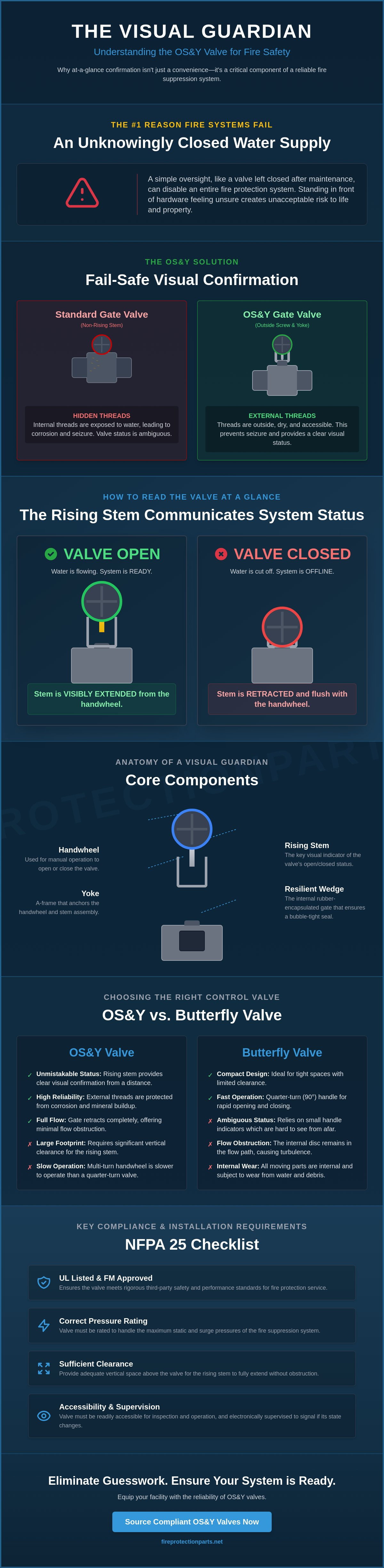
The term OS&Y stands for Outside Screw and Yoke. It's a specialized type of gate valve engineered specifically for the rigors of fire protection. While many industrial valves hide their internal workings, the os&y valve puts its primary operating mechanism on full display. This isn't for aesthetics; it's about reliability. By moving the threaded stem to the exterior of the valve body, the design ensures the threads never touch the water flowing through the pipe. An os&y valve acts as a critical control point for fire suppression water supplies, providing a physical and visual guarantee that the system is ready for action.
In a standard gate valve, the operating threads are often submerged. Over time, minerals and sediment in the water supply can build up on these threads. This leads to corrosion or "freezing," where the valve becomes impossible to turn. In a fire emergency, a stuck valve is a catastrophic failure. The OS&Y design eliminates this risk by keeping the screw threads dry and accessible. This simple mechanical shift provides peace of mind for facility managers and inspectors alike.
The Anatomy of an Outside Screw and Yoke Valve
Understanding the components of this valve helps you appreciate its role as a visual guardian. Each part is built for strength and clear communication.
- The Yoke: This is the sturdy, Y-shaped frame that sits on top of the valve body. It acts as the anchor for the handwheel and provides the track through which the stem moves. Its heavy-duty construction ensures the valve can withstand the high-pressure surges typical in fire suppression systems.
- The Rising Stem: This threaded rod is the most important visual feature. As you rotate the handwheel, the stem moves vertically. It doesn't just open the gate; it tells a story. If the stem is extended, the valve is open. If it's retracted, the water is cut off.
- The Resilient Wedge: This is the internal gate. Unlike older solid metal gates, a resilient wedge is typically made of ductile iron encapsulated in a rubber-like elastomer. This provides a bubble-tight seal even if small debris is present in the line.
Why "Outside" Screw Matters for Fire Safety
The "outside" designation is the valve's greatest safety feature. Since the threads are external, they are protected from the scale and mineral deposits that naturally occur inside water pipes. This ensures the valve remains operational even after years of being in the same position. It also allows for effortless maintenance. You can lubricate the moving parts and inspect for wear without ever having to shut down the water supply or disassemble the valve body. This design removes the guesswork, providing a level of professional assurance that internal-thread valves simply can't match. It's a utilitarian solution for a high-stakes environment.
The Rising Stem: How the OS&Y Valve Communicates System Status
The rising stem is the defining feature that sets an os&y valve apart from standard plumbing hardware. It serves as a high-visibility communication tool. In a fire emergency, seconds matter. Personnel can't afford to guess if a handle is turned correctly or if a valve is partially obstructed. The mechanical design of the outside screw and yoke provides an immediate, non-electronic status report. When the stem is visible and fully extended from the yoke, the valve is open. Water is available. When the stem is retracted and flush with the handwheel, the valve is closed. The supply is cut off. This physical movement removes the human error often associated with non-rising stem valves, where the handle's position doesn't always reflect the internal gate's state.
Clarity is the ultimate safety feature. Because the stem is attached directly to the internal gate, its position is an absolute reflection of the valve's interior state. There's no ambiguity. This transparency is why these valves are the gold standard for main control points in fire suppression systems. They provide a level of certainty that protects both the facility and the people inside it.
Visual Verification for First Responders
Fire departments and marshals prioritize visual certainty. During a walk-through or an active emergency, they look for the stem position first. A "blind" valve, one that doesn't indicate its state, is a liability. If a valve is accidentally left closed after routine maintenance, a building's entire suppression capability is neutralized. The os&y valve eliminates this doubt in the riser room. It provides a level of professional assurance that the system is ready to perform. Selecting the right fire protection hardware is about more than just meeting a checklist; it's about eliminating the possibility of a dry system when it's needed most.
Tamper Switches and Electronic Monitoring
Modern fire safety relies on more than just human eyes. Most building codes require these valves to be electronically monitored. This is where the rising stem proves its versatility. A tamper switch is mounted to the yoke, featuring a spring-loaded lever that rests against the stem. If someone begins to close the valve, the stem moves, triggering the switch. This sends an immediate signal to the fire alarm control panel. This integration ensures that any unauthorized or accidental closure is addressed instantly. It's a double-layered approach to safety: physical verification for those on-site and electronic monitoring for 24/7 protection. It ensures that the critical water supply remains uncompromised at all times.
OS&Y Valve vs. Butterfly Valve: Choosing the Right Control
Choosing between an os&y valve and a butterfly valve isn't just about the purchase price. It's a decision that affects your system's hydraulics, maintenance schedule, and physical layout. While both serve as control valves, they operate on entirely different mechanical principles. An os&y valve is a gate valve that lifts a resilient wedge completely out of the water's path. A butterfly valve uses a rotating disc that stays in the center of the flow even when fully open. This fundamental difference in design dictates where and when each should be installed to ensure maximum system reliability.
The physical footprint of a gate valve is significantly larger than its butterfly counterpart. Because the stem must fully extend to indicate an open state, you need ample vertical or horizontal clearance. If your riser room has low ceilings or crowded piping, an os&y valve might be physically impossible to operate. Butterfly valves are compact and lightweight. They utilize a "wafer" or "lug" style connection that takes up a fraction of the space. However, that convenience comes with a trade-off in hydraulic efficiency. Every pound of pressure counts in fire suppression. Because the butterfly disc remains in the waterway, it creates more friction loss than the clear, straight path provided by an open gate valve.
When to Use an OS&Y Valve
The gate design is the professional choice for main water supply inlets. Its low friction loss ensures that your fire pump or municipal supply delivers maximum pressure to the sprinkler heads. It's the preferred hardware when visual physical verification is the highest priority. You don't need to check a dial or an electronic signal; the position of the stem provides an absolute answer. Additionally, many local jurisdictions and fire marshals mandate gate valves for specific high-hazard applications. They value the mechanical simplicity and the "outside" thread design that prevents internal corrosion from jamming the mechanism during a crisis.
When the Butterfly Valve is the Better Choice
Space-constrained riser rooms are the primary environment for butterfly valves. They offer an efficient solution when you can't afford the clearance required for a rising stem. Most modern butterfly valves also feature built-in tamper switches, which simplifies the wiring process for your electronic monitoring system. This can lead to faster installation and lower labor costs on large-scale projects. If you're weighing your options for a complex layout, consult our Fire Protection Control Valves guide for a deeper look at hardware selection. Ultimately, the right choice balances the physical limits of your building with the hydraulic requirements of your fire suppression plan. We help you eliminate the guesswork so you can focus on safety.
Installation and Maintenance: Keeping Your Valves Code-Compliant
Installing an os&y valve correctly is the first step in ensuring long-term system integrity. Orientation is paramount. You must verify that the area surrounding the valve provides sufficient clearance for the stem to extend fully without hitting conduits, walls, or structural beams. A valve that cannot open completely is a system that cannot protect. Beyond physical space, you must choose the right connection type. Flanged ends provide a traditional, heavy-duty bolted connection, while grooved ends offer faster installation and flexibility for seismic bracing. Both methods ensure a secure, high-pressure seal that stands up to the demands of a fire event.
Maintenance is where many facility managers fall behind. Because the screw threads are on the outside, they're exposed to dust, moisture, and ambient debris. Regular lubrication is essential. Use a high-quality, water-resistant grease to keep the threads moving smoothly. This prevents seizing and ensures that when the time comes to shut down for maintenance or respond to an emergency, the hardware operates without resistance. Neglecting this simple step can lead to a frozen valve that fails an inspection or, worse, fails during a fire.
NFPA 25 Inspection Requirements
Adherence to the 2026 edition of NFPA 25 is mandatory for maintaining code compliance. Weekly or monthly visual inspections are required to confirm that every os&y valve is in the wide-open position. This is easily verified by looking at the rising stem. Once a year, you must perform a full operation test. This involves closing the valve completely and reopening it to ensure there's no internal obstruction or mechanical binding. To meet safety standards, an OS&Y valve must be able to be operated by a single person using the handwheel.
Troubleshooting Common OS&Y Issues
Even the most durable hardware can encounter issues over time. A common problem is a leaking packing nut. In many cases, this can be resolved by slightly tightening the nut to compress the packing material around the stem. This often stops the leak without requiring a full system shutdown. You should also watch for physical stem damage or significant mineral buildup on the exterior threads. If the stem is bent or the threads are heavily pitted, the mechanical integrity is compromised. When you identify these issues, you must decide whether to repair the components or replace the unit entirely. You can find high-quality fire protection parts and hardware for system repairs to keep your suppression system in peak condition.
Proactive care eliminates the risk of hardware failure when it matters most. If your current valves show signs of excessive wear or fail their annual operation test, it's time to upgrade. You can order certified fire protection hardware directly to ensure your facility remains protected and compliant with the latest safety standards.
Sourcing Quality OS&Y Valves for Your Fire System
Procuring a reliable os&y valve requires more than just matching pipe diameters. It's an exercise in risk management. You aren't just buying a piece of industrial hardware; you're investing in a fail-safe component that must perform perfectly after years of dormancy. Professional procurement involves evaluating the specific hydraulic demands of your facility and ensuring every component is listed for its intended use. Sourcing from a dedicated fire protection retailer ensures that the hardware you install today will meet the rigorous demands of an emergency tomorrow. It's about eliminating the possibility of mechanical failure when life safety is on the line.
The choice of end-connections is equally vital for a secure system. Flanged connections provide a traditional, bolted seal for heavy-duty main inlets. Grooved ends have become the industry standard for their speed of installation and their ability to integrate with seismic bracing. In smaller residential or light commercial applications, threaded connections may still be appropriate. Regardless of the connection type, the valve must be rated for the correct working pressure. While 175 PSI is common for many systems, high-rise buildings or facilities with powerful fire pump systems often require hardware rated for 300 PSI to handle increased hydraulic stress.
Understanding UL and FM Standards
UL (Underwriters Laboratories) and FM (Factory Mutual) certifications are non-negotiable benchmarks for fire protection. A UL Listing confirms that the os&y valve has undergone extensive testing for structural integrity and operational performance under extreme conditions. FM Approval is often a requirement for high-hazard industrial environments, focusing on the valve's reliability in the most demanding scenarios. Using non-listed valves is a dangerous shortcut. It can void your building's insurance policy and lead to an immediate failure during a fire marshal inspection. These markings provide the professional assurance that the valve is built to survive the high-pressure surges typical of a suppression event.
Ready to Secure Your System?
Selecting the right hardware is the final step in ensuring your fire suppression system remains code-compliant. We provide professional-grade valves designed for long-term reliability and ease of maintenance. Our team offers the technical support you need to identify the correct replacement parts and pressure ratings for your specific building layout. Don't leave your facility's safety to chance with generic industrial components that lack the necessary fire-service approvals. Browse our selection of UL/FM OS&Y Valves at Fire Protection Parts to find the visual guardians your system requires. We help you move quickly from identifying a need to implementing a certified, high-performance solution.
Securing Your System with Visual Certainty
A reliable fire suppression system depends on components that eliminate guesswork. By mastering the mechanics of the os&y valve, you ensure your facility has a clear, visual indicator of its water supply status. You now understand the importance of the rising stem for immediate verification and how to choose between gate and butterfly designs based on your riser room's specific footprint. Maintaining these valves through regular lubrication and NFPA 25 inspections isn't just a code requirement; it's a commitment to life safety.
We provide the expert sourcing you need for NFPA-compliant systems. Our inventory features UL Listed and FM Approved components that are trusted by contractors and facility managers nationwide. Don't leave your building's protection to chance with unverified hardware. You can Shop Professional OS&Y Valves and Fire Protection Hardware to ensure your suppression system is built for long-term performance. Take the next step in professional safety management and secure the peace of mind that comes with high-quality, certified equipment. Your facility deserves the protection of a system that's always ready to respond.
Frequently Asked Questions
What does OS&Y stand for in fire protection?
OS&Y stands for Outside Screw and Yoke. The "outside" designation means the threaded stem is exterior to the valve body, while the "yoke" is the sturdy frame holding the stem in place. This design is the industry standard for fire suppression because it keeps the operating threads away from corrosive water. It ensures the valve remains functional and accessible during a crisis.
Is an OS&Y valve a gate valve?
Yes, the os&y valve is a specialized type of gate valve. It utilizes a wedge-shaped gate that moves vertically to start or stop the flow of water. Unlike standard plumbing gate valves with internal threads, the OS&Y version is engineered for fire service with its rising stem and exterior screw. This design makes it a primary choice for main control points in commercial sprinkler systems.
How can you tell if an OS&Y valve is open or closed?
You can verify the status by looking at the position of the threaded stem. If the stem is extended and visible above the handwheel, the valve is open and water is available. If the stem is retracted and flush with the wheel, the valve is closed. This provides an immediate visual confirmation that doesn't require electronic monitoring or mechanical testing to verify system readiness.
Can an OS&Y valve be installed horizontally?
OS&Y valves can be installed in both vertical and horizontal orientations. However, you must ensure there is enough physical clearance for the stem to fully extend in either position without hitting obstructions. In horizontal runs, it's often best to install the valve with the stem pointing upward or to the side. This prevents sediment from settling in the bonnet and interfering with the seal.
Why do OS&Y valves have a rising stem?
The rising stem serves two critical purposes: visual verification and mechanical longevity. It allows fire marshals and facility managers to confirm the system state at a glance from across a riser room. Because the threads move outside the valve body, they are also protected from internal corrosion and mineral buildup. This ensures the os&y valve won't seize when you need to operate it during an emergency.
What is the difference between an OS&Y valve and a PIV?
The primary difference is the location and the type of indicator used. An OS&Y valve is typically located inside a building and uses a rising stem to show its status. A PIV (Post Indicator Valve) is usually installed outside the building on an underground water main. The PIV features a vertical post with a small window that displays the words "OPEN" or "SHUT" to indicate the valve position.
Do OS&Y valves require a tamper switch?
Most modern building codes and NFPA standards require these valves to be monitored by a tamper switch. This mechanical device triggers a signal to the fire alarm control panel if the valve is moved from its fully open position. It provides a secondary layer of protection against unauthorized closure. This electronic monitoring works alongside the physical rising stem to ensure the water supply remains uncompromised.
How often should OS&Y valves be inspected?
According to the 2026 edition of NFPA 25, you should perform a visual inspection weekly or monthly to ensure the valve is open. An annual operation test is also mandatory. This involves fully closing and reopening the valve to verify it moves freely and seats correctly. Regular maintenance, including lubricating the exterior threads, ensures the hardware remains compliant and ready for a suppression event.

