



CPVC Fire Protection Fittings: Types, Compatibility, and Selection
Could a fitting that physically fits still be wrong for a fire sprinkler system? Yes. CPVC fire protection fittings must match the pipe system and its intended application. A familiar connection type alone does not establish compatibility. With elbows, tees, adapters, and other fitting names to distinguish, it is easy to mistake general plumbing guidance for fire protection requirements.
Checking before selecting components helps avoid mismatches. The right fitting depends on the system’s specified components and the requirements for the application, so choosing parts based on appearance or fit alone can raise compatibility and compliance concerns. This guide explains common fitting types, how to check compatibility, and what product details to review before sourcing. It also explains why sprinkler components should be selected as a coordinated system. Fire Protection Parts supplies fire protection components, including Viking Plastics CPVC pipe and CPVC fittings. Use the steps below to narrow your options and make a more informed purchasing decision.
Key Takeaways
- Understand how CPVC fittings connect, branch, redirect, or end compatible fire sprinkler pipe runs.
- Recognize common fitting categories, including elbows, tees, couplings, adapters, and caps, by the job each performs.
- Choose CPVC fire protection fittings for the specified system and application, rather than assuming they are interchangeable based on appearance.
- Use project requirements and product documentation to guide component selection before sourcing.
- Compare fitting function, system compatibility, and documentation to make a more informed purchasing decision.
What Are CPVC Fire Protection Fittings, and What Do They Do?
CPVC stands for chlorinated polyvinyl chloride, a plastic material used in piping systems designed for specific fire sprinkler applications. A fitting may look simple, but it has a defined role: joining parts of a pipe network that carries water through the system. For a general overview of how components work together in fire sprinkler systems, consider the system as a whole, not just the individual parts.
A CPVC fire protection fitting is a connection component designed to join, branch, redirect, transition, or close compatible CPVC pipe within a fire sprinkler system. Its suitability depends on the system and application, not just its material or shape.
How CPVC fittings connect fire sprinkler piping
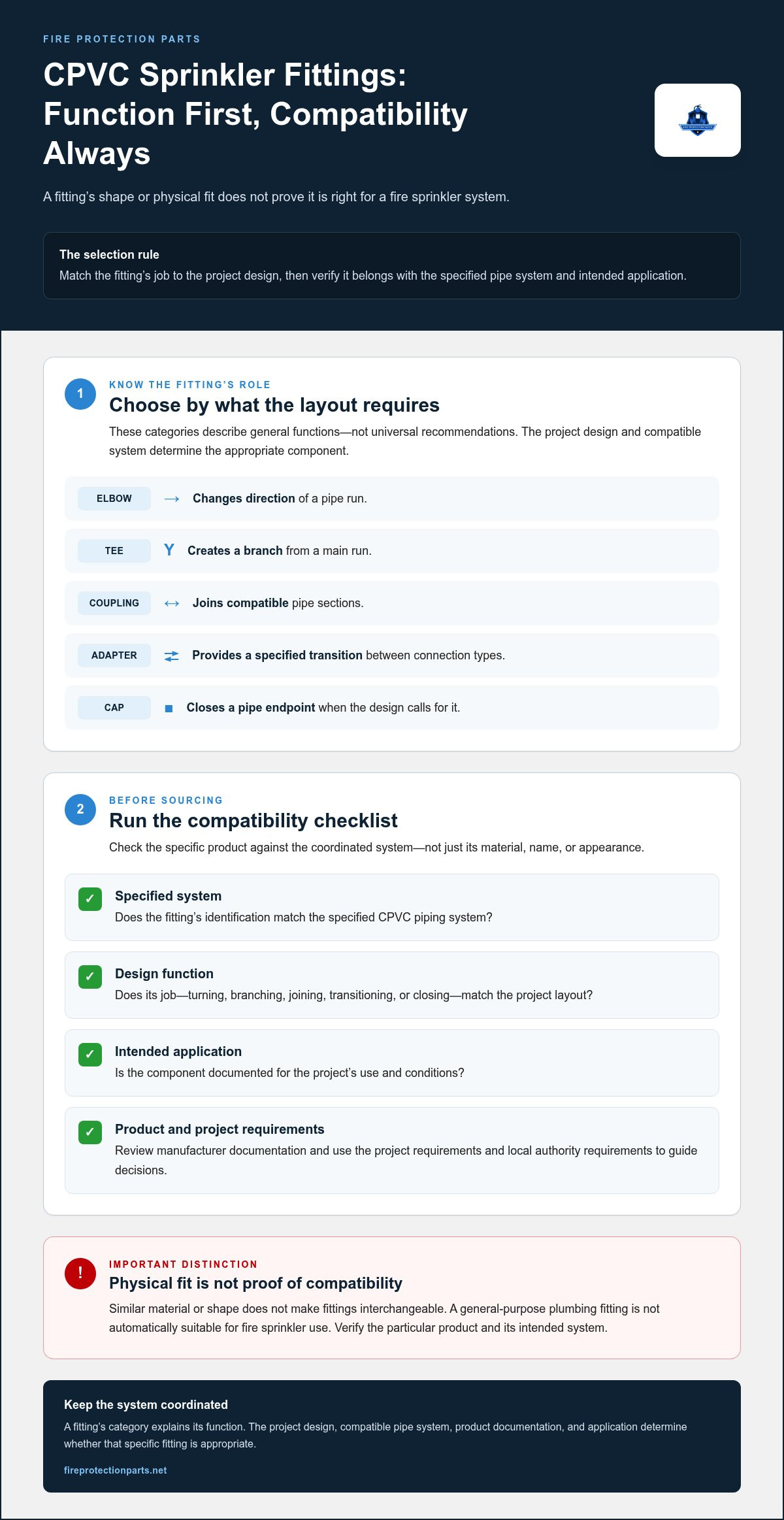
Fittings let a pipe run follow the layout shown in a project design. An elbow changes direction, while a tee creates a branch from a main run. A coupling joins compatible pipe ends, an adapter provides a transition between connection types, and a cap closes a pipe end. These names describe a fitting’s function. They do not establish that a particular product is right for every system.
Each connection must match the pipe and intended use. The design determines where a turn, branch, transition, or endpoint belongs. A fitting that appears to fit can still be the wrong component if its product details do not match the specified system.
Why fire protection use differs from ordinary plumbing
Similar material does not mean interchangeable purpose. A general-purpose plumbing fitting is not automatically suitable for a fire sprinkler system just because it is made from CPVC or has a connection that appears to match. Fire protection components must meet the product and system requirements for their intended application.
That distinction matters because pipe and fittings function as a coordinated system. A component selected without regard to system documentation or project requirements may not suit the design. Before sourcing, verify the specific product information and match the fitting to the compatible pipe system.
Manufacturer instructions and local authority requirements govern project decisions. Use the project design as your starting point, then review product documentation to determine whether a fitting aligns with the specified system and application. Keep these checks in view as you compare fitting categories and select components for a fire protection piping layout.
Which CPVC Fire Protection Fitting Types Appear in Sprinkler Systems?
Fitting names are easier to understand when you connect each one to its job in a pipe layout. A turn, branch, pipe connection, or closed endpoint can call for a different fitting shape. The examples below describe general functions, not universal recommendations. The project design and compatible system determine which component is appropriate.
Common fitting shapes and their functions
Directional and joining fittings help shape a pipe route. An elbow redirects a run, while a tee creates a branch connection. A coupling joins compatible pipe sections. A cap closes an endpoint where the system design calls for one. These descriptions explain the categories, but do not confirm that a particular product is suitable for every CPVC fire protection system.
Branches and turns help the piping follow the design. For example, a branch can serve a separate part of a layout, while an elbow helps a run change direction. Choose the fitting type to match the specified arrangement, not simply because its shape seems convenient.
| Fitting category | Illustrative function |
|---|---|
| Elbow | Changes pipe direction |
| Tee | Creates a branch connection |
| Coupling | Joins compatible pipe sections |
| Adapter | Provides a specified connection transition |
| Cap | Closes a pipe endpoint when the design calls for it |
Transitions, adapters, and system boundaries
An adapter or other transition fitting may connect differing components, but only when the specified system permits that exact product and use. It is not a default fix for combining materials or systems. Review the manufacturer’s documentation for the transition component, its intended application, and any limits on its use. UL Solutions provides background on UL standards for CPVC fittings and related fire sprinkler requirements.
Before sourcing, compare the fitting’s function with the project design, then verify that the specific component is compatible with the intended system. A category name alone does not establish compatibility or product approval. For a practical starting point, explore fire protection system components alongside the project’s specified pipe and fitting requirements.
How to Check CPVC Fitting Compatibility and Fire Protection Requirements
CPVC fittings can look interchangeable across systems, especially when they share a material and similar shape. Appearance is not proof of a match. Material type alone does not establish compatibility with a fire sprinkler system. Before sourcing, confirm that each fitting aligns with the specified piping system, intended application, product documentation, and project requirements.
Use these checks to compare a proposed fitting with the project requirements:
- System compatibility: Does the fitting’s identification match the specified CPVC piping system?
- Intended application: Is the component documented for the project’s use and conditions?
- Product documentation: Do the manufacturer’s instructions and exact product records support the selection?
- Project requirements: Does the proposed component meet the design and applicable code decisions?
These checks work together. A fitting’s shape or material can help identify its general function, but neither confirms that it belongs in a particular system. For CPVC fire protection fittings, rely on product-specific records rather than broad claims about a product line or material category.
What to verify in product and system documentation
Start with the product identification and compare it with the specified CPVC pipe system. Then review the manufacturer’s documentation for the fitting’s intended application, joining method, and system limitations. Keep the review tied to the exact component. Similar names or appearances do not establish that two products have the same use or status.
If documentation or marketing refers to UL or FM status, verify the claim against records for that exact product. Do not assume an entire category, brand, or material carries the same listing or approval. Product listings and requirements can be specific, so check the relevant details before selecting a fitting.
How NFPA guidance and the authority having jurisdiction fit in
NFPA requirements depend on the type of sprinkler system and project conditions. The authority having jurisdiction (AHJ) provides project-specific code interpretation and acceptance. Manufacturer instructions, applicable NFPA requirements, product documentation, and AHJ decisions all inform selection. One should not be treated as a substitute for the others.
Standards change, and project requirements can differ. Verify the applicable NFPA standard and edition, along with any listing, approval, or product detail, against current project documents and the relevant authority’s direction. This gives the sourcing decision a clear basis: the specified system, documented component, intended use, and project requirements must align.
How to Select and Source CPVC Fire Protection Fittings
Start with the project design and the CPVC manufacturer system it specifies. This gives you a documented basis for identifying components, rather than relying on a fitting’s appearance or a broad material label. Before sourcing CPVC fire protection fittings, turn the design and product records into a clear purchasing checklist.
A practical pre-purchase CPVC fitting checklist
Work through these steps in order, using the project documents and the exact products they identify.
- 1. Confirm project requirements. Review the project design and applicable requirements, including relevant authority having jurisdiction decisions that affect component selection.
- 2. Identify the fitting function. Record whether the design calls for a directional fitting, branch connection, pipe join, transition, or closure. Do not substitute a different function for convenience.
- 3. Capture connection and size details. Note the specified connection type and size as shown in the design and manufacturer documentation. These details help distinguish components that may look similar.
- 4. Record product identifiers. Write down the manufacturer and exact product identifier provided in the system documentation. Use those details to compare the proposed component with the specified system.
- 5. Verify documentation before purchase. Check manufacturer records for intended application, compatibility, joining method, and stated limitations. If considering a substitution, confirm it against project requirements and applicable AHJ decisions before sourcing it.
A complete record makes mismatches easier to spot. For example, a fitting with the right general shape may still differ from the design in its connection details or product identification. Match the documented component, not just the broad category.
Avoiding common sourcing mistakes
Do not choose by material label, appearance, or a generic description alone. Those clues do not establish that a fitting belongs with the specified pipe system or suits the project application. Avoid undocumented substitutions as well. A component without a clear match to the system documentation can create compatibility questions and may complicate project acceptance.
Keep the design, product identifiers, and manufacturer records together while sourcing components. This makes the selection easier to trace and helps maintain alignment between the project requirements and the parts being considered.
Once you have the required fitting details, browse fire protection components from Fire Protection Parts, including CPVC pipe and fittings for fire protection systems.
CPVC Fire Protection Fittings: From Product Understanding to System Confidence
A sound selection brings together four details: the fitting’s function, compatibility with the specified system, supporting product documentation, and project requirements. None replaces the others. A fitting that appears to match may still be unsuitable if its documented use does not align with the design.
A final review before ordering CPVC components
Before finalizing an order, use this short review:
- Function: Does the fitting perform the role shown in the system design?
- System: Does its exact product identification match the specified CPVC piping system?
- Documentation: Do manufacturer records describe the intended use and applicable limitations?
- Project requirements: Does the component align with the design and project-specific requirements, including applicable AHJ decisions?
Keep product identifiers and supporting documentation with procurement records. That record connects the selected component to the project requirements and makes later review clearer, especially when collaborating with industrial procurement services UAE to source MEP, plumbing, and mechanical piping materials.
CPVC describes a material, not automatic suitability for a specific fire sprinkler system. The component’s system-specific documentation and intended application matter.
Explore CPVC fire protection products
For related system context, read the Viking Plastics CPVC fire sprinkler pipe guide. The fire protection parts and system repairs guide offers broader background on sourcing system components. Use these resources alongside project documents when comparing products, and keep selection decisions tied to the specified system.
Fire Protection Parts offers fire protection components, including Viking Plastics CPVC pipe and CPVC fittings. Explore the product range while comparing products against your project’s documented requirements.
Make Your Next Component Choice with Confidence
Choosing the right fitting takes more than matching shapes. Confirm its function, compatibility with the specified system, supporting product documentation, and fit with project requirements. Common fitting names help identify their roles, but do not establish suitability on their own.
For CPVC fire protection fittings, material type is not enough. The exact component and its documented use must align with the system. Keep product identifiers and records together so your sourcing decision stays clear and traceable.
Fire Protection Parts sells fire protection hardware and specialized system components, including Viking Plastics CPVC pipe for fire protection. Use the product range to support your project’s component sourcing, guided by its design and documentation.
Explore fire protection components at Fire Protection Parts and take the next step with confidence.
Frequently Asked Questions
What are CPVC fire protection fittings used for?
CPVC fire protection fittings connect compatible CPVC pipe in a fire sprinkler system. Depending on their shape and the system design, they can change a pipe run’s direction, create a branch, join pipe sections, provide a specified transition, or close an endpoint. Their purpose is to form the piping layout. Select fittings for the documented system and intended application, rather than by shape or material alone.
Are all CPVC fittings suitable for fire sprinkler systems?
No. A fitting made from CPVC is not automatically suitable for fire sprinkler use. Fire protection components must match the specified piping system and intended application, with product documentation supporting that selection. Check the exact product identification and manufacturer information, including any relevant listing or approval claims. Do not assume a general-purpose plumbing fitting or a fitting from another system is interchangeable because it looks similar.
What is the difference between a CPVC elbow and a CPVC tee?
A CPVC elbow redirects a pipe run, while a CPVC tee creates a branch connection. For example, an elbow may suit a change in direction shown in the design, while a tee may connect a branch to a main run. These are general functions, not installation instructions or proof of system suitability. The specified layout and compatible product documentation determine which fitting is appropriate.
Can CPVC fire protection fittings connect to other pipe materials?
They may connect to another pipe material only when the project design and specified system permit the exact transition component and use. An adapter is not a default solution for mixing materials. Verify the transition product’s identification and manufacturer documentation, along with project requirements and applicable authority having jurisdiction decisions. Similar dimensions or a physical fit do not establish compatibility or acceptance in a fire sprinkler system.
Do CPVC fire protection fittings need to meet NFPA requirements?
Fire sprinkler projects must account for applicable requirements, including the relevant NFPA guidance for the system type and project conditions. The applicable standard and edition can vary, so do not assume one requirement applies to every system. Product documentation, manufacturer instructions, project design, and authority having jurisdiction decisions also matter. Verify current project-specific requirements rather than relying on a general statement about CPVC fittings.
How do I know which CPVC fitting size to order?
Use the project design and specified piping system to identify the required fitting size and connection details. Record the fitting function, size, connection type, and product identifier, then compare them with the manufacturer’s documentation for the compatible system. Do not estimate from appearance or select a size based only on an existing component. If documents conflict or a substitution is being considered, resolve it against project requirements before sourcing.
Can CPVC fire protection fittings be installed with ordinary plumbing solvent cement?
Do not assume ordinary plumbing solvent cement is suitable for a fire sprinkler system. Use the joining materials and method specified in the manufacturer’s instructions for the exact CPVC piping system and application. Product compatibility and application requirements matter. Cement intended for general plumbing does not establish suitability for fire protection use. Check the system documentation and project requirements before selecting joining materials, and follow applicable instructions for the specified components.

