

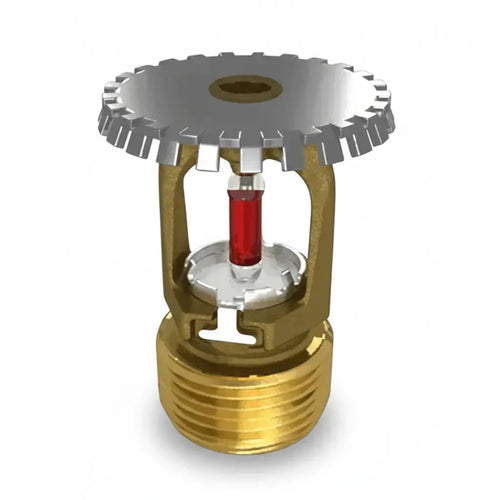


Dry Pendent Sprinkler Heads: Where They Work and How to Specify Them
A dry pendent sprinkler head isn’t a standalone fix for freezing temperatures. The wrong barrel length, rating, or system connection can leave a gap in protection. When water-filled piping extends into an unheated space, freezing is a real concern, and dry pendent sprinkler heads may be appropriate when the system design and location call for them.
These heads are designed to keep water out of the exposed section until activation. Choosing the right one involves more than matching a sprinkler to a cold room. Its construction, orientation, dimensions, temperature rating, K-factor, and approvals must align with the project design and applicable requirements.
This guide explains where dry pendent heads may be used and how their sealed barrel helps limit freeze exposure. It also provides a practical checklist for verifying system compatibility, barrel length, response type, and product listings before selecting or sourcing a component.
Key Takeaways
- Learn where dry pendent sprinkler heads may suit cold or freeze-prone spaces, and why location alone doesn’t determine the right choice.
- Understand how the sealed barrel helps keep water out of the exposed section until sprinkler activation.
- Compare product details, including orientation, connection, and dimensions, against the project documents before selecting a head.
- Use a pre-installation verification checklist to confirm product identification, system conditions, and manufacturer instructions.
- Confirm the manufacturer, model, and required specifications before sourcing a replacement or new component.
What Are Dry Pendent Sprinkler Heads, and Where Are They Used?
A dry pendent sprinkler head has a sealed barrel that helps keep water out of the exposed section until activation. It is designed for a pendent position, with the sprinkler below a ceiling or other overhead surface, where the surrounding space may be cold enough to create a freezing risk. The barrel extends from the water supply into that exposed area, and the seal helps prevent water from sitting in the section vulnerable to freezing.
A dry pendent head is a sprinkler component, not another name for a dry-pipe system. Dry-pipe describes a system arrangement; dry pendent describes the construction and orientation of a sprinkler. A dry pendent head may be considered for different system arrangements, but compatibility depends on the exact product and the complete design. For background on system types, see this overview of the fire sprinkler system.
How a dry pendent sprinkler head differs from a standard pendent head
A standard pendent head connects to piping that supplies water to the sprinkler. In a cold space, water in the exposed portion of an unsuitable arrangement could freeze. A dry pendent head’s barrel and seal separate that exposed section from the water-filled piping until the sprinkler operates. This doesn’t make one type universally better. The intended location, system design, product construction, and listing determine which installation conditions are approved.
Check the manufacturer’s documentation rather than relying on the broad label “dry pendent.” Products can differ in orientation, connection, and installation requirements. The head must match the conditions and configuration for which it is listed.
Where dry pendent sprinklers may be considered
Dry pendent sprinklers may be considered where a pendent sprinkler must protect an area exposed to freezing temperatures while its water supply remains in a warmer space. Examples include cold rooms, loading areas, or other unheated spaces. These are possibilities, not blanket approvals. Temperature exposure, ceiling arrangement, system type, and the selected product all matter.
Before specifying or replacing a dry pendent head, have the project designer confirm that the component fits the system design. The authority having jurisdiction must also confirm applicability to the project. A cold location alone isn’t enough to select a head. Check the product’s approved use and installation conditions against the project documents and manufacturer instructions.
How Dry Pendent Sprinkler Heads Operate in a Sprinkler System
A dry pendent sprinkler head holds water back from its exposed barrel until heat activates the sprinkler. The exact sequence depends on the head’s construction and the system it connects to, so use the manufacturer’s terminology and documentation for the selected component. The general principle is that heat opens an individual sprinkler, after which water reaches its discharge path.
What happens when heat activates the sprinkler
As heat reaches the sprinkler’s heat-responsive element, the element operates and releases the seal in the dry barrel. In a wet-pipe arrangement, the seal holds back water at the sprinkler inlet until activation. Once the seal opens, water can pass through the barrel and out of that sprinkler. In a dry-pipe arrangement, activation also affects the system’s pressurized air. The resulting pressure change allows the dry-pipe valve to admit water into the piping. The specific mechanism varies by product, so confirm its operation in the manufacturer’s instructions.
Activation is local to the sprinkler exposed to sufficient heat. The other heads don’t all open simply because one has activated. The heat-responsive element initiates discharge at that location, while the system supplies water according to its design.
Why system design still matters
The barrel helps keep water out of the exposed portion during normal conditions, but it doesn’t make a head compatible with every system or installation. The designer must account for the hazard being protected, water supply, hydraulic calculations, and the product’s approved use. Connection type, orientation, dimensions, and installation conditions must also match the project documents and manufacturer instructions.
Dry-pipe systems use air pressure as part of their operation, so related components and system conditions need to be coordinated. For background on that equipment, see this guide to air compressors for dry sprinkler systems. It provides context, but doesn’t replace confirmation of the sprinkler head’s compatibility with the project.
For additional industry context on dry-barrel sprinkler applications and types, consult this guide to dry barrel sprinklers. General references are background information. Product-specific instructions and approved project documents remain the basis for selection and installation.
Before sourcing a dry pendent sprinkler head, confirm the exact product and system requirements with the project designer. Once the specification is established, review dry pendent sprinkler components as a sourcing option. Check current product details against the approved documents before ordering.
How to Compare Dry Pendent Sprinkler Head Specifications
Compare dry pendent sprinkler heads against the approved project documents, not just a photo or broad product category. A head that looks similar or has a matching thread size may still differ in orientation, barrel requirements, performance characteristics, or approved use. Create a comparison table for the exact candidates, enter values from manufacturer documentation, and mark missing or unclear fields “verify” rather than assuming they match.
Which specifications must match the project?
Start with the specified sprinkler type and orientation, then check the product’s technical details. The project designer should confirm that each value fits the system design and intended hazard protection.
- Orientation and connection: Compare the listed orientation and connection details with the drawings and piping arrangement.
- Barrel or extension and dimensions: Check the specified length and overall dimensions against the ceiling depth, piping location, and installation conditions. Don’t estimate from a similar-looking head.
- K-factor and temperature rating: Match the specified values to the exact product documentation. For context on temperature selection, see the fire sprinkler head temperature ratings guide.
- Response characteristics and finish: Verify the response type and finish where the project documents specify them. Treat unconfirmed details as questions to resolve, not interchangeable options.
A comparison table helps reveal gaps before ordering. Useful columns include manufacturer and exact model, orientation, connection, barrel or extension requirement, dimensions, K-factor, temperature rating, response type, finish, listing or approval details, and source document. Add a status column, such as “confirmed” or “verify,” so missing information isn’t mistaken for a match.
How to verify approvals and system compatibility
Check listing and approval details in documentation for the exact product. Confirm that they cover the intended application and installation conditions. A general claim about a product family may not establish the status of a particular configuration. Keep the manufacturer’s documentation with the comparison record so the basis for selection is clear.
Then compare the candidate with the project specifications and applicable code requirements, as confirmed by the responsible professional. If the required listing, system compatibility, or acceptance is unclear, pause and ask the project designer or authority having jurisdiction. Appearance and thread size alone don’t prove compatibility. Confirm every critical field before sourcing. Fire Protection Parts lists dry pendent sprinklers, but product-specific details should be checked against current manufacturer documentation and approved project requirements.
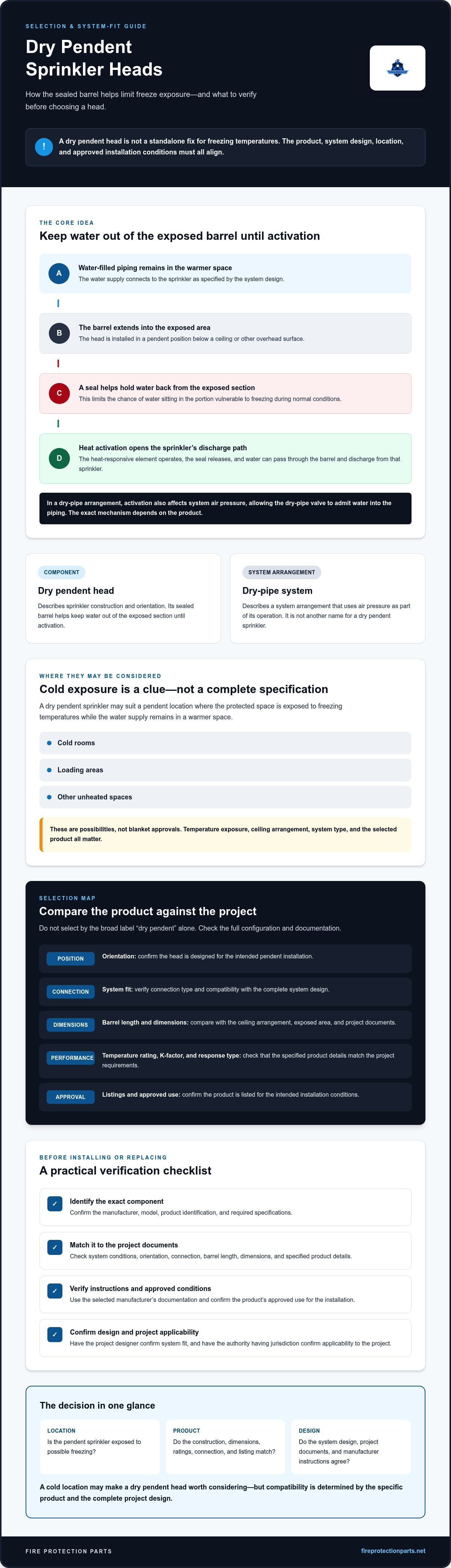
What to Verify Before Installing or Replacing a Dry Pendent Head
Pause before ordering or replacing a sprinkler. A similar-looking head may not match the installed system or approved design. Installation and replacement should be handled by qualified fire protection professionals, following project documents and manufacturer instructions. Don’t modify a product or rely on general guidance instead of its documentation.
A pre-installation verification sequence
Use this checklist to identify gaps before work begins:
- Start with project records. Review approved plans, schedules, and prior product information to identify the specified or existing sprinkler.
- Confirm exact identification. Match the manufacturer and product identification to its documentation. A broad category name doesn’t establish that a replacement is interchangeable.
- Check system conditions. Confirm the system arrangement and relevant operating conditions against the project documents.
- Compare ratings and physical requirements. Verify the specified orientation, temperature rating, K-factor, connection, dimensions, and barrel or extension requirements against the approved plans and manufacturer instructions.
- Confirm approved use. Check that product documentation supports the intended application and installation conditions.
- Resolve discrepancies before work. Refer conflicting or missing information to the engineer or responsible fire protection professional before ordering or installation.
Keep the source for each confirmed detail with the project record. If a dimension, rating, or product identification can’t be verified, mark it for resolution rather than treating it as a match.
Replacement, inspection, and code questions
A damaged, painted, corroded, or otherwise suspect head needs evaluation by a qualified fire protection professional. Don’t attempt to repair or alter it based on appearance. Replacement timing and acceptance depend on applicable requirements and the specific product. There isn’t a universal interval to apply without checking the governing documents and qualified guidance.
Confirm applicable code requirements and project specifications with the responsible professional. If product acceptance or applicable requirements remain unclear, ask the authority having jurisdiction. This section is a verification guide, not installation instructions or a determination that a sprinkler is compliant.
For related component-sourcing context, see the fire protection parts and system repair guide. Once the specification is confirmed, review dry pendent sprinkler options and check the exact product details against the approved project documents before ordering.
How to Source Dry Pendent Sprinkler Heads with Confidence
Procurement should follow a confirmed specification, not start with a broad search for a “dry pendent” head. Before ordering, obtain the exact manufacturer, model, and product documentation identified for the project. Compare the product listing with the approved project documents. Similar names or appearances don’t establish that two components are interchangeable, and a product category listing doesn’t confirm suitability for a particular system.
What information to have ready when ordering
Gather the approved product identification, required quantity, and relevant project specification. Confirm which details are mandatory for the application, then check that the candidate’s documentation addresses them. Use this order checklist to avoid guessing:
- Product identity: Manufacturer and exact model, matched to the approved schedule or another project record.
- Configuration: Required orientation, connection details, dimensions, and barrel or extension requirements.
- Specified characteristics: Temperature rating, K-factor, response type, finish, and any other characteristics named in the project documents.
- Use and documentation: Product-specific listing or approval information and the manufacturer’s instructions for the intended application.
- Order details: Quantity and any product or documentation questions to resolve with the supplier before purchase.
Mark unavailable or unclear information for verification. Don’t fill a gap by assuming a product is equivalent because it belongs to the same general category or has a matching connection. If a substitution is proposed, or the specification is incomplete or conflicting, ask the design professional or responsible fire protection professional to resolve it before buying.
The next step after confirming the specification
Once the requirement is settled, compare it with current product documentation for the exact item. Confirm current product details and availability with the supplier, and check any approval or listing claims against manufacturer documentation. A supplier listing can help identify a potential source, but it doesn’t replace approved project documents or establish that a component will fit or comply.
Fire Protection Parts lists dry pendent sprinklers at Fire Protection Parts as part of its online component offering. Use the listing as a sourcing starting point, then compare the product information with the confirmed specification before ordering.
Specify with Confidence, Then Source the Right Component
Dry pendent sprinkler heads are a location-specific part of a complete fire protection design, not a universal freeze-proof solution. Their sealed barrel helps protect the exposed section, but correct selection depends on matching the exact head to the system, project conditions, and approved product documentation.
Before ordering, confirm the manufacturer and model, orientation, dimensions, connection, ratings, and approved use. If a detail is missing or a substitution is being considered, resolve it with the responsible design professional before purchase. This verification helps prevent mismatches that appearance or a broad product description can’t rule out.
Once the specification is confirmed, Fire Protection Parts offers dry pendent sprinklers among its online fire protection components and serves individual and bulk purchasing needs. Check current product details and availability against your project documents, and verify product-specific approvals with manufacturer documentation. Browse dry pendent sprinklers as a sourcing starting point, then select only a component that matches the confirmed requirement.
A careful specification makes the next step clearer. With the right information in hand, you can move forward with greater confidence.
Frequently Asked Questions
What is a dry pendent sprinkler head?
A dry pendent sprinkler head is a pendent sprinkler with a sealed barrel that helps keep water out of the portion exposed to cold conditions. It extends from a water supply into a space where freezing is a concern. The seal opens when the sprinkler activates, allowing water to discharge through the head. Approved use and installation conditions depend on the exact product documentation and system design.
Where should dry pendent sprinkler heads be used?
Dry pendent sprinkler heads may be considered where a pendent sprinkler is needed in a space that could freeze, such as a cold room or unheated loading area. These are examples, not automatic approvals for a particular building or system. The project designer should confirm suitability against the system design and site conditions. The authority having jurisdiction must also confirm applicability where required.
How does a dry pendent sprinkler head work?
Heat activates the sprinkler’s heat-responsive element, opening the head and its sealed barrel so water can reach the discharge opening. In a wet-pipe system, the seal holds water back from the exposed barrel until activation. In a dry-pipe system, activation also affects air pressure and valve operation, allowing water into the piping. The exact mechanism depends on the sprinkler and system, so follow manufacturer documentation.
Can a dry pendent sprinkler head be installed on a wet-pipe system?
Some dry pendent sprinklers are designed for wet-pipe systems, where the head’s seal keeps water from entering the exposed barrel until activation. That doesn’t mean every model is compatible with every wet-pipe installation. Check the exact product’s listing and manufacturer instructions, then compare the connection, orientation, dimensions, and system conditions with approved project documents. The responsible design professional should verify compatibility before selection or installation.
Can I replace a standard pendent sprinkler head with a dry pendent head?
Don’t treat a dry pendent head as a direct substitute for a standard pendent head without professional review. The two may differ in construction, dimensions, connection, ratings, and approved installation conditions. A qualified fire protection professional should compare the proposed head with project documents and manufacturer instructions. Resolve any proposed substitution with the design professional and, if acceptance is unclear, the authority having jurisdiction before work proceeds.
What information do I need to select a dry pendent sprinkler head?
Start with the approved product identification, project drawings or sprinkler schedule, and system details. Confirm the manufacturer and model, orientation, connection, barrel length or extension, dimensions, K-factor, temperature rating, response characteristics, finish, and required listing or approval details. Not every project will specify every field, so mark missing information for verification. Check product-specific documentation and have the responsible professional resolve any uncertainty before ordering.
Do dry pendent sprinkler heads prevent an entire sprinkler system from freezing?
No. A dry pendent head is designed to keep water out of its exposed barrel, but it doesn’t protect every pipe or component in the system from freezing. Other portions may still be exposed to low temperatures or have separate freeze-protection requirements. The full system design must account for its location and conditions. Have a qualified fire protection professional evaluate the design rather than relying on one sprinkler head for whole-system protection.

