



Fire Hose Angle Valve Buying Guide: Choose the Right Fit
Could a fire hose angle valve that looks like the right size still fail to fit your system? Yes. A mismatch in inlet or outlet threads, pressure rating, or valve configuration can delay sourcing and leave a critical connection unready. Appearance alone cannot confirm compatibility.
If you're comparing valves, start with your system documentation, not guesswork. This guide explains how to identify the required connections, compare valve sizes and materials, and check pressure ratings and required approvals before ordering.
You'll also learn how standard and pressure-restricting angle valves differ, which details to verify against the hose, coupling, and outlet, and how to assess related hose equipment without assuming similar-looking parts are interchangeable. If your records don't clearly identify a thread standard or rating, pause and ask the qualified professional responsible for the system to confirm it. Use the checks ahead to narrow your options and verify the required configuration.
Key Takeaways
- Choose a fire hose angle valve by matching its size, inlet and outlet connections, thread standard, material, and pressure rating to your system requirements.
- Use approved drawings, equipment schedules, and manufacturer documentation to identify the required configuration before selecting a replacement.
- Compare valve types using confirmed product specifications. A product name or similar appearance alone does not establish fit or performance.
- Check the exact product details for related hose equipment, including its connection arrangement and rated pressure, before ordering.
What Is a Fire Hose Angle Valve, and Where Is It Used?
A fire hose angle valve controls water flow through a hose connection. Its angled body redirects the flow path between the inlet and outlet. The exact angle, connection arrangement, and operating method vary by model, so use the manufacturer’s documentation to confirm the configuration instead of relying on the product name or appearance.
Angle valves may be used at hose outlets in standpipe systems, but an angle pattern is not suitable for every outlet or layout. A standpipe supplies water to designated hose connections in a building; see Standpipe (firefighting) for an overview. Approved plans, equipment schedules, local requirements, and the authority having jurisdiction determine which valve configuration is appropriate.
How an angle valve fits into a fire hose connection
Water enters through the inlet and exits through the outlet toward the connected hose. The angled body changes the direction of flow, which may suit a particular outlet orientation or clearance. A handle or other operating mechanism opens or closes the valve. Check the manufacturer’s instructions for that model’s operation and intended use. The outlet location and system function, rather than convenience alone, should determine whether an angle pattern fits.
Angle valve versus other hose connection components
A straight-pattern hose valve directs flow along a straight path, while an angle valve redirects it. Neither pattern is inherently better. The system design and product specifications determine the right one. Valves are also different from hose assemblies, couplings, and caps, which carry out other connection or closure functions. A fire department connection is a separate component used to connect fire department pumping equipment to a building’s piping.
Keep these parts distinct when checking a replacement. Matching threads do not prove that a valve has the right body pattern or role. For broader context on fire protection parts and hardware for system repairs, consult a relevant repair guide, then verify each component against the approved system documents. Confirm the selection before ordering, especially if the existing equipment or drawings do not clearly show the intended arrangement.
Which Fire Hose Angle Valve Specifications Should You Compare?
Start with documented specifications, not a visual estimate or product title. Record the details for both ends of the connection and compare them with the system’s approved documentation. Nominal size alone does not establish that two threaded parts will mate correctly.
| Specification | What to verify |
|---|---|
| Size | Nominal valve size and the size required at the system connection. |
| Inlet connection | Connection type, size, thread form, and gender at the inlet. |
| Outlet connection | Connection type, size, thread form, and gender for the hose or attached component. |
| Thread standard | The exact standard stated in system and manufacturer records, not just a similar-looking label. |
| Material | Material specified for the application and confirmed by the product documentation. |
| Rated pressure | The valve’s documented rating compared with system requirements and operating conditions. |
Match both ends to approved system documentation before ordering.
Match size and threads to the system
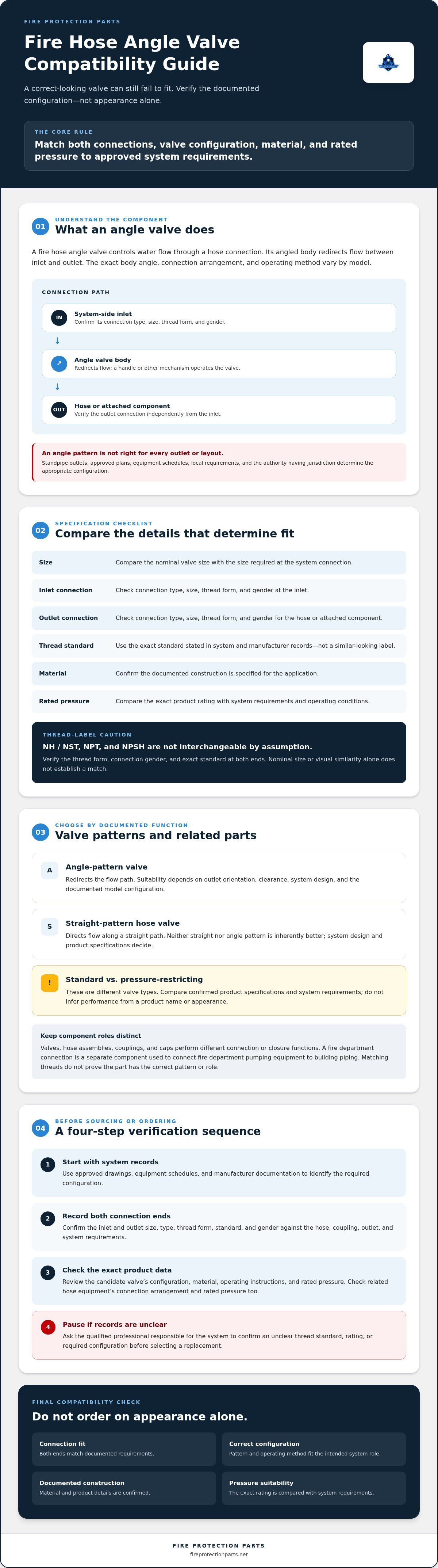
Check the existing connection, equipment schedule, and manufacturer specifications. Do not treat labels such as NH or NST, NPT, and NPSH as interchangeable or assume they are the same based on appearance. Verify the thread form, connection gender, and standard at both the inlet and outlet. If the records are unclear, ask a qualified professional to confirm the connection before selecting a replacement.
Compare material and pressure rating with evidence
Material choice depends on the application and the valve’s documented construction. Do not assume a pressure figure on one listing applies to every valve or system. Compare the exact product rating with documented system requirements and operating conditions. For broader procurement context, review Principles of Fire Protection Engineering, then follow the project’s approved specifications when selecting components.
Keep the relevant records together while sourcing: system-side connection details, manufacturer specifications, and the candidate valve’s complete product data. You can also browse related hose equipment, then check the current product details against the required configuration. A similar size or thread label on its own is not enough to establish compatibility.
How Do You Compare Valve Types and Avoid a Mismatch?
Compare documented configurations, not product names or photos. A listing may describe a valve by size, material, or connection arrangement, but those details do not prove it matches your system or is approved for your application. The valve must meet project requirements at both connections and under its intended operating conditions.
| Listing detail | What the buyer must confirm |
|---|---|
| Body pattern and outlet direction | Whether the layout suits the approved drawings, hose routing, clearance, and access. |
| Inlet and outlet connections | Exact sizes, thread standards, and connection genders at both ends. |
| Material or construction description | The stated material and construction match the project documentation. |
| Pressure rating | The product-specific rating is compatible with documented system requirements and operating conditions. |
| Product approvals or listings | Any required approval is confirmed in current manufacturer records and project documents. |
When connection layout matters more than appearance
Body pattern affects the direction water travels after entering the valve. Check the space around the outlet, the planned hose route, and whether users can reach and operate the valve as intended. A product photo may not show important dimensions or connection details, so compare technical sheets and drawings. The choice between an angle and straight pattern is specific to the project and must agree with system documentation.
How to interpret material and pressure claims
Descriptions such as brass, cast, or forged are manufacturer-stated details, not proof of suitability or performance. Confirm the exact material and construction in current product data. Apply the same check to pressure claims: a rating shown for one listing applies to that specified product, not every valve in its category. A higher rating does not automatically make a valve suitable for a particular installation.
A common mismatch is assuming equal nominal sizes mean compatible connections. They do not. Two ends can differ in thread form, standard, or gender even when the stated size looks right. Check each detail against the system record, then confirm the candidate valve’s complete specifications with the manufacturer. If a listing leaves a detail unclear, treat it as unverified rather than making an assumption.
What Should You Verify Before Ordering a Fire Hose Angle Valve?
A replacement should match the system’s documented function and configuration, not just the part being removed. Before ordering, consult approved drawings, equipment schedules, and manufacturer documentation. If the specifications are incomplete or conflict, pause and ask a qualified fire protection professional to review them.
A five-step pre-order compatibility checklist
- Identify the application. Record where the valve will be used and its intended function. Confirm whether the specified component is an angle-pattern valve or another valve type.
- Check system documents. Review approved drawings and equipment schedules for the required valve location, nominal size, and configuration. Confirm applicable project requirements with the authority having jurisdiction.
- Confirm both connections. Record inlet and outlet sizes, thread standards, and connection genders. Verify them against the mating equipment and manufacturer documentation instead of estimating from appearance.
- Verify the rating. Compare documented system requirements and operating conditions with the exact manufacturer rating for the proposed product. Do not assume a rating from a similar model applies.
- Confirm current product details. Check the specific configuration, compatibility information, and any listing or approval required for the project against current product records before checkout.
Common ordering mistakes that delay a project
Nominal size is only one detail. Matching sizes do not prove that threads are compatible, and familiar-looking labels can refer to different connection standards. Product photos may also hide connection details or body orientation. Use technical data and system documents to check the complete configuration.
Do not substitute an angle valve for a straight valve, or either type for a pressure-reducing valve, based on appearance or a similar product name. These configurations can serve different system requirements. Confirm any proposed substitution against the approved project documents and with the qualified professional responsible for the system. Code requirements and approvals may depend on the system, jurisdiction, and authority having jurisdiction, so a product listing alone does not prove acceptance.
Once you’ve identified the required specifications, browse hose equipment and compare available components. Check each current product record carefully. Related hose valves are not automatically angle valves, so verify the exact configuration before ordering.
Which Hose Equipment Products Can Support Your System?
Hose systems use different components for different jobs. A valve controls flow, a hose carries water, a cap protects a connection, and a fire department connection provides a separate system interface. Assess each component separately. A related hose-valve listing is not automatically a fire hose angle valve, and the product name alone does not establish its body pattern, thread details, or suitability.
Standout related products in the hose equipment collection
Examples of related hose equipment include several different component types. They are not interchangeable options:
- 2-1/2" Hose Valve Threaded X Threaded For Fire Hoses: A threaded hose-valve option. Check its exact configuration and both connection details in the current product specifications before considering it for a system.
- Zurn Wilkins ZW5000 2-1/2" Pressure Reducing Hose Valve for Fire Systems: A pressure-reducing hose valve. It is a distinct product type, not a substitute for an angle valve unless the approved system documents specifically call for that configuration.
- 1.5" 100' NST Rack Hose: A rack-hose example. Verify that its stated connections and other specifications match the equipment it must connect to.
- 2-1/2" Plastic Cap with Chain For ABS NST FDC Connection: A connection-protection accessory, not a valve. Confirm its connection details against the fire department connection.
- 2-1/2" NST Single Snoot FDC Brass Construction System: A separate fire department connection component. Check its product documentation and system requirements independently of hose-valve specifications.
Browse by the component your project actually needs
Start with the required function: flow control, hose, connection protection, or a fire department connection. Then compare the selected component’s exact configuration with the approved drawings, equipment schedule, and manufacturer documentation. If your facility project also requires specialized fluid lines or custom plastic tubing, manufacturers like abbeyextrusions.com can provide bespoke hose and extrusion profiles. Similar nominal sizes or familiar thread labels are not enough to establish compatibility. Product details and availability can change, so check the current listing before purchasing.
For a fire hose angle valve, confirm that the product is specifically documented as an angle-pattern valve and that its connections, rating, and intended application match the project. To compare related components, browse the hose equipment collection, then check current specifications before ordering.
Make Your Next Valve Selection With Confidence
A reliable selection starts with the system documents, not a visual match. Confirm the fire hose angle valve’s body pattern, inlet and outlet connections, thread details, material, and pressure rating against approved requirements. Then verify the exact product configuration and any required approvals in current manufacturer documentation.
Fire protection systems use hose valves, hose assemblies, caps, and fire department connection components for different functions. Do not treat a threaded hose valve or pressure-reducing valve as an angle valve unless its specifications confirm that configuration. Check current listing details before purchase.
Browse hose equipment and verify the right component for your system. Compare product records with your project documents, and seek qualified review if a specification is unclear.

