



Air Compressor for Dry Pipe Sprinkler: The 2026 Professional Buying Guide
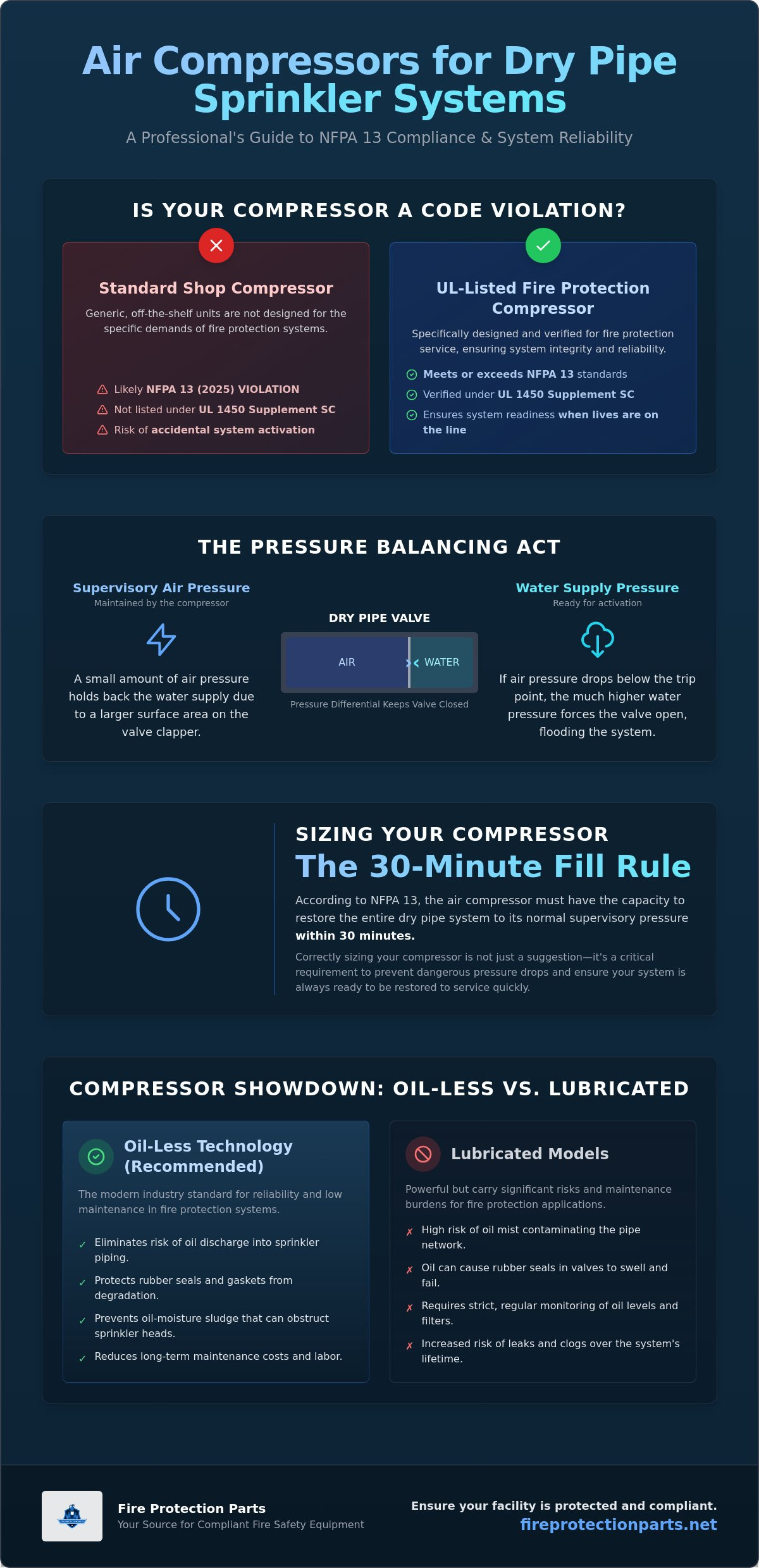
That standard shop compressor in your riser room isn't just a maintenance headache; under the NFPA 13 2025 Edition, it's likely a code violation that puts your entire facility at risk. Selecting an air compressor for dry pipe sprinkler systems is no longer about finding the cheapest unit at a hardware store. Recent updates to UL 1450 Supplement SC mandate that dedicated compressors must be specifically listed for fire protection service. If your equipment doesn't carry this verification, you're looking at more than just a failed inspection. You're looking at a system that might not perform when lives are on the line.
We understand the frustration of navigating shifting regulations and the fear of accidental system trips caused by inadequate pressure. You want a solution that works without constant oversight. This guide provides the professional assurance you need to master technical requirements and NFPA compliance standards. We'll explain how to satisfy the critical 30-minute fill rule and why oil-less technology is the benchmark for modern reliability. You'll learn exactly how to identify the correct horsepower for your system volume and ensure your fire protection is beyond compromise.
Key Takeaways
- Verify your equipment meets the latest NFPA 13 (2025) standards to avoid failed inspections and ensure total facility protection.
- Master the 30-minute fill rule to correctly size an air compressor for dry pipe sprinkler systems and prevent dangerous pressure drops.
- Evaluate the performance benefits of oil-less technology versus lubricated models to reduce long-term maintenance and protect your piping infrastructure.
- Differentiate between standard shop compressors and UL-listed fire protection units to eliminate the risk of accidental system activations.
- Identify the ideal mounting configuration for your riser room to maximize space and guarantee reliable supervisory pressure.
The Role of Air Compressors in Dry Pipe and Pre-Action Systems
In unheated environments like parking garages, cold storage, or warehouses, water in piping is a liability. It freezes, bursts, and causes catastrophic damage. This is why dry pipe sprinkler systems are the industry standard for cold-weather protection. These systems don't hold water in the overhead piping during normal operation. Instead, they're filled with pressurized air. An air compressor for dry pipe sprinkler systems serves as the critical guardian of this pressurized environment. It provides the mechanical force required to hold the dry pipe valve closed against the massive pressure of the water supply. Without a steady, reliable air source, the system is prone to accidental activation, leading to expensive water damage and system downtime.
Supervisory Pressure vs. Trip Pressure
The mechanical integrity of the system relies on a pressure differential. A dry pipe valve uses a larger surface area on the air side of the clapper to hold back a smaller area on the water side. This design allows a relatively small amount of air pressure to restrain significantly higher water pressure. It's a balance of forces. If the air pressure drops below the specific trip point, the clapper opens and water floods the system. The compressor's job is to maintain supervisory pressure, which is the safety margin above that trip point. In unheated spaces, air contracts as temperatures fall. A sudden cold snap can trigger a low-pressure alarm or an accidental trip if your compressor isn't sized correctly or responsive enough. Professional-grade compressors ensure the system stays active 24/7, providing peace of mind through automated pressure maintenance.
Dry Pipe Valve Integration
Your compressor is a central component of the fire riser room. It connects to the dry pipe valve through an air maintenance device. This device regulates the flow, ensuring the compressor doesn't accidentally prevent the valve from opening during a fire. This integration is even more vital in pre-action systems. In these configurations, air pressure monitors the integrity of the pipe network. If a pipe breaks, the drop in air pressure alerts the system before water is released. For high-hazard environments, the air compressor for dry pipe sprinkler works alongside electric deluge valve fire suppression setups. In these scenarios, the air supply acts as a primary safeguard against false alarms. It ensures water only flows when the detection system confirms a genuine fire event. Reliable air supply is your first line of defense against both fire and accidental water damage.
Key Selection Criteria: Oil-Less vs. Lubricated and Mounting Options
Selecting the correct air compressor for dry pipe sprinkler systems is a decision that impacts the reliability of your fire protection for decades. The choice isn't just about power. It's about the quality of the air entering your pipes and the physical footprint of the equipment in your riser room. Facility managers must choose between two primary mechanical designs: oil-less and lubricated. Each has distinct advantages depending on the environment and the size of the system being protected. Making the wrong choice can lead to premature pipe corrosion or increased maintenance labor costs.
Most modern fire protection professionals favor oil-less compressors. These units eliminate the possibility of oil mist entering the sprinkler piping. Oil in the pipes can degrade gaskets and collect debris, leading to clogs or leaks. Lubricated models are powerful and suit environments where the compressor runs frequently. However, they demand strict monitoring of oil levels and filtration systems to prevent contamination. If you choose a lubricated model, you must commit to a more rigorous maintenance schedule to ensure the air remains clean.
Oil-Less Technology for Fire Protection
Oil-less compressors have become the industry standard for a reason. They eliminate the risk of oil discharge into the sprinkler piping, which is a common failure point in older systems. When oil enters the pipes, it can cause the rubber seals in dry pipe valves to swell or degrade. It also mixes with moisture to create a sludge that can obstruct sprinkler heads. By removing oil from the equation, you simplify your maintenance schedule and protect the integrity of your pipe network. Oil-less technology is the preferred choice for NFPA 13 compliance in 2026 because it ensures that no petroleum-based contaminants interfere with the listed performance of the sprinkler components. These units are specifically designed for the intermittent duty cycles typical of supervisory pressure maintenance. They offer a clean, reliable solution that requires far fewer site visits from your service contractor.
Riser Mount vs. Tank Mount
The physical layout of your fire riser room often dictates your mounting choice. Riser-mount units are the ultimate space-savers. These compressors attach directly to the system piping, keeping the floor clear for other essential equipment. They are an excellent choice for single-valve systems or retrofits where space is at a premium. Their "plug-and-play" design allows for fast installation without the need for complex mounting brackets or dedicated floor space. When you are Sizing Your Compressor for a smaller facility, a riser-mount unit is usually the most efficient path forward.
In contrast, tank-mounted compressors are built for scale. They include a storage tank that provides a buffer of air. This reservoir allows the compressor to satisfy small leaks without the motor starting and stopping constantly. For large facilities with multiple dry pipe valves, a tank-mounted unit reduces motor wear and extends the lifespan of the equipment. If your system volume is high, the stored air ensures you can maintain pressure even during minor fluctuations. For those seeking a balance of durability and code compliance, exploring professional-grade air compressors for sprinkler systems ensures you find a mounting configuration that fits your specific mechanical room layout. Whether you prioritize a compact footprint or heavy-duty capacity, the right mount ensures your system remains pressurized and ready for action.
Compliance Standards: Why UL 1450 and NFPA 13 (2025/2026) Matter
The regulatory environment for fire suppression equipment is tightening. For years, many facilities relied on standard "shop" compressors as a cost-cutting measure. That era has ended. The 2025 edition of NFPA 13 introduces a mandatory requirement: any air compressor for dry pipe sprinkler systems dedicated to the system must be "listed" for fire protection service. This isn't a suggestion. It's a code requirement that ensures the equipment maintaining your supervisory pressure is as reliable as the pipes themselves. If your compressor isn't listed, your system isn't compliant.
Shop compressors lack the durability and specific pressure switch configurations required for life safety. They're built for intermittent use in garages, not for the 24/7 reliability needed to prevent accidental system trips. Professional fire protection compressors are engineered to withstand the unique environment of a riser room. They provide the precise pressure control needed to keep the dry pipe valve seated without the risk of motor burnout or pressure drift. Choosing listed equipment is the only way to eliminate doubt and ensure your facility meets modern safety benchmarks.
Understanding UL 1450 Certification
UL 1450 certification is the industry gold standard for motor-operated air compressors. To achieve this listing, a compressor must undergo rigorous testing that simulates years of fire protection service. This includes Supplement SC, which specifically evaluates the compressor's performance in sprinkler applications. There's a massive difference between a consumer-grade pump and a fire-rated air supply. A listed unit features heavy-duty components and specialized pressure switches that prevent the short-cycling that kills cheaper motors. When a fire marshal enters your riser room, "Is it listed?" is the first question they'll ask. Having the UL mark on your equipment is your proof of professional adherence to safety standards.
Liability and Insurance Considerations
The hidden cost of using an unlisted "band-aid" compressor can be devastating. Beyond the risk of inspection failures, you're looking at significant insurance liability. If a dry pipe system fails or suffers an accidental trip, and an investigator discovers non-compliant equipment, property owners face the very real threat of denied claims. Code compliance is your primary defense against financial loss. It ensures that every component, from the air supply to the fire protection control valves, operates within a verified ecosystem of safety. A stable, listed air supply prevents the pressure fluctuations that stress these valves, preserving the integrity of your entire installation. Protecting your building means choosing equipment that offers an absence of compromise.
Sizing Your Compressor: The 30-Minute Fill Rule
NFPA 13 isn't vague about timing. It requires that an air compressor for dry pipe sprinkler systems must be capable of restoring the entire system to its required supervisory pressure within 30 minutes. This isn't just a benchmark for convenience. It's a safety mandate designed to minimize the time a facility remains unprotected after a system trip or maintenance event. If your compressor takes 45 minutes to fill a large warehouse network, you're in violation of life safety codes and potentially compromising your insurance coverage.
While the 30-minute rule is standard for dry systems, pre-action systems often allow for a 60-minute fill time. This depends on the specific hazard classification and system design. However, the goal remains the same: reliable pressure restoration. You must balance the need for speed with the mechanical limits of your equipment. Oversizing a compressor to beat the clock is a common mistake. A motor that's too large for the pipe volume will short-cycle. This leads to rapid wear, heat buildup, and eventual motor failure. Proper sizing is about precision, not just raw power.
Calculating System Volume
To find the right unit, you first need to determine the total capacity of your pipe network. This involves using pipe schedules to estimate the volume in gallons or cubic feet. You'll need to account for every foot of large-diameter mains and the long branch line runs typical in industrial settings. Once you have the total volume, you calculate the required Cubic Feet per Minute (CFM) based on the target supervisory pressure. The compressor must deliver this CFM at the specific pressure where the dry pipe valve clapper seats. It's a technical calculation that leaves no room for guesswork. If you don't have the original as-built drawings, manual pipe counting is the only way to ensure accuracy.
The Role of Air Maintenance Devices (AMD)
An Air Maintenance Device (AMD) is the critical link between your compressor and the dry pipe valve. If you're using a tank-mounted or high-capacity air compressor for dry pipe sprinkler, an AMD is a code-mandated requirement. It acts as a pressure regulator, ensuring that air enters the system at a controlled, steady rate. Without it, a high-output compressor could fill the system too quickly during a fire. This would prevent the air pressure from dropping fast enough to trip the valve, delaying water delivery when it's needed most. This is a critical safety gap that many general contractors overlook.
The AMD also provides a vital monitoring point. It often works in tandem with other riser room components, including the os&y valve, to provide a complete picture of system readiness. By regulating the flow, the AMD prevents small leaks from causing constant compressor starts, protecting your motor from premature burnout. For professional-grade equipment that meets these rigorous sizing standards, explore our full selection of air compressors for sprinkler systems. Our experts can help you match a UL-listed unit to your specific system volume, ensuring 100% compliance and long-term reliability.
Sourcing Reliable Fire Protection Air Compressors
Securing a code-compliant air compressor for dry pipe sprinkler systems is the final step in protecting your infrastructure. You can't afford delays when a system is down or an inspector is on-site. Fire Protection Parts serves as a mission-driven partner for contractors and facility managers. We maintain a comprehensive inventory of UL-listed compressors designed specifically for the rigors of fire protection. Whether you need a compact riser-mount unit for a small retail space or a heavy-duty tank-mounted system for an industrial complex, our selection ensures you never have to compromise on quality or safety. We prioritize hardware that meets the strict UL 1450 Supplement SC requirements, giving you a clear path to successful inspections and total compliance.
Our team provides the expert support necessary to help you navigate the technical nuances of the 30-minute fill rule. We don't just sell equipment; we help you verify that your chosen specs match your system's total piping volume. Fast shipping is our standard. We understand that every hour your system lacks supervisory pressure is an hour of unacceptable risk. From vibration isolation pads to specialized pressure switches, we stock the essential accessories that keep your air compressor for dry pipe sprinkler setup online and fully operational. Our warehouse is stocked and ready to move at the speed of your project, ensuring your facility remains protected without interruption.
Why Buy from Fire Protection Parts?
Procuring hardware through verified channels is the only way to guarantee adherence to the latest NFPA standards. We offer direct access to the industry's most trusted brands, providing fire protection parts online with full technical documentation. Our professional-grade hardware eliminates the guesswork often associated with code compliance. By choosing our expert-selected inventory, you gain the unwavering assurance that every component in your riser room is built for longevity and life-safety performance.
Next Steps for Installation and Repair
Maintaining an existing system often requires identifying specific replacement parts for older compressor setups. If your motor is showing signs of heat fatigue or your fill times are drifting beyond the 30-minute mark, it's time for an upgrade. We provide the technical data sheets required to ensure your new unit integrates perfectly with your existing air maintenance device and riser configuration. Always consult with a licensed fire protection professional for the final installation and testing of your new equipment. This ensures that your system integration is seamless and that your supervisory pressure levels are calibrated correctly. Your facility's safety depends on the synergy of quality parts and professional expertise. Browse our full selection of Fire Protection Air Compressors today to secure your facility's future.
Secure Your Compliance and System Reliability
Protecting your facility requires more than just meeting the bare minimum. As the 2025 NFPA 13 standards take full effect, the transition to listed equipment is a critical step for every building owner and contractor. You've learned that the right air compressor for dry pipe sprinkler systems must balance precise sizing with the durability of UL 1450 listed hardware. By prioritizing oil-less technology and adhering to the 30-minute fill rule, you eliminate the risks of pipe contamination and motor failure. These aren't just technical details; they're the foundation of a system that works when it's needed most.
Don't leave your code compliance to chance. Our inventory features NFPA 13 compliant solutions that are trusted by fire protection contractors nationwide. We provide the professional-grade hardware and expert guidance necessary to ensure your installation is beyond reproach. Shop Code-Compliant Air Compressors for Dry Pipe Systems today and gain the peace of mind that comes with unwavering reliability. Your facility deserves the protection of a system built without compromise.
Frequently Asked Questions
Does NFPA 13 require an air compressor for all dry pipe systems?
NFPA 13 requires a reliable, permanent air supply for every dry pipe system to maintain supervisory pressure. While this can technically come from a plant air system, a dedicated air compressor for dry pipe sprinkler use is the industry standard. It ensures that the fire protection system remains independent of other facility operations. If your primary air source fails, the dedicated compressor acts as the critical safeguard against an accidental system trip.
What is the difference between a shop air compressor and a fire protection air compressor?
The primary difference is the UL 1450 listing and the intended duty cycle. Shop compressors are consumer-grade tools built for intermittent tasks like powering pneumatic wrenches. Fire protection compressors are professional-grade machines designed for 24/7 supervisory service. They feature specialized pressure switches and motor windings that handle the unique demands of a fire riser room. Using a non-listed shop unit is a code violation that compromises system reliability.
How do I calculate the 30-minute fill time for my sprinkler system?
You must determine the total internal volume of your piping network in gallons. Use the pipe diameter and length to find the capacity, then convert that to cubic feet. The compressor's CFM output at the system's required pressure must be sufficient to fill that total volume from zero to the target supervisory pressure within 30 minutes. Most manufacturers provide sizing charts that simplify this calculation based on total system gallons.
When is an air maintenance device (AMD) required?
An air maintenance device is mandatory whenever you use a tank-mounted compressor or a plant air supply. The AMD acts as a pressure regulator that limits the rate of airflow into the sprinkler system. Without it, a high-capacity compressor could supply air faster than the system can vent it through a fused sprinkler head. This would prevent the dry pipe valve from tripping, causing a dangerous delay in water delivery during a fire.
Can I use a nitrogen generator instead of an air compressor?
Yes, nitrogen generators are an excellent alternative that helps prevent internal pipe corrosion. These systems still utilize a compressor to move gas into the pipes, but they pass the air through a membrane to remove oxygen. While the initial investment is higher, nitrogen is the preferred choice for extending the lifespan of your piping. It's fully compliant with NFPA 13 standards and works seamlessly with standard dry pipe valves.
What are the maintenance requirements for an oil-less air compressor?
Maintenance for oil-less units is straightforward but essential for long-term performance. You must inspect the air intake filters monthly and replace them if they're clogged with dust or debris. It's also vital to drain any accumulated moisture from the tank or the riser drip leg to prevent internal corrosion. Because these units don't use oil, you don't have to worry about monitoring lubricant levels or disposing of hazardous waste.
Is UL 1450 listing mandatory for fire sprinkler compressors in 2026?
Yes, the 2025 edition of NFPA 13 mandates that any air compressor for dry pipe sprinkler service must be listed for fire protection. This refers specifically to the UL 1450 Supplement SC standard. This requirement ensures that the compressor has been tested for the specific pressures and environmental conditions found in fire riser rooms. Installing an unlisted compressor in 2026 will likely result in a failed fire marshal inspection and potential insurance liability.
Can one compressor serve multiple dry pipe valves?
A single, correctly sized tank-mounted compressor can serve multiple dry pipe valves. However, each individual system must have its own dedicated air maintenance device. This configuration allows the central compressor to maintain a reservoir of air while the AMDs regulate the specific pressure needed for each valve. It's a cost-effective solution for large facilities, provided the compressor's CFM output can satisfy the 30-minute fill rule for the largest single system.

