



Ames Single Detector Checks: The 2026 Professional Buyer’s Guide
Is your fire protection system truly secure, or is a single corroded valve putting your entire facility at risk? Selecting the wrong backflow assembly leads to more than just a failed inspection; it can result in catastrophic water damage or a system that fails during an emergency. You need ames single detector checks that offer uncompromising reliability and adhere to the latest ANSI/CAN/UL 312:2022 standards.
We know that navigating model suffixes like SS, LG, and OSY feels like decoding a foreign language while project deadlines and local water authority requirements pile up. This 2026 guide eliminates the guesswork, ensuring you master the technical nuances of Ames assemblies to keep your water supply secure and your site fully compliant. We'll break down the specific differences between the 2000SS and 3000SS series, explain the integrated monitoring capabilities of detector checks, and show you how to select a UL/FM-approved assembly that fits your existing footprint without the headache of long lead times. You'll gain the expert confidence needed to source reliable parts that guarantee long-term performance and peace of mind.
Key Takeaways
- Learn to differentiate between bypass meters and main checks to identify leaks or unauthorized water use before they impact system integrity.
- Compare the Ames 2000SS and 3000SS series to determine whether a standard double check or a detector assembly is required for your specific hazard level.
- Identify the best configurations for ames single detector checks, including OS&Y valves and grooved connections, to ensure rapid installation and visual status monitoring.
- Discover why 300-series stainless steel construction is the professional standard for corrosion resistance and longevity in fire protection environments.
- Streamline your procurement process by understanding how to source UL/FM-approved assemblies that meet strict local water authority and NFPA codes.
Understanding Ames Single and Double Detector Check Assemblies
An Ames detector check assembly is a sophisticated safeguard for your building's infrastructure. It functions as a specialized Backflow Prevention Device, preventing stagnant fire system water from re-entering the public drinking supply. While standard valves simply stop flow, ames single detector checks incorporate a bypass meter to identify low-flow events. This dual-purpose design ensures that every drop of water is accounted for, whether it's a slow leak or a minor unauthorized tap. It's a proactive approach to facility management that prioritizes both safety and resource conservation.
The 'detector' component is the heart of the system. It uses a small bypass line equipped with a meter to record low-volume water usage that wouldn't trigger the main check valve. When a fire occurs and high demand is placed on the system, the main check opens to provide full flow. This setup protects the utility's revenue and alerts facility managers to potential system compromises before they become expensive failures. It effectively eliminates the risk of "silent" leaks that can lead to significant property damage over time.
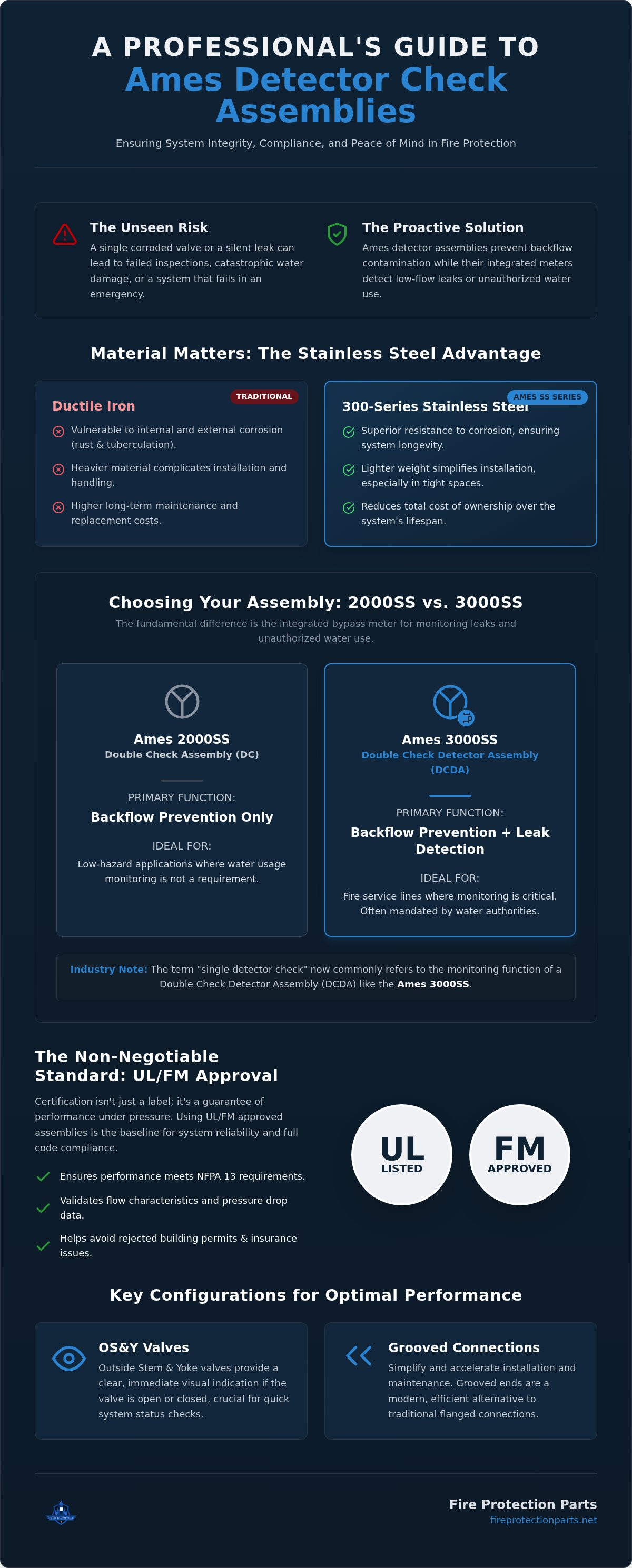
Ames set a new benchmark with its SS series. By utilizing 300-series stainless steel instead of traditional ductile iron, these assemblies offer superior corrosion resistance. This is vital in wet-pipe systems where internal rust can degrade performance over decades. The lighter weight of stainless steel also simplifies installation for contractors working in tight mechanical rooms. It's a shift toward longevity that reduces the total cost of ownership for building owners.
Single Check vs. Double Check Detector Assemblies
Terminology in fire protection has evolved significantly. Historically, a single check detector assembly was used to monitor water usage. However, modern safety standards and local water authorities now almost universally require Double Check Detector Assemblies (DCDA). A DCDA provides two independent check valves, offering a higher level of redundancy. If one check fails due to debris, the second check maintains the seal. Ames terminology has shifted to reflect these safety demands; while some still search for ames single detector checks, the industry has largely transitioned to the DCDA to meet modern NFPA 13 requirements.
The Importance of UL/FM Approval in 2026
In 2026, verification is everything. UL/FM certification isn't just a label; it's a rigorous validation of flow characteristics and pressure drop data. Using non-certified components can lead to rejected building permits or increased insurance premiums. These approvals confirm that the assembly will perform exactly as specified during a high-pressure fire event. UL/FM approval is the baseline for system reliability. Choosing an Ames assembly with these marks eliminates doubt for both the inspector and the property owner, ensuring the system remains code-compliant throughout its service life.
Comparing Ames 2000SS, 3000SS, and 4000SS Series
The "SS" designation in Ames assemblies isn't just a marketing label; it's a technical upgrade to 300-series stainless steel. In high-humidity riser rooms, traditional ductile iron valves eventually succumb to exterior corrosion and internal tuberculation. Stainless steel eliminates these risks, offering a lighter, more durable alternative that simplifies maintenance. When you're sourcing ames single detector checks for a modern facility, you're essentially matching the level of protection and monitoring to your building's specific risk profile.
2000SS vs. 3000SS: When Monitoring Matters
The fundamental difference between these two series lies in the bypass. The Ames 2000SS is a standard Double Check Valve Assembly (DC) designed for low-hazard applications where backflow prevention is the only goal. However, many fire service lines require more than just prevention. The Ames 3000SS is a Double Check Detector Assembly (DCDA), which is what many professionals refer to when searching for ames single detector checks for fire service monitoring.
The 3000SS includes a bypass meter to detect leaks or unauthorized water usage. This is critical for systems with fire pumps, as it identifies small flows that might otherwise go unnoticed. While the 2000SS serves as a cost-effective baseline for commercial risers, the 3000SS is often mandated by local water authorities to protect their revenue and system integrity. If your project involves a residential fire riser where constant monitoring is a code requirement, the 3000SS is the non-negotiable choice.
Moving to the 4000SS for High-Hazard Scenarios
When your fire protection system includes chemical additives, such as anti-freeze or corrosion inhibitors, the hazard level shifts from low to high. In these scenarios, a standard double check isn't enough. The Ames 4000SS is a Reduced Pressure Zone (RPZ) assembly that provides the highest level of protection. It features a relief valve that maintains a lower pressure zone between two check valves, ensuring that any backflow is discharged rather than allowed into the potable supply.
The 3-inch 4000SS OS&Y model is a standout for high-hazard commercial applications. It offers the same stainless steel longevity as the rest of the SS line but adds the critical safety of an RPZ. Keep in mind that 4000SS installations require proper drainage to manage potential relief valve discharge. If you're unsure which series fits your local code, you can browse our full range of Ames backflow preventors to find the exact model for your hazard level.
Selecting the Right Configuration: OS&Y, Grooved, and Size Options
Selecting the right configuration for ames single detector checks requires more than just knowing the pipe size. You must account for how the assembly will be inspected and maintained over its 20 to 30-year lifespan. While the internal mechanics of the SS series remain consistent, the external connections and valve types define your installation speed and long-term compliance. Ames offers a comprehensive range from 2-1/2 inch residential units to 10 inch industrial detector assemblies, ensuring a fit for any fire riser footprint.
One critical choice is the 'Less Gates' (LG) suffix. This option is a strategic move for replacement projects. If you're performing a repair where the existing shutoff valves are still functional and code-compliant, an LG assembly allows you to replace the core check body without the unnecessary cost of new gate valves. It's a functional remedy that respects your budget while restoring system integrity. For new installations, choosing between grooved and flanged ends is equally vital. Grooved connections allow for rapid assembly and easier alignment in the field, while flanged ends provide the traditional, rigid security often preferred in heavy industrial environments.
Valve Types: OS&Y and Beyond
Visual verification is the cornerstone of fire safety. This is why OS&Y (Outside Screw and Yoke) valves are the preferred choice for fire protection control valves. When the threaded stem is extended, the valve is open; when it's retracted, the system is shut down. This simple mechanical indicator allows fire marshals and facility managers to confirm system status at a glance from across the room. The 3000SSOSY 2-inch and 3-inch variants are particularly popular for smaller commercial risers where space is at a premium but visual monitoring is non-negotiable. Don't compromise on this feature; it's often the first thing an inspector looks for during an annual audit.
Installation Patterns: N-Pattern vs. Z-Pattern
Tight riser rooms demand creative engineering. Ames solves this with varied installation patterns. The Z-Pattern configuration is a game-changer for compact spaces. By offsetting the inlet and outlet, the Z-Pattern assembly reduces the overall length of the unit. For example, the 4-inch Reduced Pressure Detector Assembly Z-PAT optimizes space without sacrificing flow performance. In contrast, the N-pattern offers a more traditional straight-through flow. When selecting your pattern, prioritize maintenance access. You'll need enough clearance to test the checks and service the bypass meter. A space-saving design is only effective if your technician can actually reach the test cocks.
Top Ames Standouts for Fire Protection Systems
Efficiency in fire protection isn't just about the valves; it's about matching the right assembly to your specific riser footprint. While Ames offers a massive selection of 84 products, a few models have emerged as the industry benchmarks for 2026. The Watts/Ames Series 3000SS Double Check Detector Assembly remains the gold standard for monitoring. It's the primary choice for contractors searching for ames single detector checks that combine 300-series stainless steel longevity with the precise leak detection required for modern fire risers.
For residential safety, the 3-inch Ames OSY Residential Reduced Pressure Assembly provides a compact yet powerful solution. It's designed to protect potable water in multi-family dwellings where fire pumps are present. On the other end of the spectrum, the 10-inch Reduced Pressure Detector Assembly with OS&Y valves serves as the heavy-duty choice for industrial complexes. These massive assemblies handle high-demand fire events without compromising on backflow security, ensuring that even the largest systems remain code-compliant and secure.
The CAM-CHECK Tool: A Contractor's Essential
Maintenance is a non-negotiable part of fire safety. The Ames CAM-CHECK tool is a mandatory investment for anyone responsible for system testing. Priced at approximately USD 775, this precision-engineered tool is specifically designed for the 2000SS and 3000SS series. It allows technicians to remove and install check modules without damaging the internal components or the stainless steel body. By using the CAM-CHECK, you significantly reduce downtime during annual backflow certifications. It's a functional remedy for the slow, manual testing procedures that often lead to project delays.
Mid-Range Reliability: The 2-1/2 Inch Ductile Iron Assembly
While stainless steel is the preferred benchmark for 2026, the 2-1/2 inch ductile iron Double Check Detector Backflow Preventor Valve remains a reliable choice for cost-sensitive projects. This assembly is often used in environments where the extreme corrosion resistance of the SS series isn't a strict requirement. It features internal component compatibility with the Ames SS series, which simplifies parts management for facility managers. Choosing this ductile iron model allows you to maintain Ames quality while adhering to tighter budget constraints. Ensure your system stays operational by sourcing your Ames backflow preventors from a trusted partner who understands these technical nuances.
Procurement and Compliance: Why Source from Fire Protection Parts?
Procuring the right backflow assembly is a critical step in building a code-compliant fire system. With an 84-product collection, finding specific ames single detector checks can be daunting for facility managers and general contractors. Sourcing fire protection parts online provides the transparency and speed required for rapid repairs and new installations. This digital-first approach eliminates the delays often found with traditional distributors. It ensures your project meets NFPA 13, 13R, and 13D standards without compromise.
Effective procurement means looking at the system holistically. You must ensure your backflow assembly integrates seamlessly with other critical components, such as seismic bracing for sprinkler systems. This is especially true in high-risk zones where structural integrity during an earthquake is a primary safety requirement. By choosing a partner that understands these technical intersections, you eliminate doubt and secure your water supply. We position ourselves as a mission-driven partner, guiding you through complex safety requirements with a no-nonsense approach to business.
Bulk Ordering for Large Scale Projects
Large-scale industrial projects often require 10-inch assemblies that weigh hundreds of pounds. Logistics for these items require precision and a seasoned professional's touch to avoid site delays. We coordinate these heavy-duty deliveries to align with your installation of Viking CPVC fire sprinkler pipe, creating a streamlined workflow from the riser to the sprinkler head. For these larger valves, the fusion-bonded epoxy coatings provide an additional layer of protection against internal corrosion and external wear. This methodical approach ensures that even the most complex procurements feel manageable and results-oriented.
Final Checklist for Ames Backflow Buyers
Before you finalize your purchase, run through this verification checklist to ensure long-term performance and adherence to standards. It's a functional remedy to avoid the risk of non-compliance. Confirm your requirements before the order leaves the warehouse.
- Confirm the pipe size (2-1/2 inch to 10 inch) matches your existing footprint.
- Identify the hazard level to choose between a Double Check (DC) or Reduced Pressure Zone (RPZ) assembly.
- Verify if your local water authority requires the assembly to be on a specific 'Approved List'.
- Determine if you need OS&Y valves for visual status monitoring or if a 'Less Gates' (LG) option is suitable for a replacement.
Make a safe and compliant choice for your facility today. Use professional expertise to eliminate uncertainty. Browse the full Ames Single Detector Check collection here to find the exact assembly for your fire protection needs.
Securing Your Fire Protection Infrastructure
Securing your facility requires more than just meeting a basic checklist. It demands high-performance components that stand up to the rigors of time and environmental stress. You've learned how to distinguish between the standard 2000SS and the monitoring-focused 3000SS series. You now understand why stainless steel is the professional benchmark for riser rooms. These technical nuances ensure your water supply remains uncontaminated and your fire protection system stays operational when it matters most.
Selecting the correct ames single detector checks is a functional remedy for non-compliance risks. Don't leave your facility's safety to chance. We provide UL/FM approved assemblies in both stainless steel and ductile iron options to fit any system footprint. Our team offers expert support for backflow compliance to help you eliminate doubt and navigate complex local regulations. Shop the Complete Ames Single Detector Check Collection today and take the next step toward a safer, more reliable building.
Frequently Asked Questions
What is the difference between an Ames Single Detector Check and a Double Check Detector Assembly?
A single detector check uses one check valve to monitor water usage, while a Double Check Detector Assembly (DCDA) utilizes two independent checks for redundant safety. Modern fire codes and local water authorities almost always mandate the DCDA for fire service lines. This redundancy protects the potable water supply if one check fails due to debris. While users often search for ames single detector checks, the DCDA is the current professional standard.
Does the Ames 3000SS series include the bypass meter?
Yes, the Ames 3000SS series is a Double Check Detector Assembly that includes a bypass line equipped with a meter. This meter records low-volume water usage, such as leaks or unauthorized taps, that wouldn't trigger the main check valve. It's an essential feature for revenue protection and system monitoring. The bypass assembly ensures that every drop of water in the fire system is accounted for during non-emergency periods.
When should I use a Reduced Pressure (RP) detector assembly instead of a Double Check (DC)?
You must use a Reduced Pressure Detector Assembly, like the Ames 4000SS, whenever your fire protection system is classified as a high-hazard risk. This includes systems containing chemical additives, anti-freeze, or corrosion inhibitors. A standard Double Check (DC) is only suitable for low-hazard applications where the water is stagnant but non-toxic. Always verify your system's hazard level with the local fire marshal or water authority before procurement.
Are Ames backflow preventers UL and FM approved for fire service?
Ames backflow preventers are both UL listed and FM approved, meeting the stringent ANSI/CAN/UL 312:2022 standards. These certifications guarantee that the assemblies have undergone rigorous testing for flow capacity, pressure drop, and structural integrity. Using UL/FM approved components is often a requirement for building permits and can lead to lower insurance premiums. It provides the professional assurance that your system will perform reliably during a high-pressure fire event.
Can I use an Ames 2000SS for a high-hazard fire protection system?
No, the Ames 2000SS is a Double Check Valve Assembly designed strictly for low-hazard applications. It lacks the relief valve necessary to protect against high-hazard contaminants like chemicals or anti-freeze. For high-hazard systems, you must select the Ames 4000SS Reduced Pressure Zone assembly. Installing an inadequate backflow preventer can lead to code violations and serious health risks for the public water supply.
What is the 'LG' suffix in Ames product names?
The 'LG' suffix stands for "Less Gates," indicating that the assembly is provided without the shutoff gate valves. This configuration is a functional remedy for replacement projects where the existing OS&Y valves are still in good working condition. By ordering an LG model, you reduce the overall cost of the hardware while maintaining the integrity of the check assembly. It's a strategic choice for facility managers looking to optimize their repair budgets.
How often should an Ames detector check assembly be tested?
Standard industry practice and NFPA 25 requirements dictate that ames single detector checks and DCDAs be tested at least once every year. Some local water authorities or jurisdictions with high-risk profiles may require more frequent semi-annual testing. Regular testing identifies internal check failures or bypass meter inaccuracies before they compromise system safety. Always document your results to maintain compliance with building codes and insurance requirements.
Is stainless steel always required for Ames backflow assemblies?
Stainless steel isn't a universal requirement, but it's the preferred choice for 2026 due to its superior corrosion resistance. While Ames continues to offer ductile iron options for cost-sensitive projects, the SS series provides a lighter, more durable solution for riser rooms. Stainless steel eliminates the risk of internal tuberculation, which can restrict flow over time. It represents a long-term investment in system longevity and reduced maintenance costs for any modern facility.

