



ASC Seismic Bracing Requirements: A 2026 Guide to NFPA 13 Compliance
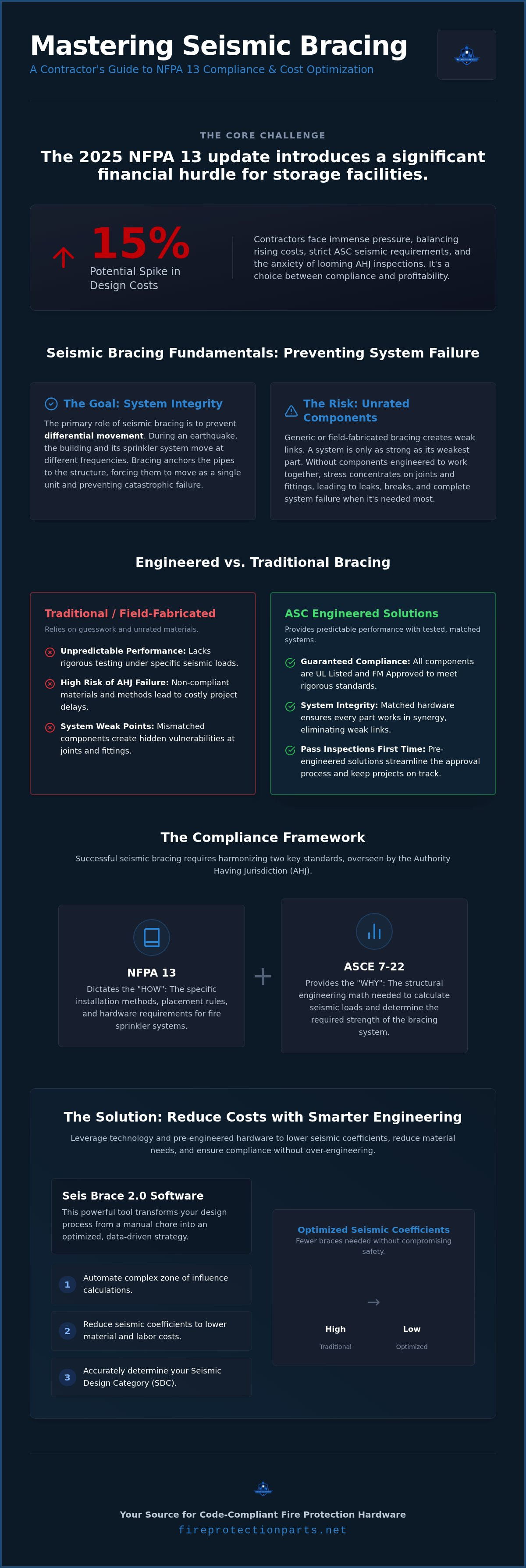
Did you know that the adoption of the 2025 edition of NFPA 13 can spike design costs by as much as 15% for storage-driven buildings? It's a staggering figure that highlights the immense pressure on modern fire protection projects. Most contractors and engineers already feel the weight of these rising costs and the anxiety of a looming AHJ inspection. Navigating the latest ASC seismic bracing requirements often feels like a stressful balancing act between over-engineering for safety and staying within a tight project budget. You shouldn't have to choose between compliance and profitability.
This guide will help you master the technical nuances of NFPA 13 compliance while leveraging engineering advantages to actually lower your seismic coefficients. By understanding the synergy between hardware and design, you can reduce the number of required braces without compromising structural integrity. We'll break down the 2026 standards, explore the Seis Brace 2.0 software, and show you how to source UL Listed and FM Approved hardware that saves both labor and material. You'll gain the expert confidence needed to pass inspections the first time and keep your projects moving forward with unwavering reliability.
Key Takeaways
- Simplify the complex ASC seismic bracing requirements to ensure your fire sprinkler systems withstand differential movement during an earthquake.
- Align your projects with the 2025 edition of NFPA 13 and ASCE 7-22 standards to accurately determine your Seismic Design Category.
- Identify specific attachment needs for different pipe materials, such as steel and Viking Plastics CPVC, to ensure every component is UL Listed for its application.
- Use Seis Brace 2.0 software to automate zone of influence calculations and reduce seismic coefficients, directly lowering your total material and labor costs.
- Streamline your procurement process by sourcing pre-engineered, FM Approved hardware that eliminates the risk of failed AHJ inspections.
Understanding ASC Seismic Bracing Requirements for Fire Sprinkler Systems
Seismic bracing isn't just a regulatory hurdle; it's a critical safety system designed to keep fire sprinkler piping intact during an earthquake. In the fire protection industry, meeting ASC seismic bracing requirements ensures that a sprinkler system remains functional even when the ground is moving. These systems use a network of restraints to manage the kinetic energy transferred from the building's structure to the fire suppression network. The goal is simple: prevent the pipe from tearing itself apart.
The primary role of ASC (Afcon) hardware is to prevent differential movement. During a seismic event, a building and its internal piping often move at different frequencies. Without specialized bracing, this disparity creates massive stress on joints and couplings. ASC components act as a bridge, anchoring the pipe to the building structure so they move as a single unit. Relying on "generic" or unrated bracing often fails because these components lack the rigorous synergy required by modern, high-performance systems. If the hardware isn't designed to work together, the system is only as strong as its weakest unrated part.
The Core Purpose of Seismic Restraint
The ultimate objective of seismic bracing is three-fold: life safety, property protection, and post-event functionality. By applying Earthquake engineering principles, these restraints limit pipe movement to prevent impact with other structural elements like HVAC ducts or steel beams.
- Protecting Joints: Bracing reduces torsional stress on critical fittings, which are the most common failure points.
- Maintaining Water Supply: A system that breaks during a tremor is useless if a fire breaks out afterward. Bracing ensures water supply integrity.
- Ensuring Stability: Proper restraints prevent the "whipping" effect that can shatter standard pipe hangers.
ASC Engineered Solutions vs. Traditional Bracing
Traditional field-fabricated bracing often relies on guesswork and unrated materials. In contrast, ASC Engineered Solutions provide predictable performance under extreme loads. These components are tested as a matched system, ensuring that a swivel attachment and a pipe clamp work together without a weak link. For a deeper look at these requirements, you can explore our seismic bracing for sprinkler systems guide. Using matched components from a single manufacturer like Afcon isn't just about convenience; it's about system integrity. When every part is engineered to the same standard, you eliminate the variables that lead to failure during a disaster. Professional contractors know that ASC seismic bracing requirements are the foundation of a reliable installation.
Navigating NFPA 13 and ASCE 7-22 Compliance Standards
Compliance isn't just about following a single manual. It's about the critical intersection of NFPA 13 and ASCE 7-22 compliance standards. While NFPA 13 dictates the specific installation methods for sprinkler systems, ASCE 7-22 provides the structural load math required to survive a seismic event. Meeting ASC seismic bracing requirements means balancing these two frameworks to ensure your hardware doesn't just look right but actually performs under calculated loads. If the math and the hardware don't align, the system is destined for failure.
The Authority Having Jurisdiction (AHJ) acts as the final gatekeeper for your project. They verify that your seismic design category (SDC) matches local geological data and that your bracing placement meets both lateral and longitudinal spacing rules. Lateral braces prevent side-to-side swaying. Longitudinal braces stop the pipe from sliding along its axis. Proper placement of both is non-negotiable for passing inspections and protecting the building's occupants. If you need to verify your hardware choices before the inspector arrives, you can browse our selection of ASC bracing for certified components.
Key Updates in NFPA 13 Standards
Recent editions of NFPA 13 have refined how we brace branch lines and main piping to account for higher K-factors and ESFR storage rules. There's a heightened focus on clearance around pipes that penetrate walls or floors to prevent structural impact during a tremor. The Zone of Influence is the area of piping supported by a single brace. Understanding this zone is vital for calculating the actual weight a brace must hold. If you miscalculate this area, you risk over-stressing the hardware and failing a post-event audit.
ASCE 7-22 and Seismic Design Categories
Your project's geographic location and soil type dictate your SDC, which ranges from A (low risk) to F (high risk). For fire protection systems, the Importance Factor (Ip) is almost always 1.5 because these systems must remain functional after an earthquake. Bracing density increases significantly as you move toward SDC D, E, or F. However, exemptions do exist. For example, small-diameter piping in lower SDCs may not require the same level of restraint as high-risk mains. Knowing when you can safely apply these exemptions is the key to reducing material costs without compromising safety. Professional grade ASC seismic bracing requirements are built to handle these high-stakes design categories with ease.
Structural and Pipe Attachment Requirements for Steel and CPVC
Selecting the right hardware for your fire suppression system requires more than just matching pipe sizes. You must account for the physical properties of the piping material itself. Steel and thermoplastic systems react differently to seismic forces, and their ASC seismic bracing requirements reflect these differences. While steel pipe relies on its inherent rigidity, CPVC requires a more nuanced approach to prevent physical damage during a tremor. Using UL Listed components specifically rated for your pipe material is the only way to ensure the system doesn't fail at the most critical moment.
Structural attachments also vary based on the building's anatomy. Whether you're anchoring to steel beams, wood joists, or concrete slabs, the attachment must be capable of transferring the full seismic load without pulling free. Longitudinal braces, which prevent the pipe from sliding along its axis, often require more robust structural anchors than lateral braces. Failing to distinguish between these two can lead to an under-engineered system that won't pass an AHJ inspection.
Bracing Requirements for Steel Fire Sprinkler Pipe
Steel systems are the workhorse of the industry, but they demand high-strength hardware to manage their significant weight. Afcon swivels are engineered to provide the necessary flexibility while maintaining a rigid connection to the structure. Achieving the correct torque on these structural attachments is vital. If a bolt is under-torqued, it can vibrate loose; if it's over-torqued, the metal can become brittle and snap under load. You should also consider the environment. Galvanized finishes are standard for high-moisture areas to prevent corrosion, while painted finishes may suffice for climate-controlled interiors.
Specialized Bracing for CPVC Systems
Working with Viking CPVC fire sprinkler pipe requires specialized knowledge to avoid chemical or physical compromise. CPVC is sensitive to "point loading," where a narrow metal brace concentrates too much pressure on a single spot. During an earthquake, this concentration can lead to pipe fractures. Specialized hangers and braces for CPVC feature wider surface areas and smooth edges to prevent abrasion. It's also critical to ensure that any lubricants or coatings on the hardware are chemically compatible with the pipe. For more details on maintaining system integrity, refer to our guide on CPVC fire protection fittings. When you follow the correct ASC seismic bracing requirements for non-metallic pipe, you protect the system from the vibration-induced cracks that plague poorly designed installations.
Optimizing Seismic Coefficients with Seis Brace 2.0
Manual seismic calculations are often the most time-consuming part of a fire protection project. They're prone to human error and frequently lead to over-engineered systems that drive up costs. Seis Brace 2.0 solves this by automating complex Zone of Influence (ZOI) calculations. By integrating the specific ASC seismic bracing requirements into a digital workflow, you can accurately determine the exact number of braces needed for any given run of pipe. This isn't just about speed; it's about precision that protects your bottom line.
The financial impact of this technology centers on the seismic coefficient (Cp). When you use software to optimize your design, you can often justify a lower Cp, which reduces the horizontal force requirements for the entire system. Lowering this coefficient means you can reduce the total "points of attachment" throughout the building. Fewer attachments translate directly to lower material expenses and significantly reduced labor hours. You can order ASC seismic hardware directly from our store to ensure your physical components match your optimized digital submittals.
The Math Behind the Savings
The relationship between horizontal force and brace capacity is the foundation of seismic engineering. If a brace can't handle the calculated load, the system fails. ASC swivels provide a distinct advantage here because they maintain high load ratings at various installation angles, ranging from 30 to 90 degrees. This flexibility allows for better load distribution across the structure. Seis Brace 2.0 uses ASCE 7 data to optimize brace spacing, ensuring that every component operates within its tested limits while maximizing the distance between supports.
Streamlining the AHJ Approval Process
A failed inspection is an expensive setback. To avoid this, your seismic submittal package must be beyond reproach. A professional submittal includes detailed layouts, calculation summaries, and verification of UL/FM approvals. Using engineering software allows you to generate detailed "cut sheets" for every specific brace location in the building. These sheets provide the plan reviewer with the exact data they need to verify compliance without sending a Request for Information (RFI). By addressing potential concerns proactively, you move from the design phase to the installation phase faster. This methodical approach eliminates the guesswork that often leads to project delays and ensures your installation meets all ASC seismic bracing requirements from day one.
Sourcing Code-Compliant ASC Bracing Components
You've completed the engineering and optimized your seismic coefficients. Now comes the final, most critical step: sourcing the physical hardware. Meeting ASC seismic bracing requirements starts with a rigorous procurement strategy that prioritizes verified performance over the lowest bid. In the fire protection industry, using unrated or generic hardware isn't just a compliance risk; it's a liability that could lead to catastrophic system failure. Every component you source must match the specifications generated in your design phase to ensure the system performs as a cohesive unit during a tremor.
Verifying UL Listing and FM Approval on all sourced hardware is mandatory. These certifications provide the professional assurance that the swivels, clamps, and structural attachments have been tested under extreme seismic loads. When you're managing large-scale commercial projects, buying in bulk from a specialized supplier ensures consistency across the entire installation. This consistency simplifies the work for your field crews and provides a clear, uniform paper trail for the AHJ inspector.
The Essential ASC Hardware Checklist
A complete seismic restraint system relies on three primary categories of hardware. First, you need swivel attachments. These provide the flexible link between the pipe and the brace, allowing for the precise angles required to manage load distribution. Second, structural attachments are the "bones" of the system. They secure the entire assembly to the building's steel beams, concrete slabs, or wood joists. Finally, you must select the correct brace pipe. Most ASC seismic bracing requirements specify either schedule 40 or schedule 10 pipe for the brace itself. Using the wrong schedule can compromise the load capacity of the entire assembly, regardless of how strong the attachments are.
Efficiency in Procurement
Large projects move fast, and you don't have time for the "corporate runaround" common with general hardware vendors. Using a dedicated store for fire protection parts online allows you to source everything from a single, expert partner. This approach is especially valuable when you need to integrate seismic restraints with other supports, such as all thread rod for standard hangers.
Before the hardware arrives on-site, perform a final verification. Check that every part number matches your Seis Brace submittal exactly. If you're handling a mix of new installs and repairs, refer to a sprinkler system components online guide to ensure your inventory remains code-compliant. Taking these extra minutes to verify your sourcing prevents the expensive delays of field corrections and ensures your project maintains its schedule without compromising safety.
Secure Your Compliance and Your Bottom Line
Mastering ASC seismic bracing requirements is a strategic advantage that protects both lives and project budgets. By leveraging engineering software like Seis Brace 2.0, you can move away from over-engineered designs and toward optimized, code-compliant systems that reduce material costs and labor hours. Whether you're working with heavy-duty steel or specialized Viking Plastics CPVC, the key to success lies in using matched, UL Listed components that work in synergy with the building structure. Proper hardware selection eliminates the guesswork that often leads to failed inspections and costly field corrections.
Don't let the complexity of NFPA 13 or ASCE 7-22 slow your progress. Sourcing your hardware from a partner that understands the technical nuances of fire protection ensures you pass inspections the first time. We provide expert technical support and a full inventory of FM Approved Afcon components to keep your projects moving forward without the corporate runaround. Our fast shipping ensures you have the swivels, structural attachments, and pipe clamps you need exactly when you need them.
Ready to finalize your design? Shop Code-Compliant ASC Seismic Bracing at Fire Protection Parts today. Take the doubt out of seismic protection and build with the confidence of a seasoned professional.
Frequently Asked Questions
What is the maximum spacing for lateral seismic braces in an ASC system?
The maximum spacing for lateral seismic braces is generally 40 feet according to NFPA 13 standards. However, specific ASC seismic bracing requirements often dictate shorter intervals based on the Zone of Influence calculation for your specific pipe run. You must verify the total weight of the piping and its contents against the rated load capacity of the Afcon hardware. Engineers often reduce this spacing in high-hazard areas to maintain structural integrity.
Do I need seismic bracing for pipes smaller than 2.5 inches?
Bracing requirements for smaller pipes depend on the building's Seismic Design Category. While some exemptions exist for 2 inch pipes in low-risk zones, most commercial systems in categories C through F require restraint for all branch lines. Because fire protection systems have an Importance Factor of 1.5, these exemptions are often removed to ensure the system remains functional after an earthquake. Always check local AHJ amendments for specific size thresholds.
Can I use ASC seismic bracing with Viking Plastics CPVC pipe?
You can use ASC bracing with Viking Plastics CPVC, but you must select hardware specifically UL Listed for non-metallic pipe. Standard metal clamps can cause abrasion or point loading that leads to pipe fractures during a tremor. Afcon offers specialized swivels and clamps with wider surface areas to protect the thermoplastic material. Using these matched components ensures chemical compatibility and prevents the physical damage that occurs with generic, unrated metal hangers.
What is the difference between UL Listed and FM Approved seismic bracing?
UL Listing confirms that a component meets specific safety and performance standards through independent testing. FM Approval means the hardware meets the higher loss-prevention standards required by FM Global, which often focus on property protection and business continuity. Many AHJs and insurance providers require both certifications for seismic hardware. While UL focuses on the minimum requirements for life safety, FM Approval often indicates a higher threshold for durability and predictable performance under stress.
How do I calculate the seismic coefficient (Cp) for my project?
The seismic coefficient is calculated using data from ASCE 7-22, including the spectral response acceleration and the component's Importance Factor. You also have to factor in the height of the brace attachment relative to the building's roof line. Seis Brace 2.0 software automates this process by pulling geological data based on your project's zip code. This precision allows you to optimize your design and potentially reduce the number of braces required for compliance.
Is seismic bracing required for all fire sprinkler systems in the United States?
Seismic bracing is not required for every system; it depends on the local Seismic Design Category. Buildings in low-risk areas like SDC A or B are generally exempt from these restraints. However, most modern commercial projects in the Western US or along seismic fault lines must follow strict ASC seismic bracing requirements to pass inspection. As of 2026, more states have adopted updated codes that expand these requirements to include critical infrastructure nationwide.
What are the requirements for longitudinal bracing vs. lateral bracing?
Lateral bracing prevents side-to-side swaying and is required at 40-foot intervals. Longitudinal bracing prevents the pipe from sliding along its axis and is required every 80 feet. Both must be installed within specific distances from the end of a pipe run or a change in direction to be effective. Longitudinal braces typically face higher cumulative loads, so they often require more robust structural attachments and larger brace pipes to manage the increased horizontal force.
Can I mix different brands of seismic bracing components?
Mixing different brands of seismic hardware is a major compliance risk and is generally prohibited. Seismic bracing is tested and UL Listed as a complete assembly. If you pair an Afcon swivel with a competitor's pipe clamp, you void the system's certified load rating and the manufacturer's warranty. To ensure your system survives a seismic event and passes an AHJ audit, you should always source a single, engineered system of matched components from one manufacturer.

