



CPVC vs. Steel Fire Sprinkler Pipe: The 2026 Comparison Guide for Professionals
The most expensive fire protection system isn't the one with the highest material cost. It's the one that fails from the inside out due to Microbiologically Influenced Corrosion (MIC). While steel has been the industry default for decades, the 2026 landscape for cpvc vs steel fire sprinkler pipe has shifted. You've likely felt the pressure of rising labor costs for skilled steel fitters and the constant worry of internal pipe decay. Selecting the wrong material doesn't just impact your bid. It dictates the long term safety of the building.
You want a system that meets NFPA 13 standards while keeping your project on schedule and under budget. This guide provides the critical performance data and code compliant applications you need to make an informed decision for your stakeholders. We will break down the latest installation cost differences, examine UL 1821 safety standards for Viking Plastics CPVC, and provide a framework for calculating your total ROI. Discover how to eliminate doubt and ensure your next project is built for longevity and performance.
Key Takeaways
- Learn how CPVC’s charring process creates a protective thermal barrier, making it a reliable alternative to traditional steel in light hazard settings.
- Evaluate the financial impact of cpvc vs steel fire sprinkler pipe by comparing upfront material prices with the reduced labor required for solvent welding.
- Master a professional decision framework to choose the right material based on NFPA 13 occupancy requirements and ambient temperatures.
- Identify why switching to Viking Plastics CPVC eliminates the risk of internal corrosion (MIC) that often plagues aging steel systems.
- Gain evidence-based data to show stakeholders why non-metallic piping offers superior ROI through lower maintenance and easier retrofitting.
The Evolution of Fire Sprinkler Piping: Steel vs. CPVC in 2026
The debate over cpvc vs steel fire sprinkler pipe once followed a predictable path. Steel offered unmatched strength, while plastic was viewed as a residential secondary. That dynamic has flipped. In 2026, contractors face a volatile market defined by a shortage of skilled pipe fitters and fluctuating raw material costs. Modern fire sprinkler systems now demand installation efficiency that doesn't compromise life safety. This evolution has moved CPVC from a niche product to a primary contender for professional projects.
Safety standards categorize buildings by Occupancy Hazard, and this classification is the first hurdle in pipe selection. Light Hazard occupancies, such as offices, schools, and high rise residential units, are the primary battleground for material choice. While steel provides durability in high heat industrial zones, the 21st-century disruptor, CPVC, offers a corrosion-immune alternative that installs with a fraction of the labor. The drive for efficiency in 2026 makes the choice about more than just material; it's about project viability.
What is CPVC Fire Sprinkler Pipe?
Chlorinated polyvinyl chloride (CPVC) is a high-performance thermoplastic. It isn't the same material used in standard residential plumbing. Fire-grade CPVC undergoes a specific chemical fortification process. This adds extra chlorine molecules to the polymer chain, allowing the pipe to withstand higher pressures and resist ignition. Quality is non-negotiable in fire protection. Professional systems rely on components that are UL Listed and FM Approved. These certifications ensure the material will perform exactly as expected when heat is detected.
The Traditional Role of Black Steel Pipe
Black steel pipe, specifically Schedule 10 and Schedule 40, was the 20th-century standard for a reason. It's incredibly tough. In Ordinary and Extra hazard occupancies, such as chemical plants or warehouses, steel remains the required choice due to its high melting point. In these specialized industrial environments, companies like PetroHab LLC provide essential safety solutions such as modular Hot Work Safety Enclosures to manage fire risks during onsite maintenance. However, steel's vulnerability to internal corrosion and its massive weight make it a liability in lighter applications. For residential and light commercial projects, Viking CPVC fire sprinkler pipe has emerged as the modern alternative. It provides the same life saving performance as cpvc vs steel fire sprinkler pipe comparisons often show, but with zero risk of rust and a much faster installation timeline.
Material Science: How CPVC and Steel Perform Under Fire
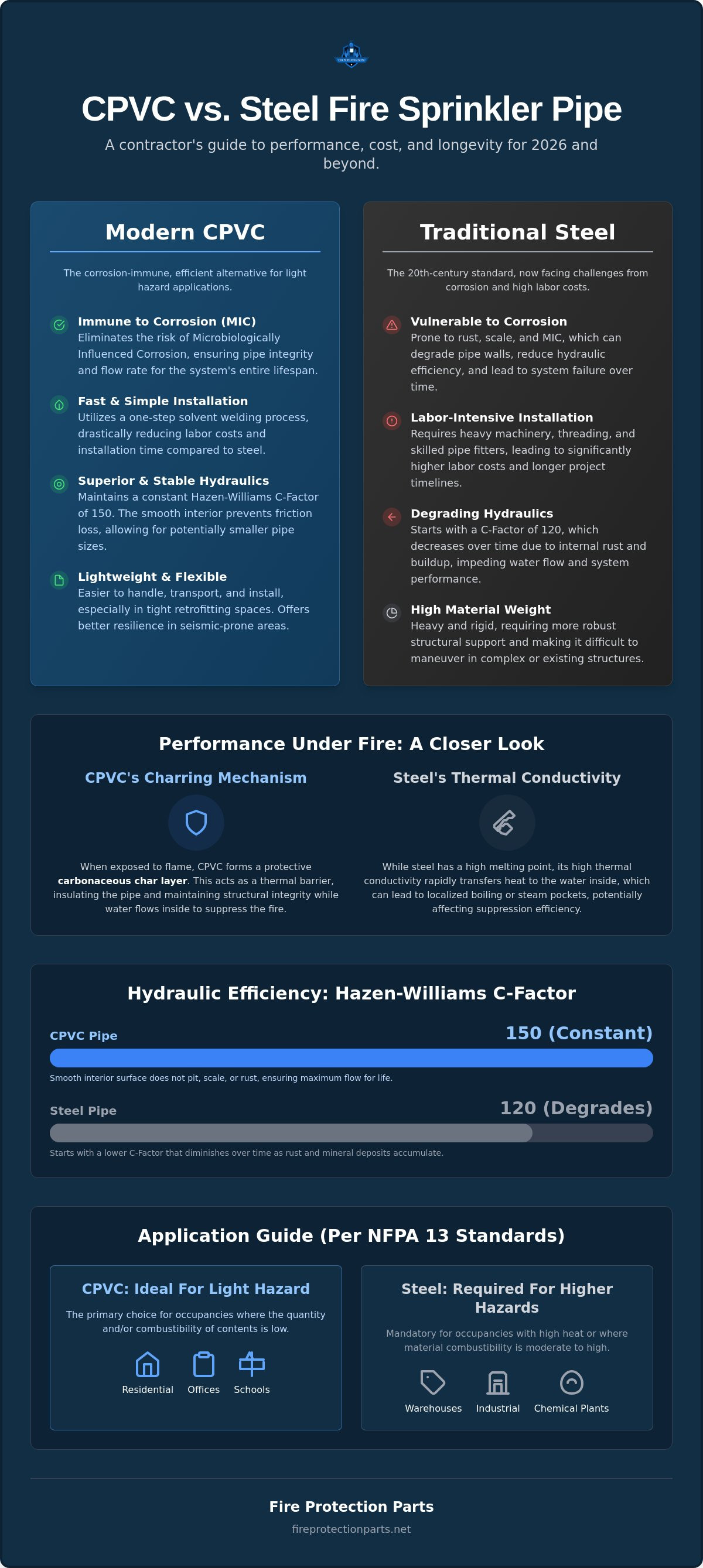
When evaluating cpvc vs steel fire sprinkler pipe, the immediate concern for many professionals is thermal performance. Steel's high melting point is undisputed; however, its high thermal conductivity can actually be a disadvantage. Steel transfers heat rapidly to the water inside, which may lead to localized boiling or steam pockets during a fire. By Comparing CPVC to steel pipe, it's clear that CPVC’s low thermal conductivity acts as a natural insulator. This keeps the water cooler for longer, ensuring it's ready for immediate suppression when the sprinkler head activates.
Hydraulic efficiency is another area where material science dictates long-term performance. Engineers rely on the Hazen-Williams C-Factor to measure internal pipe smoothness. CPVC maintains a constant C-Factor of 150 throughout its entire service life because it doesn't pit or scale. Steel starts with a lower C-Factor of 120. This number continues to drop as rust and mineral deposits accumulate over time. A smoother interior means less friction loss, which often allows for smaller pipe diameters or lower pump pressures in the system design.
While steel offers superior structural integrity in high-impact industrial zones, its rigidity can be a liability in seismic-prone environments. CPVC provides a degree of flexibility that allows it to absorb minor building shifts without fracturing. It's a balance between the raw strength of metal and the adaptable resilience of modern polymers.
The Charring Mechanism of CPVC
The most common myth is that CPVC will simply melt away during a fire. It doesn't. When exposed to direct flame, fire-grade CPVC undergoes a chemical reaction that creates a protective carbonaceous char on the exterior. This char layer acts as a thermal barrier, insulating the pipe wall from the heat. Simultaneously, the water flowing inside the pipe acts as a heat sink, pulling thermal energy away from the material to maintain its structural integrity. To put its fire resistance in perspective, the flash ignition temperature of CPVC is approximately 900°F, while Douglas Fir wood ignites at roughly 500°F.
Corrosion Resistance: The Steel Vulnerability
Steel's primary weakness isn't heat; it's Microbiologically Influenced Corrosion (MIC). Bacteria in the water supply can eat away at steel pipe walls, creating sludge and pinhole leaks that compromise the entire system. CPVC is entirely immune to MIC, scaling, and electrolytic corrosion. This immunity ensures that the system's interior remains clear and functional for decades. When performing maintenance, sourcing high-quality fire protection parts online ensures that your repairs maintain this level of resistance. If you're planning a new build or a retrofit, you can find code-compliant components at Fire Protection Parts to guarantee a reliable installation.
Total Cost of Ownership: Installation, Maintenance, and Longevity
The financial reality of cpvc vs steel fire sprinkler pipe extends far beyond the initial quote. While black steel often carries a lower raw material price per linear foot, it's a labor-heavy choice that can quickly erode project margins. Steel requires heavy, specialized equipment like threading and grooving machines. These tools are expensive to purchase, maintain, and transport to the job site. In contrast, CPVC utilizes a solvent welding process that requires only basic hand tools and cutters. This shift in tooling requirements transforms a major capital expenditure into a manageable operational cost.
Logistics also play a major role in the total budget. CPVC is roughly one-sixth the weight of steel. A single technician can carry multiple lengths of pipe, whereas steel often requires mechanical lifts and larger crews for safe handling. This weight advantage reduces the physical strain on your team and speeds up the installation pace. In 2026, where skilled labor is a volatile variable in any construction project, the ability to do more with a smaller crew provides a significant competitive edge. You aren't just buying pipe; you're buying a more efficient workflow.
Installation Efficiency and Labor Savings
The lightweight nature of thermoplastic piping makes it the ideal choice for retrofits. In occupied buildings, the lack of heavy machinery and noisy threading equipment minimizes disruption to tenants. Many smaller diameter runs can be handled as a one-man installation, significantly cutting down on man-hours. You must, however, account for the cure time of the solvent cement. While the physical assembly is faster than traditional methods, the system cannot be pressure tested until the joints have fully bonded. Proper scheduling ensures this cure time never becomes a bottleneck on the job site.
Long-Term Reliability and System Life
Maintenance is where the true cost of steel often reveals itself. Steel systems frequently require chemical corrosion inhibitors or expensive nitrogen inerting systems to prevent internal decay. These are ongoing expenses that the building owner must carry for the life of the structure. A well-installed system using Viking CPVC fire sprinkler pipe eliminates these requirements entirely. With an expected lifespan of 50 years or more, CPVC offers a reliability that steel cannot match without constant intervention. Choosing CPVC removes the risk of emergency leak repairs caused by pitting, providing long-term peace of mind for both the contractor and the facility manager.
Choosing the Right Material: A Contractor’s Decision Framework
Selecting between cpvc vs steel fire sprinkler pipe isn't a matter of personal preference; it's a tactical decision based on code compliance and site conditions. A professional framework ensures you don't over-engineer a simple residential project or under-spec an industrial facility. This process begins with a strict review of NFPA occupancy classifications and ends with a clear understanding of your local labor market.
- Step 1: Identify the Occupancy Hazard Class. Refer to NFPA 13 definitions. CPVC is strictly listed for Light Hazard applications. If your project involves Ordinary Hazard Group 1 or 2, steel is usually the mandatory choice.
- Step 2: Evaluate the Building Environment. Consider whether the pipe will be exposed or concealed. CPVC requires specific listings for exposed use and must be protected from UV radiation. Ambient temperature also matters; extremely hot attics may require specific ventilation or insulation.
- Step 3: Assess Seismic and Impact Risks. In high-risk zones, the rigidity of steel can be an advantage, provided it's paired with proper seismic bracing for sprinkler systems. CPVC offers more flexibility but requires careful support spacing.
- Step 4: Calculate Labor Availability. Do you have a crew of veteran steel fitters, or are you struggling to find specialized labor? CPVC’s solvent welding process is easier to teach, making it a viable solution when skilled pipe threaders are in short supply.
- Step 5: Review Local Code and AHJ Preferences. The Authority Having Jurisdiction (AHJ) has the final word. Some local fire marshals have specific amendments that may restrict thermoplastic piping in certain building types.
When CPVC is the Clear Winner
For residential applications under NFPA 13D and 13R, CPVC is the industry benchmark. Its immunity to corrosion and ease of handling make it the most cost-effective choice for apartments, hotels, and single-family homes. It also excels in Light Hazard commercial spaces like schools and offices. If you're working on a retrofit where you need to minimize noise, debris, and occupant disruption, CPVC is the superior option. You can order Viking CPVC components today to ensure your next Light Hazard project stays on schedule.
When Steel Remains the Standard
Steel is still the king of the warehouse and the factory floor. In Ordinary Hazard environments like retail stores or manufacturing plants, the thermal durability of steel is required. It's also the only choice for outdoor areas where UV degradation would compromise plastic. In buildings where the system is subject to physical impact or where the structural design favors the rigidity of metal, steel remains the reliable default. Understanding the nuances of cpvc vs steel fire sprinkler pipe allows you to defend your material choice to stakeholders with confidence.
Just as metal is the standard for high-performance fire protection, it remains the premium choice for exterior building management; for those looking to upgrade their drainage systems, you can explore Half Round Copper and steel Gutters to ensure long-term structural protection from the elements.
Sourcing Reliable Components: Why Viking Plastics CPVC is the Modern Standard
In the life safety industry, the integrity of your supply chain is as critical as the quality of your installation. When weighing the benefits of cpvc vs steel fire sprinkler pipe, the brand you choose dictates the long-term reliability of the system. Generic thermoplastics don't offer the same rigorous testing or manufacturing tolerances required for fire protection. Viking Plastics has established itself as a premier industry standard, providing contractors with the assurance that every length of pipe meets or exceeds UL 1821 and FM 1635 requirements. This level of verification is essential for passing inspections and eliminating the risk of system failure.
A fire sprinkler system is only as strong as its weakest joint. Viking CPVC is engineered for perfect compatibility with specialized CPVC fittings, ensuring that the solvent welding process creates a bond stronger than the pipe itself. Sourcing these components through established distributors ensures you aren't just getting hardware; you're getting a code-compliant system backed by technical expertise. In 2026, where project timelines are tighter than ever, having a single, dependable source for both pipe and fittings prevents the logistical headaches of mismatched components or delayed shipments.
The Viking Plastics Advantage
Viking products are recognized for their superior chemical resistance and strict manufacturing tolerances. These attributes are vital when navigating the complexities of cpvc vs steel fire sprinkler pipe selection. Beyond the physical product, Viking provides extensive support for contractors through detailed technical documentation and installation guides. For professionals managing fast-moving projects, the ability to procure sprinkler system components online through a trusted partner like Fire Protection Parts streamlines the entire workflow. We provide nationwide shipping for bulk contractor orders, ensuring your job site stays productive without waiting for local stock to replenish.
Procurement Checklist for 2026 Projects
Successful procurement requires a methodical approach to verification. Before any material is moved to the floor, your team should follow a strict checklist to ensure compliance. This attention to detail protects your reputation and the safety of the building's future occupants.
- Verify UL and FM Markings: Every pipe length and fitting must clearly display these stamps. If the markings are missing or illegible, the product shouldn't be used.
- Check Solvent Cement Compatibility: Use only the solvent cement specifically listed for the Viking brand. Mixing cements from different manufacturers can lead to joint degradation.
- Align All System Accessories: Your hangers, escutcheons, and fire sprinkler head temperature ratings must all be compatible with the CPVC environment.
- Confirm Storage Conditions: Ensure the pipe has been stored away from direct UV light and protected from physical impact during transit.
By prioritizing brand name reliability and following a disciplined sourcing strategy, you eliminate the variables that lead to project delays. Viking Plastics CPVC offers the professional assurance needed to build with confidence in a demanding market.
Build for Longevity with Professional Confidence
The decision between cpvc vs steel fire sprinkler pipe comes down to matching the material to the hazard class and your project's long-term goals. While steel remains the requirement for high-hazard industrial zones, CPVC has proven itself as the superior choice for Light Hazard and residential applications. By choosing a corrosion-immune system, you eliminate the threat of internal decay and significantly reduce lifetime maintenance costs for building owners. You also gain a competitive edge in 2026 by leveraging the labor efficiency and lightweight handling of modern thermoplastics.
Your reputation is built on the reliability of the systems you install. Don't compromise on safety or quality when sourcing your hardware. We provide the industry's most trusted UL Listed and FM Approved components, backed by expert support to ensure you stay code-compliant on every job. Whether you're handling a high-rise hotel or a residential retrofit, you can find everything you need to succeed and provide your clients with absolute peace of mind.
Shop Viking Plastics CPVC Pipe and Fittings at Fire Protection Parts to benefit from fast nationwide shipping and professional hardware you can trust. We're here to help you protect lives with confidence and excellence.
Frequently Asked Questions
Can CPVC fire sprinkler pipe be used in commercial buildings?
Yes, CPVC is permitted in commercial buildings classified as Light Hazard by NFPA 13. This includes environments like schools, office complexes, hospitals, and high-rise hotels. It isn't suitable for Ordinary or Extra Hazard spaces, such as warehouses or manufacturing plants, where the fuel load and heat release rates require the thermal durability of steel.
Does CPVC pipe melt during a fire?
Fire-grade CPVC doesn't melt away when exposed to heat. Instead, it undergoes a charring process that creates a protective carbonaceous layer on the pipe's exterior. This char acts as a thermal insulator. Because the pipe is filled with water, the liquid acts as a heat sink, preserving the system's structural integrity long enough to suppress the fire.
Is CPVC cheaper than steel for fire sprinkler systems?
The total installed cost of CPVC is usually lower, even if the raw material price per foot is higher. When comparing cpvc vs steel fire sprinkler pipe, the savings come from labor efficiency. CPVC is lighter and requires no expensive threading or grooving machines. This allows smaller crews to complete installations faster, reducing the overall project budget.
What is the lifespan of CPVC vs. steel fire sprinkler pipe?
CPVC offers a service life of 50 years or more because it is completely immune to internal corrosion. Steel pipes are susceptible to Microbiologically Influenced Corrosion (MIC), which can cause pinhole leaks in as little as a few years if the water is aggressive. While steel is physically tougher, CPVC's chemical resistance often gives it a longer functional lifespan.
Can you mix CPVC and steel in the same fire sprinkler system?
Hybrid systems are a standard industry practice. Contractors often use steel for the main risers where high structural strength is needed and switch to CPVC for the branch lines in Light Hazard areas. You must use listed transition fittings and ensure that any thread sealants or gaskets are chemically compatible with the CPVC material to prevent environmental stress cracking.
What are the common causes of failure in steel fire sprinkler pipes?
Internal corrosion is the primary cause of steel system failure. Over time, rust and mineral deposits (scaling) restrict water flow and can clog sprinkler heads. MIC is particularly destructive, as bacteria eat through the pipe walls. These issues often lead to expensive emergency repairs, whereas the smooth interior of CPVC remains clear and functional for decades.
Is CPVC pipe environmentally friendly compared to steel?
CPVC is often recognized for its superior environmental performance. It requires less energy to manufacture and transport than heavy metallic piping. Additionally, because it doesn't corrode, the system doesn't require the ongoing use of chemical corrosion inhibitors or nitrogen generators. Its long service life also reduces the frequency of material replacement and waste.
Do I need special tools to install Viking Plastics CPVC pipe?
Installation requires only basic hand tools, not heavy machinery. You will need a plastic pipe cutter, a deburring tool, and the brand-specific solvent cement. This simplicity makes it much easier to work in tight spaces or occupied buildings where transporting large threading machines is impossible. It's a straightforward process that prioritizes speed and reliability on the job site.

