



NFPA Fire Sprinkler Parts: 2026 Compliance Guide
A single non-compliant valve or an unlisted pipe fitting can turn a high-stakes fire protection project into a failed inspection liability. You shouldn't have to guess if your hardware meets the rigorous NFPA standards for fire sprinkler parts. Whether you are managing a commercial high-rise or a residential dwelling, the margin for error is zero. The 2026 edition of NFPA 25 and the 2025 updates to NFPA 13 have introduced stricter requirements for component verification, including new rules for corrosion mitigation and solenoid monitoring.
It's frustrating to sort through technical data sheets only to find your materials don't match the local jurisdiction's code. We understand the fear of failing an inspection because of a hardware mismatch or a misunderstanding of material compatibility. This guide provides a clear path through the complexity of NFPA requirements to ensure every sprinkler head, pipe, and valve in your system is verified and ready for inspection. We'll examine the critical distinctions between NFPA 13 and 13D hardware, clarify temperature ratings, and help you select listed components, such as Viking CPVC or ASC seismic bracing, that guarantee long-term system reliability.
Key Takeaways
- Identify "Listed and Labeled" hardware to ensure your components meet UL and FM Global certification requirements for total code compliance.
- Distinguish between NFPA 13 commercial systems and NFPA 13D residential setups to select the correct fire pumps and piping for your specific project.
- Master the technical specifications for sprinkler heads by matching K-factors and temperature ratings to the specific heat hazards of your building's environment.
- Navigate the 2026 updates to NFPA 25 with clear visual inspection criteria for identifying corroded or loaded components before they cause an inspection failure.
- Secure your system by verifying NFPA standards for fire sprinkler parts to avoid the high-stakes safety risks of using unbranded or generic hardware.
Understanding the Role of NFPA Standards in Part Selection
NFPA standards aren't just suggestions; they're the technical backbone of every fire sprinkler system. These documents establish the minimum requirements for design, installation, and maintenance. Local Authorities Having Jurisdiction (AHJs) use these standards as the law. If your hardware doesn't meet the NFPA standards for fire sprinkler parts, the AHJ won't sign off on your project. This leads to costly delays and potential legal exposure. Compliance is the only way to ensure life safety and property protection.
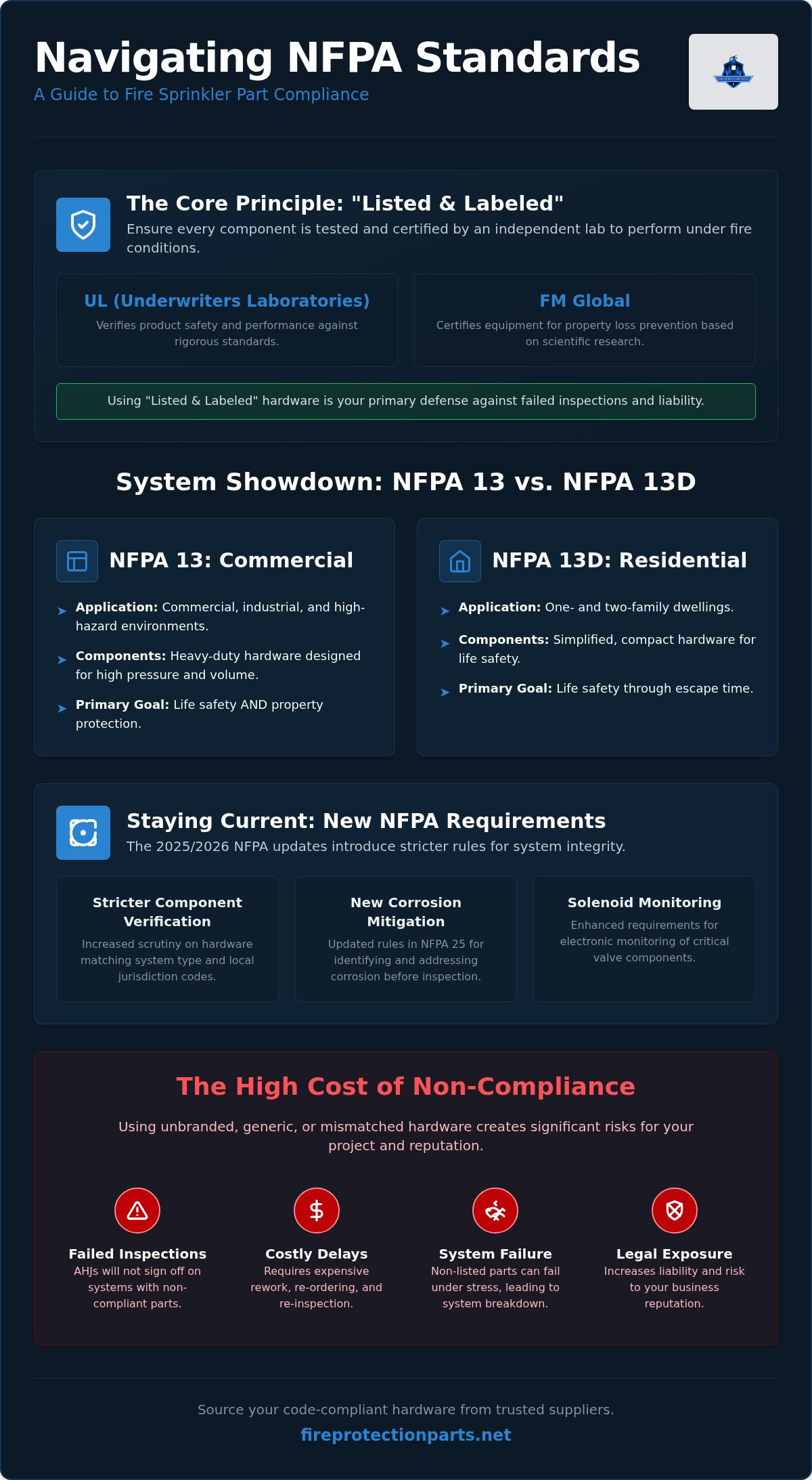
Every component you install must be "Listed and Labeled." This means independent labs like UL or FM Global have tested the part to ensure it performs under extreme heat and pressure. Using unbranded or generic hardware is a gamble you can't afford. In 2026, staying ahead of evolving safety requirements means verifying every part before it arrives on-site. Brands like Viking Plastics CPVC or ASC seismic bracing provide the peace of mind that comes with verified performance. Reliability starts with the right certifications.
The Difference Between Standards and Building Codes
Building codes, like the International Building Code (IBC), tell you where a system is required. NFPA 13 tells you how to build it. Think of the IBC as the mandate and NFPA as the manual. Adhering strictly to NFPA 13 is your best defense against liability. It ensures that your part selection isn't based on guesswork but on proven engineering data. When you follow the standard, you're choosing the safest path for the building's occupants and your business reputation.
Key Regulatory Bodies: UL, FM Global, and NFPA
Testing laboratories act as the final gatekeepers for fire protection hardware. Organizations like UL and FM Global verify that a part will function as intended during a fire event. Non-listed parts often fail under stress, which leads to system-wide breakdowns and massive legal penalties. You can usually find the UL or FM symbol stamped directly onto sprinkler heads, valves, and fittings. It's the only way to confirm you're installing components that meet the NFPA standards for fire sprinkler parts. Verification is the core of professional fire protection. Don't settle for hardware that lacks these critical marks of quality.
NFPA 13 vs. NFPA 13D: Matching Components to System Type
Selecting hardware requires a precise understanding of the system's intended occupancy. NFPA 13 governs commercial and high-hazard environments, demanding heavy-duty components that handle high pressure and volume. In contrast, NFPA 13D focuses on one- and two-family dwellings, prioritizing life safety through simplified hardware. NFPA 13R serves as the middle ground for low-rise residential buildings. You cannot simply swap parts between these systems. Each standard has unique testing protocols. Using a commercial head in a residential application can lead to delayed activation or system failure.
Compliance depends on matching the hardware to the specific standard. Mixing components often violates the manufacturer’s listing. This is a common point of failure during inspections. Ensuring you have the correct NFPA standards for fire sprinkler parts for your specific building type is the first step in a successful installation. Authorities Having Jurisdiction (AHJs) are increasingly strict about part verification, especially with the 2025 updates to the residential standards. Every component must be verified to ensure the system functions as a cohesive unit.
Residential Fire Pump Systems and NFPA 13D
If the domestic water supply lacks the pressure to meet hydraulic demands, a residential fire pump system becomes mandatory. These pumps are designed to ensure that at least two sprinkler heads can operate simultaneously at the required minimum pressure. The 2025 edition of NFPA 13D introduced revised conversion factors that impact how these systems are sized. Unlike massive industrial pumps, residential units must be compact and reliable enough for home environments. Selecting a pump that meets these specific hydraulic demands is critical for NFPA 13D compliance. It's the difference between a system that works in a crisis and one that sits idle. Proper pump selection eliminates the doubt that your system will underperform when it is needed most.
Material Differences: CPVC vs. Steel
Material selection is another area where standards diverge. While steel is the default for high-hazard NFPA 13 systems, Viking CPVC fire sprinkler pipe is a preferred choice for NFPA 13R and 13D projects. It's lightweight and corrosion-resistant, but it has strict temperature and pressure limitations. You must ensure that all fittings match the pipe material exactly to create a code-compliant seal. Using the wrong solvent cement or mismatched fittings can compromise the entire network. With Viking announcing price increases of approximately 6% in mid-2026, securing your materials early is a practical way to manage project budgets. If you're unsure about material compatibility, checking our stock of listed fire protection components can help you avoid costly mistakes.
Core Sprinkler Components: Requirements for Heads, Pipes, and Fittings
The integrity of a fire suppression system is only as strong as its weakest fitting. While previous sections focused on the regulatory framework, this section addresses the specific physical requirements for the hardware itself. Adhering to NFPA standards for fire sprinkler parts means moving beyond general descriptions and into precise technical specifications. Every head, pipe, and valve must be selected based on the specific hydraulic and environmental conditions of the installation site. Reliability isn't accidental; it's the result of matching listed components to calculated risks.
Selecting the Right Sprinkler Head
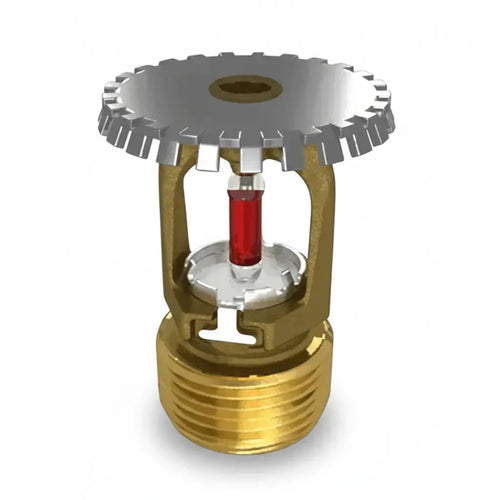
Orientation and K-factor are the two most critical variables when choosing a head. A pendent head cannot be used in an upright position without violating its listing and failing inspection. In unheated areas like walk-in freezers or attic spaces, dry pendent sprinkler heads are required to prevent pipe bursts. You must also match the hardware to the environment. Understanding fire sprinkler head temperature ratings ensures the bulb won't burst prematurely in high-heat zones like commercial kitchens. Escutcheons aren't just decorative; they must be specifically listed for use with the head to maintain the fire-resistive integrity of the ceiling.
Steel piping must meet ASTM A53 or A135 requirements, while CPVC must adhere to ASTM F442. Mixing materials requires specialized adapters to avoid leaks or chemical incompatibility. Control valves and backflow preventers are equally vital. These components must remain in the open position and be supervised to ensure water supply integrity. For ongoing maintenance and replacement schedules, contractors should consult NFPA 25, which outlines the rigorous testing these valves must undergo. Proper valve supervision prevents the number one cause of system failure: a closed water supply.
Seismic Bracing and Support Standards
In high-risk zones, system stability during an earthquake is a non-negotiable requirement. NFPA 13 mandates seismic bracing for sprinkler systems to prevent the piping from swinging and breaking. This involves a combination of sway braces and lateral restraints that lock the system to the building's structural members. Using all-thread rod and hangers isn't enough; these supports must meet specific structural load requirements calculated for the weight of the water-filled pipe. Proper bracing ensures the system stays intact when the building moves, protecting both the structure and the occupants.
Maintenance and Replacement Standards Under NFPA 25
Installation is only the first step in fire protection. Long-term safety depends on rigorous adherence to NFPA 25, the standard for inspection, testing, and maintenance. While earlier sections focused on initial NFPA standards for fire sprinkler parts, NFPA 25 ensures those parts remain functional for decades. A system that isn't maintained is a system that might fail when it's needed most. You must perform regular visual inspections to identify heads that are corroded, painted, or "loaded" with dust. If a head is compromised, NFPA 25 is clear: you cannot clean it; you must replace it.
Replacement intervals vary by environment and component type. Most standard sprinklers require testing or replacement every 50 years, but the 2026 edition of NFPA 25 introduced specific new rules for sprinklers in dwelling units that have reached this age. Harsh environments, such as those with high humidity or chemical exposure, require much more frequent attention. If your components show any signs of leakage or physical damage, immediate replacement is the only compliant path. Proactive maintenance eliminates the risk of a catastrophic failure during a fire event. Reliability is a continuous commitment, not a one-time setup.
Anti-Freeze Solutions and NFPA Standards
Managing anti-freeze systems has become significantly more technical. As of 2026, NFPA standards require the use of factory-premixed solutions. Field-mixed solutions are now considered a major compliance risk because improper concentrations can actually become combustible. You must verify the concentration levels annually to ensure winter safety. If your system still contains an old field-mixed batch, it is time to flush the lines and refill with a listed, premixed solution to maintain your code-compliant status. This simple step prevents internal corrosion and ensures the system functions in freezing temperatures.
Dry Pipe System Maintenance: Air Compressors
Dry pipe systems rely on constant pressure to hold back the water supply. Code requirements for air compressors for dry sprinkler systems dictate that the compressor must be able to restore full system pressure within 30 minutes. If your compressor is undersized or failing, the entire system is at risk of accidental trips. Many modern facilities are switching to nitrogen generators instead of standard compressed air to prevent internal pipe corrosion. This shift drastically extends the lifespan of your piping and reduces long-term maintenance costs. If you need to upgrade your hardware to meet these rigorous NFPA standards for fire sprinkler parts, you can browse our selection of UL-listed maintenance components to ensure your system passes its next inspection.
Sourcing Code-Compliant Fire Protection Parts Online
Convenience should never come at the expense of compliance. When you source hardware online, the risk of receiving unbranded or generic components increases significantly. These generic parts often lack the rigorous testing required by NFPA standards for fire sprinkler parts. A failed inspection is a minor setback compared to the liability of a system failure during a fire event. We eliminate this doubt by only stocking trusted, code-compliant brands like Viking and PTR. This ensures that every item you purchase is ready for the scrutiny of an Authority Having Jurisdiction (AHJ).
Streamlining your procurement process starts with active verification. Don't settle for product descriptions that use vague safety claims. Look for explicit UL and FM Global listings on every product page before you add items to your cart. Professional contractors know that brand-name components provide the engineering documentation and technical support necessary for complex installations. By choosing verified hardware, you protect your reputation and the safety of the building's occupants. Reliability is a choice you make at the point of purchase. It's the only way to ensure your system remains operational for the long term.
Identifying Genuine Viking and PTR Components
Receiving a shipment is a critical moment for verification. Genuine components from Viking or PTR will always feature clear visual cues, including stamped logos and specific identification marks. Always check the Sprinkler Identification Number (SIN) to confirm the head matches your design specifications exactly. Documentation is equally important. Manufacturer-backed warranties are essential for life safety parts, providing a layer of protection that generic brands simply cannot offer. Our sprinkler system components online guide provides a detailed roadmap for building a compliant bill of materials without the guesswork.
Ordering for Repairs and Emergency Replacements
Finding exact matches for legacy systems is a common challenge for facility managers. When a head is damaged or reaches its replacement interval, use the SIN number to find an identical model. This ensures the K-factor and response time remain consistent with the original hydraulic calculations for the building. Bulk sourcing fire protection parts online is the most efficient way to keep critical inventory on hand for immediate repairs. If you're unsure if a specific part meets the latest NFPA standards for fire sprinkler parts, contact our experts. We provide the technical assurance you need to keep your system code-compliant and ready for its next inspection.
Securing Your Compliance for 2026 and Beyond
Achieving code compliance isn't just a hurdle for inspection day; it's the foundation of long-term property protection. By prioritizing UL and FM Global listed components, you ensure that every part of your system can withstand the extreme demands of a fire event. Whether you're installing Viking CPVC for a residential project or managing seismic bracing for a commercial high-rise, your choice of hardware defines the reliability of your life safety network. Following the latest NFPA standards for fire sprinkler parts eliminates the guesswork and legal risks associated with non-compliant systems.
We are here to help you navigate these complex requirements with confidence. As a specialized Viking CPVC distributor, we provide the expert technical support contractors need to get the job done right the first time. Shop Code-Compliant Fire Sprinkler Parts at Fire Protection Parts today to find the verified components your project requires. You can move forward with the professional assurance that your system is built to last and ready for any inspection.
Frequently Asked Questions
What is the most common NFPA standard for fire sprinkler parts?
NFPA 13 is the primary benchmark for the design and installation of fire suppression systems. It establishes the technical requirements for everything from pipe sizing to head placement in commercial buildings. For ongoing care, NFPA 25 serves as the definitive guide for inspection and maintenance. Adhering to these NFPA standards for fire sprinkler parts ensures your system remains compliant with local building codes and ready for professional inspection.
Do all fire sprinkler parts need to be UL listed?
Almost all critical components must be "Listed and Labeled" by a nationally recognized testing laboratory like UL or FM Global. This certification proves the part has undergone rigorous testing to ensure it functions under fire conditions. Using non-listed hardware is a major code violation that can lead to system failure and legal liability. Always check for the UL or FM stamp on sprinkler heads, valves, and fittings before installation.
How often does NFPA 25 require fire sprinkler heads to be replaced?
Standard response sprinkler heads typically require testing or replacement every 50 years. However, specific environments or specialized heads have much shorter intervals. For example, fast-response sprinklers often require testing after 20 or 25 years of service. The 2026 edition of NFPA 25 emphasizes that any head showing signs of corrosion, loading, or physical damage must be replaced immediately to maintain system integrity and life safety.
Can I use CPVC pipe in a commercial fire sprinkler system under NFPA 13?
You can use CPVC pipe in commercial settings only if the area is classified as a light hazard occupancy and the pipe is specifically listed for that application. NFPA 13 allows Viking CPVC in certain residential portions of commercial buildings or where it's protected by a specific fire rating. It's not permitted in ordinary or extra-hazard environments where higher temperatures and pressures require the structural strength of steel piping.
What are the NFPA requirements for fire sprinkler anti-freeze in 2026?
As of 2026, NFPA standards mandate the use of factory-premixed anti-freeze solutions for all fire protection systems. Field-mixing is no longer permitted because inaccurate concentrations can become flammable or cause internal corrosion. You must use listed solutions and verify their concentration levels during annual inspections. This shift ensures that the anti-freeze provides reliable freeze protection without compromising the fire-suppression capabilities of the water supply.
Is a fire pump always required for NFPA 13D residential systems?
A fire pump isn't always necessary for NFPA 13D systems if the domestic water supply can meet the hydraulic demand of the sprinklers. However, if your local water pressure is too low to support at least two heads operating simultaneously, a residential fire pump system becomes mandatory. Modern residential pumps are designed to be compact and efficient, ensuring your home suppression system has the force required to control a fire.
What is the difference between NFPA 13 and NFPA 13R parts?
NFPA 13 parts are engineered for high-hazard commercial environments where maximum protection is required. NFPA 13R is a specialized standard for low-rise residential buildings up to four stories tall. While some hardware overlaps, NFPA 13R allows for specific residential sprinkler heads and piping materials like Viking CPVC that might be restricted in heavy industrial NFPA 13 applications. Always verify that your NFPA standards for fire sprinkler parts match the occupancy type.
How do I identify the SIN number on a fire sprinkler head for replacement?
You can find the Sprinkler Identification Number (SIN) stamped directly onto the head's deflector. This alphanumeric code consists of one or two letters followed by three or four numbers. It identifies the manufacturer, K-factor, and response type of the head. Using this number is the only way to ensure you find an exact match for replacement, which is critical for maintaining the hydraulic balance of your existing system.

