



Seismic Bracing for Fire Sprinklers: 2026 CPVC Guide
What if the very system designed to protect your facility becomes its greatest liability during a seismic event? In high-risk zones, a fire sprinkler system that isn't properly secured can fail at the joints, leading to devastating water damage or a total failure during a fire. You know that complying with the 2025 edition of NFPA 13 is complex, especially when you're trying to coordinate rigid hardware with flexible piping. Selecting the right seismic bracing for fire sprinkler systems requires more than just following a checklist; it demands a deep understanding of material compatibility and load requirements.
It's a heavy responsibility, and you shouldn't have to guess whether your bracing hardware will damage your CPVC pipes. This guide teaches you how to select the right seismic bracing components and compatible CPVC fittings to ensure your fire sprinkler system remains code-compliant and operational during an earthquake. We'll explore the specific requirements for Seismic Design Categories C through F and provide a clear roadmap for sourcing UL Listed parts. From ASC bracing to Viking Plastics fittings, we'll preview the essential combinations that offer professional assurance and long-term performance.
Key Takeaways
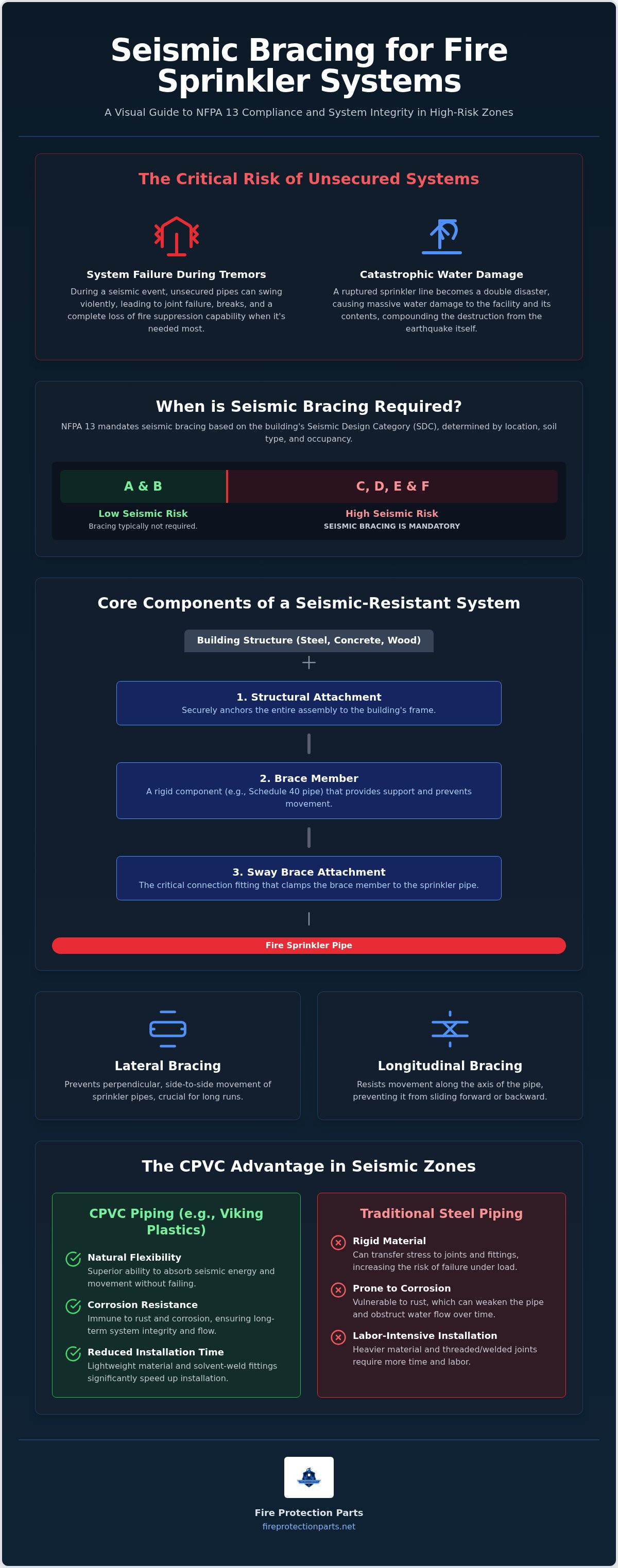
- Learn how to navigate NFPA 13 standards to determine exactly when your project requires seismic bracing for fire sprinkler systems based on Seismic Design Categories.
- Understand why CPVC’s natural flexibility and corrosion resistance make it a superior choice for absorbing seismic energy compared to traditional steel.
- Identify the critical sway and structural attachments needed to create a secure, code-compliant connection between your building's frame and Viking Plastics piping.
- Master the calculations for horizontal seismic loads and brace spacing to ensure your system remains operational during an earthquake.
- Discover how using compatible solvent-weld CPVC fittings can significantly reduce installation time while maintaining total system integrity.
Understanding Seismic Bracing for Fire Sprinkler Systems & NFPA 13
Seismic bracing isn't just an accessory; it's a structural requirement for safety. It consists of specialized hardware designed to prevent pipe movement during earthquakes. Without these supports, the dynamic forces of a tremor can tear a system apart. This seismic bracing for sprinkler systems serves as the foundation of life safety in high-risk zones. It ensures that the pipes move in sync with the building rather than against it. Installing high-quality seismic bracing for fire sprinkler systems is the only way to guarantee protection when the ground starts to shift.
The role of NFPA 13 is to define exactly when and where these protections are needed. It provides the technical framework for designing fire sprinkler systems that can withstand ground acceleration. Why does this matter? Because a pipe rupture during an emergency is a double disaster. You lose the ability to fight the fire, and you sustain massive water damage from the broken lines. Using code-compliant components like ASC Seismic Bracing eliminates this doubt and provides professional assurance that the system will perform under pressure.
Sway Bracing vs. Restraint
Different movements require specific mechanical solutions. Lateral bracing prevents side-to-side movement in branch lines and mains. This type of brace is essential for keeping long pipe runs from swinging and hitting the building's structure. Longitudinal bracing resists movement along the axis of the pipe, preventing the system from sliding forward or backward. Restraints are also necessary; they ensure individual components like sprinkler heads don't strike structural elements during a shake. Each piece of hardware must work together to maintain the system's integrity.
Seismic Design Categories (SDC) Explained
Seismic Design Categories (SDC) range from A to F and dictate the level of protection required for your project. SDC is the primary metric used by engineers to dictate seismic hardware needs. If your building falls into SDC C, D, E, or F, seismic bracing for fire sprinkler systems isn't optional. These categories are determined by the building's location, the soil properties beneath it, and the occupancy type. For example, hospitals and fire stations are often held to higher standards because they must remain operational after a disaster. Understanding your project's SDC helps you source the right components, like Viking Plastics CPVC, which offers the flexibility needed for these demanding environments.
Core Components of a Seismic-Resistant Sprinkler Support System
A complete seismic assembly is only as strong as its weakest link. Sway brace attachments form the critical connection between the sprinkler pipe and the structural brace. These must be paired with structural attachments that anchor the assembly to the building's steel, concrete, or wood frame. For the brace members themselves, contractors typically use schedule 40 pipe or specialized channels to provide the necessary rigid support. Adhering to NFPA 13 seismic protection standards requires every component to be tested and listed for the specific load it will carry. This ensures the system moves in unison with the structure, preventing catastrophic failures during ground movement.
Reliability starts with procurement. Sourcing your sprinkler system components online ensures a verified chain of custody for safety parts. This transparency is vital for passing inspections and maintaining system integrity. When you select seismic bracing for fire sprinkler systems, you aren't just buying hardware; you're investing in a system that must function without fail during a crisis. Professional-grade parts eliminate the risks associated with unverified or incompatible materials.
ASC Seismic Bracing Hardware
ASC Engineered Solutions provides some of the most reliable hardware for seismic applications. These components are favored for their multi-directional adjustment and high load capacities. Contractors prefer ASC because the parts are designed for easy installation, which reduces labor costs on complex jobs. Every piece is UL-listed and FM-approved. This level of verification removes the guesswork from compliance. You can find code-compliant ASC hardware and fittings that match your specific project requirements and provide the long-term assurance your clients expect.
All Thread Rod and Pipe Supports
All thread rod plays a dual role in fire protection. It provides essential vertical support while acting as a component of the seismic restraint assembly. Selecting the correct rod diameter is a technical necessity based on the total system weight and calculated seismic load. For CPVC systems, this selection is even more critical. Hangers and supports must be installed to ensure they don't restrict the natural thermal expansion of the pipe. If the support is too rigid or poorly placed, it can stress the CPVC joints and lead to leaks. Proper seismic bracing for fire sprinkler systems balances rigid protection with the physical properties of the piping material to ensure total system safety.
The Role of CPVC Fittings in Seismic-High-Risk Zones
CPVC offers a distinct mechanical advantage in earthquake-prone regions. While traditional steel is rigid, CPVC’s lower modulus of elasticity allows it to absorb seismic energy. This flexibility reduces the shock transferred to the building’s structure. Choosing Viking CPVC fire sprinkler pipe as the foundation for your system provides the resilience needed to survive ground movement. Additionally, the significant weight reduction of CPVC compared to metallic piping means your seismic bracing for fire sprinkler systems doesn't have to support as much mass. Lower mass results in lower horizontal seismic forces, simplifying your brace calculations and reducing stress on structural attachments.
Corrosion resistance is another critical safety factor. Metallic fittings can weaken over years of internal scaling and oxidation. If a seismic event occurs, these compromised joints are the first to fail. CPVC fittings remain structurally sound for decades, ensuring that the system you install today is just as strong during an earthquake years from now. This long-term reliability provides the peace of mind that a safety-conscious professional requires. It's about eliminating the variables that could lead to a system failure when it's needed most.
Solvent-Weld Integrity
The method of joining pipes is just as important as the material itself. Solvent welding creates a chemical bond that fuses the pipe and fitting into a single, continuous piece. In earthquake-prone environments, this "one-piece" system is far superior to mechanical couplings. Mechanical joints rely on gaskets and friction; they can shift or leak when subjected to extreme vibration. A solvent-welded joint resists vibration-induced leaks because it has no moving parts. High-quality CPVC fittings are the strongest bond in your system when selected and installed correctly. They eliminate the doubt associated with mechanical failure points during a tremor.
Standard Compliance for CPVC Fittings
Verification is the only way to ensure safety. You must look for ASTM F442 and UL 1821 certifications on every component you source. These standards verify that the fittings can handle the pressures and temperatures required for both hot- and cold-water fire suppression. All CPVC fittings in the collection meet or exceed these critical industry standards. Using certified parts ensures that your seismic bracing for fire sprinkler systems is supporting a pipe network capable of meeting modern safety codes. You can browse our collection of durable solvent-weld CPVC fittings to find the exact matches for your project requirements.
Critical Selection Factors for Seismic Bracing and Hardware
Precision in selection is the only way to ensure system integrity. Calculating the horizontal seismic load (Fp) is your first technical requirement. This calculation must include the total weight of the water-filled pipe, not just the dry pipe weight. Ignoring the mass of the water leads to undersized braces and potential system failure. Once you have your load requirements, you can consult the fire protection parts online inventory to ensure all necessary hardware is available for immediate dispatch. Professional assurance comes from knowing your parts are in stock and ready to perform.
Spacing and coverage are equally vital. NFPA 13 standards typically require brace spacing every 25 to 40 feet for mains. However, you must also verify the "Zone of Influence" for each individual brace. This ensures that every inch of your seismic bracing for fire sprinkler systems provides complete coverage without leaving vulnerable gaps. Additionally, always check the compatibility of bracing clamps with the outer diameter (OD) of your CPVC piping. A clamp that is too small will cause physical damage, while one that is too large won't provide the necessary restraint.
Avoiding Common Selection Mistakes
Errors during procurement can lead to failed inspections or, worse, system failure during a tremor. Using non-listed hardware for seismic applications is a common but dangerous mistake. If a part isn't UL-listed or FM-approved, it hasn't been verified for the extreme forces of an earthquake. Another frequent error is over-tightening clamps on CPVC pipe. This creates localized stress and can lead to stress fractures over time. Proper installation involves snugging the hardware to the manufacturer's torque specifications without crushing the pipe wall. You can source the correct, listed fittings and hardware to eliminate these risks entirely.
Material Compatibility: CPVC and Metal
Chemical compatibility is a non-negotiable rule when mixing metal hardware with CPVC. Some oils or coatings found on standard metal braces can chemically degrade CPVC fittings, leading to environmental stress cracking. To prevent this, always use listed hardware specifically designed for use with plastic piping. If direct contact with potentially incompatible materials is unavoidable, use protective sleeves as a barrier. Sourcing your components from a dedicated fire protection store reduces the risk of using incompatible parts. It ensures that every piece of your seismic bracing for fire sprinkler systems is safe for use with your Viking Plastics network, providing total peace of mind.
Buying Guide: Top Seismic-Ready CPVC Fittings and Bracing Solutions
A unified system is the most effective way to ensure seismic resilience. While previous sections focused on calculations and material science, this guide helps you finalize your procurement list. The most reliable configurations pair ASC Bracing hardware with Viking CPVC fittings. This combination provides a verified, high-performance solution that meets the 2025 edition of NFPA 13. By using a single, expert-vetted source, you eliminate the risk of mismatched parts that could fail during an earthquake. Investing in seismic bracing for fire sprinkler systems is a commitment to safety that shouldn't be compromised by low-quality components.
Efficiency matters on the job site. Solvent-weld fittings are a major advantage in complex bracing layouts because they significantly reduce labor costs. Unlike mechanical joints that require precise alignment and torque for every coupling, solvent welding creates a permanent bond quickly. This ease of installation allows your crew to focus on the precise placement of seismic hardware without fighting the pipe network. When you source from a curated collection, you gain the professional assurance that every fitting is designed for the high-vibration environments found in Seismic Design Categories C through F.
Standout Products from the CPVC Fittings Collection
Our inventory features over 60 durable solvent-weld fittings to meet any project requirement. Certain components are particularly vital for seismic-ready installations:
- CPVC 90-Degree Elbows: These are essential for re-routing pipe around structural seismic obstructions like beams or HVAC ducts without losing flow efficiency.
- CPVC Tees and Adapters: These provide reliable connections for branch lines. They're designed to handle the dynamic loads present in high-vibration zones.
- CPVC Pipe Supports: Specialized supports hold the Viking Plastics pipe securely. They prevent surface damage while allowing for the necessary movement defined in your seismic design.
Explore the full range of CPVC Fittings for Fire Protection to complete your seismic-ready system and ensure total code compliance.
Why Source from Fire Protection Parts?
We act as your mission-driven partner in fire safety. Every item in our inventory is expert-vetted. We only list code-compliant, professional-grade parts that we trust in the field. This no-nonsense approach to business means you don't have to spend hours verifying technical data sheets; we've already done the work for you. In a time-sensitive seismic retrofit, you can't afford project delays. We prioritize fast shipping to get your seismic bracing for fire sprinkler systems hardware to the site exactly when it's needed. Choosing our components provides the peace of mind that your system meets 2026 safety standards and will remain operational when it counts the most.
Secure Your System with Professional-Grade Seismic Protection
Building a resilient fire protection network requires a commitment to quality and a deep understanding of material synergy. You now know that the right seismic bracing for fire sprinkler systems balances the rigid strength of ASC hardware with the natural flexibility of Viking Plastics CPVC. This combination doesn't just meet the 2025 edition of NFPA 13; it provides the professional assurance that your system will remain operational when the ground shifts. By focusing on verified load ratings and chemical compatibility, you eliminate the risks that lead to system failure.
Don't leave your facility's safety to chance or unverified components. We offer a curated inventory of UL-Listed and FM-Approved components designed for durability and ease of installation. Our team provides expert technical support to help you navigate complex requirements and select the right parts for your specific Seismic Design Category. Choosing durable ASC and Viking brand hardware is the most effective way to protect your investment and ensure long-term compliance. Shop Code-Compliant CPVC Fittings for Seismic Systems at fireprotectionparts.net today. Stay safe and stay compliant.
Frequently Asked Questions
Do all fire sprinkler systems require seismic bracing?
No, not all systems require it; requirements depend on the Seismic Design Category (SDC). Systems in SDC A and B generally don't require it. However, systems in SDC C through F must have seismic bracing for fire sprinkler systems installed. NFPA 13 also provides exemptions based on pipe size and proximity to the ceiling. Always verify your local building code and SDC before finalizing your design. This ensures your project remains fully compliant.
Is CPVC pipe allowed for use in seismic design categories D, E, and F?
Yes, CPVC pipe is permitted in these high-risk categories. Its lower modulus of elasticity provides a flexibility advantage that helps absorb seismic energy. However, you must use listed components like Viking Plastics CPVC and compatible ASC hardware. The installation must strictly follow NFPA 13 guidelines regarding brace spacing and mounting to ensure the system remains operational during a major earthquake. This provides professional assurance in high-risk zones.
What is the difference between lateral and longitudinal sway bracing?
Lateral bracing prevents the pipe from moving side-to-side, perpendicular to the pipe run. It's essential for protecting branch lines and mains from striking structural elements. Longitudinal bracing resists movement along the axis of the pipe, preventing the line from sliding forward or backward. A code-compliant system requires a combination of both types to provide multi-directional stability during ground acceleration. This dual-protection strategy is vital for maintaining system integrity.
How do I ensure my seismic braces are chemically compatible with CPVC fittings?
You must use bracing hardware that is specifically listed for use with CPVC. Standard metallic braces may have oils, coatings, or gaskets that cause environmental stress cracking in plastic pipes. Sourcing from a specialized supplier like Fire Protection Parts ensures that your ASC bracing and Viking Plastics components are chemically compatible. If you're unsure, use a protective sleeve as a barrier between the metal and the CPVC. This eliminates the risk of premature material degradation.
What are the spacing requirements for seismic bracing on CPVC fire sprinkler mains?
NFPA 13 typically requires lateral braces every 40 feet and longitudinal braces every 80 feet for most mains. However, for CPVC systems, spacing is often tighter, ranging from 25 to 40 feet depending on the calculated seismic load (Fp). You must calculate the Zone of Influence for each brace to ensure the weight of the water-filled pipe doesn't exceed the brace's rated capacity. This precision prevents structural failure during tremors.
Can I use standard pipe hangers as seismic restraints?
No, standard hangers are designed only for vertical support. Seismic restraints must resist horizontal forces. While some hangers can be part of a restraint assembly, they must be paired with specific seismic hardware to prevent upward or lateral movement. Using standard hangers alone for seismic bracing for fire sprinkler systems is a violation of NFPA 13 and puts the system at risk. Always use hardware listed for seismic loads to ensure performance.
What certifications should I look for when buying CPVC fittings for fire protection?
Always verify that fittings carry UL 1821 and ASTM F442 certifications. These standards ensure the material can withstand the specific pressures and temperatures required for fire suppression. Additionally, look for FM Approval if the project insurance requires it. Using uncertified fittings in a seismic zone is dangerous, as they haven't been tested for the dynamic loads experienced during an earthquake. Certified parts offer the peace of mind professionals demand.
How does seismic bracing affect the thermal expansion of CPVC pipes?
Seismic bracing is rigid, while CPVC pipes need to expand and contract with temperature changes. If a brace is too tight or poorly placed, it can create a fixed point that leads to stress fractures. You must install bracing in a way that allows for natural thermal movement. This often involves using specific offsets or flexible loops that provide seismic protection without restricting the pipe's physical properties. It's about balancing rigidity with flexibility.

