



4000B-20 Reference Guide: Watts 4000B Specs
In a high-hazard fire protection system, a single incorrect component isn't just a maintenance error; it's a liability that can compromise an entire facility's safety. When you're responsible for system integrity, the 4000b-20 backflow preventer serves as a critical line of defense against cross-contamination. You shouldn't have to guess if a part is compatible or if your current assembly still meets the rigorous demands of local water authorities. Uncertainty in this industry leads to downtime, failed inspections, and unnecessary risk.
We understand that finding precise technical data for the 4000b-20 is often harder than it should be. You need reliable information to ensure your hardware meets current NFPA standards and remains fully compliant. This guide is designed to eliminate that doubt by providing a comprehensive breakdown of the 4000B-20 specifications. We'll walk you through the essential internal components for repairs, clarify compatibility requirements, and outline the maintenance protocols necessary for long-term performance. By the end of this reference, you'll have the expert knowledge required to secure your system and maintain professional-grade protection without compromise.
Key Takeaways
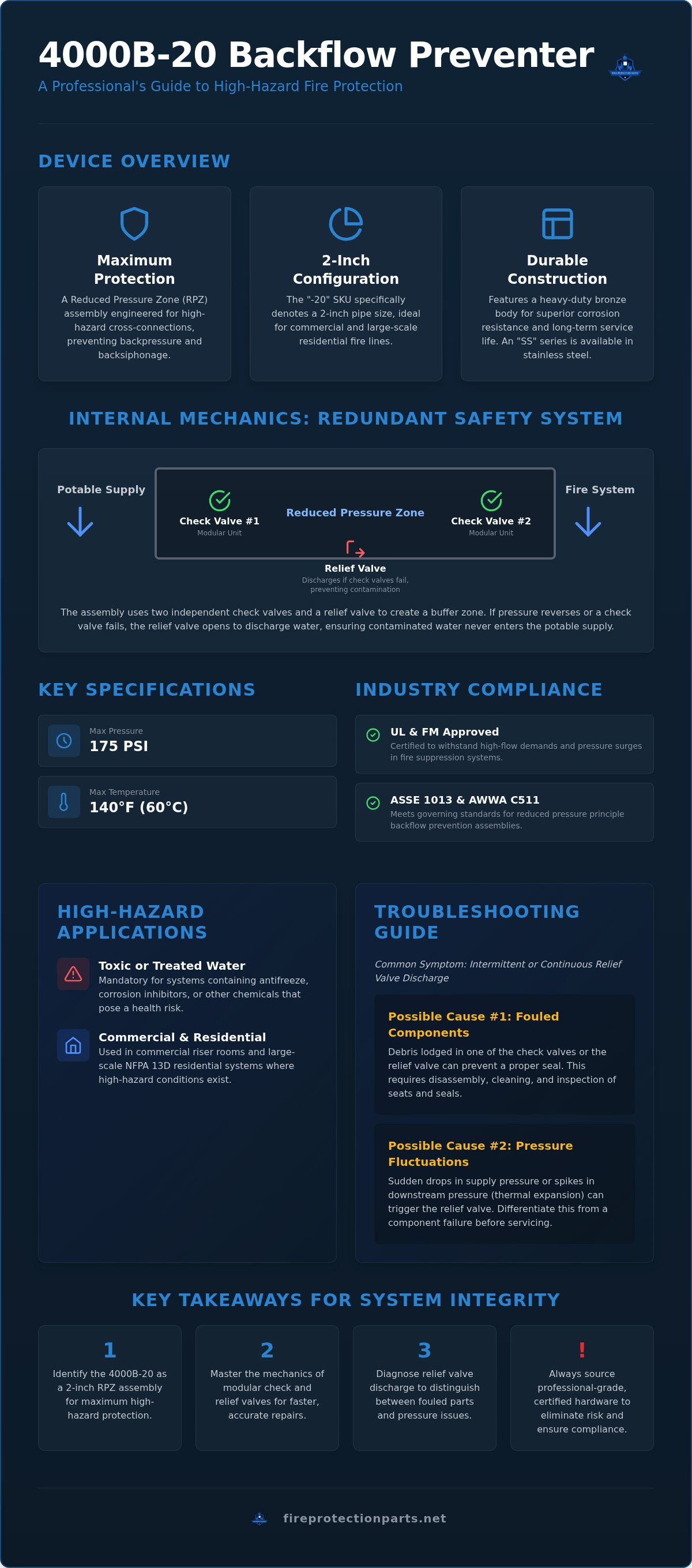
- Identify the 4000b-20 as a 2-inch Reduced Pressure Zone assembly designed to provide maximum protection in high-hazard fire protection systems.
- Learn to verify system compatibility for applications involving toxic or chemically treated water to maintain strict code compliance.
- Master the internal mechanics of modular check valves and relief valve assemblies to facilitate faster, more accurate repairs.
- Diagnose common failure symptoms, such as relief valve discharge, to distinguish between fouled components and external pressure fluctuations.
- Secure your facility's safety by sourcing professional-grade hardware that eliminates the risks associated with unverified third-party parts.
What is the 4000B-20? Identification and Overview
The 4000b-20 isn't just another part; it's a specific 2-inch configuration of the Watts 4000B Reduced Pressure Zone (RPZ) assembly. This backflow prevention device is engineered specifically for high-hazard cross-connections. Its primary job is to stop contaminated water from entering the potable supply through backpressure or backsiphonage. In fire protection, where systems may contain stagnant water or chemical additives, this protection is non-negotiable for life safety and code compliance.
The assembly uses a heavy-duty bronze body. This material provides the necessary corrosion resistance and durability for long-term service in fire lines. The design is built around two independent, modular check valves and a bottom-mounted relief valve. This layout ensures that if a check valve fails, the relief valve can discharge to maintain a zone of lower pressure. This redundant safety mechanism prevents any risk of contamination even under the most demanding system conditions.
Understanding the 4000B Series Nomenclature
The "-20" in the 4000b-20 SKU is the specific indicator for a 2-inch pipe size. While the base 4000B series is constructed from bronze, you might also encounter the 4000SS series. The "SS" denotes stainless steel, which is often used in environments where weight or specific chemical resistance is a factor. To verify your specific unit, look at the nameplate located on the side of the body. It contains the serial number and manufacture date. These details are essential for tracking maintenance history and ensuring you're using the correct repair kits during your annual inspections.
Industry Standards and Certifications
Compliance isn't optional in fire safety. The 4000b-20 meets ASSE 1013 requirements for reduced pressure principle assemblies and adheres to AWWA C511 standards. For fire protection professionals, the UL and FM approvals are the most critical benchmarks. These certifications prove the hardware can withstand the high-flow demands and pressure surges typical of a fire suppression system without failing. When you choose an assembly with these approvals, you're opting for verified reliability. Using certified equipment isn't just about following the law; it's about eliminating the risk of system failure when it matters most.
System Compatibility and High-Hazard Applications
High-hazard applications represent the most critical service environments in the fire protection industry. A system is classified as high-hazard when the water in the fire line contains substances that are toxic or chemically treated, such as antifreeze or corrosion inhibitors. In these scenarios, a standard double-check valve isn't sufficient. The 4000b-20 provides the necessary protection by utilizing the reduced pressure principle to ensure no contaminated fluid can migrate back into the public water supply. This assembly is a staple on the USC List of Approved Backflow Prevention Assemblies, which serves as the definitive verification for contractors and inspectors alike. Reduced pressure zone assemblies like this one hold a 31.0% share of the global backflow market in 2026, reflecting their status as the preferred choice for maximum protection.
When integrating this unit with other sprinkler system components online, you must account for its specific flow characteristics. The 2-inch assembly is designed to handle significant volume, but it does introduce a measurable pressure drop. For instance, at typical fire flow velocities, the pressure loss across the RPZ must be factored into your hydraulic calculations to ensure the most remote sprinkler heads receive adequate pressure. Most commercial fire systems operate within a standard range of up to 175 psi and temperatures up to 140°F, which aligns with the design limits of the 4000b-20.
Residential vs. Commercial Installation
While typically found in commercial riser rooms, the 4000b-20 is also utilized in large-scale residential NFPA 13D systems where high-hazard conditions exist. In these installations, space is often at a premium. The compact bronze body of the 4000B series makes it easier to fit into tighter riser configurations compared to larger iron-body alternatives. It is fully compatible with Viking CPVC fire sprinkler pipe, provided that the transition fittings are properly supported to prevent stress on the CPVC joints.
Seismic and Support Requirements
The weight of a 2-inch bronze backflow assembly requires robust physical support. It's not just about gravity; you must also consider lateral forces. Integrating seismic bracing for sprinkler systems is essential in many jurisdictions to protect the backflow unit from shifting during a seismic event. Beyond bracing, ensure there is at least 12 to 30 inches of clearance around the relief valve. This space is necessary for both discharge drainage and maintenance access during annual testing. If you're looking to upgrade your current setup, you can find professional-grade backflow preventors and accessories that ensure long-term compliance.
Internal Components and Repair Kit Breakdown
The 4000b-20 is built with a modular design that simplifies field service and reduces system downtime. Maintaining the assembly's integrity requires a detailed understanding of how its internal parts interact to create a reduced pressure zone. Every component has a specific role in preventing backflow. If one part fails, the entire system's compliance is at risk. Understanding these internals is the first step toward a successful repair strategy.
The 4000b-20 utilizes four primary internal systems to ensure safety:
- Modular Check Valves: These consist of a first and second check assembly. The first check is designed to maintain a specific pressure drop (usually 5 to 7 psi) across the relief valve, while the second check provides a redundant seal against backpressure.
- Relief Valve Assembly: This is the "brain" of the unit. It includes the diaphragm, seat, and various O-rings that react to pressure changes between the inlet and the reduced pressure zone.
- Sensing Lines: These internal passages communicate pressure differentials to the relief valve. If these lines become clogged with scale or debris, the relief valve won't react accurately to pressure fluctuations.
- Test Cocks: The assembly features a 4-gate valve configuration. These are the access points used during annual testing to verify that each check valve and the relief valve are functioning within their required parameters.
Total Relief Valve Repair Kits
When the relief valve begins to drip or discharge constantly, it's often a sign that the rubber components have reached the end of their service life. You'll need to decide whether to replace just the diaphragm or the entire relief valve module. In most high-hazard environments, replacing the total rubber kit is the safest choice. It's vital to use OEM-grade rubber parts. These materials are specifically formulated for long-term sealing and resistance to chemical additives in fire lines. During assembly, always use an FDA-approved lubricant on internal O-rings to prevent pinching and ensure a watertight seal.
Check Valve Maintenance
Debris-induced fouling is the most common cause of check valve failure. Even a small piece of construction debris can prevent a check disc from seating properly. When servicing the 4000b-20, inspect the first check first, as it's the most likely to capture pipe scale. If you find pitted seats or worn discs, replace the springs and discs as a set to ensure a drip-tight seal. Field-servicing the 4000B-20 typically requires standard wrenches and a socket set; no specialized proprietary tools are needed for basic maintenance. This accessibility is a major advantage for facility managers who need to restore protection quickly.
Troubleshooting the 4000B-20: Signs of Failure
A malfunctioning backflow preventer is more than a maintenance headache; it's a direct threat to the safety of the local water supply. When your 4000b-20 begins to discharge water from the relief valve, it's communicating a specific internal failure that requires immediate attention. Ignoring these signs can lead to system downtime or a failed annual inspection, which often results in the termination of water service. Understanding the difference between a minor pressure fluctuation and a critical component failure allows you to prioritize repairs and maintain system compliance.
The most common symptom is constant relief valve discharge. This usually points to a fouled first check valve. If the first check doesn't seat properly due to debris or scale, the pressure in the intermediate zone rises. When this pressure comes within 2 psi of the inlet pressure, the relief valve opens to dump the potentially contaminated water. Conversely, intermittent spitting usually happens because of supply pressure fluctuations. If the city's water pressure drops suddenly, the 4000b-20 reacts by discharging a small amount of water to maintain the required pressure differential. While annoying, spitting is often a symptom of the environment rather than a hardware failure.
Leaking test cocks are another frequent issue. Worn seals or internal corrosion in the bronze body can make it impossible for a technician to get an accurate reading during testing. If a test cock won't close completely, it's a sign that the unit's physical integrity is degrading. If you're facing a failed annual test, the first step is always to clean the internal components and check for debris before committing to a full rebuild. To restore your system quickly, you can order code-compliant backflow preventors and repair kits for immediate fulfillment.
Diagnostic Checklist for Relief Valve Leaks
Before disassembling the unit, follow this three-step diagnostic process. First, check for inlet pressure fluctuations by monitoring the system gauges; if the supply is unstable, you may need a check valve upstream. Second, inspect the first check valve for debris. Even a tiny pebble can prevent a drip-tight seal. Third, verify the relief valve diaphragm integrity. A torn diaphragm won't be able to hold the spring tension required to keep the valve closed, leading to constant dumping regardless of check valve performance.
When to Repair vs. Replace
Deciding whether to rebuild or replace an older 4000b-20 depends on the condition of the bronze body. If the internal seats are deeply pitted or the body shows signs of significant corrosion, a repair kit is only a temporary fix. In these cases, the cost-benefit analysis favors a new assembly to ensure long-term reliability. Remember that in certain jurisdictions, like Colorado, regulations updated on March 28, 2025, require certified technicians to attach a compliance tag to the device after any repair. Ensuring continuity of protection during these maintenance shutdowns is vital, so always have your replacement parts on-site before you begin the work.
Sourcing Professional Grade 4000B-20 Components
Sourcing parts for a 4000b-20 isn't just about finding the lowest price. It's about ensuring life-safety compliance. Using unverified, third-party internal components in a backflow assembly is a gamble that contractors can't afford to take. Generic rubber kits often lack the specific material density required to maintain a drip-tight seal under high-hazard conditions. If a seal fails during an emergency, the consequences extend far beyond a simple leak. You need components that are verified to meet the exact tolerances of the original equipment to maintain the integrity of the reduced pressure zone.
The physical installation of a 4000b-20 requires attention to detail that goes beyond the valve itself. A 2-inch bronze assembly is heavy. You must ensure that all thread rods and supports are rated to match the total weight of the backflow assembly and the water it contains. Standard hangers may not suffice for these high-hazard units. Using professional-grade hardware ensures the system remains stable during pressure surges and seismic events. By choosing a partner that prioritizes verification and adherence to standards, you protect both the potable water supply and your professional reputation.
Procurement for Contractors
Large-scale commercial developments require a streamlined supply chain to stay on schedule. We provide the infrastructure for bulk ordering to ensure your project doesn't stall due to a missing component. When you're navigating fire protection parts online, you need more than a digital catalog; you need a partner that understands the urgency of immediate inspection needs. If you're struggling to identify an obscure replacement SKU for an older model, our technical support team acts as a bridge between technical complexity and a functional remedy. We help you secure code-compliant hardware before a minor maintenance issue becomes a major compliance failure.
The Fire Protection Parts Advantage
Fire Protection Parts operates as a mission-driven partner rather than a mere vendor. We focus on providing direct access to high-impact safety components that eliminate doubt for facility managers and contractors alike. Our commitment to excellence means every item in our inventory, from backflow preventors to specialized fittings, meets the highest industry standards. We act as a dependable guide in a complex procurement environment, projecting the confidence of seasoned professionals who value quality above all else. This no-nonsense approach to business ensures you receive the hardware you need without unnecessary fluff or delays. It's about providing peace of mind through professional expertise and a refusal to compromise on safety.
Securing Your High-Hazard Fire Protection System
Maintaining a high-hazard fire protection system requires technical precision and the right hardware. You've learned that the 4000b-20 is a critical safeguard against contamination in chemically treated fire lines. By identifying early signs of failure like relief valve discharge and understanding the modular check valve design, you can prevent costly system downtime. Sourcing verified, professional-grade components is the final step in ensuring your facility remains fully compliant with local codes and NFPA standards.
Don't let an unverified part compromise your life-safety infrastructure. We provide expert-vetted fire safety hardware and professional-grade reliability to help you eliminate doubt during your next inspection. With fast shipping for critical repairs, you can restore your system's integrity without delay. Take the guesswork out of your maintenance schedule today.
Shop Code-Compliant 4000B-20 Parts and Assemblies
You're now equipped to manage your backflow prevention with the confidence and expert authority of a seasoned professional.
Frequently Asked Questions
What is the difference between the Watts 4000B and 4000SS?
The primary difference is the body material. The 4000B features a durable bronze construction, while the 4000SS uses stainless steel. Stainless steel models are typically lighter and provide superior resistance in specific corrosive environments. For most standard fire line installations, the bronze 4000B remains the industry staple due to its longevity. Both models utilize the same internal reduced pressure principle technology to ensure high-hazard protection across your facility's water infrastructure.
How often does a 4000B-20 backflow preventer need to be tested?
Most jurisdictions require annual testing for the 4000b-20 assembly to maintain legal compliance. For example, as of July 1, 2026, California requires all testers to be state-certified, while Colorado regulations from March 2025 mandate that certified technicians attach a compliance tag after every inspection. Regular testing ensures the internal checks and relief valve operate correctly under pressure, preventing catastrophic system failure and the potential termination of your water service.
Can I use a 4000B-20 for both potable water and fire protection?
Yes, the 4000b-20 is specifically designed to protect potable water supplies from high-hazard fire protection systems. Because fire lines often contain stagnant water or chemical additives like antifreeze, they pose a significant contamination risk. The reduced pressure zone technology in this assembly creates a physical air gap if a backflow event occurs. This makes it an ideal solution for containment at the service line entrance for both commercial and residential properties.
What causes the relief valve on a 4000B-20 to dump water constantly?
Constant dumping is usually caused by a fouled first check valve or a damaged relief valve diaphragm. If debris like pipe scale prevents the first check from closing tightly, the pressure in the intermediate zone rises, triggering the relief valve to open. Alternatively, a tear in the diaphragm prevents the unit from sensing pressure differentials accurately. Cleaning the internal seats and replacing the rubber repair kit usually resolves this issue and restores system balance.
Are the internal parts for a 2-inch 4000B compatible with other sizes?
No, the internal components are size-specific and aren't interchangeable between different pipe sizes. The "20" suffix denotes a 2-inch assembly, which uses modular check valves and diaphragms scaled specifically for that volume of flow. Using parts intended for a 1-inch or 3-inch unit will result in a failed seal and could cause physical damage to the bronze body. Always verify your model's serial number before ordering replacement kits to ensure exact compatibility.
Do I need special tools to repair a Watts 4000B-20 assembly?
You don't need proprietary or specialized tools to perform standard maintenance on this assembly. The modular design allows you to access the internal check valves and relief valve using common field tools like a socket set and adjustable wrenches. This accessibility simplifies the repair process for facility managers and contractors. You must ensure that any replacement parts are professional-grade and expert-vetted to maintain the unit's original safety certifications and performance standards.
Is the 4000B-20 lead-free compliant for drinking water systems?
The standard 4000B-20 is a bronze assembly, but lead-free compliance depends on the specific model variant. For applications requiring adherence to lead-free laws for drinking water, you must select the LF4000B model. This version is engineered with lead-free materials to meet stringent potable water standards. Always check your local plumbing codes and the project specifications to determine if a lead-free assembly is mandatory for your particular installation site.
What should I do if my 4000B-20 fails its annual backflow test?
If the assembly fails its test, you should first inspect the internal check valves for debris or mineral buildup. Often, a simple cleaning of the seats and discs can restore a drip-tight seal. If the failure persists, you'll need to install a total rubber repair kit to replace worn diaphragms and O-rings. Once repairs are complete, the unit must be re-tested by a certified technician to verify it meets the required pressure differentials for compliance.

