



Backflow Grooved Systems: The Complete 2026 Commercial Buyer’s Guide
Wrestling a massive flanged valve into a cramped mechanical riser room is a fast way to blow through labor budgets and stall project timelines. If you've spent exhausting hours leveling, aligning, and torquing heavy flanged bolt patterns in tight corners, you know traditional hardware often creates unnecessary jobsite friction. Deploying a modern backflow grooved assembly eliminates these clearance headaches, allowing contractors to slash installation hours, reduce physical strain, and maintain uncompromising hydraulic performance under pressure.
You shouldn't have to gamble with municipal compliance just to keep an installation on schedule. In this 2026 commercial buyer's guide, you'll discover how to select, size, and source the right grooved backflow preventer assembly for code-compliant fire safety systems. We cover everything from distinguishing high-hazard RPZ units from low-hazard double checks to leveraging compact N-pattern and Z-pattern footprints for demanding risers. Here is what you need to build safer, leaner, and faster.
Key Takeaways
- Upgrading to a backflow grooved system replaces bulky flanged bolt patterns with mechanical couplings, cutting contractor assembly time and field labor costs.
- Hazard classification guidelines dictate whether your fire line demands a high-hazard Reduced Pressure Zone (RPZ) device or a Double Check Valve Assembly (DCVA).
- Space-saving configurations like N-pattern and Z-pattern geometries fit strict riser rooms where traditional straight-line layouts cannot clear walls or access doors.
- Factory-integrated supervisory switches and grooved butterfly valves streamline electrical hookups and ensure fire suppression systems pass inspection on the first walk.
- Sourcing certified commercial units built with ASTM A536 ductile iron guarantees reliable hydraulic performance and lasting compliance across demanding municipal water systems.
What Is a Backflow Grooved Assembly and Why Does Piping Design Rely on It?
A grooved backflow preventer is an inline mechanical valve assembly designed to prevent reverse fluid flow that connects directly into a piping network using roll- or cut-grooved couplings instead of traditional flanged faces. In commercial fire suppression, this hardware forms an impenetrable physical barrier. It protects public drinking water mains from the stagnant, chemically treated water sitting inside fire sprinkler risers. While standard specifications often defaulted to flanged units in decades past, modern system design increasingly relies on a backflow grooved configuration to resolve tight physical tolerances and aggressive project schedules.
Every commercial cross-connection introduces potential vulnerability through backpressure or backsiphonage. A specialized backflow prevention device stops contaminated fire system water from migrating backward into municipal networks during sudden main pressure drops. Beyond hydraulic defense, mechanical grooved connections give pipefitters controlled joint flexibility. The grooved profile accommodates slight angular deflection, thermal expansion, and seismic movement without placing destructive shear stress on adjacent valve bodies or structural riser hangers.
The Mechanics of Grooved End Connections
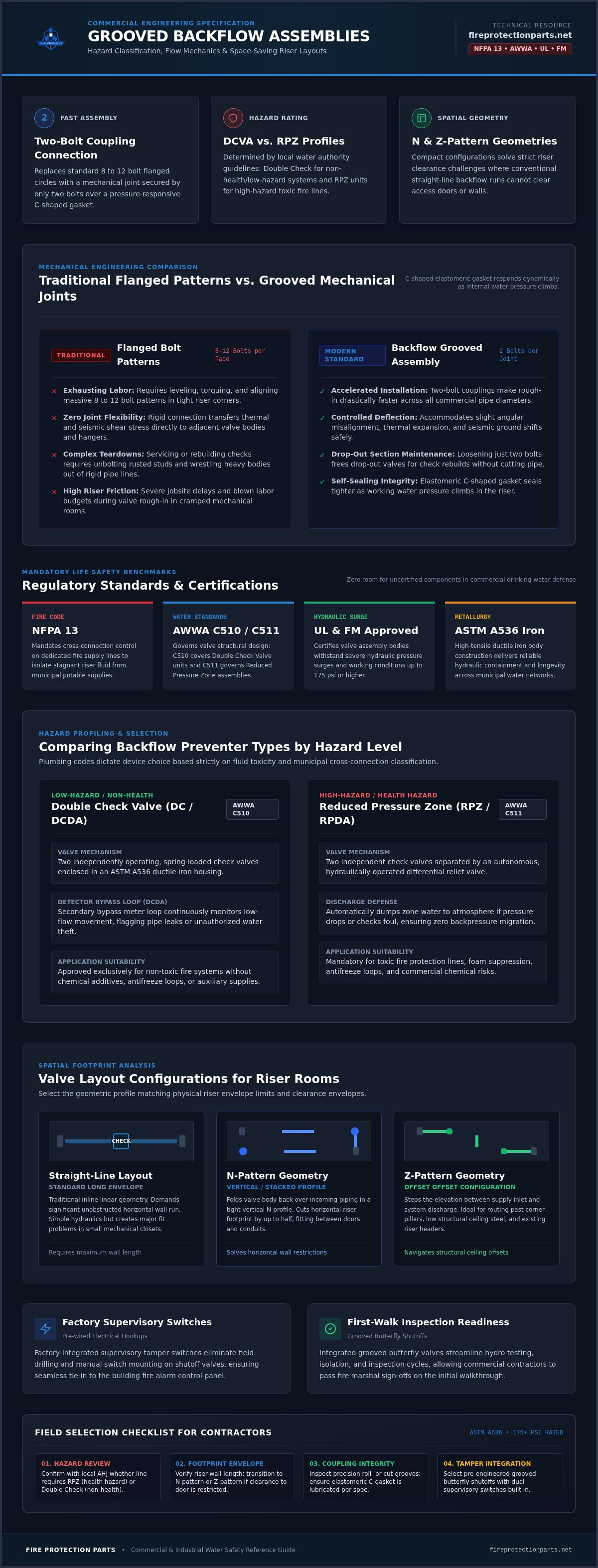
The engineering advantage of grooved hardware centers on speed and joint integrity. Instead of aligning an eight- or twelve-hole bolt circle, technicians secure a grooved coupling with just two bolts over an elastomeric, pressure-responsive C-shaped gasket. As internal system pressure climbs, the gasket seals tighter against precision-machined pipe grooves. This mechanical engagement delivers several distinct field advantages:
- Accelerated installation: Two-bolt couplings make rough-in significantly faster than torquing heavy multi-bolt flange patterns across large pipe diameters.
- Deflection tolerance: Mechanical couplings absorb subtle piping misalignments that would otherwise bind or warp a rigid flanged assembly.
- Simplified teardown: Removing two bolts frees the drop-out section for check valve rebuilds without cutting pipe or wrestling rusted flange studs.
Regulatory Compliance: AWWA, UL, and FM Global Standards
Life safety and water hygiene leave zero room for uncertified components. Standard plumbing and fire codes enforce strict rules governing where and how cross-connection assemblies operate:
- NFPA 13: Mandates cross-connection control on dedicated fire supply lines to isolate stagnant riser fluid from potable supplies.
- AWWA Standards: Governs valve structural design, specifying AWWA C510 for double check valves and AWWA C511 for reduced pressure zone units.
- UL Listing and FM Approval: Underwriters Laboratories and FM Global certify that assembly bodies withstand extreme pressure surges and working conditions up to 175 psi or higher without structural failure.
Specifying a certified backflow grooved assembly ensures your installation passes municipal water authority review, clears fire marshal sign-offs, and satisfies strict commercial insurance underwriting on day one. While commercial facilities install specialized backflow assemblies to defend municipal supplies from cross-connection hazards, residential properties also benefit from robust safeguarding against supply contaminants and line issues; homeowners can discover CastleGuard for whole-home water protection solutions.
Comparing Backflow Preventer Types: Double Check vs. Reduced Pressure Zone
Selecting the correct device begins with the local Authority Having Jurisdiction (AHJ) and municipal water purveyor. Plumbing codes categorize cross-connections into non-health hazards and health hazards based on fluid toxicity. Installing an inadequate assembly risks municipal fines and water supply contamination. Choosing an over-engineered unit can cause unnecessary friction loss and drainage challenges. As detailed by the CCPIA in their overview of Backflow Preventers at Commercial Properties, commercial facilities require certified assemblies that match the exact chemical and physical hazard profile of the building.
Double Check Valve & Detector Assemblies (DC / DCDA)
Double Check Valve Assemblies rely on two independently operating, spring-loaded check valves housed inside an ASTM A536 ductile iron body. A Double Check Detector Assembly (DCDA) adds a secondary bypass meter loop that monitors low-flow movement, flagging system leaks or unauthorized water theft. Key operating parameters include:
- Application: Approved exclusively for low-hazard, non-toxic fire systems without antifreeze, foam additives, or chemical treatment loops.
- Hydraulics: Produces minimal head loss, which preserves crucial dynamic water pressure for downstream sprinkler heads.
- Drainage: Operates as a closed system without continuous relief discharge, simplifying installations in dry riser cupboards.
Reduced Pressure Zone & Detector Assemblies (RP / RPDA)
Reduced Pressure Zone assemblies provide the highest mechanical defense against backpressure and backsiphonage. Between two independent check valves sits a hydraulically operated differential pressure relief valve. If either check fouls or municipal pressure drops below internal system pressure, the relief valve dumps water directly to atmosphere, maintaining an internal air gap that contaminants cannot cross.
- Application: Mandatory for high-hazard connections containing toxic additives, glycols, or auxiliary water supplies like onsite storage tanks.
- Drainage demands: Must be paired with an air gap funnel and a floor drain capable of handling the maximum continuous discharge volume to prevent catastrophic riser room flooding.
When retrofitting tight mechanical spaces, pairing either configuration with a modern backflow grooved body eliminates heavy companion flanges and eases valve alignment. You can review our technical guide on fire protection parts online to coordinate compatible mechanical couplings and shutoff components. If you need to verify sizing and local AHJ approvals, explore our full backflow grooved preventer selection to source assemblies configured for rapid riser rough-in.
Evaluating Valve Layouts: Straight-Line, N-Pattern, and Z-Pattern Configurations
Spatial constraints in mechanical riser rooms dictate assembly geometry just as much as hydraulic calculations. In retrofit projects or multi-tenant commercial risers, fitting a full-sized backflow assembly along an uninterrupted wall run is rarely practical. Sourcing a backflow grooved system gives system designers geometric versatility, allowing the valve body to fold into compact layouts that conserve valuable floor space. Because grooved couplings permit clean 360-degree rotation prior to bolt tightening, contractors can make precise field adjustments without fabricating custom welded spool pieces.
Every suspended directional change adds structural load. When deploying non-linear geometries, you must anchor the assembly securely and coordinate sway bracing with code-compliant seismic bracing for sprinkler systems to resist dynamic thrust forces during full-flow activation.
Straight-Line Grooved Valve Assemblies
The traditional straight-line configuration aligns shutoff valves, check modules, and test cocks along a single horizontal plane. This design provides uniform laminar flow with minimal turbulence and lowest localized pressure drop. Certified backflow testers appreciate the unobstructed line-of-sight access to all four test cocks. However, a 4-inch or 6-inch straight assembly demands extensive horizontal wall clearance, making it impractical for undersized utility closets.
N-Pattern and Z-Pattern Compact Configurations
Folded patterns solve severe horizontal space deficits by utilizing vertical riser loops, cutting horizontal footprint requirements by up to 60 percent:
- N-Pattern: Water enters from below, travels vertically through the first shutoff valve, crosses horizontally through the checks, and drops back down into the system. This works well against standard-height walls where width is restricted.
- Z-Pattern: Water enters low, transitions up through the check modules, and continues horizontally along an elevated ceiling run. This layout eliminates awkward drop-down piping when serving upper-floor distribution mains.
Shutoff Options: Grooved Butterfly vs. OS&Y Gate Valves
Isolation shutoffs dictate the final envelope size. While Outside Screw and Yoke (OS&Y) gate valves remain a viable flanged standard, pairing your assembly with a backflow grooved butterfly valve offers undeniable field advantages:
- Integral monitoring: Grooved butterfly valves include factory-integrated supervisory tamper switches, eliminating field-wired external switch kits and speeding fire panel termination.
- Weight and space: Butterfly designs reduce overall face-to-face length by several inches per valve and eliminate over 50 percent of the dead weight compared to cast iron gate valves.
- Water hammer defense: Internal slow-close gear operators require multiple handwheel rotations to shut, preventing destructive hydraulic shock waves across fire mains.
How to Choose the Right Grooved Backflow Assembly: A 4-Step Checklist
Sourcing commercial backflow hardware without an organized plan leads to field rework, failed inspections, and blown delivery milestones. Follow this 4-step procurement framework to specify the right hardware with total confidence:
- Step 1: Confirm municipal hazard classifications. Consult your local water purveyor to see if chemical additives or municipal cross-connection policies mandate an RP/RPDA over a DC/DCDA unit.
- Step 2: Match hydraulic service requirements. Verify that line diameters and pressure ratings align directly with fire protection engineering calculations.
- Step 3: Map mechanical room clearances. Measure wall runs, door swings, and vertical drop space to choose between straight-line, N-pattern, or Z-pattern orientations.
- Step 4: Specify integrated supervisory shutoffs. Choose pre-assembled butterfly shutoffs to eliminate external tamper kit installations and reduce electrical labor.
Always verify hardware compatibility across all mating sprinkler system components online to ensure matching grooved roll dimensions and gasket elastomeric ratings across the entire riser manifold.
Assessing Hydraulic Demand and Pipe Diameters
Never downsize the backflow assembly diameter below the nominal riser service size to cut short-term expenses. Downsizing restricts flow and spikes friction loss curves exponentially at peak delivery volume. Cross-reference manufacturer friction loss curves against your required sprinkler head demand in GPM. Verify that the rated working pressure of the backflow grooved body matches your static supply conditions, especially in systems utilizing high-pressure booster pumps.
Evaluating Mechanical Space and Clearance Constraints
Layout errors frequently stall final sign-offs. Prevent red-tag delays by confirming critical clearances on your submittals:
- Test cock service envelope: Maintain at least 12 inches of unobstructed access in front of test cocks so certified testers can connect field gauge hoses without scraping walls.
- RP relief funnel clearance: Provide sufficient air-gap clearance beneath the relief valve discharge port. The air gap must equal twice the effective diameter of the relief valve inlet.
- Vertical pattern ceilings: Measure overhead obstructions carefully before roughing in vertical N-pattern and Z-pattern loops to prevent collisions with cable trays, HVAC ductwork, or structural beams.
Procuring Code-Ready Assemblies Online
Field-assembling individual checks, spool pieces, and shutoffs increases the risk of misaligned couplings and pinhole gasket leaks. Ordering complete, factory-tested assemblies ensures the valve arrives ready for installation. Ensure shutoff valves feature pre-wired internal supervisory switches that link straight into the building's fire alarm control panel. When project schedules leave zero margin for supply chain delays, explore the complete Fire Protection Parts backflow grooved selection to secure fully certified riser assemblies shipped directly to your jobsite.
Featured Grooved Backflow Preventers for Commercial and Industrial Facilities
Selecting the right assembly means matching specific pipe diameters, hazard profiles, and physical room geometries to proven hardware. Top commercial assemblies pair ASTM A536 ductile iron bodies with factory-integrated butterfly shutoffs, giving contractors verified performance under high-pressure fire suppression demands. Industry benchmarks from Ames and Zurn Wilkins arrive pre-configured with grooved ends, speeding mechanical rough-in and simplifying annual ASSE-compliant testing procedures.
Heavy-Duty 8" Double Check Detector Assemblies
Managing main municipal utility feeds for large logistics hubs or commercial towers requires immense flow capacity. The Ames 8-inch Double Check Detector Valve with Grooved Butterfly Valves handles high-volume primary supply mains with minimal head pressure loss. Cast from rugged ASTM A536 ductile iron, this assembly withstands severe municipal line pressure spikes. Its integrated bypass meter tracks hairline leaks and unauthorized water draws without impeding emergency fire flow, while pre-mounted grooved butterfly valves allow rapid, reliable shutoff during scheduled check servicing.
High-Hazard Protection: 6" and 3" Reduced Pressure Assemblies
When systems contain toxic additives or foam concentrates, high-hazard isolation is mandatory. The Zurn Wilkins 375A Reduced Pressure Detector Assembly provides absolute hydraulic defense against backpressure and backsiphonage in critical water supply feeds. If riser room width is limited, the Ames 6-inch Reduced Pressure Detector Z-Pattern Valve steps piping upward, delivering high-hazard defense without claiming excessive wall space. For tighter light-commercial risers, the Ames 3-inch Reduced Pressure Assembly in an N-pattern layout folds the flow path neatly. Both designs utilize durable internal polymer check modules that resist scaling, debris fouling, and chlorine corrosion over decades of service.
Compact 2-1/2" and 4" Detector Check Solutions
Medium and small commercial risers require agile configurations that drop directly into standard footprint spaces. The Ames 4-inch Double Check Detector with Grooved Butterfly Valves delivers dependable, non-health hazard protection for standard office and retail developments. In space-restricted multi-family or light industrial footprints, the Ames 2-1/2-inch NPAT Grooved Reduced Pressure Device packs maximum protection into tight physical envelopes. Sourcing a dedicated backflow grooved assembly allows contractors to complete drop-in retrofits without torching old flanges or cutting back existing steel lines. To equip your next riser with code-certified hardware, shop the backflow grooved collection and ensure fast jobsite delivery.
Equip Your Riser for Long-Term Compliance and Performance
Selecting the right cross-connection hardware protects both municipal drinking water and project margins. Switching to a modern backflow grooved system eliminates labor-intensive flange bolt patterns, solves tight riser clearances, and guarantees verified hydraulic delivery during peak fire demands. Whether your local AHJ mandates a double check detector assembly or a high-hazard reduced pressure unit, deploying compact folded geometries like N-pattern and Z-pattern configurations keeps mechanical rooms orderly and fully accessible.
Reliability starts with proven manufacturing. Field-tested assemblies featuring rugged ASTM A536 ductile iron bodies along with UL Listed and FM Approved ratings ensure your fire lines withstand heavy surges without structural failure. Specifying trusted industry benchmarks from Ames and Zurn Wilkins eliminates field guesswork, simplifies annual certification, and secures immediate approval on your final walk-through.
Ready to optimize your mechanical space and cut installation hours? Upgrade your fire riser with code-compliant backflow grooved assemblies from Fire Protection Parts today and build with complete confidence.
Frequently Asked Questions
What is the primary difference between flanged and grooved backflow preventers?
The primary difference lies in the joint connection method and mechanical profile. Flanged units require bolting mating flange faces with full-circle gaskets, which demands precise alignment and extensive labor. A backflow grooved unit uses mechanical couplings over precision roll grooves, securing the joint with just two bolts. This cuts down assembly labor, reduces overall valve weight, and allows slight angular deflection to accommodate building movement.
Can a double check detector assembly be installed on a system with chemical additives?
No, double check detector assemblies are strictly prohibited on systems containing chemical additives. Double check valves only defend against non-health hazards. Fire protection lines containing glycols, foam concentrates, or chemically treated solutions pose a severe health hazard if backflow occurs. Municipal plumbing codes and water authorities mandate a Reduced Pressure Zone (RPZ or RPDA) assembly, which features an atmospheric relief valve to prevent toxic chemicals from reaching public drinking water mains.
Why do fire protection systems require a detector assembly instead of a standard backflow valve?
Fire protection systems require detector assemblies to alert utilities and building operators to unauthorized water use or undetected line leaks. Standard backflow units only block reverse flow. A detector assembly incorporates a secondary, low-flow bypass meter loop parallel to the main check valves. If a leak develops or water is pulled illicitly from the fire line, the bypass meter registers the consumption without impeding the high-volume water flow required during an active fire emergency.
What are the space-saving advantages of an N-pattern or Z-pattern grooved assembly?
Folded N-pattern and Z-pattern geometries reduce horizontal wall footprint by up to 60 percent compared to inline configurations. Traditional straight valves demand extensive horizontal clearance that many compact mechanical rooms lack. An N-pattern loops flow vertically up and back down, while a Z-pattern steps flow upward to feed elevated distribution lines. Sourcing a backflow grooved model in these patterns eliminates fabricated spool pieces and simplifies valve placement in tight utility alcoves.
How often must a commercial grooved backflow preventer undergo certified testing?
Are grooved butterfly valves on backflow assemblies required to have supervisory tamper switches?
Yes, NFPA standards require all shutoff valves controlling fire protection water supplies to have integrated supervisory monitoring. An unmonitored shutoff poses an extreme life-safety threat if closed accidentally or maliciously. Grooved butterfly valves engineered for backflow service feature factory-installed internal supervisory tamper switches. These switches wire directly into the facility's fire alarm control panel, instantly triggering a supervisory trouble signal if the valve handwheel turns even slightly from its fully open position.

