



Fire Sprinkler Pipe Fittings: The 2026 Buying Guide to Pipe Nipples
The integrity of a high-pressure fire suppression system is only as reliable as its smallest connection. When you're sourcing fire sprinkler pipe fittings, a single poorly machined thread or an incorrect material schedule can lead to catastrophic leaks or a failed inspection. You know that cutting corners on these critical components isn't an option when lives and property are on the line. Precision matters because every joint represents a potential point of failure in a crisis.
We understand the frustration of dealing with internal corrosion in dry systems or the stress of ensuring every fitting meets the updated 2025 NFPA 13 standards. This guide will help you master the technical nuances of selecting code-compliant, leak-free pipe nipples for your system. We'll explore the critical differences between galvanized and black steel, the importance of precision NPT threading for secure engagement, and how to choose between Schedule 40 and Schedule 80 applications. You'll gain the expert confidence needed to source high-quality components that ensure long-term performance and rapid, reliable installation.
Key Takeaways
- Identify the critical chemical differences between black steel and galvanized coatings to ensure long-term corrosion resistance in wet or dry systems.
- Learn how to differentiate between Schedule 40 and Schedule 80 wall thicknesses to match your fire suppression system’s specific pressure requirements.
- Navigate 2026 NFPA 13 requirements and verify UL/FM approvals for fire sprinkler pipe fittings to guarantee total code compliance.
- Master precision NPT threading standards to ensure secure, leak-free engagement and eliminate the risk of failed hydrostatic tests.
- Explore the functional benefits of extended nipple lengths for recessed head applications and specialized industrial configurations.
Understanding the Role of Pipe Nipples in Fire Sprinkler Systems
A fire sprinkler pipe nipple is a short length of pipe featuring male threads at both ends. While it may appear as a simple hardware component, its role is foundational. These nipples serve as the essential connection point between the sprinkler heads and the branch line. In any high-pressure suppression layout, system integrity begins at these connection points. If the nipple fails, the entire branch is compromised.
Precision isn't a luxury; it's a requirement for safety. Because fire systems remain pressurized for years before activation, the threads must maintain a perfect, leak-free seal. Any deviation in manufacturing can lead to slow drips that damage property or, worse, a catastrophic failure during a fire event. Choosing the right fire sprinkler pipe fittings ensures that your system remains dormant but ready for decades.
Anatomy of a Fire-Grade Nipple
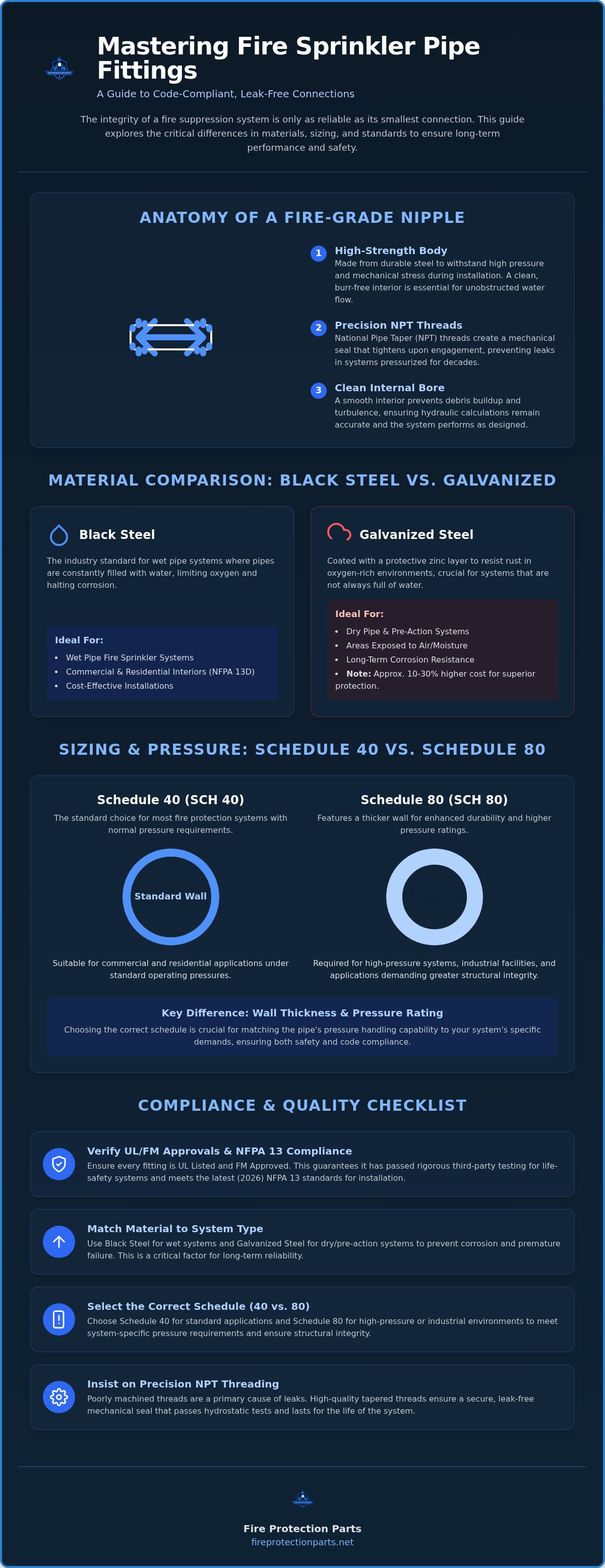
A professional-grade nipple consists of three primary elements: the body, the threads, and the internal bore. The body must be made from high-strength steel to withstand the mechanical stresses of installation and the hydraulic pressure of the water supply. We prioritize clean, burr-free interiors because internal obstructions can disrupt water flow and skew hydraulic calculations. Even a small piece of stray metal inside the bore can snag debris or create turbulence.
The threads themselves follow the National Pipe Taper (NPT) standard. This tapered design allows the threads to tighten as they are screwed into a fitting, creating a mechanical seal. In the trade of sprinkler fitting, ensuring these threads are cut to exact tolerances is the difference between a compliant system and one that fails a hydrostatic test.
Why Quality Fittings Prevent System Failure
It's tempting to source nipples from "big box" retail stores, but these generic plumbing components often lack the rigorous quality control required for life-safety systems. Sub-standard nipples may have shallow threads or inconsistent wall thicknesses. Poor thread engagement is a leading cause of slow leaks and gradual pressure loss. These issues often go unnoticed until an inspection reveals a system that can't hold its required pressure.
High-quality fire sprinkler pipe fittings eliminate this doubt. They act as the reliable bridge between the sprinkler system components online and the final discharge point. By investing in precision-engineered nipples, you ensure that every head in your facility is backed by a secure, code-compliant connection that won't fail when it matters most.
Material Comparison: Black Steel vs. Galvanized Pipe Nipples
Selecting the correct material for your fire sprinkler pipe fittings is a decision that dictates the lifespan of the entire suppression system. The industry primarily relies on two options: black steel and galvanized steel. Black steel is raw carbon steel finished with a protective oil or lacquer to prevent rust during storage. Galvanized steel undergoes a hot-dip process that coats the metal in a protective layer of zinc. This chemical difference determines how the fitting reacts to water, oxygen, and the specific environment of your facility.
Material choice also impacts your defense against Microbiologically Influenced Corrosion (MIC). MIC occurs when specific bacteria thrive in stagnant water, creating acidic byproducts that eat through pipe walls. While no metallic fitting is entirely immune, the choice between black and galvanized steel depends heavily on the presence of oxygen. According to the NFPA 13 installation standards, choosing the wrong material for the environment can lead to pinhole leaks and premature system failure. While galvanized options are approximately 10% to 30% more expensive than black steel, the investment often pays for itself in reduced maintenance costs over the system's life.
When to Choose Black Steel Fittings
Black steel is the standard choice for wet pipe systems. In these configurations, the pipes are constantly filled with water. Once the initial oxygen in the water is depleted through minor oxidation, the corrosion process effectively stops. This makes black steel a cost-effective and reliable solution for commercial interiors. It's also the preferred material for residential NFPA 13D systems where cost-efficiency and standard pressure ratings are the priority. If your system is protected from the elements and remains fully charged with water, black steel provides the necessary strength without the added cost of zinc coating.
The Advantages of Galvanized Nipples for Corrosion Resistance
Galvanized nipples are essential for dry pipe and pre-action systems. Because these systems contain a mix of air and moisture, they are highly susceptible to oxidation. The zinc coating acts as a sacrificial anode, corroding before the underlying steel is affected. This protection is vital in high-moisture environments like parking garages or unheated warehouses. Additionally, galvanized fittings are often used in hybrid configurations alongside Viking CPVC fire sprinkler pipe to provide metallic strength at critical transition points while maintaining high corrosion resistance.
Ensuring your system uses code-compliant materials eliminates inspection anxiety and protects your long-term investment. You can browse our specialized nipple collection to find the exact material and finish required for your next project.
Selecting the Right Size and Schedule for Your Project
Choosing the correct dimensions for fire sprinkler pipe fittings is about more than just a snug fit; it's about hydraulic performance and structural integrity. Common diameters for nipples typically range from 1/2" to 2", though larger industrial systems may require specialized sizes. Beyond diameter, you must decide between a "close nipple"—where the threads meet in the center—and extended lengths. Selecting the wrong size can lead to improper head placement or restricted water flow.
To ensure accuracy during procurement, follow this measurement checklist:
- Measure end-to-end: Always use the total length of the nipple for ordering, not just the exposed pipe between threads.
- Verify Nominal Pipe Size (NPS): Ensure the diameter matches the branch line outlet, not the outside diameter of the pipe.
- Account for thread take-up: Remember that a portion of the nipple length will disappear into the fitting once tightened.
- Check for consistency: Ensure the internal bore is uniform to maintain the hydraulic calculations of the system.
Schedule 40 vs. Schedule 80: Pressure Ratings
The schedule of a nipple refers to its wall thickness, which directly correlates to its pressure-carrying capacity. Schedule 40 is the industry standard for most commercial applications. However, Schedule 80 features a heavier wall that provides a higher burst pressure and increased resistance to mechanical stress. You must match the nipple schedule to the rest of your system piping to avoid creating a weak link. High-pressure risers or industrial loops often demand the added durability of Schedule 80. These requirements are often mirrored in DoD fire protection engineering standards, which specify material thickness to ensure longevity in mission-critical environments.
Determining the Correct Nipple Length for Recessed Heads
Installing recessed sprinkler heads requires precise nipple lengths to ensure the head sits flush with the ceiling tile or drywall. If a nipple is too short, the head won't engage with the escutcheon. If it's too long, the head will protrude, potentially violating code or affecting the spray pattern. You must calculate the distance from the branch line outlet to the finished ceiling surface while accounting for the depth of the fitting. This level of precision is why sourcing exact fire protection parts online is essential for both new installations and system repairs. Using the correct extended fire sprinkler pipe fittings ensures the escutcheon can adjust properly, maintaining the aesthetic and functional integrity of the ceiling assembly.
NFPA Standards and Installation Best Practices
Compliance with NFPA 13 installation standards is non-negotiable. For metallic fire sprinkler pipe fittings, the code dictates specific manufacturing and performance criteria that ensure the system functions under extreme heat and pressure. Using UL Listed and FM Approved nipples provides verified assurance that the component has undergone rigorous testing for structural integrity. These approvals are your first line of defense against liability and system failure. They represent a commitment to safety that satisfies both insurance requirements and local fire codes.
Achieving a permanent seal requires a disciplined "Three-Step Seal" process. First, inspect every nipple for burrs, debris, or flattened threads that could compromise the NPT connection. Second, apply a high-quality thread sealant. While many contractors use pipe dope, you must ensure it's chemically compatible with the system's materials. Finally, apply torque with precision. Over-tightening is a frequent error that leads to hairline fractures in the fitting or the branch line. These cracks might not leak during the initial hydrostatic test, but they often fail as the system undergoes thermal expansion and contraction over time.
Ensuring Code Compliance During Sourcing
Nipples must meet ASTM A53 or ASTM A106 standards to be considered code-compliant. ASTM A53 covers welded and seamless pipe, while A106 is the standard for high-temperature seamless carbon steel. During a final fire marshal inspection, you'll need the submittal documentation to prove every component meets these specifications. We've simplified this process by ensuring all 58 variations in our collection are built to meet or exceed these rigorous industry standards. You can buy code-compliant pipe nipples here to ensure your project passes inspection without delay.
Common Installation Mistakes to Avoid
A common mistake is the excessive use of PTFE tape. In fire systems, shredded tape can travel through the lines and clog the small orifices of the sprinkler heads. Professional installers generally prefer high-grade pipe dope because it provides lubrication and a superior seal without the risk of internal debris. Another critical risk is cross-threading. If a nipple doesn't spin in easily by hand for the first few turns, back it out and restart. Forcing a cross-threaded connection creates a permanent leak path that is difficult to repair once the system is live. Proper installation protects the entire assembly, ensuring that the fire sprinkler head temperature ratings aren't compromised by moisture or pressure loss at the connection point. Using precision-engineered fire sprinkler pipe fittings reduces these risks by providing consistent thread engagement every time.
Shop the Collection: Premium Pipe Nipples at Fire Protection Parts
Sourcing components from a specialized fire protection retailer ensures that every part is built for life-safety performance, not just general plumbing. Our curated collection features 58 distinct pipe nipple variations, providing the exact specifications needed for professional installations. Whether you're managing a new build or a critical repair, having access to a comprehensive inventory of fire sprinkler pipe fittings eliminates procurement delays. We focus on providing parts that meet strict industry standards for thread engagement and material strength.
By choosing the right finish and schedule, you ensure the longevity of the entire suppression system. Our inventory includes both galvanized and black steel options in Schedule 40 and Schedule 80 wall thicknesses. This variety allows you to match your fittings to the specific environment and pressure requirements of your facility, providing peace of mind and total code compliance.
Top Picks: Galvanized Pipe Nipples for Durability
For wet systems and high-moisture environments, galvanized steel provides the necessary defense against oxidation. Our 1" x 3" Galvanized Nipple is a top choice for standard wet-system drops, offering the perfect balance of length and corrosion resistance. In zones prone to heavy moisture or industrial runoff, we recommend our Schedule 80 galvanized options. These heavy-wall fire sprinkler pipe fittings provide superior burst pressure ratings and structural durability. Every galvanized unit in our collection features precision NPT threading to guarantee a secure, leak-free seal under constant pressure.
Top Picks: Black Steel Nipples for Commercial Mains
Black steel remains the industry standard for commercial mains and residential wet systems where oxygen levels are controlled. The 2" Black Steel Close Nipple is a vital component for compact riser configurations where space is a primary constraint. For industrial warehouse applications, we offer extended length black steel nipples that allow for precise head placement across large ceiling spans. These parts are cost-effective, fully code-compliant, and designed for rapid installation on the job site. Choosing these professional-grade components ensures your system remains reliable without unnecessary material costs.
Ready to Secure Your System?
We encourage bulk ordering for contractors to help manage project expenses and maintain a consistent supply of essential parts. Our team understands the urgency of fire protection projects, which is why we prioritize fast shipping and expert support for every order. Don't compromise on system integrity with generic hardware from big-box retailers. Browse the full Pipe Nipple collection for your next installation or repair.
Secure Your Suppression System with Precision Fittings
Every connection in your fire suppression system is a potential point of failure. Choosing the right fire sprinkler pipe fittings isn't just about making a connection; it's about ensuring long-term reliability and total code compliance. We've explored the critical importance of matching your nipple schedule to system pressure and selecting the correct material finish to prevent internal corrosion. Whether you need the rust-resistant properties of galvanized steel for a dry system or the cost-effective strength of black steel for commercial mains, precision is the only acceptable standard.
Don't leave your project's success to chance with sub-standard hardware. Our inventory features 58+ variations of pipe nipples, all built to meet strict ASTM standards for thread engagement and durability. From Schedule 40 standard drops to Schedule 80 heavy-wall industrial loops, we provide the verified components you need to pass inspection with confidence. You can Shop the Pipe Nipple Collection at Fire Protection Parts to find the exact specifications for your next installation or repair. Protecting lives and property starts with the smallest connection. Make the right choice for safety today.
Frequently Asked Questions
What is the difference between a pipe nipple and a pipe coupling?
A pipe nipple features male threads on both ends and is used to connect a sprinkler head to a fitting. In contrast, a pipe coupling has female threads on both ends and is designed to join two sections of male-threaded pipe together. While a coupling extends a straight run, a nipple typically acts as a bridge between the branch line and the discharge point. Selecting the right fire sprinkler pipe fittings ensures a secure connection regardless of the joint type.
Are galvanized pipe nipples allowed in all fire sprinkler systems?
Galvanized nipples are permitted and often required in specific configurations. NFPA 13 mandates their use in dry and pre-action systems where moisture and oxygen create a high risk of internal corrosion. However, they are generally 10% to 30% more expensive than black steel. While they offer superior protection in unheated spaces, black steel remains the cost-effective standard for most fully charged wet pipe systems. Always verify your specific local fire code before finalizing material selection.
Can I use Schedule 40 nipples with Schedule 80 pipe?
You shouldn't mix schedules because it creates a structural weak point. Schedule 80 pipe is designed for higher pressure and features thicker walls than Schedule 40. If you install a Schedule 40 nipple in a Schedule 80 system, you've introduced a component with a lower burst pressure rating. This compromise can lead to system failure during a high-pressure event or hydrostatic testing. Always match the nipple schedule to the rating of the surrounding system pipe.
How do I determine the correct length for a replacement nipple?
Determine the correct length by measuring the nipple from end to end. You must account for:
- Thread take-up into the fitting.
- Finished ceiling thickness for recessed heads.
- Escutcheon adjustment ranges.
What thread sealant is recommended for fire sprinkler pipe fittings?
Professionals recommend using a high-quality pipe dope or an anaerobic thread sealant. These products provide lubrication during installation and create a pressure-tight seal. You should avoid excessive use of PTFE tape in fire sprinkler pipe fittings because shredded tape can travel through the lines and clog sprinkler head orifices. Always ensure the sealant is chemically compatible with your piping materials, particularly when transitioning from metallic nipples to CPVC fire protection systems.
Do these pipe nipples meet NFPA 13 requirements?
Yes, the pipe nipples available at Fire Protection Parts are designed to meet NFPA 13 requirements. They are manufactured to ASTM A53 or A106 standards, ensuring they possess the structural integrity needed for fire suppression. These components are UL Listed and FM Approved, which provides the verified documentation required for final fire marshal inspections. Using code-compliant fittings eliminates inspection anxiety and guarantees that your system is built to recognized life-safety standards.
What happens if a pipe nipple is over-tightened during installation?
Over-tightening a nipple can cause hairline fractures in the threads or the branch line fitting. While these cracks might not leak immediately, they often fail under the stress of thermal expansion or pressure surges. This damage compromises the NPT seal and can lead to a catastrophic failure during a fire. If a nipple doesn't spin in easily by hand for the first few turns, back it out to avoid cross-threading and apply torque with professional restraint.
Are black steel nipples suitable for outdoor fire protection lines?
Black steel nipples aren't suitable for outdoor use because they lack a protective coating. Exposure to rain, humidity, and temperature fluctuations will cause them to rust rapidly, leading to structural degradation and leaks. For outdoor fire protection lines or high-moisture environments, you must use galvanized steel. The zinc coating on galvanized nipples acts as a sacrificial barrier that prevents oxidation, ensuring the fitting remains functional and code-compliant despite exposure to the elements.

