



Fire Sprinkler Pipe Hangers and Supports: The 2026 Professional Buying Guide
If your fire sprinkler pipe hangers and supports cannot withstand five times the weight of a water-filled pipe plus an additional 250 pounds, your entire installation is a liability. You understand that meeting safety codes is not just a legal hurdle; it is a commitment to protecting lives and property. However, the technical gap between standard bracing and seismic requirements often causes frustration during inspections. Finding UL/FM approved black cast iron fittings in specific sizes shouldn't be the reason your project stalls.
This guide helps you master the complexities of the NFPA 13 (2025 edition) standards and the UL 203 revisions updated on July 30, 2026. You'll learn how to select the heavy-duty cast iron fittings required for a fail-safe system that passes every fire marshal inspection. We provide a clear breakdown of support requirements for various materials, including CPVC and steel. We also explore the latest industry shifts toward nitrogen generators and seismic-rated bracing. By the end of this article, you'll have the confidence to build a compliant, high-pressure system using professional-grade components that leave no room for compromise.
Key Takeaways
- Understand how strategic support spacing and material selection prevent pipe sagging and protect your system from long-term joint stress.
- Navigate the 2026 NFPA 13 and UL 203 standards to ensure your fire sprinkler pipe hangers and supports meet every compliance requirement.
- Discover why UL/FM approved black cast iron fittings and 300# rated flanges are the professional standard for high-pressure system integrity.
- Identify specialized hardware needs for varying environments, from standard wet pipe systems to high-vibration seismic zones.
- Access a professional checklist to audit your hardware inventory and streamline the bulk sourcing of rare-sized reducing fittings.
Fire Sprinkler Pipe Hangers and Supports: The Backbone of System Integrity
A fire sprinkler system is only as reliable as the hardware that holds it in place. While pipes carry the water, the fire sprinkler pipe hangers and supports ensure that water reaches its destination without a catastrophic structural failure. These components prevent pipe sagging, which often leads to pooling, internal corrosion, and eventual joint stress. Sourcing high-quality fire protection parts online is the first step in ensuring your installation meets strict safety codes and remains operational for decades. Without robust support, even the most expensive pipes are prone to failure during a high-pressure event.
The Physics of Fire Suppression Support
Fire protection systems face unique physical stresses that standard plumbing simply doesn't encounter. When a valve opens or a pump kicks in, the resulting water hammer creates immense surge pressure. If your hangers are weak, this energy can tear the system from the ceiling. Thermal expansion also plays a role, as pipes shift with temperature changes in large facilities. Following established Pipe support principles helps engineers account for these forces. Heavy-duty cast iron fittings are essential here. They provide the mass and rigidity needed to absorb system vibrations that would otherwise rattle and weaken standard fittings over time.
NFPA 13 Standards for Pipe Support
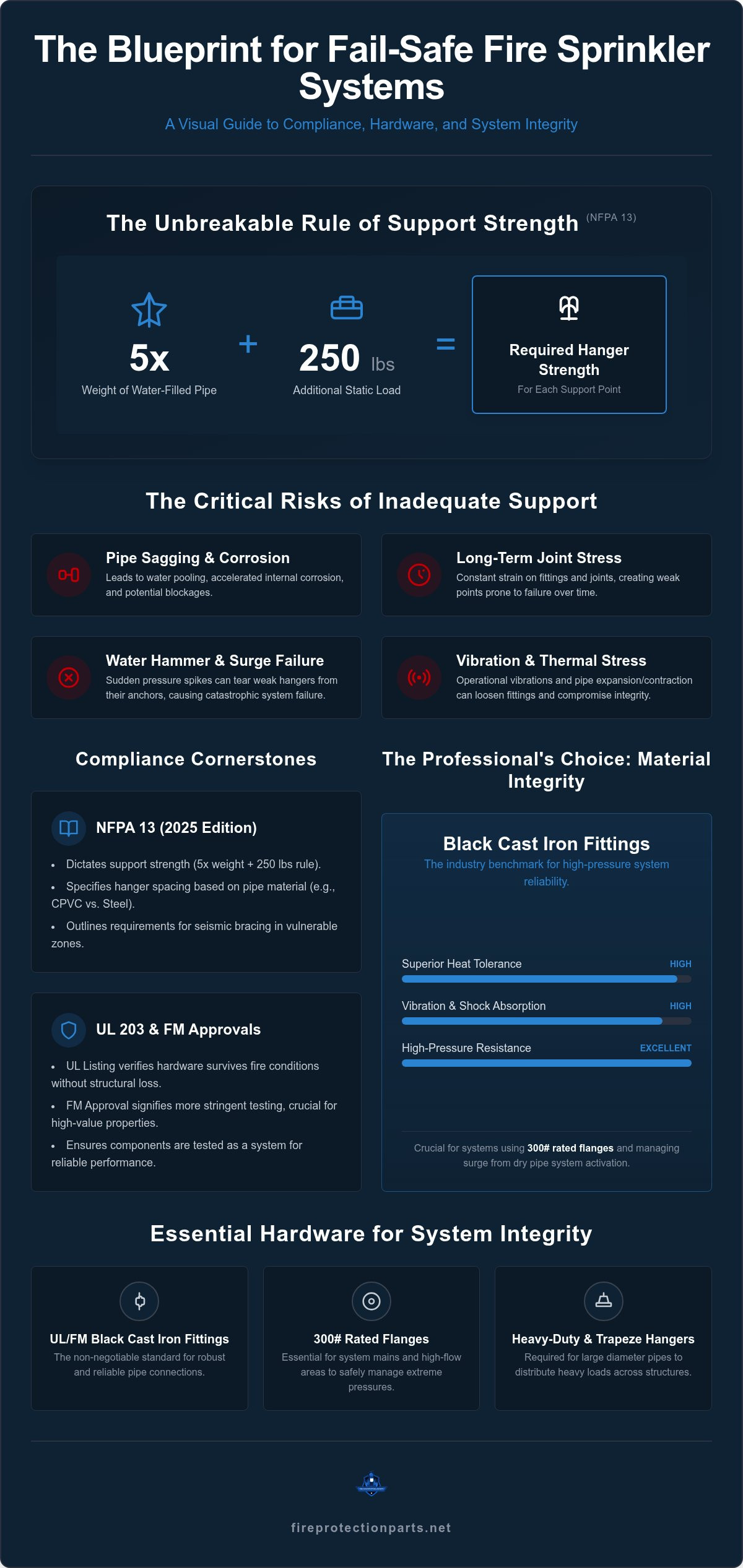
Compliance is the only path to safety. The NFPA 13 (2025 edition) and the revised UL 203 standard from July 30, 2026, dictate exactly how these systems must be anchored. Every hanger must support five times the weight of the water-filled pipe, plus an extra 250 pounds at each support point. Spacing varies significantly by material. For instance, Viking Plastics CPVC pipe requires more frequent support than traditional schedule 40 steel due to its flexibility. All fire sprinkler pipe hangers and supports must be UL/FM listed. Using unlisted hardware is a fast track to a failed inspection and a dangerous liability. Larger pipe diameters require more robust support types, such as riser clamps or heavy-duty trapeze hangers, to manage the increased weight and hydraulic load. High-pressure black cast iron fittings should be used at all connection points to maintain the synergy between the pipe and its support network.
Key Features to Evaluate: Material, Approval, and Load Capacity
Procuring fire sprinkler pipe hangers and supports in 2026 requires a sharp focus on material chemistry and certification dates. With the UL 203 standard revision effective as of July 30, 2026, and recent price volatility in the steel market, making the right choice the first time is essential for project budgets and safety. You need hardware that does more than just hang; it must perform under the extreme heat and hydraulic stress of a fire event. Professional installers prioritize three core pillars: material integrity, verifiable approvals, and load-bearing performance.
Material Science in Fire Protection
Black cast iron is the industry benchmark for long-term system integrity. While galvanized steel is common in standard plumbing, it often falls short in high-pressure fire suppression scenarios. Black cast iron threaded fittings provide superior heat tolerance and vibration absorption. For complex system mains, heavy-duty 300# rated flanges are the only safe choice to manage high-flow pressures. Malleable iron is particularly valuable for reducing tees and elbows, as its structural properties allow it to resist fracturing during the sudden kick of a dry pipe system activation. Sourcing specific, rare sizes like the 6x4x4 CI Tee in heavy-duty cast iron is critical for maintaining flow in complex layouts. Following Federal sprinkler support regulations ensures your material selection aligns with the rigid safety mandates for commercial and residential installations.
Decoding UL and FM Approvals
Verification is your best defense against system failure and legal liability. A UL listing confirms that your fire sprinkler pipe hangers and supports have been tested to survive fire conditions without losing structural strength. FM Global approval is even more stringent, providing peace of mind for high-value properties where insurance requirements are non-negotiable. Always check for the UL/FM stamp on high-stress components like the 1 inch Cast Iron Cross. If you are working with Viking CPVC fire sprinkler pipe, verify that your supports are specifically approved for use with CPVC. Some standard metal hangers can cause chemical compatibility issues or physical scoring on plastic piping, leading to premature leaks. You can secure your project's integrity by sourcing UL/FM approved black cast iron fittings that meet these rigorous 2026 standards directly from a trusted professional inventory.
Essential Black Cast Iron Fittings for Robust Support Networks
A robust support network relies on more than just the external fire sprinkler pipe hangers and supports; it requires internal fittings that can handle the same hydraulic loads. While the hangers maintain the structural position of the pipe, black cast iron fittings manage the directional changes and pressure shifts within the system. High-pressure environments demand fittings that won't crack under sudden activation surges. Using the right combination of tees, elbows, and crosses ensures that your system branching remains as secure as its anchoring. Every joint is a potential point of failure if the material grade doesn't match the system's requirements.
Branching and Directional Fittings
Directional changes are where systems are most vulnerable to stress. The Black Cast Iron Tee Fitting ($8.99–$869.99) serves as the primary component for branching lines from the main riser, offering the structural mass needed to resist movement. For complex junctions where multiple lines meet, the 1-1/4" Cast Iron Cross Import provides a centralized connection point that reduces the total number of joints in a run. In tight mechanical rooms or space-constrained ceiling layouts, the 4" x 3" Black Cast Iron 90 Degree Red Elbow allows for efficient routing without sacrificing flow capacity. These fittings are engineered to work in tandem with your fire sprinkler pipe hangers and supports to distribute weight and pressure evenly across the network.
Heavy-Duty Flanges and Secure Transitions
Riser rooms and high-pressure zones require specialized anchor points to prevent system displacement. The 1-1/4" Cast Iron Threaded Companion Flange 300# is designed specifically for these high-stress areas, providing a bolted connection that resists mechanical vibration. In fire riser assemblies, the 2-1/2" x 7-1/2" Black Cast Iron Threaded Red Flange facilitates the transition between different pipe sizes while maintaining a rigid, fail-safe seal. Transition components like the Fire Protection Hex Bushing VT155 are equally vital for adapting pipe sizes without introducing weak points in the line. Finally, for sealing off unused ports during maintenance or system expansion, the 1-1/4" Cast Iron Black Plug Solid Import ensures a leak-proof finish that stands up to 2026 compliance standards. Every fitting in your inventory should be selected with the same rigor as your primary supports to ensure total system reliability.
Selection Framework: Matching Hardware to Your System Environment
Every installation environment presents unique mechanical challenges. A warehouse system has different structural needs than a residential complex. Matching your fire sprinkler pipe hangers and supports to the specific system type is non-negotiable for long-term safety. Wet pipe systems provide a constant weight load on the building structure. In contrast, dry pipe systems introduce sudden surges and internal corrosion risks that require more robust anchoring. You must also consider the pipe schedule. Schedule 40 steel requires different support spacing than lightweight CPVC, and your fittings must match the outer diameter and pressure rating of the chosen pipe material.
Dry systems require precise coordination between hardware and pressurized air. Integrating your fittings with reliable air compressors for dry sprinkler systems ensures the pipes remain clear of water until the system activates. In these setups, black cast iron is the professional choice. It handles the rapid transition from air to water without the risk of fracturing under pressure. This material also resists the internal corrosion that can occur when oxygen and moisture mix in a dry system.
High-Pressure and Industrial Environments
Large facilities require heavy-duty components to manage massive water volumes. Precision parts like the 6" X 4" X 4" Red Black Cast Iron CI Tee are essential for high-volume main lines. Load calculations for long horizontal runs in warehouses must account for the weight of the water and potential seismic activity. In areas prone to movement, using ASC Seismic Bracing alongside your fire sprinkler pipe hangers and supports provides the necessary flexibility to prevent pipe rupture. For specialized branch drops, the 4" X 4" X 1-1/4" Black Cast Iron CI Tee Fitting offers the structural integrity needed to maintain flow while keeping the system rigid.
Residential vs. Commercial Support Needs
Residential NFPA 13D systems often utilize Viking Plastics CPVC pipe for fire protection. These systems require lightweight but durable fittings that won't compromise the plastic pipe's integrity. Sourcing compact options like the 1" X 3/4" X 3/4" Cast Iron Red Tee is ideal for small plumbing and fire hybrids found in modern homes. For those balancing budget and performance, malleable iron reducing tees ($7.99–$113.99) offer a cost-effective alternative to heavy cast iron while still meeting professional standards. This balance ensures you pass inspections without overspending on residential projects.
Browse our complete collection of UL/FM approved fire protection hardware to find the right fit for your environment.
Sourcing and Installation: Building a Code-Compliant Inventory
A successful fire protection project depends on the seamless transition from engineering plans to physical inventory. Having the right fire sprinkler pipe hangers and supports on your submittal is only the first step. You must ensure that every listed component arrives on-site, passes a pre-installation inspection, and is installed according to the 2026 standards. Sourcing your inventory through a direct online channel eliminates the delays often found with traditional local representative models. This efficiency allows you to maintain momentum without compromising on the quality of your high-pressure fittings.
To keep your project on schedule, Browse the full Threaded Fittings Black Cast Iron collection to secure all necessary components in a single order. Bulk sourcing ensures material consistency across the entire system, which is vital for passing rigorous fire marshal inspections.
The Procurement Checklist
Before the first length of pipe goes up, perform a comprehensive audit of your hardware. This prevents costly work stoppages and ensures the structural integrity of the network. Use the following checklist to verify your inventory:
- Hanger Compatibility: Verify that all thread rod sizes match the load requirements for your specific pipe diameters.
- Transition Fittings: Ensure specific parts like the 2" X 2" X 3/4" Black MI Reducing Tee are on-site for branch line transitions.
- Approval Markings: Check every cast iron fitting for visible UL/FM stamps to guarantee code compliance.
- Head Coordination: Double-check fire sprinkler head temperature ratings to ensure they align with the environmental needs of each zone before final assembly.
Expert Installation Tips for Cast Iron Systems
Installation quality is just as critical as the hardware itself. When working with black cast iron, proper threading techniques are essential to avoid leaks that can lead to system corrosion or false alarms. Always use high-quality pipe dope or PTFE tape specifically rated for fire protection service. For fire sprinkler pipe hangers and supports involving bolted connections, pay close attention to torque settings for companion flanges. Over-tightening can crack cast iron, while under-tightening leads to leaks under high-pressure surges. Final inspections should confirm that all hangers are plumb and that the pipe is not resting on any structural elements that could cause friction or noise during system activation.
Ready to finalize your project requirements? Secure your system with professional-grade cast iron fittings from Fire Protection Parts and ensure your installation stands the test of time.
Secure Your System with Professional Integrity
Building a fail-safe fire suppression network requires a relentless focus on the smallest details. You've learned that the synergy between high-pressure cast iron fittings and certified fire sprinkler pipe hangers and supports is the only way to ensure long-term stability. By prioritizing UL/FM approved components and professional 300# rated flanges, you eliminate the risk of structural failure during a high-pressure surge. Meeting the 2026 standards isn't just about passing a fire marshal's inspection; it's about the unwavering protection of your facility and those inside it.
Don't settle for inferior hardware that compromises your system's integrity. We provide the heavy-duty components you need to handle every directional change and riser assembly with confidence. With 84+ specialized fitting sizes in stock, you can source rare parts without the typical lead times. Shop heavy-duty threaded black cast iron fittings now and secure your installation with components designed for longevity. Your commitment to professional-grade quality today ensures a safer, code-compliant environment for years to come.
Frequently Asked Questions
What is the difference between black cast iron and malleable iron fittings?
Black cast iron is known for its high heat tolerance and rigidity, making it ideal for high-pressure mains. Malleable iron undergoes an annealing process to increase its ductility. This treatment allows malleable fittings to resist fracturing under sudden mechanical shocks or water hammer. While both materials are common, cast iron is often the professional choice for large-scale industrial systems where structural mass is required to absorb vibration.
Do all fire sprinkler pipe hangers need to be UL/FM approved?
Yes, every component in your support network must be listed and labeled by a nationally recognized testing laboratory. This requirement ensures that your fire sprinkler pipe hangers and supports meet the mandatory "5-times weight" rule. This standard mandates that each hanger supports the weight of the water-filled pipe plus an additional 250 pounds. Using unlisted hardware is a significant liability that results in failed fire marshal inspections.
How do I determine the correct spacing for my pipe hangers?
Hanger spacing is dictated by the pipe material and diameter as outlined in the NFPA 13 (2025 edition). Steel pipes generally allow for wider spans than flexible materials like Viking Plastics CPVC. For instance, a 1-inch steel pipe typically needs support every 12 feet, while CPVC requires much closer intervals to prevent sagging. You should always verify the specific spacing requirements with the pipe manufacturer's installation guide to ensure full code compliance.
Can I use black cast iron fittings with CPVC fire sprinkler pipe?
You can use black cast iron fittings with CPVC, but you must prioritize chemical compatibility. Some oils used in the manufacturing of metal fittings can cause environmental stress cracking in plastic pipes. It's essential to use UL-listed transition fittings and approved thread sealants. Always verify that the specific cast iron components are rated for use in hybrid systems to maintain the integrity of the Viking Plastics CPVC pipe.
What is a companion flange and when is it required in a fire system?
A companion flange is a threaded fitting that allows you to bolt a pipe directly to a flanged valve or pump. These are typically required in riser rooms where the system must remain perfectly rigid under high pressure. For systems operating above 175 psi, you must specify heavy-duty 300# rated companion flanges. These components provide a fail-safe connection that prevents the system from shifting during a high-volume water discharge.
How do I choose the right size reducing tee for my branch lines?
Choosing the correct reducing tee depends on the hydraulic flow requirements of your specific branch lines. These fittings are identified by the size of the run followed by the size of the outlet. If you are branching a 1-inch line from a 2-inch main, you need a 2" x 2" x 1" tee. Selecting the right size ensures that water pressure remains consistent as it moves from the main riser into individual sprinkler zones.
Are threaded cast iron fittings suitable for high-pressure 300# systems?
Threaded cast iron fittings are suitable for 300# systems only if they are manufactured to that specific pressure class. Standard cast iron fittings are usually rated for lower pressures, such as Class 125 or 150. In high-rise buildings or industrial facilities where pressure exceeds 175 psi, you must use 300# rated components. Always look for the pressure rating stamped on the fitting to verify it can handle the expected hydraulic load.
What are the common mistakes to avoid when installing pipe supports?
The most frequent errors include using unlisted plumbing hardware and failing to account for seismic bracing requirements. Many installers also make the mistake of over-tightening cast iron fittings, which can lead to hairline fractures and eventual leaks. Additionally, improper spacing of fire sprinkler pipe hangers and supports can cause pipes to sag, leading to internal corrosion and joint stress. Following the 2026 UL 203 revisions is the best way to avoid these issues.

