



Residential Fire Pump Controller: The Definitive 2026 Guide to Selection and Compliance
Did you know that an estimated 30% of fire pump failures stem from material wear? When a fire breaks out, you can't afford to discover that your system's "brain" is the weak link. Selecting the right residential fire pump controller isn't just about checking a box for a building inspector. It's about ensuring your suppression system activates automatically and without hesitation when it matters most. You need a solution that balances uncompromising reliability with the simplified electrical requirements of a residential setting.
It's common to feel overwhelmed by the technical gap between commercial and residential specifications. Sourcing code-compliant parts online shouldn't feel like a gamble with your safety. This guide eliminates that doubt. You'll learn exactly how to select, install, and maintain a controller that meets the 2026 NFPA 25 and 2025 NFPA 13D standards. We'll walk through the specific hardware needed for automatic operation and the maintenance routines that guarantee long-term performance. By the end, you'll have a clear roadmap to full compliance and the peace of mind that comes with a professional-grade defense.
Key Takeaways
- Understand why the controller serves as the system's brain by translating pressure drops into immediate pump activation.
- Learn how to select a residential fire pump controller that matches your home's electrical grid using across-the-line or soft-start methods.
- Identify essential safety certifications like UL Listing and FM Approval to ensure your equipment is verified for life-safety use.
- Navigate the specific compliance differences between NFPA 13D for single-family homes and NFPA 13R for multi-family residential buildings.
- Discover the benefits of sourcing specialized components from a single provider to ensure every part of your system works together seamlessly.
Residential Fire Pump Controllers: Why They Are Critical
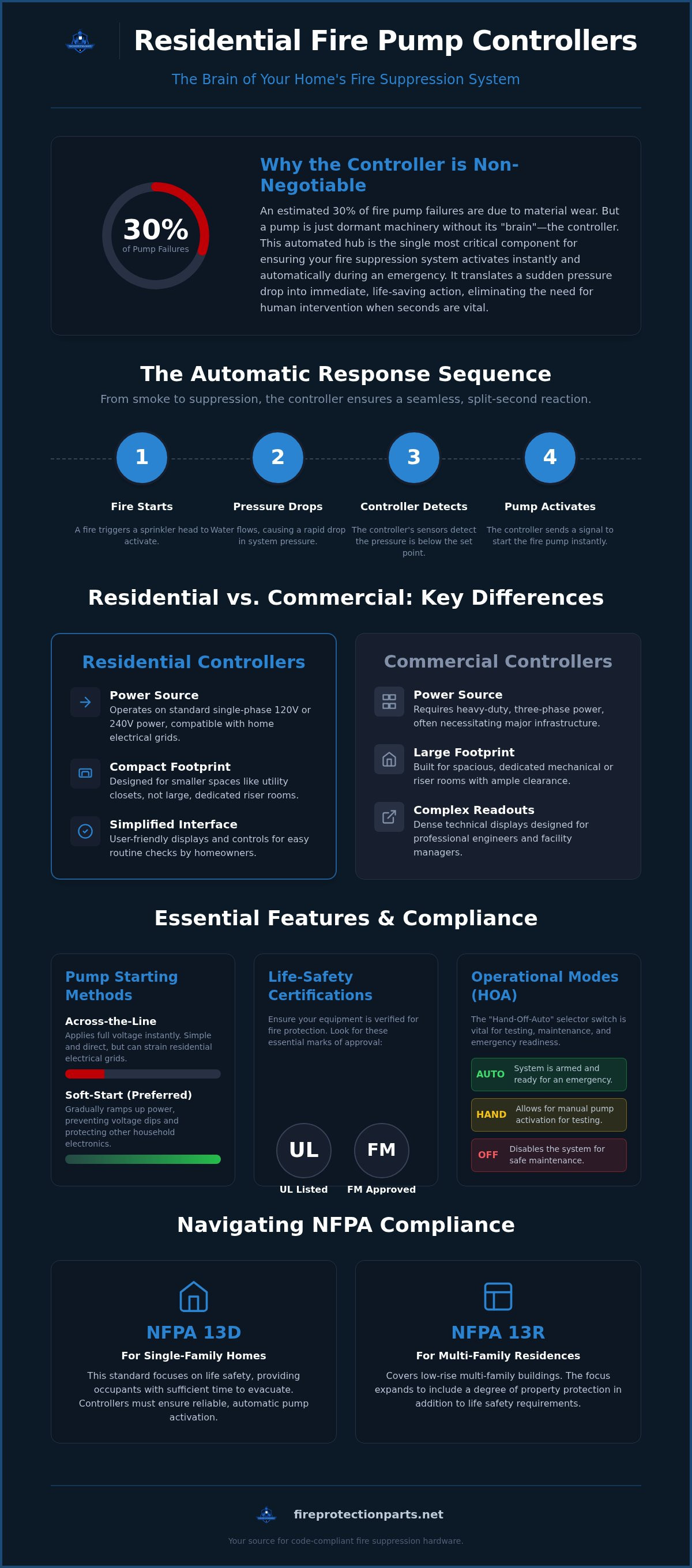
A residential fire pump controller is the command center of your home fire suppression system. It is an automated control hub that monitors system pressure and activates the fire pump when needed. When a fire occurs and a sprinkler head activates, the resulting drop in pressure is detected by this unit. It then triggers the pump to start immediately. Think of it as the system's "brain." Without it, a pump is just a dormant piece of machinery that cannot respond to an emergency.
Life safety depends on this automation. In a residential fire, every second is vital. Manual pump activation isn't a viable option. Occupants are often focused on evacuation or may be asleep when the fire starts. The controller ensures the pump performs without human intervention. To achieve this, the unit utilizes several specialized components:
- Pressure Switches: Sensors that detect when the water pressure falls below a set point.
- Start/Stop Logic: Internal circuitry that manages the motor's operational sequence.
- Alarm Interfaces: Communication ports that alert you if the system is compromised or loses power.
The Role of the Controller in Automatic Sprinkler Systems
The controller must work in perfect harmony with other sprinkler system components online to maintain constant readiness. When a sprinkler head opens, the controller senses the pressure loss and initiates the pump start sequence. It also manages the pump's run time to prevent "short cycling." Rapid cycling happens when a pump turns on and off too quickly, which can burn out a motor. Modern advancements, such as Variable Speed Fire Pump Controllers, help maintain precise pressure levels and reduce mechanical stress on the entire system.
Key Differences: Residential vs. Commercial Controllers
Residential units are specifically engineered for the unique constraints of a home environment. While commercial controllers often require heavy-duty three-phase power, a residential fire pump controller typically operates on standard single-phase 120V or 240V power. This makes them compatible with standard residential electrical grids without requiring massive infrastructure upgrades.
Space is another major factor. Commercial riser rooms are large, but residential systems are often tucked into utility closets. Because of this, residential models feature a compact footprint. They also prioritize simplified interfaces. Instead of dense technical readouts, they use user-friendly displays. This clarity eliminates confusion during routine checks and ensures the system remains compliant with NFPA standards.
How Residential Fire Pump Controllers Work: A Technical Overview
The residential fire pump controller functions as a high-precision monitoring station. It constantly evaluates the hydraulic health of your system to ensure an immediate response. Most modern units utilize pressure transducers or switches to track the static state of the water line. When a sprinkler head opens, the pressure drops. The controller identifies this change and signals the pump motor to engage.
Starting methods vary based on your home's electrical capacity. Across-the-line starting is the most direct method, applying full voltage immediately. However, this can strain residential grids. Soft-start options are often preferred because they ramp up the power gradually. This prevents sudden voltage dips that could interfere with other household electronics. Reliability is further guaranteed through power source monitoring. If the controller loses its primary feed, it must trigger an alarm to alert the homeowner that the system is offline.
Every unit includes a "Hand-Off-Auto" (HOA) selector. This switch is vital for safe operation. In "Auto," the system is ready for an emergency. "Hand" allows for manual testing, while "Off" is used during maintenance to prevent accidental activation. If you are building a new system, you can browse compliant hardware to find the right match for your home's layout.
Pressure Settings and Calibration
Accuracy is everything when setting up your controller. You must define the "Cut-in" and "Cut-out" pressure points. The Cut-in point is the specific pressure level that triggers the pump to start. The Cut-out point is where it stops. Residential systems require precise calibration to avoid false starts caused by minor, non-emergency pressure fluctuations. If your system includes a jockey pump, the controller coordinates with it to handle small leaks without engaging the main fire pump. This coordination follows the NFPA 20 Standard, which provides the framework for reliable pump performance.
Alarm and Monitoring Capabilities
Modern controllers offer sophisticated feedback loops. Visual indicators, such as LED status lights, provide an immediate look at system health. You can quickly verify "Power On" or "Pump Running" status. Many homeowners choose to integrate these units with their existing home security or fire alarm panels for remote monitoring. This ensures that even if you aren't home, a pump activation or power failure is reported to a central station. Audible alarms provide a final layer of protection, sounding an alert during critical events like a phase reversal or motor overload.
Essential Features for Home Fire Pump Control Selection
Selecting a residential fire pump controller requires a focus on verified safety standards. UL Listing and FM Approval are the non-negotiable industry gold standards for life-safety hardware. These certifications prove the equipment has survived rigorous testing under extreme conditions. Without these marks, you risk system failure and local code violations. Investing in certified components is the only way to eliminate doubt regarding your home's fire defense.
Modern systems favor integrated pressure transducers over old-school mechanical switches. Digital sensing provides real-time data and significantly greater precision. It eliminates the friction and wear associated with moving mechanical parts, ensuring the controller remains accurate for years. This digital shift allows for easier calibration of the "cut-in" points discussed earlier, making the entire system more responsive to pressure changes.
Selecting the Right Enclosure for Your Riser Room
Riser rooms are often tight, damp spaces where hardware must endure years of environmental stress. You must choose between wall-mount and floor-mount configurations to maintain accessibility for annual testing. When evaluating your environment, consider these factors:
- Condensation: High humidity can cause pipe sweating that drips onto electronics.
- Valve Spray: Potential for water spray during routine valve testing or maintenance.
- Space: The physical footprint allowed for the controller cabinet.
A NEMA 2 enclosure provides basic protection against dripping water, which is suitable for most climate-controlled indoor settings. However, if your riser room is prone to heavy moisture or potential spray, upgrade to a NEMA 4 water-resistant enclosure. This choice prevents corrosion of the sensitive internal logic boards and power contacts.
Advanced Options: Weekly Test Timers
Stagnant water is a silent enemy in any fire protection system. An automatic weekly test timer is a critical feature for pump longevity. It forces the motor to run briefly on a set schedule, ensuring the internal components don't seize during long periods of inactivity. The weekly test timer serves as the primary defense against pump lock-up caused by mineral deposits. By cycling the water and moving the pump shaft, this feature guarantees the system is physically capable of spinning up when a real fire event occurs.
Always verify voltage compatibility with your local utility service before making a final selection. Most residential fire pump controller models are designed for single-phase 120V or 240V power. Selecting the wrong voltage can lead to immediate equipment damage or insufficient torque during startup. Sourcing your controller alongside your other suppression hardware ensures that every component is matched for the specific electrical and hydraulic demands of your property.
Navigating NFPA 13D and 13R Compliance for Controllers
Compliance isn't a one-size-fits-all concept in residential fire protection. The requirements for your residential fire pump controller depend heavily on whether your building falls under NFPA 13D or NFPA 13R. NFPA 13D governs one- and two-family dwellings. Its primary goal is to provide enough time for occupants to escape. Consequently, the controller specs are often streamlined to prioritize basic, reliable activation. In contrast, NFPA 13R applies to multi-family residential buildings up to four stories. This standard requires a more robust approach to system supervision and motor protection.
Your local Authority Having Jurisdiction (AHJ) holds the final word on these specifications. Even if a controller is UL listed, the local fire marshal might require specific alarm configurations or secondary power connections. A fully compliant system also relies on the integrity of the distribution network. Using Viking CPVC fire sprinkler pipe ensures that the water delivered by the pump reaches the heads through a corrosion-resistant, high-performance medium. If you're ready to secure your property, order your residential fire suppression components today.
Power Supply Reliability Standards
A fire pump is useless without a guaranteed power feed. NFPA standards require the pump to have a dedicated circuit. This means the breaker must only serve the pump and its controller. The disconnect means must be clearly identified with a red label and, in many jurisdictions, locked in the "on" position to prevent accidental deactivation. If your home uses a backup generator, your residential fire pump controller must be capable of sensing the transfer of power. This ensures the pump continues to operate seamlessly during a utility outage, which is often when fires are most likely to occur due to electrical storms or grid failures.
Documentation and Certification
Documentation is the backbone of a successful fire marshal inspection. You must keep the controller's permanent wiring diagram inside the riser room, typically stored in a pocket within the enclosure door. This allows technicians to troubleshoot the system without delay. Additionally, every unit should come with a "Certified Test Report" from the manufacturer. This document proves the specific unit you purchased passed performance testing before leaving the factory. During the final walkthrough, the inspector will verify the UL labeling on the cabinet to ensure the hardware meets the life-safety requirements established in the original building plans.
Selecting and Sourcing Your Controller at Fire Protection Parts
Sourcing a residential fire pump controller requires more than just finding a part number. It's about ensuring the component integrates perfectly with the rest of your safety infrastructure. This unit is the critical link in your residential fire pump system. When you source your equipment through a dedicated provider, you eliminate the risk of purchasing mismatched components. Just as you would rely on Preferred Yachts for expert representation in the maritime world, specialized sourcing ensures your home safety systems are handled with professional precision. Mismatched hardware leads to failed inspections and compromised safety. We provide the hardware; you get the protection.
The primary benefit of choosing a specialized fire protection parts online store is the depth of industry knowledge available. General electrical wholesalers often treat controllers as standard motor starters. They aren't. Fire-rated controllers have unique logic and monitoring requirements that industrial units lack. Our team understands how to match a controller to your specific setup, accounting for hydraulic demand and local electrical constraints. We help you move from procurement to protection with expert confidence.
Consulting with experts before you finalize your order is essential. We provide the technical support needed to verify that your selection aligns with the engineering specifications of your project. This prevents costly returns and project delays. We also prioritize secure logistics. These controllers contain sensitive electronics and heavy contactors. We ensure every unit is packaged and shipped to your job site with the care required for mission-critical hardware.
Pre-Purchase Checklist for Contractors
Before clicking buy, contractors must verify several critical data points. Missing one detail can result in a system that won't start or won't pass the final walkthrough. Use this checklist to confirm your requirements:
- Motor Horsepower (HP) and Voltage: Confirm if the pump motor is 120V or 240V and match the HP rating exactly.
- NEMA Rating: Re-evaluate the installation environment to decide if a NEMA 2 or NEMA 4 enclosure is necessary based on moisture levels.
- FACU Compatibility: Ensure the controller's alarm contacts, such as "Pump Running" and "Power Failure," are compatible with the building's Fire Alarm Control Unit.
Why Professional Sourcing Matters
Using a generic industrial controller in a fire suppression system is a dangerous shortcut. Generic units lack the UL and FM listings required by NFPA standards. They don't have the specific starting logic needed to ensure the pump runs to destruction if necessary during a fire event. Professional sourcing provides the peace of mind that comes with verified, code-compliant hardware. Don't gamble with your fire defense system.
Browse our selection of Residential Fire Pump Systems and Controllers today.
Securing Your Home with Professional Fire Protection
Selecting the correct residential fire pump controller is the most critical step in building a defense system that works when it matters most. You now understand how to balance your home's electrical requirements with the specific compliance standards of NFPA 13D or 13R. By prioritizing UL Listed and FM Approved components, you eliminate the dangerous guesswork that leads to failed inspections or system failure during a fire event. Reliability isn't an accident; it is the result of choosing hardware engineered for life-safety performance.
At Fire Protection Parts, we act as your partner in safety. We offer expert technical support for contractors to ensure every piece of hardware matches your project's unique specifications. Our commitment to fast shipping on critical fire safety parts means you can complete your installation with confidence and speed. Don't leave your property's protection to chance with generic industrial equipment that lacks the necessary certifications.
Shop Code-Compliant Residential Fire Pump Controllers today to finalize your suppression system. You are making a choice that protects your property and provides lasting peace of mind for years to come.
Frequently Asked Questions
Can I use a standard industrial motor starter as a fire pump controller?
No, you cannot use a standard industrial starter for fire protection. Industrial starters prioritize motor protection and will shut down during an electrical overload. A residential fire pump controller is designed to prioritize water delivery above all else, even if the motor is at risk of burning out. Using unlisted hardware is a direct violation of NFPA 20 and will result in a failed building inspection.
What is the difference between a limited service and a full service controller?
The primary difference lies in horsepower ratings and intended application. Limited service controllers are commonly used in residential settings for motors up to 30 HP. They are more compact and cost-effective. Full service controllers are heavy-duty units designed for large commercial pumps. For most single-family homes, a limited service model provides the necessary automation while fitting within a standard utility closet or riser room.
Does a residential fire pump controller require a backup power supply?
Secondary power requirements are determined by your building standard and local fire marshal. NFPA 13D systems generally don't mandate a backup source if the utility grid is deemed reliable. If you are under NFPA 13R or live in an area prone to power outages, a generator may be required. The controller must be capable of sensing the power transfer to ensure the pump remains operational during an emergency.
How do I test my residential fire pump controller without flooding the house?
You can perform a weekly test by using the system's test drain or a dedicated bypass loop. This allows the controller to sense a pressure drop and start the pump without water entering the sprinkler piping. Most modern units include a solenoid valve that automatically opens to simulate a pressure drop. This ensures the pump cycles regularly to prevent mineral buildup without risking water damage to your living space.
Is a jockey pump controller always required alongside the main fire pump controller?
A jockey pump controller is necessary only if your system includes a jockey pump to maintain pressure. Its role is to manage the small pump that handles minor leaks or temperature fluctuations. By using a separate controller for the jockey pump, you prevent the main residential fire pump controller from engaging the large pump unnecessarily. This reduces wear on the primary motor and prevents loud, disruptive starts during non-emergencies.
What should I do if the 'Phase Reversal' light is illuminated on the controller?
You must call a licensed electrician to swap the incoming power leads immediately. A phase reversal light indicates that the electrical supply is wired incorrectly, which will cause the pump motor to spin backward. When this happens, the pump cannot generate the pressure required to suppress a fire. This is a high-priority alarm that must be resolved before the system can be considered code-compliant and operational.
How often should a residential fire pump controller be inspected by a professional?
Professional inspections should occur annually to comply with NFPA 25 requirements. While the automatic weekly test timer handles routine motor cycling, a professional technician needs to inspect the internal electrical components and calibrate the pressure sensors. They will also verify that alarm signals are reaching your home security panel correctly. Regular professional oversight is the only way to guarantee long-term reliability and compliance with local fire codes.
Can a fire pump controller be installed in a garage or must it be in a dedicated room?
A garage installation is generally acceptable if the area is climate-controlled and the equipment is protected from impact. The controller must be located in the same room as the pump and should be easily accessible for testing. If the garage is prone to moisture or dust, you must use a NEMA 4 rated enclosure. Always confirm with your local fire marshal, as some jurisdictions have stricter requirements for fire-rated separation.

