



Seismic Bracing for Fire Sprinklers: 2026 Compliance Guide
An earthquake shouldn't turn your life-saving fire protection into a falling hazard. When the ground shifts, your suppression system must remain intact and functional to prevent a secondary disaster. You likely know the stress of navigating the dense, technical requirements of NFPA 13 or the fear that a single missed detail will result in a rejected inspection. It's a high-stakes environment where safety and compliance are non-negotiable for seismic bracing for fire sprinkler systems. You need hardware that performs and a design that meets the rigorous 2026 regulatory landscape.
This guide helps you master the latest seismic restraint requirements with professional assurance. You'll gain a clear understanding of the mechanics behind the 2025 NFPA 13 overhaul, including the critical shift toward SDS-based calculations. We provide a definitive checklist of the essential hardware required for a compliant installation, such as ASC bracing and heavy-duty all thread rod. We'll move quickly through the technical details to ensure you have the knowledge to source the right components and eliminate any doubt about your system's survivability. This is your roadmap to achieving total code compliance and long-term peace of mind.
Key Takeaways
- Understand how seismic bracing prevents catastrophic pipe failure by minimizing differential movement between the building structure and the sprinkler piping.
- Differentiate between lateral and longitudinal bracing to provide comprehensive protection against horizontal forces in all directions.
- Navigate the 2026 NFPA 13 requirements to determine if your project requires seismic bracing for fire sprinkler systems based on its Seismic Design Category.
- Identify essential UL Listed and FM Approved hardware, such as ASC Seismic Bracing and all thread rod, to ensure your installation meets rigorous safety standards.
- Simplify complex procurement by sourcing specialized restraint components from an expert provider focused on code compliance and system reliability.
What is Seismic Bracing for Fire Sprinkler Systems?
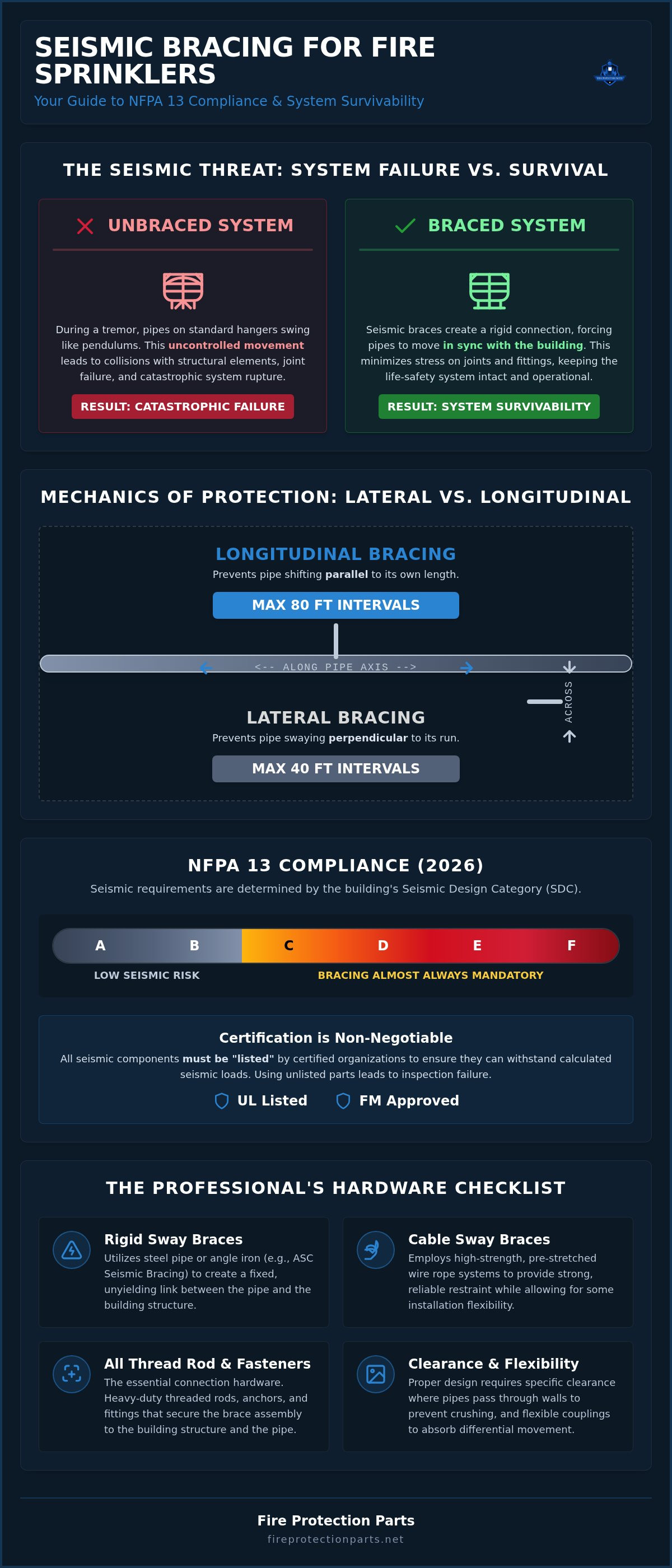
Seismic bracing for fire sprinkler systems is a specialized network of restraints designed to keep life-safety infrastructure functional when the ground moves. It's about control. These systems minimize differential movement between the building structure and the piping. Without these restraints, the building and the pipes move at different frequencies. This leads to catastrophic joint failure and system rupture. A reliable fire sprinkler system must remain operational immediately after a tremor. Earthquakes often trigger fires due to ruptured gas lines or electrical shorts. If your sprinkler pipes have snapped, the building is defenseless against the flames that follow.
Your specific requirements depend on the Seismic Design Category (SDC) assigned to the structure. This classification, ranging from A to F, is based on occupancy type and local seismic risk. For projects in categories C through F, bracing is almost always mandatory. It's also vital to understand that seismic restraints are an addition to your standard dead-load hangers, not a replacement. While hangers manage gravity and the weight of the water, seismic components manage the violent horizontal energy of a seismic event.
The Role of Sway Braces in Fire Protection
Sway braces are the primary defense against horizontal seismic forces. They provide the rigid connection needed to force the piping to move in sync with the building. There are two main types: rigid bracing and cable systems. Rigid bracing, such as ASC Seismic Bracing, uses steel pipe or angle iron to create a fixed, unyielding link. Cable systems use high-strength wire. For 2026 compliance, every component must be "listed" by organizations like UL or FM. This verification ensures the hardware can withstand the specific loads calculated for your site. Using unlisted parts is a fast track to inspection rejection and system failure.
Why Standard Hangers Aren't Enough
Standard hangers are designed for gravity. They hold the pipe up, but they don't hold it still. During a tremor, pipes on standard hangers act like pendulums. This swinging effect causes the pipe to crash into structural beams, HVAC ducts, or electrical trays. These impacts lead to fractured fittings and flooded buildings. Proper seismic design also requires specific clearance around piping where it passes through walls or floors. This gap prevents the structure from crushing the pipe as the building flexes. You aren't just supporting weight; you're managing kinetic energy and preventing destructive collisions.
The Mechanics of Seismic Protection: Lateral vs. Longitudinal
Seismic forces are chaotic. They don't strike from a single angle; they ripple through a building in multiple directions simultaneously. To ensure survival, seismic bracing for fire sprinkler systems must address forces on two distinct axes: lateral and longitudinal. Lateral bracing prevents the pipe from swaying perpendicular to its run. Longitudinal bracing stops the pipe from shifting parallel to its own length. Without both, the system remains vulnerable to joint separation or structural impact during a tremor.
According to the latest NFPA 13 requirements, spacing is a non-negotiable safety factor. These distances aren't suggestions; they're calculated limits that prevent the pipe from building up enough momentum to snap its own fittings. In most standard installations, you'll find the following maximum intervals:
- Lateral Bracing: Maximum intervals of 40 feet.
- Longitudinal Bracing: Maximum intervals of 80 feet.
Understanding Lateral Bracing Loads
Lateral braces are the most common restraints you'll install. They're required on all feed and cross mains, as well as branch lines of a certain size. The diameter of your pipe dictates the frequency and strength of the brace. Larger pipes hold more water, creating higher mass and greater force when the building flexes. If you're working with Viking CPVC fire sprinkler pipe, you benefit from a material that's naturally more flexible than steel. This flexibility helps absorb some vibrational energy, though you must still adhere to strict lateral restraint rules to prevent the pipe from striking nearby HVAC ducts or structural beams.
Longitudinal Bracing: Protecting the Mains
While lateral braces handle side-to-side sway, longitudinal braces manage the axial "shove." Without them, a long run of pipe can act like a battering ram, sliding through standard hangers and "telescoping" into couplings or elbows. This is especially dangerous for main piping that carries the highest volume of water. At the top of every riser, a "four-way" brace is required. This specialized assembly acts as the system's anchor, providing both lateral and longitudinal protection in a single point of connection. It's the foundation of a stable system. When planning your layout, you can find the necessary swivels and clamps at Fire Protection Parts to ensure every connection meets these rigorous mechanical standards.
NFPA 13 Compliance: Requirements for 2026
Compliance isn't just about following rules; it's about engineering survival. For 2026, the industry has shifted toward the 2025 edition of NFPA 13. This update significantly overhauls seismic requirements to align with ASCE 7-22. The most critical change is the move away from simple weight-based calculations for seismic loads. Designers now use the "design spectral response acceleration at short periods" (SDS). This integrates site-specific seismic data to determine the exact forces acting on seismic bracing for fire sprinkler systems. With a Component Importance Factor (Ip) of 1.5, these systems are classified as essential life-safety infrastructure that must remain functional after an event.
Bracing becomes mandatory when a project falls into Seismic Design Categories (SDC) C, D, E, or F. To meet these standards, designers utilize the "Zone of Influence" (ZOI) method. This calculation identifies every pound of pipe, water, and fitting that a specific brace must restrain. It's a precise science. If the ZOI exceeds the brace's rated capacity, the system will fail. You must ensure your hardware matches the calculated loads for your specific building height and geographic location.
Flexible Couplings and Differential Movement
Building drift is inevitable during a tremor. Rigid systems break; flexible systems survive. Flexible couplings are required at risers, floor crossings, and where piping enters a building. These components allow the pipe to move independently of the structure's primary frame. They work in tandem with your seismic braces. While the brace holds the pipe, the coupling provides the necessary "give" to prevent fractures. When sourcing sprinkler system components online, verify that they're specifically rated for the expected building drift and listed for seismic applications.
Seismic Separation Assemblies
When a pipe crosses a building's expansion joint, it enters a high-risk zone. The two sections of the building will move in different directions and at different speeds. A seismic separation assembly is required here. This usually involves a flexible loop or a series of multi-directional elbows that can handle independent structural shifts. The hardware involved must be robust. It requires specialized swivels and heavy-duty clamps that don't compromise the pipe's integrity. These assemblies are the only way to ensure the water supply remains intact when the building's joints are pushed to their limits.
Essential Hardware: ASC Seismic Bracing and All Thread Rod
Procuring the right hardware is where code theory meets field reality. For most contractors, ASC Seismic Bracing is the standard for rigid sway bracing assemblies. It isn't just about raw strength; it's about verification. Every component in your assembly must be UL Listed or FM Approved to pass a rigorous inspection. If you use unlisted clamps or sub-standard brackets, you risk a total system rejection. Proper seismic bracing for fire sprinkler systems relies on a chain of listed parts that work together to anchor the pipe to the building's primary structural members.
Structural attachments like beam clamps and wall brackets are the foundation of this assembly. Modern multi-fit seismic attachments offer the versatility needed to connect to various steel shapes or concrete surfaces without requiring custom fabrication. This adaptability speeds up installation and ensures a secure, code-compliant connection every time. You don't want to be hunting for specialized parts mid-job; you want a system that works across different structural conditions.
The Role of All Thread Rod in Seismic Support
In many rigid bracing designs, all thread rod serves as the actual "brace member" that spans the distance between the pipe and the structure. It's a simple component, but its selection is critical. You must choose a rod diameter that matches the calculated seismic load. However, a long rod is vulnerable to buckling under compression. This is why rod stiffeners are mandatory for longer spans. A stiffener prevents the rod from bending, ensuring it can transfer both tension and compression forces effectively. Without these, even the strongest rod can fail when the ground starts to move. Selecting the correct diameter and length is the only way to guarantee the assembly performs as engineered.
ASC Engineered Solutions: Reliability in the Field
Contractors prefer ASC Engineered Solutions because the hardware is designed for the person on the ladder. One standout feature is the breakaway bolt technology. These bolts are engineered so the head snaps off once the correct torque is reached. This provides an immediate, clear visual verification for both the installer and the inspector. There's no guessing if a connection is tight enough. This level of professional assurance eliminates doubt and reduces the risk of human error during high-stakes seismic projects. When you're ready to secure your system, you can shop seismic hardware to find the exact ASC components and all thread rod your project demands.
Sourcing Seismic Restraint Components Online
Finding specialized hardware isn't the same as ordering standard fire protection parts online. Seismic components are highly engineered safety devices. You need a partner that understands the difference between a standard pipe hanger and a listed sway brace. A specialized retailer offers the expertise needed to ensure every part in your order matches the engineer's specifications. This eliminates the risk of purchasing hardware that looks correct but fails to meet the necessary load ratings. When you source seismic bracing for fire sprinkler systems, you're buying a certified promise of performance.
Before you finalize your order, run through this critical checklist to ensure your parts will pass field inspection:
- Listing Status: Verify that every component is UL Listed or FM Approved for seismic use.
- Material Finish: Choose galvanized finishes for environments with high humidity or chemical exposure to prevent corrosion. Plain steel is only suitable for dry, climate-controlled interiors.
- Load Ratings: Ensure the hardware's maximum load capacity exceeds your calculated Zone of Influence (ZOI) requirements.
Don't forget the paperwork. The Authority Having Jurisdiction (AHJ) will demand detailed "Submittal Data" for every seismic component. Professional retailers provide these spec sheets upfront. Having this data ready prevents costly delays during the final inspection. It proves your system is built on a foundation of verified, compliant hardware that meets the 2026 standards.
Streamlining Procurement for Contractors
Efficiency wins on the job site. Buying seismic hardware in bulk kits reduces the time spent sorting through individual bins. These kits ensure you have all the swivels, clamps, and bolts needed for a specific run. If you're tackling a complex retrofit, expert support is invaluable. A knowledgeable supplier can help identify the exact replacement parts needed to bring an older system up to modern code. Fast fulfillment is also essential. Compliance deadlines don't wait; choose a partner with a direct-to-contractor model that prioritizes quick shipping for time-sensitive projects.
Ensuring Long-Term System Integrity
Installation is only the beginning of the safety lifecycle. Seismic braces require regular check-ups to ensure they remain ready for an event. Look for signs of corrosion or bolts that have loosened over time due to building vibration. These restraints are a core component of your broader seismic bracing for sprinkler systems safety plan. When you prioritize high-quality components from the start, you reduce the long-term maintenance burden. Browse our full inventory of ASC Seismic Bracing and All Thread Rod today.
Securing Your System for 2026 and Beyond
Seismic protection isn't just a code requirement; it's an insurance policy for your facility's safety. By mastering the 2026 NFPA 13 updates and understanding the critical balance between lateral and longitudinal restraints, you've taken the first step toward a resilient installation. You now know that seismic bracing for fire sprinkler systems requires high-performance, listed hardware that can handle the specific spectral acceleration of your site. Success in the field comes down to the quality of your components and the reliability of your sourcing.
Don't leave your compliance to chance. Shop Code-Compliant ASC Seismic Bracing at Fire Protection Parts to find UL Listed and FM Approved components backed by expert support. We offer fast shipping on all thread rod and bracing hardware so you can meet tight deadlines with professional assurance. You have the knowledge and the checklist to eliminate doubt. Now, you have the partner to help you build a system that stands firm when it matters most.
Frequently Asked Questions
Is seismic bracing required for all fire sprinkler systems?
Seismic bracing isn't mandatory for every installation. Its necessity is determined by the Seismic Design Category (SDC) of the building, which ranges from A to F. For structures classified in categories C through F, bracing is almost always a code requirement. These categories represent higher seismic risk or essential occupancy types. You should consult your local building code and project specifications to confirm if your specific system needs these specialized restraints and hardware.
What is the difference between a sway brace and a standard pipe hanger?
Standard pipe hangers are engineered to support the vertical weight of the pipe and water, known as the dead load. In contrast, a sway brace is designed to resist horizontal forces during an earthquake. While hangers allow for some movement, a sway brace creates a rigid connection between the pipe and the structure. This prevents the system from swinging and crashing into other building components, which is the primary function of seismic bracing for fire sprinkler systems.
Can I use any all thread rod for seismic bracing?
You cannot use generic all thread rod without verifying its capacity. The rod must have a diameter and material grade that matches the calculated seismic load for your specific installation. For 2026 compliance, the rod often acts as the brace member in a rigid system. It must be capable of handling both tension and compression. If the rod exceeds a certain length, you'll also need to install rod stiffeners to prevent buckling during a tremor.
How often should seismic bracing be inspected?
Seismic braces should be visually inspected annually as part of your standard fire protection maintenance routine. You should check for loose bolts, corroded components, or damaged structural attachments. It's also vital to re-examine the bracing after any significant seismic event to ensure no components have shifted or failed. While Fire Protection Parts provides the hardware, you must hire a qualified professional to perform these mandated safety inspections and ensure long-term system integrity.
What is a 'Listed' seismic component and why does it matter?
A "Listed" component has been independently tested and verified by organizations like Underwriters Laboratories (UL) or Factory Mutual (FM). This certification proves the hardware can withstand the specific mechanical stresses of an earthquake. Using listed hardware is mandatory for NFPA 13 compliance. It ensures that every clamp, swivel, and brace in your assembly performs exactly as the manufacturer claims, providing professional assurance that the system won't fail when lives are on the line.
Does CPVC piping require different seismic bracing than steel?
CPVC piping, such as Viking Plastics CPVC, requires bracing components specifically listed for use with plastic pipe. While the mechanics of lateral and longitudinal protection remain the same, the hardware must not damage the pipe's surface. CPVC is more flexible than steel, which can be an advantage in seismic zones, but it still requires strict adherence to restraint spacing. Always verify that your ASC Seismic Bracing swivels and clamps are compatible with non-metallic piping.
What is the maximum spacing for lateral seismic braces?
Under standard NFPA 13 guidelines, the maximum spacing for lateral seismic bracing for fire sprinkler systems is typically 40 feet. However, this distance can decrease based on the pipe's diameter and the calculated seismic load for the building. These intervals ensure the pipe doesn't build up excessive momentum during a tremor. You must always refer to your specific engineering submittals to confirm the exact spacing required for your project's unique Seismic Design Category.
What happens if a fire sprinkler system lacks seismic bracing during an earthquake?
Without proper bracing, sprinkler pipes act like pendulums during an earthquake. The resulting movement often leads to fractured fittings, snapped joints, and massive water damage. More importantly, a broken pipe renders the suppression system useless. Since earthquakes frequently trigger fires through ruptured gas lines or electrical shorts, a non-functional sprinkler system leaves the building defenseless. Bracing ensures the life-safety infrastructure remains intact and ready to suppress flames immediately following a seismic event.

