



CPVC Fire Sprinkler Pipe vs. Steel: The 2026 Comparison Guide
The perceived strength of a steel system might actually be the greatest hidden risk to your project's longevity. While metal was once the undisputed standard, the constant threat of Microbiologically Influenced Corrosion (MIC) and the rising costs of specialized labor have changed the calculation for 2026. You've likely felt the frustration of managing complex threading and welding schedules only to worry about pipe degradation years later. Choosing a high-quality cpvc fire sprinkler pipe is no longer just a cost-saving measure; it's a strategic engineering decision to ensure long-term reliability.
In this guide, you'll discover why CPVC has outperformed metal in residential and light hazard applications, offering a 33.7% reduction in installation man-hours. We'll provide a clear comparison of hydraulic performance, including the superior C-Factor of 150, and validate how these systems meet strict NFPA 13D and 13R codes. From chemical compatibility to fire resistance, you'll gain the technical clarity needed to select Viking CPVC with absolute confidence. We'll also cover the latest market shifts and performance data to help you stay ahead of industry standards and protect what matters most.
Key Takeaways
- Understand the hydraulic advantages of a 150 C-factor, which allows for smaller pipe diameters and improved water flow compared to steel.
- Learn why cpvc fire sprinkler pipe is immune to Microbiologically Influenced Corrosion (MIC), eliminating the primary cause of metal system failure.
- Examine the science behind fire performance, including how a protective char layer insulates the system against high heat.
- Identify critical installation requirements, from the solvent welding process to ensuring chemical compatibility with FBC-listed materials.
- Discover why Viking Plastics is the industry standard for reliability and how to source compliant components for your residential or light hazard project.
What is CPVC Fire Sprinkler Pipe?
Understanding the fundamental differences between materials is critical when lives are on the line. Chlorinated polyvinyl chloride (CPVC) is a high-performance thermoplastic engineered specifically to withstand the rigors of fire suppression. Unlike standard PVC used in irrigation or drainage, cpvc fire sprinkler pipe is chemically treated to handle significantly higher temperatures and pressures. Standard PVC is strictly prohibited in fire suppression systems because it softens and fails at temperatures as low as 140°F. In contrast, CPVC maintains its structural integrity under intense heat, making it the industry standard for specific occupancies.
The role of CPVC is clearly defined by National Fire Protection Association (NFPA) standards. It's primarily utilized in the following applications:
- NFPA 13D: One- and two-family dwellings and manufactured homes.
- NFPA 13R: Residential occupancies up to and including four stories in height.
- NFPA 13: Specific light hazard occupancies when installed according to strict listing limitations.
One of the most important technical distinctions is the SDR 13.5 pressure rating. This rating refers to the Standard Dimension Ratio, which defines the relationship between the pipe's outside diameter and its wall thickness. For fire protection, this specific ratio ensures the pipe can handle the high-pressure surges required during a fire event. It's significantly more robust than the thin-walled pipes found in residential plumbing. You aren't just buying plastic; you're investing in a life-safety component designed for extreme performance.
The Chemistry of Fire Resistance
The secret to the material's performance lies in its molecular structure. Adding an extra chlorine atom to the polymer chain creates a barrier that resists heat and pressure. This makes the pipe inherently flame-retardant. It won't support combustion on its own. Instead of burning, the material forms a protective char layer on the outside. This char acts as an insulator, protecting the water flow inside. You can easily identify these systems by their distinct orange color. This color-coding isn't for aesthetics; it's a safety requirement that ensures inspectors and contractors don't confuse fire lines with standard potable water pipes.
Regulatory Standards and Listings
Reliability in fire protection isn't assumed; it's verified. Every length of cpvc fire sprinkler pipe must meet rigorous testing standards to earn its place in a building. The UL 1821 and FM 1635 listings are the gold standards for thermoplastic pipe performance. These tests verify the pipe's ability to remain functional during a fire. Additionally, ASTM F442 ensures manufacturing consistency across every batch. While these listings provide proof of quality, the "Authority Having Jurisdiction" (AHJ) always has the final word on local code compliance. For professionals who demand the highest level of verification, sourcing from a trusted partner like Fire Protection Parts ensures you receive Viking Plastics components that meet every one of these stringent requirements.
CPVC vs. Steel: Comparing Performance, Durability, and Cost
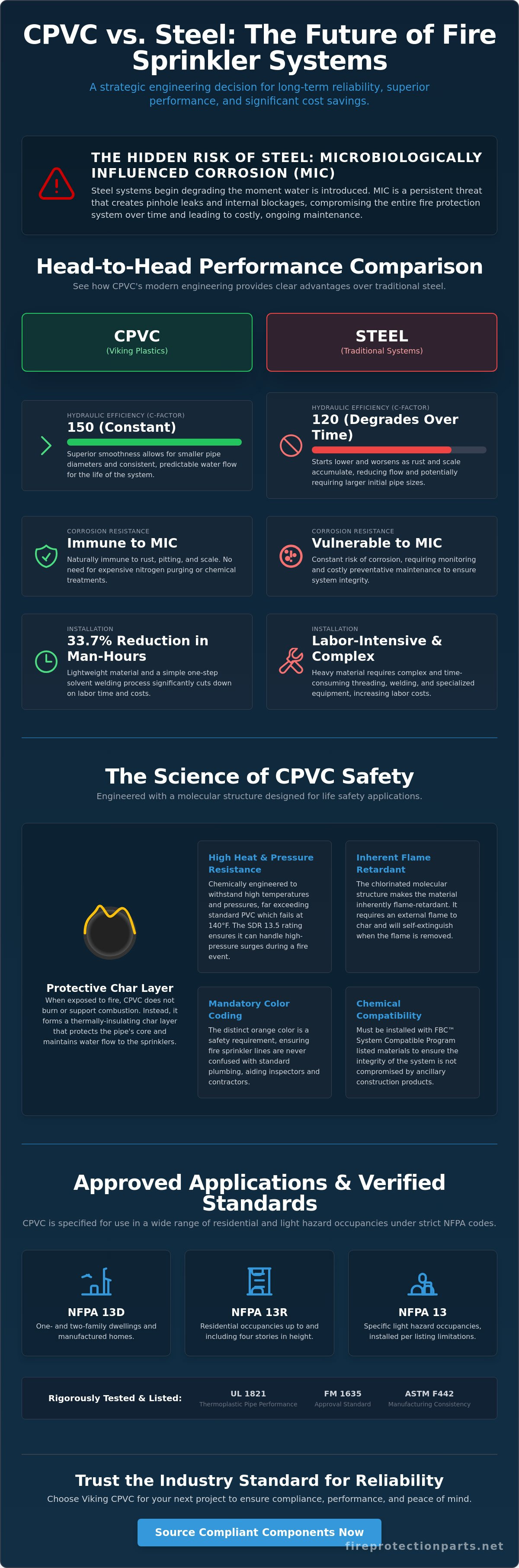
When evaluating cpvc fire sprinkler pipe against traditional steel, the performance gap is defined by hydraulic efficiency. Engineers use the Hazen-Williams C-factor to measure interior pipe smoothness, which directly impacts water pressure. CPVC maintains a constant C-factor of 150. New steel starts at 120 and decreases over time as scale and rust accumulate. This superior smoothness allows designers to use smaller pipe diameters while achieving the same water flow. By Comparing CPVC to steel pipe, it becomes clear that thermoplastic systems offer a more predictable hydraulic profile for the entire lifespan of the building.
The Fight Against Corrosion (MIC)
Steel pipe begins to degrade the moment water is introduced. Microbiologically Influenced Corrosion (MIC) is a persistent threat that creates pinhole leaks and internal blockages. To combat this, steel systems often require expensive nitrogen purging or ongoing chemical treatments. These maintenance costs accumulate quickly and require constant monitoring. CPVC is naturally immune to MIC. It doesn't rust, pit, or scale. This "set it and forget it" durability provides peace of mind for facility managers who want to avoid the surprise of water damage or system failure. For projects requiring high-performance components, sourcing Viking plastics pipe ensures your system remains free from the fatal flaws of metal.
Installation Efficiency and Labor
The weight of Schedule 40 steel creates significant logistical hurdles. It requires heavy machinery for transport and multiple installers for overhead placement. CPVC is significantly lighter, reducing physical strain on the crew and simplifying logistics. The installation process itself is a major differentiator. While steel requires heavy threading and welding equipment, CPVC utilizes a one-step solvent cement joining method. This efficiency translates to real-world savings. Research indicates that CPVC systems can lead to a 24.5% decrease in labor costs and a 33.7% reduction in man-hours compared to steel. These faster timelines minimize site disruption and allow for easier field adjustments in tight residential spaces.
Total cost of ownership is where the comparison truly favors thermoplastic. A cost comparison study showed that steel was $18,409.05 more expensive than CPVC for a new dwelling, representing a 24.3% difference in direct material costs. When you factor in the 30% overall savings reported across the industry, the choice becomes clear. Even with the announced 6% price adjustment on Viking-manufactured products effective June 26, 2026, the long-term value remains high. You aren't just saving money on the initial build; you're avoiding the inevitable replacement costs associated with corroded metal systems. This makes CPVC the professional choice for those who value both performance and the bottom line.
The Science of Safety: Heat Resistance and Fire Performance
A common misconception among facility managers and contractors is that thermoplastic piping will simply melt and fail the moment a fire breaks out. This "melting myth" stems from confusing cpvc fire sprinkler pipe with standard PVC or other low-grade plastics. In reality, the chemical engineering behind CPVC makes it an incredibly resilient material that performs with expert precision under thermal stress. While standard plastics might drip or fuel a fire, CPVC is inherently flame-retardant and will not support combustion on its own. It requires an oxygen concentration of at least 60% to burn, whereas the Earth's atmosphere only contains about 21% oxygen.
The safety of these systems is further enhanced by the presence of water. Because these are wet-pipe systems, the water inside the pipe acts as a heat sink. It absorbs and dissipates thermal energy far more effectively than the air found in dry metal systems. This thermal management ensures that the interior of the pipe remains cool enough to maintain pressure-bearing capacity even when the exterior is exposed to high temperatures. Research from the International Code Council confirms that product compatibility enhances fire protection performance, ensuring that every component in the system works together to maintain safety when it matters most.
Flashover and Structural Integrity
Flashover is the point in a fire where every combustible surface in a room ignites simultaneously, typically occurring at temperatures around 1,100°F. While no material is completely indestructible, water-filled cpvc fire sprinkler pipe is designed to survive these conditions long enough for the sprinkler heads to activate and suppress the threat. Unlike steel, which can expand and warp at high temperatures, causing stress on hangers and joints, CPVC remains stable. The material undergoes a chemical reaction that creates a carbonaceous char, which serves as a natural heat shield to insulate the pipe interior from thermal degradation. This protective layer ensures the system continues to deliver water until the fire is controlled.
Seismic Resilience and Flexibility
Safety isn't just about heat; it's about structural survival. In regions prone to earthquake activity, the rigidity of steel can actually be a liability. Rigid metal pipes are susceptible to brittle fracture at the joints when a building shifts. CPVC offers a degree of inherent flexibility that allows it to absorb energy and move with the structure rather than breaking against it. This flexibility reduces the stress on fittings and connections during a seismic event. To maximize this advantage, it's critical to integrate proper seismic bracing for fire protection systems. These bracing solutions ensure that while the pipe remains flexible enough to survive movement, it stays securely positioned to protect the building's occupants.
Installation Best Practices and Chemical Compatibility
Success with cpvc fire sprinkler pipe depends entirely on proper field execution. While the material is engineered for resilience, improper handling during installation can compromise the system's life-safety rating. Ensuring that every component is FBC System Compatible is the first step in eliminating doubt. This industry-standard program verifies that ancillary products, such as thread sealants and firestops, won't cause the thermoplastic to degrade prematurely. You must treat the installation as a precise engineering task rather than a standard plumbing job.
The Solvent Welding Process
Solvent welding is not a mere glue joint. It's a chemical fusion that creates a permanent bond stronger than the pipe itself. The process follows a strict sequence: cut the pipe squarely, deburr the edges to prevent flow restriction, apply the primer, and then the solvent cement. Using the correct fire protection fittings and accessories is essential to maintain this molecular bond. Any deviation from the manufacturer's instructions can result in weak joints that fail under pressure.
Cure times are non-negotiable. They vary based on ambient temperature and pipe diameter. For instance, installations should typically occur between 40°F and 100°F to ensure the chemical reaction proceeds as intended. Rushing the pressure test before the joints have fully cured is a common pitfall that leads to avoidable leaks. Proper planning ensures that the system is allowed to set completely before water is introduced into the lines.
Avoiding Chemical Incompatibility
Environmental stress cracking is the primary cause of CPVC failure when best practices are ignored. This occurs when the pipe comes into contact with incompatible chemicals found in common job site materials. This isn't just a surface stain; it's a chemical reaction that weakens the plastic at a molecular level. To protect your system, keep the following items away from your cpvc fire sprinkler pipe:
- Petroleum-based oils and greases
- Non-compatible firestop caulks and foams
- Certain pesticides and termiticides
- Standard pipe dopes and thread sealants not listed for CPVC
Even the fluids inside the pipe must be carefully selected. If your system requires freeze protection, you must use specialized, glycerin-based fire sprinkler antifreeze. Standard automotive glycols or unlisted chemicals will damage the thermoplastic and lead to catastrophic system failure. For reliable performance and peace of mind, always source your fire protection components from a supplier that understands these critical technical requirements and stocks only compatible materials.
Why Viking CPVC is the Professional Choice
Viking Plastics has built a reputation for unwavering reliability in the fire suppression industry. When you choose Viking, you aren't just selecting a material; you're investing in a legacy of engineering excellence. Their cpvc fire sprinkler pipe is designed to work seamlessly with their own line of sprinkler heads and valves, creating a unified system where every component is optimized for performance. This system-wide compatibility eliminates the guesswork often associated with mixing different manufacturers' parts. It ensures that your hydraulic calculations remain accurate and that your system responds exactly as intended during a fire event.
Sourcing these components correctly is just as important as the engineering itself. Sourcing through Fire Protection Parts provides a significant advantage for both bulk procurement and individual project needs. We understand that contractors need a reliable partner who can provide genuine Viking Plastics hardware without delay. A one-stop-shop approach ensures that every component in your riser room, from the backflow preventer to the dry pendent sprinklers, meets the highest standards of verification and compliance. Professional support is built into every transaction, helping you navigate complex safety requirements with ease.
Sourcing Quality Components
Finding a dependable source for Viking CPVC fire sprinkler pipe is critical for maintaining project timelines. You need more than just a vendor; you need a partner that understands the technical nuances of fire protection. We ensure that every piece of hardware is genuine and verified, protecting you from the risks of non-compliant or counterfeit parts. Genuine Viking hardware is easily identified by its distinct markings and high-quality finish, providing the visual confirmation that your system is built to last. This commitment to quality ensures that your installation meets the rigorous demands of NFPA standards and local building codes.
Final Checklist for Your Next Project
Before you begin your next installation, verify these critical details to ensure complete safety and code compliance:
- Verify that your pipe size and SDR 13.5 rating match the hydraulic calculations exactly.
- Confirm that all accessories, including hangers, escutcheons, and sealants, are listed as CPVC-compatible.
- Ensure the riser room is equipped with the correct Viking valves and backflow preventors for the specific occupancy.
- Check that your solvent cement and primer are within their expiration dates and stored at proper temperatures.
Professional sourcing through a dedicated partner eliminates the doubt of non-compliant parts. It provides the peace of mind that comes from knowing your project is backed by industry-leading expertise and professional-grade support. Whether you are navigating complex NFPA 13R requirements or a standard residential build, Viking cpvc fire sprinkler pipe remains the superior choice for those who refuse to compromise on safety. By sticking to a single-source system, you ensure that every bond, fitting, and head works in perfect harmony to protect lives and property.
Secure the Future of Your Fire Suppression System
The transition from traditional steel to high-performance thermoplastic is an evolution in fire safety engineering. You now have the data to confirm that cpvc fire sprinkler pipe provides a superior hydraulic profile while eliminating the risk of internal corrosion. By prioritizing material longevity and installation efficiency, you protect both your project's budget and the lives of its future occupants. The 2026 market demands solutions that are both cost-effective and uncompromising in quality.
Making the right choice for your facility requires access to verified, code-compliant components. As a Viking Plastics Authorized Retailer, Fire Protection Parts ensures you receive expert-verified technical specs for every order. We provide the professional-grade support needed to eliminate doubt during procurement. Our commitment to code-compliant sourcing means you never have to settle for less than the industry standard. Shop Code-Compliant Viking CPVC Pipe and Fittings Now to secure your system with unwavering reliability. You're building for the long term; we're here to ensure you do it with absolute confidence.
Frequently Asked Questions
Can CPVC fire sprinkler pipe be used in commercial buildings?
CPVC is approved for use in commercial buildings classified as light hazard occupancies under NFPA 13. This includes facilities like office buildings, nursing homes, and educational institutions. It isn't suitable for high-hazard industrial environments or warehouses with high-piled storage. Always verify the specific building classification with your local Authority Having Jurisdiction (AHJ) to ensure full compliance with regional fire codes.
Does CPVC fire sprinkler pipe melt during a fire?
CPVC doesn't melt or drip like traditional plastics. When exposed to extreme heat, it undergoes a chemical reaction that creates a carbonaceous char on the exterior. This layer acts as a thermal barrier, protecting the pipe's interior and allowing the water inside to continue flowing. Because it requires 60% oxygen to support combustion, it won't fuel a fire in the Earth's 21% oxygen atmosphere.
How long does CPVC fire sprinkler pipe last compared to steel?
A cpvc fire sprinkler pipe system is designed for a 50-year service life. Unlike steel, which begins to degrade as soon as water and oxygen are introduced, CPVC is immune to the internal pitting and scaling caused by corrosion. In environments where Microbiologically Influenced Corrosion (MIC) is prevalent, a thermoplastic system will significantly outlast metal piping by eliminating the primary cause of system failure and leaks.
Is CPVC pipe for fire protection the same as plumbing CPVC?
Fire protection CPVC is distinct from standard plumbing CPVC. While both are thermoplastics, fire-rated pipe is manufactured to SDR 13.5 specifications to handle higher pressure surges during sprinkler activation. It also carries specific UL 1821 and FM 1635 listings that plumbing pipes lack. You can identify fire-rated pipe by its bright orange color, which is a code requirement for safety and easy identification by inspectors.
What chemicals are incompatible with CPVC fire sprinkler systems?
Incompatible chemicals include petroleum-based oils, certain termiticides, and non-approved firestop caulks. Contact with these substances can lead to environmental stress cracking, which compromises the pipe's molecular structure. To maintain system integrity, you should only use products verified through the FBC System Compatible program. This includes ensuring that any thread sealants or gaskets used in the riser room are specifically listed as safe for use with CPVC.
Do I need special glue for CPVC fire sprinkler pipes?
You must use a one-step solvent cement that is specifically UL-listed for fire protection systems. Standard plumbing glue or multi-purpose cements are not substitutes. These specialized cements are engineered to create a chemical fusion between the pipe and fittings that can withstand the high-pressure demands of a fire event. Always check the expiration date on the can and follow the manufacturer's specific instructions for application and cure times.
Is CPVC cheaper to install than steel sprinkler systems?
Installing a cpvc fire sprinkler pipe system is typically more cost-effective than steel due to lower labor requirements. Because the material is lightweight and uses solvent welding instead of heavy threading or welding equipment, crews can complete projects faster. Industry data shows a 24.5% decrease in labor costs when switching from steel. This efficiency reduces project timelines and minimizes the need for specialized, high-cost onsite machinery.
Can CPVC be used in dry pipe sprinkler systems?
CPVC is generally listed for wet-pipe sprinkler systems only. Standard listings do not cover its use in dry systems where the pipe is filled with pressurized air or nitrogen. Using it in a dry application can lead to brittle failure if the material isn't specifically rated for those conditions. If your project requires a dry system, you should look into specialized dry pendent sprinklers or traditional galvanized steel options instead.

