



Dry Pipe Valve Accelerator Rebuild Kit: The 2026 Professional Buyer’s Guide
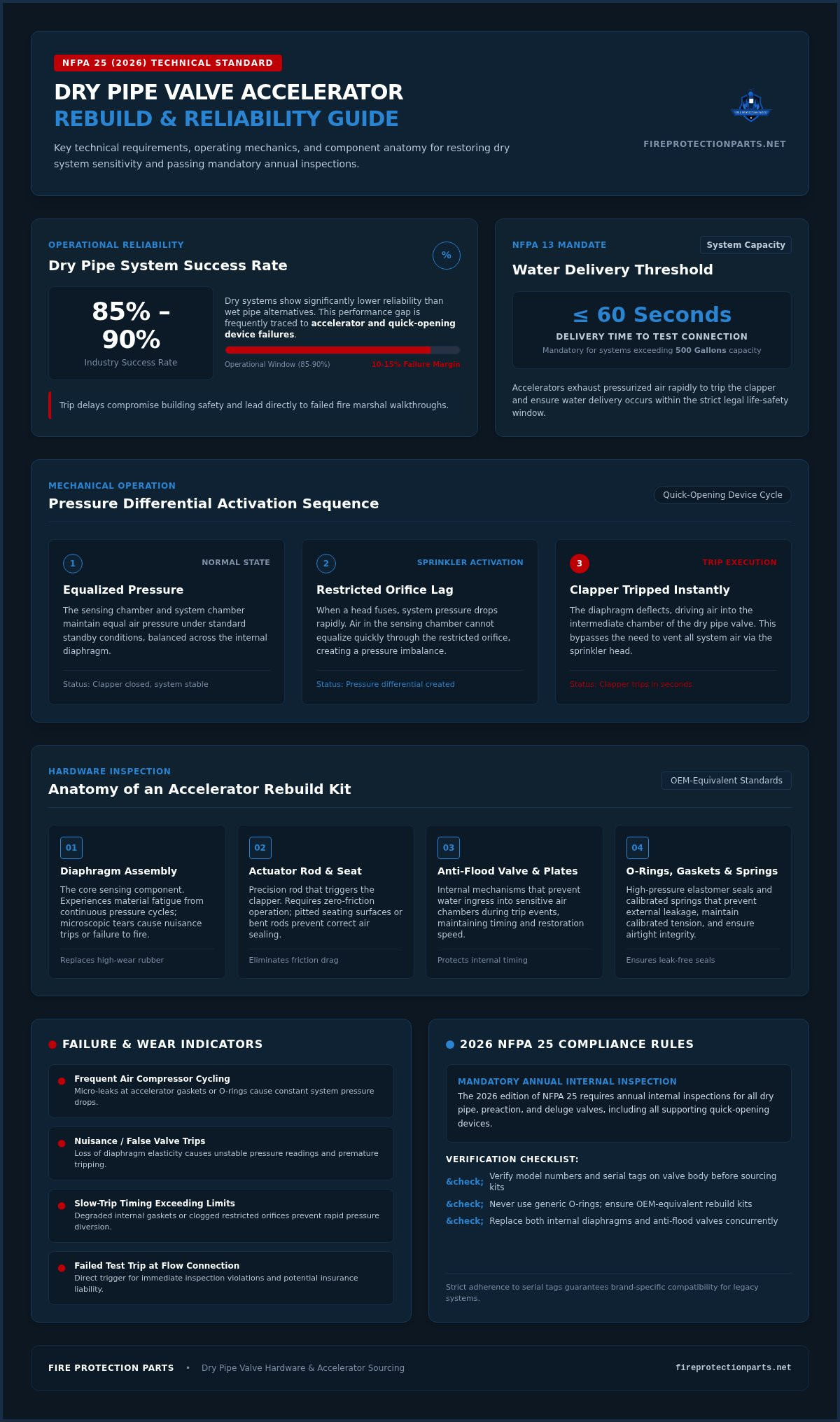
Industry data shows that dry pipe systems have a success rate between 85% and 90%, which is significantly lower than wet pipe alternatives. This reliability gap is frequently caused by the failure of quick-opening devices like accelerators. You know the frustration of dealing with trip delays that lead to failed inspections and compromised safety. A malfunctioning component isn't just a maintenance headache. It's a direct threat to your facility's protection and code standing.
Identifying the exact dry pipe valve accelerator rebuild kit you need can be difficult, especially when navigating brand-specific compatibility for older models. You deserve a clear path to restoring system sensitivity without the confusion. This guide will teach you how to select and source the correct hardware to ensure leak-free operation and full compliance with the 2026 edition of NFPA 25. We'll provide the professional insights necessary to restore your system's performance and give you total confidence before your next fire marshal walkthrough.
Key Takeaways
- Accelerators function as essential quick-opening devices that reduce water delivery delays to meet strict NFPA safety standards.
- Selecting a high-quality dry pipe valve accelerator rebuild kit allows you to replace high-wear diaphragms and gaskets before they cause a system-wide failure.
- Compatibility is non-negotiable in fire protection, so you must verify model numbers and serial tags to ensure the kit matches your specific valve brand.
- Identifying early warning signs like frequent air compressor cycling helps you schedule a rebuild before a failed inspection occurs.
- Sourcing specialized components from a dedicated provider ensures your system meets the new 2026 NFPA 25 annual internal inspection requirements.
The Critical Role of Accelerators in Dry Pipe Sprinkler Systems
In a fire, every second counts. Dry pipe systems are inherently slower than wet systems because they must exhaust pressurized air before water reaches the sprinkler head. An accelerator acts as a quick-opening device, designed specifically to address this lag. By sensing the rapid drop in air pressure that occurs when a sprinkler activates, the accelerator redirects that pressure to trip the dry pipe valve almost instantly. This ensures water delivery happens within the narrow window required for life safety and property protection.
How Accelerators Speed Up System Trip Time
The physics of an accelerator rely on a sensitive pressure differential. Most mechanical accelerators feature a sensing chamber and a system chamber separated by a diaphragm. Under normal conditions, these pressures are equal. When a sprinkler head opens, the system pressure drops faster than the sensing chamber can equalize through its restricted orifice. This imbalance forces the diaphragm to move, opening a path for air to enter the intermediate chamber of the dry pipe valve. This bypasses the need for all air to exit through the sprinkler head, tripping the clapper in seconds. For systems with a capacity exceeding 500 gallons, NFPA 13 mandates that water must reach the test connection within a specific time frame, often 60 seconds or less depending on the hazard classification.
NFPA 13 and 25 Requirements for Dry Systems
Compliance isn't just about the initial installation; it's about rigorous maintenance. The 2026 edition of NFPA 25 has tightened the rules, requiring an annual internal inspection for all dry pipe, preaction, and deluge valves. This includes the quick-opening devices that support them. If your accelerator fails to trip during a mandatory test, you face immediate code violations and potential insurance liability. A malfunctioning unit often stems from degraded internal gaskets or clogged orifices. Utilizing a high-quality dry pipe valve accelerator rebuild kit is a proactive way to restore sensitivity and ensure your system passes its next inspection. Understanding The Critical Role of Accelerators in Dry Pipe Sprinkler Systems is the first step toward building a reliable maintenance schedule.
Neglecting these components leads to "slow-trip" scenarios, where water delivery exceeds the legal limit. This failure can result in catastrophic fire spread and the need for a total hardware replacement. Sourcing the right parts shouldn't be a guessing game. You can find essential sprinkler system components online to keep your hardware in peak condition. A targeted rebuild using a dry pipe valve accelerator rebuild kit is always more cost-effective than managing the fallout of a non-compliant system.
Anatomy of a Dry Pipe Valve Accelerator Rebuild Kit
Patching a sensitive safety device with individual O-rings from a generic hardware store is a recipe for disaster. Fire protection systems operate under constant pressure and environmental stress. A comprehensive dry pipe valve accelerator rebuild kit provides the specific, OEM-equivalent materials required to maintain a leak-free seal. These kits are designed to restore the device to its original factory specifications, which is essential for maintaining 2026 Compliance. Minor trim kits often only include external gaskets, but a professional-grade internal rebuild kit provides the pivot plates and anti-flood valves necessary for a complete restoration of the unit's timing and sensitivity.
The Role of the Diaphragm and Actuator
The diaphragm is the heart of the accelerator. It experiences significant material fatigue over years of service due to constant air pressure fluctuations. A microscopic tear or a loss of elasticity in this component leads to "nuisance trips" or, in worst-case scenarios, a total failure to fire during an emergency. The actuator rod must move with zero friction to trigger the dry valve clapper effectively. If the seating surface is pitted or the rod is slightly bent, the device won't seal correctly. Using a dry pipe valve accelerator rebuild kit ensures that these precision-engineered parts are replaced simultaneously, eliminating the risk of mismatched wear patterns that cause system instability.
O-Rings, Gaskets, and Springs: Seal Integrity
Seal integrity is the difference between a reliable system and a code violation. Professional kits use specialized materials like EPDM for standard air and water seals, while Nitrile is often reserved for specific high-pressure interfaces. The compression spring is another critical but frequently overlooked component. It must provide the exact force needed to reset the device after a trip; a weakened spring can prevent the accelerator from closing, leading to a flooded system. When you perform a rebuild, ensure your kit includes this essential hardware checklist:
- Pivot plate assembly for smooth mechanical action
- Anti-flood valve to prevent water from entering the sensing chamber
- Relief valve components to manage excess pressure
- High-grade EPDM and Nitrile O-rings
- Heavy-duty compression springs for reliable resetting
Selecting a high-quality dry pipe valve accelerator rebuild kit is the most reliable way to prevent nuisance trips and ensure your system is ready for its next annual internal inspection. Don't risk a "slow-trip" failure by reusing old hardware that has already reached its service limit.
Compatibility Guide: Matching Kits to Valve Models and Brands
Compatibility is the most common point of failure in fire system procurement. You can't swap components between manufacturers without compromising the entire safety assembly. A dry pipe valve accelerator rebuild kit is precision-engineered for a specific internal geometry. Mixing a Viking diaphragm with a Reliable housing isn't just a technical error; it's a safety violation that voids your UL/FM certifications. You must verify the exact brand and model before ordering to ensure the system trips as intended during a fire event.
Brand-Specific Hardware Requirements
Manufacturers like Reliable, Viking, and Victaulic use distinct internal trim patterns that aren't interchangeable. The Reliable B1 relies on a specific mechanical lever action, whereas the Viking E-1 uses a different pressure-sensing diaphragm structure. Victaulic's 746-LPA follows its own proprietary design. Always check the Revision letter on the valve's nameplate. A Revision A kit might differ from a Revision B kit in terms of O-ring thickness or spring tension. Using the wrong revision leads to persistent leaks or a failure to reset, which leaves your facility unprotected.
Model Series Identification for Contractors
Finding identifying data in a dark, cramped riser room is a challenge. Carry a high-lumen flashlight and a soft wire brush or cleaning cloth. Years of dust and corrosion often obscure the nameplate on the accelerator body. Wipe the tag clean to reveal the model number and serial data. If the plate is missing, you'll need to identify the unit by its external shape and the brand of the dry pipe valve it's attached to. You can find comprehensive support for these diverse brands by browsing fire protection parts online.
Don't assume a discontinued model means the entire valve is obsolete. Many manufacturers provide backward-compatible kits for legacy hardware. For instance, the Viking D-2 mechanical accelerator serves as a direct replacement for the older D-1 model. Similarly, the Tyco ACC-1 is designed for DPV-1 valves but also acts as a replacement for the Central Model B and Gem Model F311. Identifying these cross-references saves your facility the high cost of a total valve replacement. Using a verified dry pipe valve accelerator rebuild kit ensures that even older systems continue to meet modern 2026 performance standards.
When to Rebuild: Identifying Accelerator Failure and Wear
Waiting for a failed annual inspection to address accelerator wear is a high-stakes gamble. These devices are sensitive instruments that operate within tight tolerances. If your air compressor cycles more than once per week without a known leak in the main piping, the accelerator is a prime suspect. Small internal leaks often go unnoticed until they cause a nuisance trip or prevent the system from resetting. A dry pipe valve accelerator rebuild kit allows you to resolve these issues before they escalate into a full system failure.
Internal contamination is a silent killer for fire protection hardware. If priming water from the dry pipe valve accidentally enters the accelerator's sensing chamber, the rubber diaphragms and gaskets will rapidly degrade. Moisture also introduces the risk of internal corrosion. Research indicates that 73% of dry sprinkler systems experience significant corrosion issues after 12.5 years. In an accelerator, even a microscopic amount of scale or "green" verdigris can block the small orifices required for pressure equalization. This blockage renders the quick-opening device useless during a fire event.
Delayed Trip Times and Air Pressure Drops
Sluggish response times during a trip test are the most definitive sign of failure. If the accelerator doesn't exhaust air within the required seconds, the internal seals are likely sticking or the diaphragm has lost its elasticity. A "dead" accelerator forces the entire system to rely on the slow exhaustion of air through the sprinkler head, which often exceeds NFPA 13 water delivery limits. You should also evaluate the air quality provided by your air compressors for dry sprinkler systems. Excessive moisture in the air supply accelerates component wear and necessitates more frequent rebuilds.
External Leaks and Visual Corrosion
Visual inspections can reveal failure points before they trigger an alarm. Apply a soap-and-water solution to the accelerator body and trim connections; growing bubbles indicate a compromised seal. Look for any signs of green corrosion on brass components or white mineral deposits around the exhaust port. These are clear indicators of internal moisture. A rebuild is mandatory if you detect any audible air leak or if the device fails to trip within the manufacturer's specified time during testing. For systems that show signs of minor wear but still pass tests, a proactive rebuild is suggested to ensure 2026 code compliance.
Maintaining a reliable system requires professional-grade hardware. Don't let a minor gasket failure lead to a major code violation. You can order a dry pipe valve accelerator rebuild kit today to restore your system's sensitivity and ensure peak performance.
Sourcing Professional-Grade Repair Components for 2026 Compliance
Procurement is the final hurdle in maintaining a code-compliant fire suppression system. The 2026 NFPA 25 standards have eliminated the previous five-year service interval for resettable valves, making annual internal inspections the new baseline. This shift means you can't afford delays in sourcing hardware. A specialized dry pipe valve accelerator rebuild kit ensures you have the exact components required to pass these rigorous tests. Maintaining a "spare parts" inventory is no longer just a recommendation; it's a tactical necessity for facility managers who want to avoid emergency downtime during an inspection cycle.
Sourcing Code-Compliant Hardware
Generic O-rings from a local hardware store represent a massive liability. Fire protection environments involve high-pressure air and water cycles that standard rubber simply isn't rated to handle. Using non-listed parts can void your insurance coverage and lead to catastrophic system failure. You need UL-listed and FM-approved components to guarantee the device trips within the required four-second window. We position ourselves as your mission-driven partner, providing the verified repair hardware you need to eliminate doubt and ensure long-term performance. Every kit we offer is vetted for adherence to current safety standards and insurance requirements.
The Importance of OEM-Equivalent Parts
Precision-engineered parts are non-negotiable for high-sensitivity accelerators. A variation of even a few thousandths of an inch in a diaphragm's thickness can alter the pressure differential required to trip the valve. While a professional dry pipe valve accelerator rebuild kit represents an upfront investment, it's significantly more cost-effective than the alternative. With market prices for professional kits often ranging between $1,300 and $3,300 depending on the manufacturer, the cost of a rebuild is still a fraction of the expense associated with a total valve replacement or the damages from a "slow-trip" fire event. High-quality materials ensure you won't be performing these repairs again in six months.
Before you finalize your order, use this final checklist to ensure accuracy:
- Brand Verification: Confirm if you have a Tyco, Viking, Reliable, or Victaulic unit.
- Model Number: Locate the specific series (such as B1, E-1, or ACC-1) on the nameplate.
- Revision Status: Check for revision letters that might change gasket thickness or spring tension.
- Kit Level: Determine if you need a basic external trim kit or a full internal rebuild kit.
Don't wait for a failed inspection to secure your hardware. You can Find your specific dry pipe valve accelerator rebuild kit here to maintain your system's integrity and ensure full 2026 compliance.
Secure Your System for the 2026 Inspection Cycle
Maintaining a dry pipe system requires more than just reactive repairs. It demands a commitment to precision and adherence to the latest NFPA standards. As you prepare for the new annual internal inspection requirements, remember that a malfunctioning quick-opening device is a liability you can easily eliminate. By selecting a high-quality dry pipe valve accelerator rebuild kit, you ensure your system trips within seconds, protecting both lives and property. You've learned how to identify wear, verify brand compatibility, and source OEM-equivalent hardware that stands up to environmental stress.
Don't let a "slow-trip" failure compromise your facility's safety. We provide code-compliant parts for all major brands, backed by expert support for fire system contractors. With fast shipping across the United States, you can secure the components you need without delay. Take the guesswork out of procurement and trust in professional-grade hardware that guarantees performance. Shop Professional Dry Pipe Valve Accelerator Rebuild Kits today and approach your next fire marshal inspection with absolute confidence. Your proactive maintenance today is the ultimate safeguard for tomorrow.
Frequently Asked Questions
How often should a dry pipe valve accelerator be rebuilt?
Under the 2026 edition of NFPA 25, all dry pipe and quick-opening devices now require an annual internal inspection. You should rebuild the unit whenever these inspections reveal degraded seals or when trip tests exceed the manufacturer's time limits. While previous standards allowed for five-year intervals on certain resettable valves, the current mandate prioritizes yearly verification to prevent system-wide failures. Proactive maintenance ensures your system remains compliant and ready for emergency activation.
Can I use a universal rebuild kit for any accelerator brand?
No, you cannot use a universal kit. Every dry pipe valve accelerator rebuild kit is precision-engineered for a specific manufacturer's internal geometry. Using a Viking diaphragm in a Tyco housing will likely lead to seal failure or a non-functional trip mechanism. Furthermore, mixing brands or using non-OEM equivalent parts voids the UL Listing and FM Approval of the entire assembly. Always match your kit to the model number and revision letter found on the nameplate.
What are the most common signs of a failing dry pipe accelerator?
The most definitive sign of failure is a delayed trip time during your annual test. You should also watch for external air leaks, often identified by applying a soap-and-water solution to the body. If your air compressor cycles more frequently than usual without main pipe leaks, the accelerator's internal gaskets may be compromised. Visual indicators like "green" verdigris on brass components or white mineral deposits around exhaust ports also signal internal moisture damage.
Does a rebuild kit include the diaphragm and all necessary O-rings?
A professional-grade dry pipe valve accelerator rebuild kit typically includes all critical high-wear components. This includes the main sensing diaphragm, the anti-flood valve, the pivot plate assembly, and all necessary EPDM or Nitrile O-rings. Some kits also provide replacement compression springs and relief valve parts. It's essential to verify the kit level before ordering, as minor trim kits may only include external gaskets rather than the internal components required for a full restoration.
What NFPA standards apply to dry pipe accelerator maintenance in 2026?
NFPA 25 (2026 Edition) is the primary standard governing the inspection, testing, and maintenance of these systems. It requires yearly internal inspections for dry valves and quick-opening devices. Additionally, NFPA 13 (2025 Edition) dictates the installation and water delivery time requirements for systems over 500 gallons. Compliance with these standards is essential for maintaining building insurance and passing local fire marshal inspections. These updates emphasize corrosion mitigation and component reliability to bridge the safety gap.
Is it better to rebuild an accelerator or replace the entire unit?
Rebuilding is generally the most cost-effective solution, provided the accelerator's cast body remains free of structural corrosion or cracks. A rebuild kit costs a fraction of a full unit replacement, which can exceed several thousand dollars when labor and system downtime are factored in. However, if the internal seating surfaces are deeply pitted or the housing is damaged, a total replacement is necessary. Rebuilding restores performance to factory specifications while respecting your facility's maintenance budget.
What specialized tools are required for rebuilding a dry pipe accelerator?
Rebuilding an accelerator requires standard mechanical tools such as a set of open-end wrenches, a torque wrench for precise bolt tightening, and a soft wire brush for cleaning nameplates. You may also need a small pick for removing old O-rings and a non-petroleum-based lubricant for new seals. It's critical to avoid using aggressive metal tools that could scratch the precision-engineered seating surfaces. Always refer to the manufacturer's technical data sheet for specific torque values and assembly sequences.
How does an accelerator differ from a dry pipe valve exhauster?
An accelerator is a quick-opening device that senses air pressure drops and redirects that air to the intermediate chamber of the dry pipe valve to trip it faster. In contrast, an exhauster is a device that opens to vent system air directly to the atmosphere, speeding up the exhaustion process. While both aim to reduce water delivery time, they utilize different physical paths. Accelerators are generally preferred in modern designs due to their compact size and reliable integration with dry valve trim.

