



Fire Alarm System Components: A Professional Buyer’s Guide for 2026
According to NFPA 72, every smoke detector in your building must be replaced exactly 10 years from its date of manufacture, regardless of whether it still passes a physical functionality test. You likely already feel the weight of these rigid compliance deadlines and the stress of managing potential compatibility issues between different hardware brands. Choosing the right fire alarm system components is a critical decision where there's no room for error or second-guessing.
This guide helps you master the technical complexities of fire alarm hardware so you can source the exact, code-compliant parts required for a professional life safety system. We will break down the essential equipment categories, including how to integrate specialized items like ASC seismic bracing and backflow preventors into a unified, fail-safe network. You'll gain the expert confidence needed to navigate the 2025 NFPA requirements and secure your facility with hardware that eliminates doubt.
Key Takeaways
- Learn how to select high-quality fire alarm system components that meet strict UL/FM standards for maximum reliability.
- Understand the functional difference between optical, ionization, and multi-criteria sensors to eliminate nuisance alarms.
- Discover why the Fire Alarm Control Panel (FACP) acts as the central brain and how it communicates with remote annunciators.
- Master the technical requirements for circuit supervision and the role of specialized hardware like ASC seismic bracing in protected systems.
- Gain clarity on mandatory 2026 safety codes to ensure your life safety network remains fully compliant and operational.
Fire Alarm System Components: Building a Code-Compliant Life Safety Network
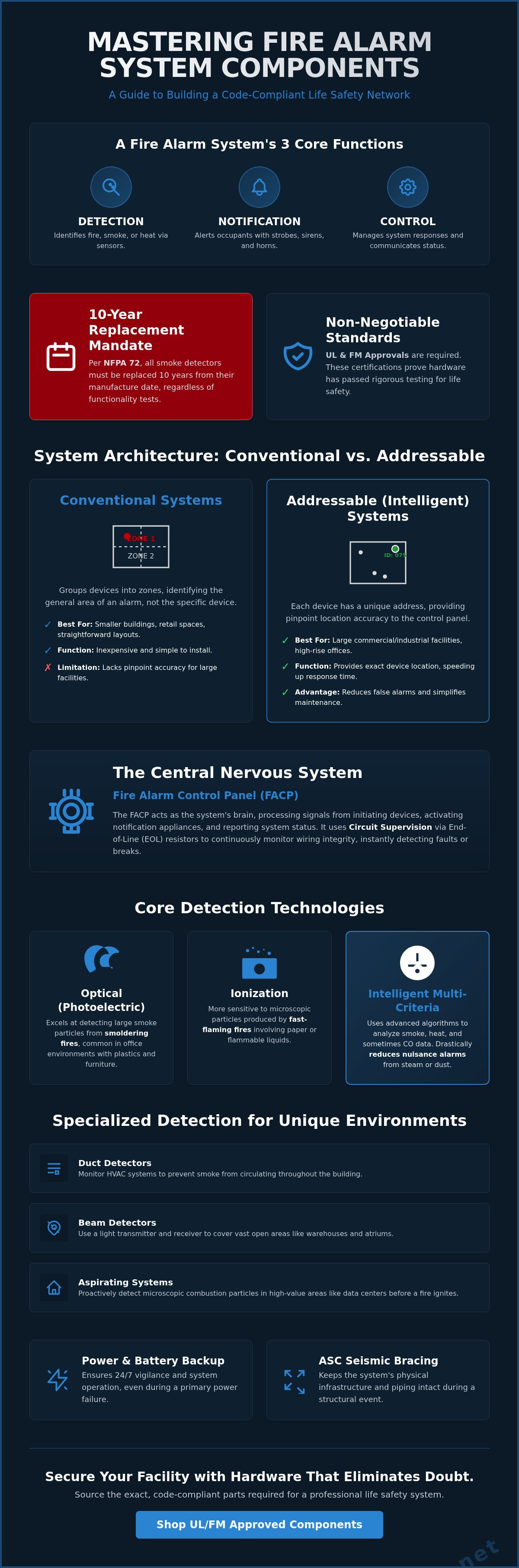
A fire alarm system is a life safety network designed to protect people and property through three core functions: detection, notification, and control. It's not just a collection of separate gadgets. It's a verified ecosystem where every device must function perfectly under extreme pressure. When sourcing fire alarm system components, your first priority is verification. UL (Underwriters Laboratories) and FM (Factory Mutual) approvals are non-negotiable standards. These certifications prove that the hardware has undergone rigorous testing to ensure it won't fail when lives are on the line.
The architecture of your system determines how it responds to a threat. At its most basic, the system includes initiating devices like smoke and heat sensors, notification appliances like strobes and sirens, and the central control panel. Choosing the right components ensures that your building remains compliant with the 2025 edition of NFPA 72, which became effective on September 18, 2024. Proper hardware selection provides the early warning necessary for a safe evacuation and reduces the risk of costly false alarms.
Understanding System Interconnectivity
Reliability depends on how these devices talk to each other. Fire alarm circuits use supervision to monitor for faults. This is achieved through End-of-Line (EOL) resistors, which allow the control panel to monitor the integrity of the wiring. If a wire breaks or a connection fails, the panel identifies a trouble condition immediately. Power supplies and battery backups are equally vital. They ensure 24/7 vigilance, even during a primary power failure. Beyond the electronics, mechanical components like ASC Seismic Bracing are often required to keep the system's physical infrastructure intact during a structural event. If your components aren't compatible, you'll likely fail your fire marshal inspection. Integration with other life safety hardware, such as backflow preventors on the water supply, is also essential for a fully compliant system.
Conventional vs. Addressable Systems
Conventional systems are the standard choice for smaller footprints with straightforward layouts. They group devices into zones. When an alarm triggers, you know the general area of the fire, but not the specific room. Addressable systems, often called intelligent systems, provide pinpoint accuracy. Each device has a unique address, allowing the panel to identify exactly which sensor was triggered. This is essential for large-scale commercial or industrial facilities where every second counts. Your choice depends on your building's occupancy and risk profile. Smaller retail spaces may thrive with conventional hardware, while high-rise offices require the granular data provided by addressable fire alarm system components.
Core Detection Technologies: Sensors for Early Fire Identification
Early identification is the critical difference between a minor incident and a total loss. Choosing the right fire alarm system components requires a clear understanding of how different sensors react to specific fire types. Optical (photoelectric) sensors excel at detecting smoldering fires, which produce large smoke particles common in office environments. Ionization sensors are more sensitive to the microscopic particles produced by fast-flaming fires. For most modern commercial buildings, a strategic mix of both is necessary to meet evolving fire alarm system requirements and ensure comprehensive coverage.
Specialized environments demand hardware that goes beyond standard spot detection. Duct detectors are essential for monitoring HVAC systems to prevent smoke from circulating through a building's ventilation. In large open areas like warehouses or atriums, beam detectors use a light transmitter and receiver to cover vast distances that would otherwise require dozens of individual sensors. For high-value areas like data centers or clean rooms, aspirating systems continuously pull air through a network of pipes to detect microscopic particles of combustion before a fire even ignites. This proactive approach provides the maximum possible response time for critical infrastructure.
Intelligent Multi-Criteria Smoke Detectors
Traditional sensors often struggle with nuisance alarms caused by steam, cooking vapors, or dust. Multi-criteria detectors solve this problem by using advanced algorithms to analyze data from smoke, heat, and sometimes carbon monoxide sensors simultaneously. The Kidde Intelligent Multi-Criteria Smoke Detector stands as a benchmark for this technology. It's designed to filter out non-fire events while maintaining high sensitivity to real threats. When installing these units, ensure they are placed away from "dead air" pockets near ceiling corners to maintain optimal airflow to the sensor chamber.
Aspirating and Beam Detection for Large Spaces
In open atriums or high-bay warehouses, standard spot detectors are often impractical due to ceiling height and maintenance access. Xtralis Imaging Beam Smoke Detectors provide a reliable solution by monitoring a path of light across the open space. If smoke obscures the beam, the system triggers an immediate response. For even earlier warning, aspirating systems like VESDA use microbore tubing to sample air from throughout the room. These systems integrate seamlessly into existing fire alarm system components, providing a layer of protection that standard hardware cannot match. If you're upgrading a commercial facility, you should browse professional fire alarm hardware to find the right fit for your layout.
The Central Nervous System: Control Panels and Communication
The Fire Alarm Control Panel (FACP) functions as the central nervous system for your entire life safety infrastructure. It receives data from initiating devices, analyzes the threat, and executes pre-programmed responses. Every one of the fire alarm system components depends on the FACP to function in a coordinated manner. For facility managers, the panel is the primary interface for system status. It allows for quick resets or silence commands during testing. Remote annunciators extend this capability to building entrances. They provide first responders with critical information immediately upon arrival. This saves precious minutes during an active emergency by showing exactly where a sensor was triggered without requiring entry to the main control room.
Maintaining system uptime requires a robust backbone of power and communication. Fail-safes like secondary battery backups and fire-rated fire alarm system components wiring ensure the panel remains operational even if primary power is lost. Modern panels also integrate with physical fire suppression hardware. For example, the control system can trigger a PTR Electric Deluge VXD or monitor the status of backflow preventors. This level of integration is what separates a basic alarm from a professional life safety network. Under the 2025 edition of NFPA 72, any panel with IP connectivity must also follow strict cybersecurity protocols to prevent unauthorized access to the safety network. FACPs now play an even larger role in maintenance schedules. Control valve supervisory devices and waterflow alarm devices require both inspection and testing semiannually. Your panel must reliably report these signals to maintain compliance.
Conventional Fire Alarm Control Panels
Selecting a panel starts with evaluating your building's zone capacity. Smaller facilities often find that a 5-zone or 10-zone configuration provides sufficient coverage without unnecessary complexity. The Kidde Conventional Fire Alarm Control Panel is a reliable benchmark for these applications. It offers several professional features:
- Zone capacity options for scalable protection
- Integrated circuit supervision to detect wiring faults
- Compatibility with modern notification appliances
You must ensure your panel meets the latest requirements for circuit supervision. This prevents compliance failures during your next inspection. Reliable panels reduce maintenance costs by providing clear, actionable data during trouble conditions.
Communication and Signal Boosting
In high-rise or reinforced concrete structures, radio signals for emergency responders often struggle to penetrate deep into the building. This is why Distributed Antenna Systems (DAS) are now a mandatory safety requirement in many jurisdictions. The Kidde ADX V DAS Remote Unit ensures that communication integrity is maintained throughout the premises. These systems rely on specialized DC power cables to maintain performance during a fire. Without these boosters, first responders lose the ability to coordinate safely. It's a critical investment that protects both the building and the crews who enter it during a crisis.
Essential Installation Hardware and Maintenance Accessories
Professional life safety networks depend on more than just high-tech sensors and panels. The smallest fire alarm system components often determine whether a system passes inspection or suffers from constant, costly trouble signals. Mounting hardware, such as flush mounts and surface kits, provides the physical stability needed for long-term operation in commercial environments. For aspirating systems mentioned earlier, specialized pipe clips and straps are mandatory. These secure the tubing to prevent sagging, which can disrupt air pressure and lead to false alerts. Properly sourcing these fire alarm system components ensures that your physical infrastructure is as reliable as your software.
Integration hardware also includes specialized adapters that allow fire alarm devices to communicate with other building systems. For example, your alarm network might need to interface with backflow preventors or ASC seismic bracing to ensure the entire life safety ecosystem remains intact during an emergency. Neglecting these small but critical parts is the most common cause of system faults. Reliable hardware eliminates the guesswork and provides the professional assurance that your building is fully protected.
While hardware detects and alerts, passive fire protection like fire stopping and fire doors contains the threat; to learn more about these specialized services, visit National Fire Ltd.
Circuit Supervision and Signal Integrity
Undetected wiring breaks are a silent threat to building safety. Kidde EOL Resistor Boards solve this problem by providing a supervised termination point at the end of the circuit. This allows the control panel to monitor the integrity of the wiring 24/7. You must choose the right resistance value, such as 100 Ohm or 10K Ohm, to match your specific panel's requirements. Using the wrong resistor will trigger a permanent fault condition. In aspirating systems, sampling point adaptors are equally crucial. They maintain the precise air pressure required for the network to detect smoke particles at the earliest possible stage, ensuring the system remains fail-safe.
Professional Testing and Maintenance
Compliance doesn't end at installation. Regular testing is a legal requirement under NFPA standards. Using Kidde Smoke Detector Test Spray allows you to simulate smoke accurately during routine checks. Unlike generic alternatives, UL-approved sprays don't leave oily residues that can damage the sensor chamber or cause future false alarms. In aspirating networks, sampling hole clips ensure that air intake remains consistent across the entire pipe run. The 2025 edition of NFPA 72 now requires that waterflow alarm devices undergo both inspection and testing semiannually. Keeping these maintenance accessories on hand ensures you can meet these increased testing frequencies without system downtime. If you're building or maintaining a life safety network, you should source professional fire alarm accessories here to ensure every part of your circuit is secure.
Standout Fire Alarm Components for Professional and Residential Use
Selecting standout fire alarm system components requires a balance between cutting-edge technology and proven durability. While previous sections focused on the central panel and core sensors, the final step in building a fail-safe network is ensuring your notification and piping infrastructure meet the same high standards. High-performance signaling is now shifting toward omni-directional speakers. These devices provide clear voice alerts that are far more effective for evacuation than simple sirens. Clear communication reduces panic. It ensures occupants follow the correct protocols during an emergency, which is vital for meeting the latest safety standards.
Integration also extends to the physical pathways of the system. Specialized piping, such as Viking Plastics CPVC Pipe for Fire Protection, provides the necessary heat resistance and longevity for professional life safety networks. Even budget-friendly essentials, such as fuses and mounting adapters, play a vital role in system repairs. A blown fuse can disable an entire zone, leaving parts of your facility vulnerable. Keeping a stock of these verified fire alarm system components is a simple way to prevent system downtime. Professional safety is built on these small, reliable choices that eliminate doubt and ensure 24/7 protection.
Featured Hardware for 2026
The Kidde HyperSpike MA-2 is the premier choice for high-decibel, clear voice signaling in large industrial environments. It's designed to cut through high ambient noise to deliver intelligible instructions. For those building advanced smoke detection pathways, Kidde VESDA CPVC Pipe ($24.53 - $1243.97) offers the precision required for aspirating systems. In expansive indoor spaces where traditional spot detectors are impractical, Xtralis Imaging Beam Smoke Detectors ($838.82+) provide wide-area coverage with minimal maintenance requirements. These components represent the benchmark for 2026 safety compliance and long-term performance.
The Final Sourcing Checklist
Before finalizing your procurement, run through this verification list to ensure total compliance and system integrity:
- Verify UL/FM listings for every component in your order. Standards don't allow for compromise in life safety.
- Match sensor types to the specific fire risks of each room. Ensure multi-criteria sensors are used near kitchens to resist nuisance alarms as per the 2025 NFPA 72 updates.
- Ensure all network-connected components follow the mandatory cybersecurity protocols established in Chapter 11 of the new code.
- Consult our Fire Alarm Systems Collection for a full range of professional-grade parts.
- Check compatibility with existing mechanical hardware, such as backflow preventors or ASC seismic bracing, to ensure a unified system.
Reliability isn't a lucky accident. It's the result of choosing verified hardware and following a methodical installation process. By sourcing the right components today, you're investing in a fail-safe system that protects lives for years to come.
Secure Your Facility with Code-Compliant Life Safety Hardware
Building a reliable fire safety network requires a methodical approach to hardware selection. You've seen how multi-criteria sensors reduce nuisance alarms and why control panels serve as the critical brain of your system. Every choice, from the specific EOL resistor to the signaling speaker, impacts your building's ability to protect its occupants and pass local inspections. Integrating advanced fire alarm system components with physical infrastructure like Viking Plastics CPVC or backflow preventors ensures a comprehensive, fail-safe environment.
Choosing UL/FM approved hardware eliminates the risk of failure when it matters most. We provide trusted brands like Kidde and Xtralis to help you maintain strict compliance with 2026 safety standards. Whether you're upgrading a commercial atrium or a residential complex, the right parts provide peace of mind and reduced maintenance costs over time.
Shop the Full Collection of Professional Fire Alarm Systems to access our verified inventory and bulk pricing for contractors. Your commitment to quality today builds a safer, more resilient environment for tomorrow.
Frequently Asked Questions
What are the four main components of a fire alarm system?
The four primary fire alarm system components are initiating devices, notification appliances, the fire alarm control panel (FACP), and power supplies. Initiating devices like smoke sensors detect the threat, while notification appliances like strobes alert occupants. The FACP acts as the brain that processes signals, and the power supply ensures the system remains active 24/7 even during a primary power failure.
Why is UL/FM approval important for fire alarm parts?
UL/FM approval provides verified assurance that a component will perform as expected during an emergency. These certifications involve rigorous third-party testing for durability and operational integrity under extreme conditions. Using non-certified parts often leads to system failure and will result in a failed inspection from your local fire marshal.
What is the difference between a smoke detector and a fire alarm system?
A smoke detector is a single initiating device, while a fire alarm system is the entire integrated network of hardware. The system includes the control panel, wiring, and notification appliances that work together to protect a building. A standalone detector only senses smoke; a system manages the total emergency response, including signaling and communication with emergency services.
How often should fire alarm system components be tested?
Testing frequencies are governed by NFPA 72 and local codes, with many fire alarm system components requiring annual or semiannual checks. Under the 2025 edition of NFPA 72, control valve supervisory devices and waterflow alarm devices must now be inspected and tested semiannually. Regular testing prevents compliance failures and ensures the system remains fail-safe when it is needed most.
Can I mix different brands of components in one fire alarm system?
Mixing brands is typically not recommended, especially for addressable systems that use proprietary communication protocols. While some conventional components may be compatible, using mismatched hardware often leads to intermittent faults or system instability. Always consult the manufacturer's compatibility list to ensure the network remains reliable and passes local fire code requirements.
What is a multi-criteria detector and why is it better?
A multi-criteria detector combines multiple sensing technologies, such as smoke, heat, and carbon monoxide, into one unit. This is superior because it uses advanced algorithms to distinguish between real fire threats and nuisance sources like steam or cooking vapors. These sensors are now mandatory within 10 to 20 feet of cooking appliances to resist false alarms as per UL 268 standards.
What are EOL resistors used for in fire alarm circuits?
EOL (End-of-Line) resistors are used for circuit supervision to monitor the physical integrity of the system's wiring. They allow the control panel to detect a broken wire or a loose connection immediately by monitoring the electrical current. Without these resistors, a fault could go unnoticed, leaving your facility unprotected during a fire event.
When should I use an imaging beam smoke detector instead of a standard sensor?
You should use an imaging beam smoke detector in large open spaces with high ceilings, such as warehouses or atriums. These are ideal for areas where the ceiling height exceeds 40 feet, as traditional spot detector placement becomes less effective at those heights. Beam detectors cover vast distances and are much easier to maintain than individual sensors mounted in hard to reach locations.

