



Fire Sprinkler Control Valve Troubleshooting: Signs of Failure and Repair Guide
Statistically, 79% of fire sprinkler system failures between 2017 and 2021 were caused by the system being shut off. This means the difference between life and death often rests on a single handle or wheel remaining in the open position. It's frustrating to deal with constant supervisory alarms on your fire panel or visible corrosion around valve stems. You want to ensure your building is safe without the fear of failing an inspection or facing costly downtime. Recognizing the signs of a failing fire sprinkler control valve early is the only way to avoid a full system impairment during your next inspection.
This guide will help you identify these critical warning signs and navigate the complexities of NFPA 25 compliance. We'll examine common mechanical issues, electronic monitoring failures, and the criteria for making code-compliant repairs. By understanding these professional troubleshooting steps, you can maintain a reliable system that protects your property and provides total peace of mind. Whether you're dealing with a weeping OS&Y valve or a faulty tamper switch, knowing when to repair or replace is essential for long-term safety and adherence to the 2026 standards.
Key Takeaways
- Learn to identify critical visual red flags on OS&Y valves and other control mechanisms before they lead to a system failure.
- Spot the mechanical signs of a failing fire sprinkler control valve, such as stem corrosion or seized wheels, without using dangerous force.
- Resolve persistent supervisory alarms by troubleshooting tamper switch alignment and electronic monitoring issues.
- Navigate NFPA 25 standards to accurately classify valve issues as noncritical deficiencies or critical system impairments.
- Gain expert advice on sourcing professional-grade, UL-listed hardware to ensure your repairs meet the highest safety standards.
Identifying Your Fire Sprinkler Control Valve and Visual Failure Signs
Control valves are the most critical fire sprinkler system components because they manage the primary water supply. According to NFPA 25 standards, these valves must remain in the "Supervised Open" position to ensure the system is ready for immediate activation. If a valve is accidentally closed or fails mechanically, the sprinklers won't have the pressure needed to suppress a fire. Recognizing the signs of a failing fire sprinkler control valve starts with understanding exactly which hardware you're looking at and what it looks like when it's healthy.
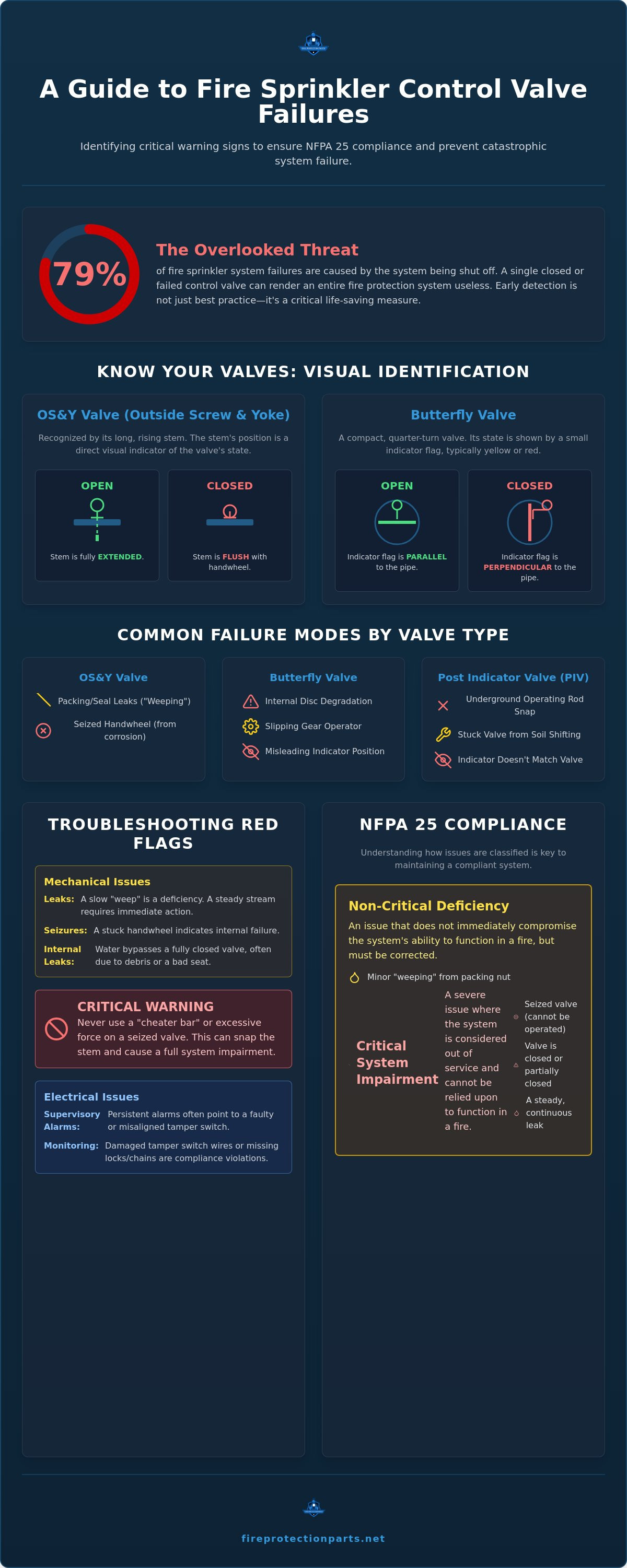
The Outside Screw and Yoke (OS&Y) valve is a common industry standard for main water entries. You'll recognize it by the long, threaded stem. When the valve is open, the stem is fully extended. If the stem is flush with the handwheel, the water is shut off. Butterfly valves are more compact alternatives. They use a gear operator and a small yellow or red indicator flag. If the flag is parallel to the pipe, it's open. If it's perpendicular, it's closed. Both types require regular visual checks to spot trouble before it triggers a supervisory alarm.
Visual red flags often appear long before a total mechanical breakdown. Look for rust-colored water pooling at the base or mineral "blooms"-white, crusty deposits-on the stem. These indicate a slow, persistent leak. You should also check for missing padlocks, broken chains, or severed tamper switch wires. Security and monitoring are just as important as mechanical integrity for code compliance.
Visual Inspection: What Does "Normal" Look Like?
A healthy valve is clean, unobstructed, and clearly labeled. For an OS&Y valve, "normal" means the stem is bright, well-lubricated, and fully extended. There shouldn't be any "weeping" or moisture around the packing nut. If you see a constant drip, the internal seal is likely failing. Every control valve should also feature a tamper switch or a physical lock and chain to prevent unauthorized closure. If these monitoring elements are damaged or missing, your system is technically impaired.
OS&Y vs. Butterfly Valve Failure Profiles
OS&Y valves typically suffer from external environmental issues. The exposed stem is prone to corrosion, especially in damp basements or mechanical rooms. If the stem becomes heavily pitted, it can't retract through the packing, which effectively seizes the valve. Butterfly valves fail differently. They often experience internal issues where the rubber-coated disc degrades or the gear operator slips. This is dangerous because the indicator might show "open" even if the internal disc has shifted into a closed position. Post Indicator Valves (PIV), found in yard mains, face unique risks. Their failure points are often underground, where shifting soil or frozen ground can snap the operating rod, leaving the valve stuck regardless of what the target window says.
Mechanical Troubleshooting: Leaks, Seizures, and Seating Issues
Mechanical reliability is the foundation of fire safety. When a valve fails mechanically, it compromises the entire system's ability to deliver water during an emergency. One of the most common signs of a failing fire sprinkler control valve is the "packing leak." This occurs when the seal around the valve stem degrades over time. While a minor "weep"-a few drops a day-might be classified as a noncritical deficiency under NFPA 25, a steady stream of water is a critical failure that requires immediate attention. Ignoring a weeping valve often leads to accelerated corrosion of the stem and yoke.
Seized valves present a different kind of danger. If a handwheel won't budge, it's often due to internal corrosion or a heavy build-up of mineral deposits. You should never use excessive force or "cheater bars" to turn a stuck wheel. Applying too much torque can snap the stem or damage internal gear operators, turning a simple repair into a total system impairment. If the valve won't operate with firm hand pressure, it's a clear indicator that the internal components have reached the end of their service life.
Internal seat leakage is harder to spot because it happens inside the pipe. You'll notice this when water continues to bypass the valve even after it's been fully closed. This is usually caused by debris trapped in the seat or a degraded rubber disc on a butterfly valve. For OS&Y models, focus on corrosion management by keeping the external threads clean and lightly lubricated. If you find yourself constantly battling rust or leaks, it's often more cost-effective to source high-quality replacement components rather than attempting a temporary fix on a compromised unit.
Step-by-Step Packing Nut Adjustment
If you find a leak at the stem, you may be able to resolve it by tightening the packing nut. Use the "quarter-turn" rule: tighten the nut only one quarter-turn at a time. Test the valve's operation after each adjustment to ensure the stem hasn't become too tight to move. If the leak persists after the nut is snug, the packing material is likely completely degraded and requires full replacement. Remember that over-tightening can lead to a seized stem, which is a significant safety risk.
Clearing Mineral Buildup and Debris
Stagnant water is the enemy of fire protection hardware. Over time, sediment and minerals settle in the valve seat, preventing a tight seal and causing internal damage. You can often clear minor debris by performing a partial flow test, which involves opening the main drain slightly to flush the seat area while the valve is partially open. To prevent these issues from developing, you must regularly "exercise" your valves. Exercise is the periodic act of cycling a valve from fully open to fully closed and back again to prevent mechanical seizure and ensure all internal parts move freely.
Electrical Troubleshooting: Tamper Switches and Trouble Signals
Mechanical checks only tell half the story. The electronic tamper switch serves as the system's primary line of defense against unauthorized closure or accidental shut-offs. When your fire alarm panel begins reporting intermittent supervisory signals, it's often one of the earliest signs of a failing fire sprinkler control valve. These signals don't necessarily mean the water is off. Instead, they indicate the connection between the valve's physical position and the monitoring system is compromised. Diagnosing these electrical faults requires a systematic approach to distinguish between a simple alignment issue and a total hardware failure.
Troubleshooting starts at the actuator arm or the mounting bracket. On OS&Y valves, the switch arm sits in a groove on the stem. If the stem is corroded or the bracket has shifted, the arm won't drop correctly. This triggers a false signal. For butterfly valves, the switch is usually housed within the gear operator. If the internal cams slip, the panel shows an alert even if the indicator flag points to "Open." You can verify the switch's health using a multimeter to check for continuity. A functional switch must change states exactly when the valve is operated.
Tamper Switch Calibration and Alignment
Proper calibration is essential for code compliance. The 2026 edition of NFPA 25 maintains that the tamper switch must initiate a signal within two full revolutions of the handwheel or one-fifth of the valve's total travel distance. If your switch trips the moment you touch the handle, it's over-sensitive. Conversely, if you can close the valve halfway without a signal, the system is non-compliant. In damp riser rooms, moisture often infiltrates the switch housing. This causes internal corrosion. If you find green oxidation on the terminals, the switch is likely failing. You'll need a professional-grade replacement to restore system integrity.
Fire Panel Communication Issues
You must understand what the fire panel is telling you. A "Supervisory" signal indicates the valve moved from its normal state. A "Trouble" signal usually points to a wiring fault. This could be a loose terminal connection or a missing end-of-line resistor in the junction box. Check the wiring for physical damage or loose screws. If the switch tests fine with a multimeter but the panel still shows a fault, the issue likely lies in the alarm circuit. In these cases, you'll need to coordinate between a sprinkler fitter for the hardware and a fire alarm technician for the electronics.
NFPA 25 Compliance: Repair, Deficiency, or Impairment?
NFPA 25 establishes a clear hierarchy for managing system faults. Understanding these classifications helps you determine whether you're facing a simple maintenance task or a regulatory emergency. When you identify signs of a failing fire sprinkler control valve, your first step is to categorize the issue. A minor "weep" around the packing nut is typically a noncritical deficiency. It's a problem that should be corrected, but it doesn't prevent the system from operating as designed. It hasn't reached the point where it restricts the rated flow of water to the sprinklers.
Critical deficiencies are more serious. A failed tamper switch or a missing padlock falls into this category because it compromises the supervision of the water supply. The most severe classification is an impairment. If a control valve is seized or the stem is snapped, the system is impaired. You must immediately implement fire watch protocols and notify the local Authority Having Jurisdiction (AHJ). All troubleshooting results and corrective actions must be recorded in your ITM (Inspection, Testing, and Maintenance) log to maintain a compliant paper trail and avoid fines during annual inspections.
Mandatory Inspection Intervals
Compliance requires consistent oversight. You must perform weekly or monthly visual inspections for all control valves to ensure they're locked or electronically supervised. Every valve requires an annual "exercise" where it's moved through its full range of motion. This prevents internal components from seizing due to mineral buildup. Additionally, certain control units and check valves require an internal inspection every five years to check for hidden corrosion that can lead to signs of a failing fire sprinkler control valve later on.
The "Repair vs. Replace" Decision Matrix
Deciding whether to rebuild or replace a valve depends on age and labor costs. For a 20-year-old butterfly valve, internal disc degradation is common. Sourcing a trim kit and paying for hours of specialized labor often costs more than installing a brand-new unit. Replacing the entire valve ensures you have a factory-sealed, UL Listed component with a fresh service life. You should always source fire protection parts online from authorized retailers to guarantee hardware compliance. If you need a reliable solution quickly, you can browse our selection of code-compliant valves to find the exact hardware required for your system.
Sourcing Professional Replacement Control Valve Components
Once you've identified the signs of a failing fire sprinkler control valve, the focus shifts to procurement. Replacing life-safety hardware requires absolute precision. You must match the existing pipe size and connection type exactly to avoid costly field modifications. Whether your system uses flanged, grooved, or threaded connections, the replacement must be a seamless fit. Sourcing brand-name hardware like Viking ensures your system remains UL Listed and FM Approved. These manufacturers provide the documented reliability required for mission-critical fire protection. Using generic, unlisted hardware can lead to catastrophic failure and legal liability if the system fails to activate during a fire.
A complete repair often involves more than just the valve body. You should also evaluate the condition of associated accessories. Tamper switches, handwheels, and internal trim kits frequently wear out at the same rate as the main valve components. Sourcing all sprinkler system components online allows you to review technical specifications and lead times before placing an order. This proactive approach minimizes the time your building remains under fire watch. It also ensures you have all necessary gaskets and mounting hardware on hand before the water is shut off, preventing unexpected delays during the installation process.
Verifying Part Compatibility
Before ordering, locate the data plate on the valve's gear operator or body. This plate contains the specific model number and manufacturer information needed for an exact match. You must also verify the pressure rating of your system. Most standard systems operate at 175 PSI, but high-rise or high-pressure applications may require 300 PSI rated hardware. Installing an underrated valve is a major code violation that can lead to explosive failure under surge pressure. Using professional-grade sources for fire protection parts online ensures you receive the correct, high-pressure components required for system longevity; additionally, for those in industries like power generation or oil and gas, you can discover OG VALVES LTD. for specialized valve solutions.
Preparing for Installation and System Restore
System downtime is a liability. You must notify your monitoring station and local fire department before shutting down any water supply. If you're performing repairs on a modern residential system, you may encounter Viking CPVC fire sprinkler pipe, which requires specific transition fittings to connect to metal control valves. Once the new valve is installed, a final verification is required. Perform a main drain test to ensure the water supply is fully restored and that no debris from the repair is obstructing the flow. This final step confirms the signs of a failing fire sprinkler control valve have been resolved and your property is once again protected by a fully functional, code-compliant system.
Maintain System Integrity with Professional Hardware
Proactive maintenance is the only way to prevent system impairments and ensure your sprinklers perform when they're needed most. By regularly exercising your valves and monitoring for moisture or supervisory alarms, you can stay ahead of critical failures. When troubleshooting reveals the signs of a failing fire sprinkler control valve, you must transition from inspection to action to maintain compliance with NFPA 25 standards.
Maintaining a safe environment goes beyond just your sprinkler system; to ensure other critical fire-safety structures like chimneys and fireplaces are in top condition, learn more about Perfect Chimney for professional maintenance and masonry repairs.
Sourcing the right hardware shouldn't be a source of doubt. Fire Protection Parts provides the professional-grade components required for life-safety systems. As an authorized retailer for Viking and other major safety brands, we offer only UL Listed and FM Approved hardware. Our commitment to fast shipping means you can address critical repairs immediately and minimize system downtime.
Protect your property with unwavering confidence. Shop Code-Compliant Fire Sprinkler Control Valves and Parts today and ensure your fire protection system is always ready for service.
Frequently Asked Questions
How do I know if my fire sprinkler control valve is open or closed?
Check the physical indicator on the valve body to determine its status. For an OS&Y valve, the threaded stem is fully extended when the valve is open. For a butterfly valve, the yellow or red indicator flag is parallel to the pipe in the open position. If the stem is flush with the handwheel or the flag is perpendicular, the water supply is shut off and the system is compromised.
What should I do if my fire panel shows a Supervisory signal for a valve?
Investigate the valve's physical position immediately to ensure the water supply hasn't been cut. A supervisory signal means the valve has moved from its normal "Open" state or the tamper switch has been triggered. Confirm the valve is fully open and the tamper switch is properly seated. If the signal persists despite the valve being open, you likely have an electronic alignment issue or a faulty switch.
Can I use WD-40 or other lubricants to loosen a stuck OS&Y valve?
Don't use standard household lubricants like WD-40 on fire protection valves. These products can attract dust and eventually gum up the mechanism, making the problem worse. Use only high-quality, water-resistant lubricants specifically recommended by the manufacturer for OS&Y stems. Proper lubrication is essential to prevent the mechanical signs of a failing fire sprinkler control valve, such as seizing or heavy thread pitting.
Why is my sprinkler valve leaking from the handle area or packing nut?
This is a packing leak caused by a degraded internal seal around the valve stem. You can often stop a minor "weep" by tightening the packing nut one quarter-turn at a time with a wrench. If the leak continues after adjustment, the packing material has reached the end of its service life. This must be addressed quickly to prevent corrosion and ensure the valve remains fully operational for inspections.
Does NFPA 25 allow for the repair of old Butterfly valves?
NFPA 25 allows for repairs, but it's often not practical for older butterfly models. These valves frequently fail internally at the rubber-coated disc or the gear operator. Sourcing specific internal parts for discontinued models is difficult and labor-intensive. In most cases, replacing the entire unit with a new UL Listed valve is more cost-effective and provides better long-term reliability than attempting a complex rebuild.
How often should fire sprinkler control valves be tested and exercised?
NFPA 25 requires you to exercise control valves annually to ensure they don't seize. This involves moving the valve through its full range of motion from open to closed and back again. Additionally, you must perform visual inspections weekly or monthly depending on whether the valve is locked or electronically supervised. Consistent testing helps you spot the signs of a failing fire sprinkler control valve before an actual emergency occurs.
What is the difference between a control valve and a check valve?
A control valve is a manually operated device used to shut off the water supply for maintenance or repairs. A check valve is an automatic device that allows water to flow in only one direction. While control valves are supervised in the "Open" position, check valves work internally to prevent backflow and maintain system pressure. Both are critical for the overall integrity of your fire protection system.
Can a building owner troubleshoot their own fire valves or is a pro required?
Owners can perform basic visual inspections and minor packing nut adjustments to stop small leaks. However, any work involving system impairment, valve replacement, or internal mechanical repairs requires a qualified fire protection professional. Most jurisdictions require certified technicians to sign off on ITM logs to maintain legal compliance and ensure the system meets all life-safety standards. Professional expertise eliminates the doubt associated with complex safety hardware.

