

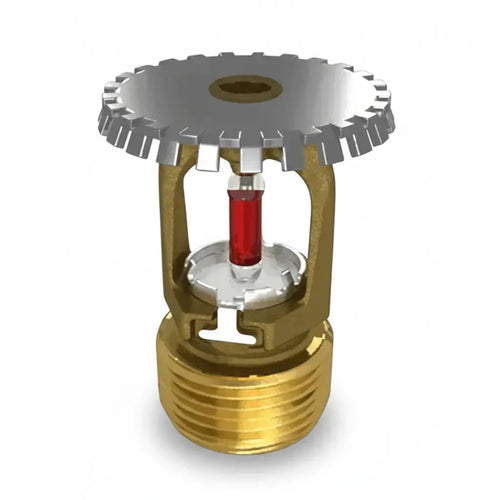


How to Select Fire Sprinkler Heads: The Professional’s 2026 Selection Guide
What if the 50-year-old sprinkler head in your facility is legally required to be replaced this year, but you can't even identify its manufacturer? Under the 2026 edition of NFPA 25, dwelling unit sprinklers in service for five decades must now be replaced or tested. This mandate leaves many facility managers and contractors scrambling to decode outdated hardware while facing the pressure of compliance. It's a high-stakes puzzle where a single mismatch can lead to system failure or costly fines.
You likely agree that identifying the right parts shouldn't feel like guesswork. It's frustrating to stare at a corroded deflector and wonder if you're looking at a standard or quick response model. You know that making the wrong choice doesn't just risk a code violation; it compromises the 96% effectiveness rate that these systems provide when they operate correctly. You need a reliable way to ensure every component, from dry pendent sprinklers to backflow preventors, meets the exact specifications of your building.
This guide will show you exactly how to select fire sprinkler heads by mastering the technical data that matters most. You'll learn to match SIN numbers to hydraulic requirements and choose the right components for your specific environment. We'll provide a clear checklist for identification and a deep dive into the criteria used by industry leaders like Viking and Tyco to ensure your system remains code-compliant and ready to perform.
Key Takeaways
- Learn to decode the alphanumeric SIN to instantly identify the hydraulic specs and performance data of any modern sprinkler head.
- Master how to select fire sprinkler heads by matching K-factors to water volume needs and temperature ratings to environmental heat.
- Identify the correct orientation, whether pendent, upright, or sidewall, to ensure your piping layout delivers code-compliant coverage.
- Address specialized risks like freezing or corrosion with high-performance solutions including dry pendent sprinklers and industrial-grade coatings.
- Eliminate procurement doubt by verifying the compatibility of your selected heads with essential components like Viking CPVC fire protection piping.
The Fundamentals of Fire Sprinkler Head Identification
Every modern fire sprinkler head is a precision-engineered life safety device. It's not just a piece of hardware; it's a calibrated instrument designed to respond to specific thermal triggers within seconds. When you're learning how to select fire sprinkler heads, you must treat these components with the technical respect they deserve. A mismatch in specifications doesn't just fail a code inspection. It can lead to catastrophic property loss or the failure of a life-saving system. Professional assurance starts with understanding that there is no room for compromise when it comes to hardware selection.
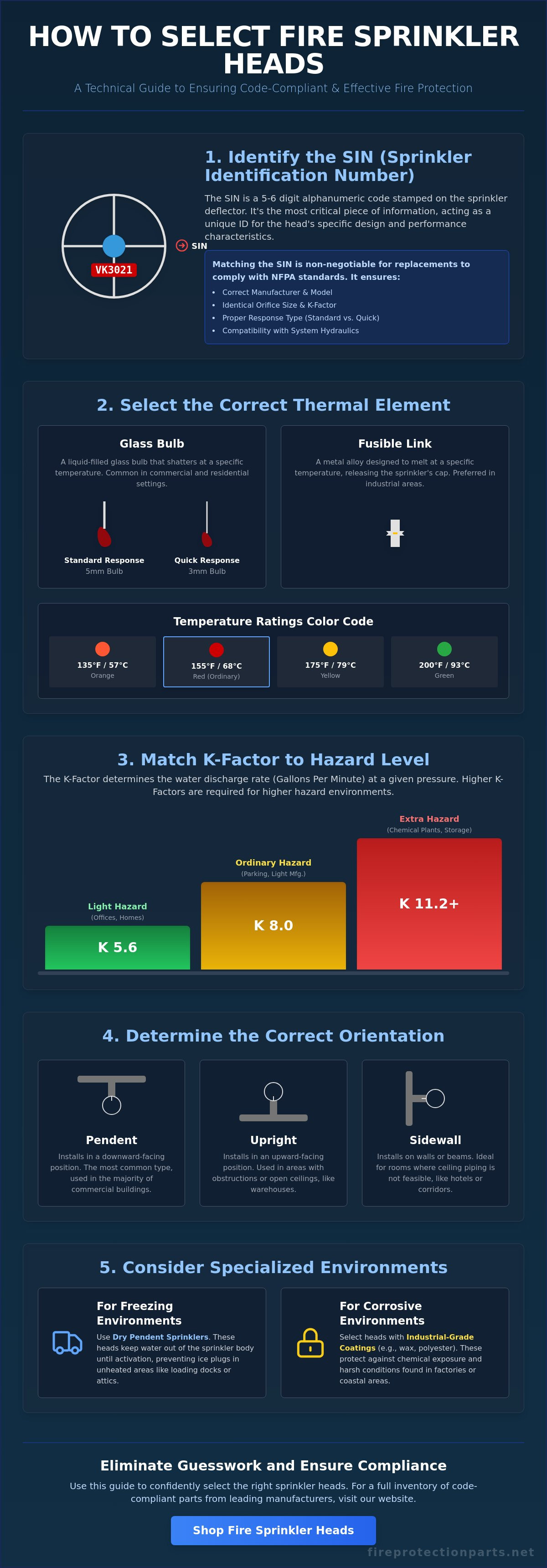
The Sprinkler Identification Number (SIN) serves as the foundation for any selection process. This 5-6 digit alphanumeric code is the industry standard for identifying a head's specific performance characteristics. Whether you're maintaining an existing system or designing a new one, matching the SIN is non-negotiable. Substituting one head for another without engineering approval is a violation of NFPA standards. This fire sprinkler overview provides historical context on how these standards evolved to ensure maximum reliability across different building types.
Decoding the Sprinkler Identification Number (SIN)
You'll typically find the SIN stamped directly onto the sprinkler deflector or the frame. This code identifies the manufacturer and the specific model's orifice size, K-factor, and response type. It's the only way to verify that a replacement part is identical to the original design. If you're sourcing a replacement, "close enough" isn't an option. For example, if your system uses Viking hardware, the SIN ensures that the head is compatible with other components like Viking Plastics CPVC pipe for fire protection. Using the wrong SIN can throw off the hydraulic calculations of the entire branch line, leading to insufficient water pressure during an emergency.
Thermal Elements: Glass Bulbs vs. Fusible Links
Understanding the thermal element is a critical step in how to select fire sprinkler heads. Most modern heads use a glass bulb filled with a temperature-sensitive liquid. A 5mm bulb is standard for most commercial applications, while a 3mm bulb is used for Quick Response heads, which activate faster to protect lives in residential settings. The smaller bulb reacts more quickly to heat, providing the rapid response needed in confined spaces.
Fusible link sprinklers use a metal alloy that melts at a specific temperature. These are often preferred in industrial environments or high-risk areas where mechanical damage to a glass bulb is a concern. Regardless of the type, the element is color-coded. A red bulb or link indicates an ordinary temperature rating of 155°F, while green or blue indicates higher thresholds. This color-coding allows for a quick visual verification of compliance during a facility walkthrough. Selecting the wrong temperature rating can lead to accidental activations near heat sources or delayed responses during an actual fire. Reliability starts with choosing the right trigger for the environment.
Technical Selection Criteria: K-Factor and Temperature Ratings
Matching a Sprinkler Identification Number (SIN) provides the identity of a head, but understanding the underlying physics is essential for system integrity. When you're determining how to select fire sprinkler heads, the hydraulic demand of the space is your primary driver. This demand is categorized by occupancy hazards. Light hazard environments, like offices or homes, require lower water densities. Conversely, Extra Hazard classifications, such as chemical plants or high-piled storage, demand massive water volumes to control a fire. This classification system is the backbone of the NFPA 13 Standard, which provides the framework for every professional installation.
Calculating the Required K-Factor
The K-factor is a mathematical coefficient that defines the relationship between water pressure and discharge volume. In simple terms, a larger K-factor allows more water to flow at a lower pressure. For most residential applications, you'll see K-factors ranging from 3.0 to 5.8. Commercial systems often require much higher values, such as K-11.2 or even K-25.2 for Early Suppression Fast Response (ESFR) systems. Selecting the wrong K-factor ruins the hydraulic balance of the system. If the orifice is too small, the system won't deliver enough water to suppress the fire. If it's too large, it may drain the water supply too quickly, leaving the building vulnerable. Ensuring you have the right high-quality fire protection components is the only way to guarantee the system meets its design intent.
Selecting the Correct Temperature Rating
Temperature ratings are a critical safety barrier. You must select a head with a rating higher than the maximum expected ceiling temperature to prevent accidental discharge. NFPA 13 classifies these into Ordinary, Intermediate, and High categories. For a standard office, a 155°F (Ordinary) head is typical. However, commercial kitchens, furnace rooms, or areas under uninsulated skylights often reach temperatures that would trigger a standard head. In these environments, you'll need Intermediate (175°F to 225°F) or High (250°F to 300°F) ratings. A mistake here is costly. An accidental discharge causes significant water damage, yet choosing a rating that's too high could delay activation, allowing a fire to grow beyond the system's control capacity. Professionals prioritize this balance to ensure the 96% effectiveness rate that these systems are designed to provide.
Response types also play a role in this technical framework. Standard Response (SR) heads are designed to protect the building structure, while Quick Response (QR) heads prioritize life safety by activating earlier in the fire's development. The 2025 edition of NFPA 13 has introduced revised requirements for high ceilings, making the choice between SR and QR even more critical for modern facility managers who need to maintain strict compliance while ensuring maximum protection.
Orientation and Coverage: Pendent, Upright, and Sidewall
Choosing the right orientation is a critical step in learning how to select fire sprinkler heads. This decision isn't based on aesthetics. It is a functional requirement dictated by your building architecture and the location of your piping. If you install a head in the wrong orientation, the deflector will not distribute water correctly. This leaves gaps in coverage that a fire can exploit. Professionals match the hardware to the physical environment to ensure the spray pattern meets the design density required for safety.
Orientation is generally divided into three primary categories: pendent, upright, and sidewall. Pendent sprinklers hang down from the branch line and are the most common choice for finished ceilings in offices or residential units. Upright sprinklers sit on top of the pipe. This position is ideal for unfinished areas with exposed piping, such as warehouses or mechanical rooms, because it prevents debris from accumulating in the head. Sidewall sprinklers mount horizontally on a wall. They are the go-to solution for hotel rooms, hallways, or any space where ceiling access is restricted or impossible.
Pendent vs. Upright: When to Use Which
The main difference between these two types lies in the deflector shape. A pendent head has a deflector that curves downward to create a circular spray pattern. An upright head has a deflector that is flat or curved upward to catch water from below and redirect it in a similar circular fashion. In unheated areas, you may need specialized hardware like dry pendent sprinklers. These are designed with an internal seal that keeps water in the heated part of the piping until the head activates. This prevents the system from freezing and rupturing in walk-in freezers or loading docks.
Extended Coverage (EC) vs. Standard Spray
When you are determining how to select fire sprinkler heads for large, open spaces, you might consider Extended Coverage (EC) models. Standard spray heads typically cover a 15 by 15 foot area. EC heads are engineered to cover much larger footprints, sometimes up to 20 by 20 feet. Using EC heads can significantly reduce your total head count and the amount of piping required, which lowers overall material costs.
However, EC heads come with strict limitations. The NFPA 13 Standard mandates specific requirements for head spacing and distance from walls when using extended coverage models. You cannot use them in rooms with complex geometries or obstructions that might interfere with their larger spray pattern. Matching the coverage pattern to the room geometry is essential. If the room has sloped ceilings or deep beams, standard spray heads are often the more reliable choice to ensure no area is left unprotected.
Specialty Sprinkler Heads for Challenging Environments
Standard hardware often fails when exposed to extreme conditions. Learning how to select fire sprinkler heads for specialized environments is what separates a basic installation from a professional, long-term safety solution. Whether you're dealing with sub-zero temperatures in a cold storage facility or corrosive chemical fumes in an industrial plant, your hardware must be engineered for that specific risk. Failure to match the head to the environment leads to premature corrosion, accidental discharge, or system failure when it's needed most.
Solutions for Freezing Environments
Freezing temperatures are a primary cause of system failure and property damage. Dry pendent sprinklers solve this by keeping water out of the freezing zone until the moment of activation. These units feature an internal seal at the top of a specialized barrel. This seal keeps the water in the heated portion of the building's piping. You must accurately determine the correct barrel length based on the depth of the ceiling and the thickness of the insulation. For systems where the entire branch line is at risk, professionals often integrate these heads with anti-freeze solutions for fire protection to ensure the water remains liquid and ready to flow. Reliability in these settings depends on a no-nonsense approach to hardware selection.
Aesthetic Selection: Concealed and Recessed Heads
High-end commercial designs and modern residential interiors often demand that safety hardware remains invisible. Concealed sprinklers use a temperature-sensitive cover plate that sits flush with the ceiling. When a fire occurs, the plate drops away at a temperature slightly lower than the sprinkler's activation point, allowing the head to deploy. While this provides a clean finish, it introduces a critical safety rule: never paint a sprinkler head or its cover plate. Even a thin layer of paint can bond the plate to the frame, preventing it from dropping and delaying system activation by several life-saving minutes. Sourcing the correct escutcheons and trim rings is the only way to achieve a professional finish without compromising the 96% effectiveness rate of the system.
Industrial sites with high humidity or chemical exposure require another level of protection. In these areas, standard brass or chrome finishes will degrade quickly. You must select heads with corrosion-resistant coatings such as Wax, PTFE, or Lead. These coatings act as a barrier, preventing the metal from pitting or the thermal element from becoming encrusted with debris. In correctional or healthcare facilities, institutional sprinklers are the standard. These are designed with tamper-resistant frames and ligature-resistant deflectors to prevent vandalism or self-harm. If your project involves these high-stakes environments, you can source UL-listed specialty hardware that meets the most rigorous safety standards. Choosing the right specialty head is about eliminating doubt and ensuring performance in the toughest conditions.
Procurement and Installation: Sourcing Code-Compliant Parts
Procurement is the final bridge between technical design and physical protection. Once you understand how to select fire sprinkler heads for your specific application, you must ensure the hardware you source is authentic and fully compliant. Cutting corners on life safety equipment is never an option. You should always prioritize manufacturers that are UL-listed and FM-approved, such as Viking or Tyco. These brands represent the industry standard for reliability and performance. Choosing unverified parts introduces a level of risk that no facility manager or contractor should accept.
System integrity also depends on material compatibility. If your project utilizes Viking CPVC fire sprinkler pipe, you must verify that the sprinkler heads and any thread sealants used are compatible with CPVC materials. Incompatible chemicals can lead to environmental stress cracking, causing the pipe to fail prematurely. Additionally, NFPA 25 mandates that every building maintain a spare head cabinet on-site. This cabinet must contain a representative sample of every head type installed in the building, along with the specific wrenches required for their installation. This ensures that if a head activates or is damaged, it can be replaced immediately to bring the system back online.
Ensuring Brand and Material Compatibility
Mixing different manufacturers within a single hydraulic design area is generally discouraged. While different brands may share similar specifications, their discharge patterns and response times can vary slightly. Sticking to a single manufacturer ensures the system performs exactly as the engineer intended. During installation, always use the specialized head wrench designed for that specific model. Using a standard pipe wrench can distort the frame or damage the thermal element, rendering the head useless. You must also ensure that all CPVC fire protection fittings are compatible with the head threads to prevent leaks or stripped connections. A professional installation is the only way to maintain the system's certification and your peace of mind.
Final Procurement Checklist for Contractors
Before you finalize any order, run through a definitive checklist to eliminate procurement errors. A single wrong digit in a SIN number can result in the delivery of a part that fails to meet your local fire code. Verify these four pillars of selection for every line item:
- SIN: Does the alphanumeric code match the design documents exactly?
- K-Factor: Is the discharge coefficient correct for the hydraulic calculations?
- Orientation: Are you ordering pendent, upright, or sidewall models as required by the piping?
- Temperature: Does the color-coding match the environmental heat requirements?
Don't forget to order matching escutcheons and cover plates at the same time. These components are often brand-specific and are not always interchangeable between different models. If you're ready to secure your facility with the highest quality hardware, you can buy fire sprinkler heads online from our code-compliant inventory. Every component we provide is selected for its strength, longevity, and adherence to the most rigorous safety standards. Making the right choice today ensures unwavering protection for years to come.
Secure Your System with Professional Grade Hardware
Mastering how to select fire sprinkler heads means moving beyond aesthetics to focus on the technical data that ensures survival. You've learned to decode the SIN, match K-factors to occupancy hazards, and choose specialized hardware like dry pendent sprinklers for harsh environments. Every choice you make impacts the 96% effectiveness rate of your fire protection system. Don't leave these critical decisions to chance or unverified vendors. A single mismatch can compromise an entire facility.
As an authorized distributor for industry leaders like Viking and Tyco, we provide code-compliant parts for both residential and commercial applications. Our team offers expert technical support to help you identify the exact hardware your specific system requires. Whether you're upgrading a warehouse or securing a new home, we have the inventory to meet your needs. Shop our full selection of UL-Listed Fire Sprinkler Heads today to eliminate doubt and ensure your property remains protected. You have the knowledge to make an informed, safety-first choice. We're here to provide the hardware that backs it up.
Frequently Asked Questions
How do I identify an existing fire sprinkler head for replacement?
Locate the Sprinkler Identification Number (SIN) stamped directly on the deflector or the frame of the head. This five to six digit alphanumeric code is the industry standard for identifying the manufacturer and the specific technical specifications of the device. If the SIN is unreadable due to corrosion or paint, you should consult the original system as-built drawings or contact a professional to verify the hardware before ordering a replacement.
Can I replace a standard response head with a quick response head?
No, you cannot swap response types without a formal engineering review and approval from the Authority Having Jurisdiction (AHJ). Quick response heads activate faster and have different water distribution characteristics than standard response models. Mixing these types can disrupt the hydraulic design of the system, potentially leading to insufficient water density during a fire. Always match the response type specified in the original design documents.
What does the K-factor mean on a fire sprinkler?
The K-factor is a mathematical coefficient that determines the volume of water discharged at a specific pressure. It represents the orifice size of the sprinkler head. A larger K-factor allows a higher volume of water to flow through the head at a lower pressure. Understanding this value is essential for how to select fire sprinkler heads that maintain the hydraulic balance required to suppress a fire in a specific occupancy hazard.
Are fire sprinkler heads universal?
Fire sprinkler heads are not universal and are never interchangeable based on appearance alone. Every head is a precision instrument designed for a specific orientation, temperature, and flow rate. To ensure a safe and compliant installation, you must match the SIN, K-factor, and response type to the system's requirements. Using an incorrect head can lead to system failure, code violations, or significant water damage from accidental discharge.
What temperature rating should I choose for a kitchen sprinkler head?
Commercial kitchens typically require Intermediate (175°F to 225°F) or High (250°F to 300°F) temperature ratings. Standard 155°F heads are likely to activate accidentally due to the high ambient heat generated by cooking equipment. When you're determining how to select fire sprinkler heads for high-heat areas, always verify the maximum expected ceiling temperature. Choosing a rating that is too low causes unnecessary discharge; choosing one that is too high delays life-saving activation.
Can I paint my fire sprinkler head or cover plate to match the ceiling?
You must never paint a fire sprinkler head or its cover plate. Even a thin layer of paint can bond the thermal element or the cover plate to the frame, which prevents the head from activating during a fire. If a head or plate has been accidentally painted, NFPA standards require its immediate replacement. If aesthetics are a priority, source factory-finished concealed heads that are pre-colored by the manufacturer to match your ceiling design.
What is the difference between a pendent and an upright sprinkler head?
The difference lies in the orientation and the design of the deflector. Pendent sprinklers hang down from the branch line and are the standard for finished ceilings. Upright sprinklers sit on top of the piping to prevent debris from settling in the head, making them ideal for unfinished spaces like warehouses. You cannot install a pendent head in an upright position because the water spray will not distribute correctly, leaving the area unprotected.
How often should fire sprinkler heads be replaced according to NFPA?
Standard fire sprinklers that have been in service for 50 years must be replaced or have a representative sample tested. According to the 2026 edition of NFPA 25, this is now a mandatory requirement for dwelling units. After the initial 50-year milestone, you must test or replace the heads every 10 years. For sprinklers that are 75 years or older, the re-testing interval increases to every five years to ensure continued reliability.

