



Jockey Pump Sizing and Selection: A Practical Guide for 2026
A jockey pump that seems safer because it has more capacity can make a fire-protection system less dependable. If it restores pressure too quickly, it may interfere with the main fire pump’s operation. That’s why jockey pump sizing and selection should start with verified system conditions, not a one-size-fits-all rule.
It’s reasonable to want a clear flow and pressure target, especially when pump curves, pressure settings, and site conditions all affect the choice. The right selection must compensate for normal leakage while allowing the main pump to start when needed. Getting that balance wrong can mean unwanted starts or pressure maintenance that doesn’t match the system.
This guide explains what information to gather, how capacity, head, and pressure settings work together, and how to compare pump curves against actual system requirements. It also covers the role of NFPA 20, 2025 Edition, and when to confirm the design with the fire protection designer or authority having jurisdiction. You’ll have a practical basis for a defensible selection, while recognizing which decisions require project-specific review.
Key Takeaways
- Start with approved design documents and verified system data to build a defensible basis for jockey pump sizing and selection.
- Account for system volume, operating pressure, elevation, piping, and expected leakage before comparing pump options.
- Use pump curves, duty points, controls, and maintenance access to assess candidates against project requirements, not brand claims alone.
- Coordinate jockey pump start and stop settings with the main fire pump controls and approved design guidance.
- Have the responsible professional verify the final specification and confirm any applicable requirements with the authority having jurisdiction.
What a Jockey Pump Does in a Fire Protection System
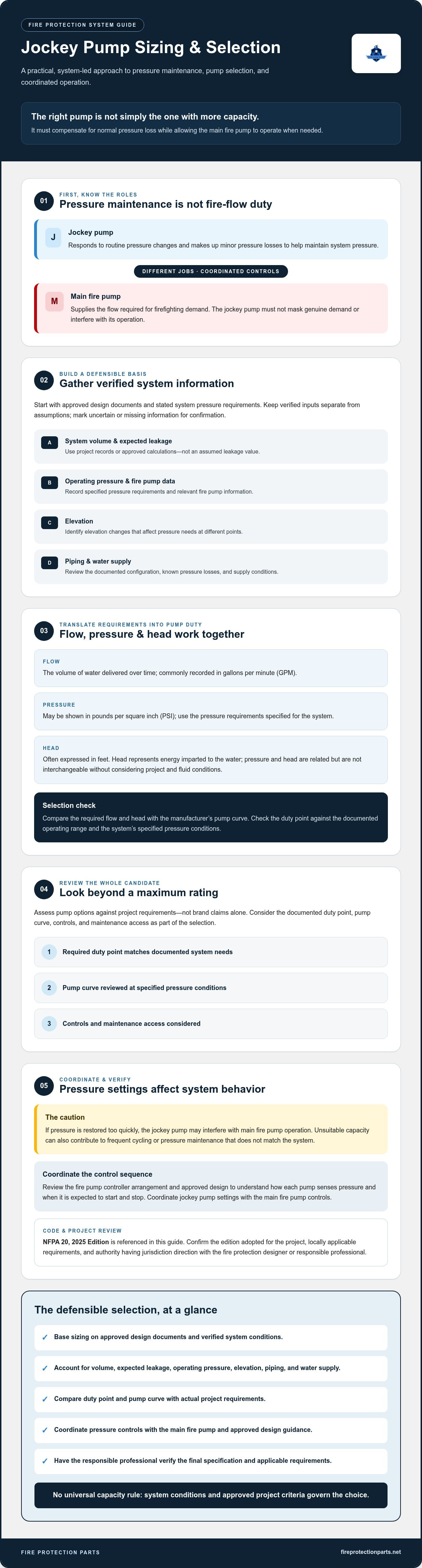
A fire protection system must hold pressure while remaining ready to deliver water when required. Small pressure losses can occur through minor leakage or other normal system conditions. A jockey pump helps restore that pressure, limiting unnecessary operation of the main fire pump. It is a pressure-maintenance pump, not a substitute for the system’s fire-flow equipment.
Standalone definition: A jockey pump maintains pressure in a fire protection system by making up minor pressure losses; the main fire pump supplies the flow required for firefighting demand.
The Jockey pump reference provides a basic overview of this pressure-maintenance role. For an actual project, however, design documents and applicable requirements must govern the equipment and its operation.
How a jockey pump differs from the main fire pump
The jockey pump responds to routine pressure changes. The main fire pump is intended to serve fire-flow demand. Pressure switches or other approved controls initiate and stop each pump according to coordinated setpoints. The jockey pump should not be selected or controlled in a way that masks genuine system demand or interferes with the main fire pump’s ability to operate.
In practice, the control sequence matters as much as the pump itself. Review the fire pump controller arrangement and the approved design to understand how each pump senses pressure and when it is expected to start.
Why sizing and pressure coordination matter
Capacity and pressure settings must suit the system. A jockey pump with unsuitable capacity may cycle frequently as it struggles to maintain pressure, or restore pressure so quickly that it delays the main pump’s operation during a real demand, depending on the system arrangement. These are design concerns to assess, not symptoms that can be diagnosed from pump size alone.
Pressure can change because of minor leakage and ordinary system conditions. The correct response is to check the documented system requirements, not assume that one standard pump size or pressure setting fits every installation. As part of jockey pump sizing and selection, confirm how the proposed duty point and control sequence relate to the main pump’s settings.
Use approved project documents as the basis for review. Confirm the applicable NFPA 20 edition, locally adopted requirements, and authority having jurisdiction direction with the fire protection designer or responsible professional. A pump choice alone doesn’t establish that the system is compliant or properly coordinated.
How to Size a Jockey Pump From System Data
System conditions determine the required pump duty. Don’t rely on a universal capacity ratio: flow and pressure requirements depend on the documented design, system configuration, and applicable criteria. Use this workflow to organize the information before comparing pump options.
Gather the inputs before calculating
Begin with the approved design documents and stated system pressure requirements. Review fire pump data, sprinkler design documents, pressure limits, and the system layout. The applicable NFPA 20 Standard is an important reference, but confirm the edition adopted for the project and any direction from the authority having jurisdiction.
- System volume and expected leakage: Use project records or approved calculations, not an assumed leakage value.
- Operating pressure: Record specified pressure requirements and relevant fire pump data.
- Elevation: Identify elevation changes that affect the pressure needed at different points.
- Piping and water supply: Review the documented configuration and any known pressure losses or supply conditions.
Separate verified design inputs from assumptions. Mark missing or uncertain information for confirmation by the responsible designer before using it in calculations.
Match required flow and pressure to pump performance
Translate the approved requirements into a duty point. Flow describes the volume of water delivered over time, commonly recorded in gallons per minute (GPM). Pressure may be shown in pounds per square inch (PSI), while pump head is often expressed in feet. Head represents the energy imparted to the water; pressure and head are related, but they are not interchangeable without accounting for the project’s fluid and system conditions.
Compare the required flow and head with the manufacturer’s pump curve. Check where the duty point falls within the documented operating range, and review the curve at the pressure conditions specified for the system. A pump’s maximum rating alone doesn’t show whether it will perform appropriately at the required point.
- 1. Confirm approved design documents, pressure requirements, and applicable criteria.
- 2. Compile system volume, expected leakage, elevation, piping, and water supply data.
- 3. Calculate the required flow and head using project-appropriate methods.
- 4. Compare the calculated duty point with the manufacturer’s curve and operating range.
- 5. Refer uncertain inputs, calculations, and curve interpretation for qualified design review.
For related fire protection hardware, you can review available system components. Confirm product availability and have the project professional verify that any selected equipment matches the approved requirements.
Compare Jockey Pump Options by Duty, Curve, and Controls
Once the required duty is documented, compare candidate pumps against the same project criteria. A familiar brand name or a high maximum rating doesn’t prove that a pump suits the system. For defensible jockey pump sizing and selection, review published performance, controls, electrical details, materials, and site conditions together.
What to check on a jockey pump curve
Locate the proposed operating point on the manufacturer’s published pump curve. Confirm that it can meet the required flow and pressure under the specified system conditions, and review its performance across the required flow range. If the curve’s units, limits, or test conditions are unclear, get clarification from the manufacturer or project engineer before procurement.
Compare controls and installation requirements
Record how each option aligns with the approved controller sequence, pressure sensing arrangement, power supply, and any alarm or monitoring interface required by the project. Also check connection details, environmental conditions, materials, and space for service access against project documents. A suitable pump does not automatically have the right motor or controls for a particular site.
| Comparison item | Option 1 | Option 2 | What to verify |
|---|---|---|---|
| Duty point | Record proposed flow and head | Record proposed flow and head | Matches the approved project requirement |
| Pump curve | Record curve reference | Record curve reference | Required point and flow range are supported by published data |
| Drive and electrical supply | Record motor and supply details | Record motor and supply details | Compatible with documented electrical conditions |
| Controller interface | Record controls and signals | Record controls and signals | Coordinates with the approved sequence and monitoring needs |
| Maintenance access | Record space and access needs | Record space and access needs | Can be accessed as required by project documents |
Use the table to expose missing information, not to fill gaps with assumptions. Motor characteristics, supply conditions, materials, and the installation environment all need project-specific review. Document any differences and resolve open questions before choosing an option.
Finally, distinguish equipment suitability from code approval. A pump curve or product document can support technical review, but purchasing a product doesn’t guarantee compliance or acceptance by the authority having jurisdiction. Have the responsible engineer or fire protection designer verify the final choice against project requirements and applicable local direction.
Set Pressure Controls and Verify Jockey Pump Operation
Correct pump capacity is only part of a dependable pressure-maintenance arrangement. Start and stop setpoints must work as a coordinated sequence with the main fire pump, so routine pressure changes can be addressed without masking genuine system demand. Settings are project-specific, not universal.
Coordinate jockey and main fire pump setpoints
Setpoints depend on the approved system design. Before making adjustments, review the design documents, fire pump controller instructions, and applicable manufacturer guidance. Confirm the intended order of operation: how the jockey pump responds to pressure changes, and how the main fire pump is expected to respond if pressure continues to fall. The approved sequence should be documented and reviewed by the responsible fire protection professional.
Don’t choose settings by copying values from another building or relying on a generic rule. System configuration and project requirements determine the appropriate separation between pump responses. For sound jockey pump sizing and selection, confirm that the chosen pump and its controls support this sequence without delaying main pump operation.
Verify operation during commissioning
Qualified personnel should verify performance under the approved project test procedure and applicable requirements. Checks should confirm that the jockey pump starts and stops as intended, that pressure sensing and controller indications respond correctly, and that operation matches the documented sequence.
- Check controller indications and the pressure response at the designated sensing points.
- Look for leaks, unexpected cycling, or operation that differs from the approved sequence.
- Record test results and refer discrepancies to the responsible fire protection professional for resolution.
Commissioning should verify the installed arrangement against its approved requirements. It shouldn’t be used to improvise setpoints or treat an unexplained operating issue as acceptable.
Avoid common selection and setup errors
Avoid sizing from a generic percentage or rule of thumb unless the project’s design criteria validate it. Don’t adjust pressure controls to conceal persistent leakage or another system defect. Those conditions need investigation and resolution through the appropriate project process, not a setting change that could affect fire pump operation.
For related sourcing context, review fire protection system components. You can also browse available fire protection hardware; verify jockey pump or accessory availability before treating any item as a match for the approved design.
Finalize the Jockey Pump Specification and Source Components
A complete specification makes review and purchasing more reliable. Before requesting quotes or placing an order, assemble the project data and confirm that the proposed equipment matches the approved design. For industrial sites sourcing comprehensive water infrastructure alongside pressure-maintenance units, visit Liquimech to review standpipe pump packages. For jockey pump sizing and selection, the engineer or responsible fire protection professional must verify the final specification against project requirements and applicable local direction.
Prepare a complete submittal and purchasing checklist
Use this checklist to identify missing details before procurement:
- Duty point: Document required flow and pressure, including the design basis used to establish them.
- Pump curve: Include the manufacturer’s published curve and identify the proposed operating point.
- Controls: Record the controller interface, pressure-sensing arrangement, and approved start-and-stop sequence.
- Electrical data: Confirm motor details and power supply requirements against project documents.
- Connections: Specify connection details and materials required for the documented system conditions.
- Supporting documents: Gather manufacturer data, applicable project approvals, and other information required for review.
Resolve gaps with the designer before requesting or placing an order. An incomplete submittal can make it difficult to confirm whether a candidate pump, controller, or connection suits the project. A product description alone isn’t a substitute for checking the selected equipment against approved requirements.
Choose the right next step for your project
Ask the fire protection designer or responsible professional to review the final pump selection and pressure sequence. This review helps confirm that the proposed equipment and controls align with the approved system design. Product purchase alone doesn’t establish code compliance or guarantee acceptance by the authority having jurisdiction.
For projects involving broader equipment needs, residential fire pump system guidance may provide relevant sourcing context. Fire Protection Parts lists residential fire pump systems and other fire protection hardware, but jockey pump availability isn’t confirmed. Browse available fire protection equipment and confirm product availability and compatibility before ordering.
Make Your Final Selection With Confidence
A dependable jockey pump selection starts with verified system conditions. Base the duty point on approved design data, compare it with the manufacturer’s pump curve, and check that controls coordinate with the main fire pump. Then have the engineer or responsible fire protection professional verify the specification and pressure sequence against project requirements.
These steps keep jockey pump sizing and selection focused on system performance rather than generic rules or product claims. They also help identify missing information before procurement, when unresolved assumptions can still be reviewed and corrected.
Fire Protection Parts is an online retailer of fire protection hardware and system components, including residential fire pump systems. Jockey pump availability isn’t confirmed, so check current listings and verify compatibility before ordering. Browse available fire protection equipment as you plan the next step for your project.
With documented requirements and professional review in place, you can move forward with greater clarity and confidence.
Frequently Asked Questions
How do you size a jockey pump for a fire protection system?
Size it from approved project data, not a universal flow formula or capacity ratio. Establish required pressure and anticipated leakage, then account for system configuration, elevation, piping, and water supply conditions. Compare the calculated duty with manufacturer pump curves to check that the pump can meet the required flow and head. An engineer or responsible professional must verify assumptions against approved design documents and applicable requirements before selection.
What is the difference between a jockey pump and a fire pump?
A jockey pump maintains system pressure during minor pressure loss, while the main fire pump is designed to provide the system’s fire-flow duty. Their functions and controls are coordinated so pressure maintenance doesn’t interfere with the main pump’s operation. A jockey pump cannot replace the main fire pump. For the correct operating sequence in a specific system, follow approved design documents and manufacturer instructions.
How should jockey pump pressure settings be selected?
Select start and stop settings as part of the approved system design, coordinating them with the main fire pump settings. There are no universal pressure values that suit every system. Review the project documents, controller instructions, manufacturer guidance, and applicable requirements with qualified professionals. During commissioning, verify the approved sequence and document the results. Don’t adjust settings based on another system’s values without project-specific review.
Can a jockey pump be too large for a fire sprinkler system?
Yes. Unsuitable capacity or pressure characteristics can affect pump cycling and coordination with the main fire pump, including its response to a genuine demand. The appropriate selection depends on actual system conditions and the proposed pump curve, not capacity alone. If frequent starts or unusual operation occur, have the system assessed by a responsible professional. Don’t try to correct the issue with unverified pressure adjustments.
Does every fire protection system need a jockey pump?
Not necessarily. The need for a jockey pump depends on the system design, pressure-maintenance requirements, and applicable project criteria. Don’t assume a blanket rule applies to every installation. Check approved drawings and specifications, the standards adopted for the project, and direction from the authority having jurisdiction. A fire protection designer can confirm whether pressure-maintenance equipment is required and how it fits the system design.
What information is needed to select a jockey pump?
Gather the required system pressure, expected leakage, elevation, piping conditions, and relevant system configuration. You’ll also need the proposed pump curve, electrical supply details, controller requirements, and applicable design documents. The final information set varies by project, so flag missing or uncertain inputs rather than filling gaps with assumptions. Confirm those details with the responsible designer before procurement to support a defensible jockey pump sizing and selection.
Who should approve jockey pump sizing and selection?
The fire protection designer or other qualified professional responsible for the system should review the proposed duty, pump curve, and pressure sequence. Manufacturer guidance and applicable authority having jurisdiction requirements should also be considered. A product listing alone doesn’t confirm that equipment suits a particular installation or has project approval. Keep design review, approval, installation, and inspection responsibilities distinct from online product sourcing; retailers supply equipment, not project approval.

