



PTR Deluge Valve: A Practical Guide to Electric-Release VXD Systems
A preassembled valve package can still be the wrong fit if its release method or connections do not match the approved system design. When a project specifies a PTR deluge valve, understand what the package includes and how electric release operates before selecting an assembly.
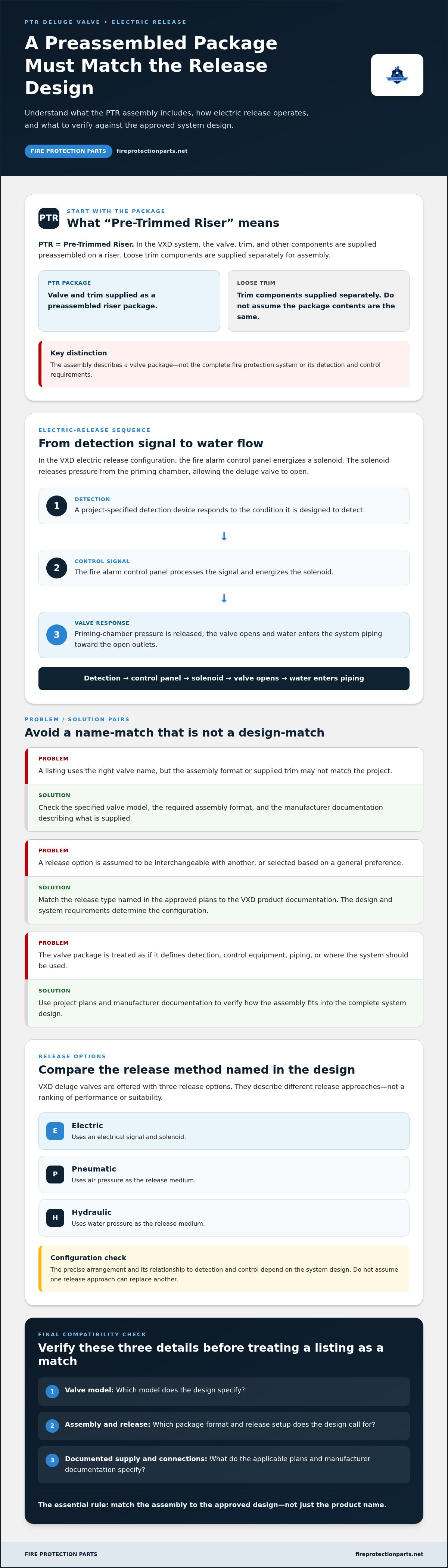
PTR stands for Pre-Trimmed Riser. In this VXD system, the package includes the deluge valve, trim, and other components preassembled on a riser. With electric release, a signal from the fire alarm control panel energizes a solenoid. The solenoid releases pressure from the valve’s priming chamber, allowing the valve to open and admit water to the system piping.
This guide explains the PTR assembly’s role, how electric release differs from other configurations, and what to compare in project documents, including connection details and system requirements. It also covers the PTR Electric Deluge VXD product category as a sourcing option. The essential rule is to match the assembly to the approved design, not just the product name.
Key Takeaways
- Understand what PTR means in a PTR deluge valve listing and how the pre-trimmed riser format differs from loose trim.
- Follow the electric-release sequence from detection signal to valve actuation, accounting for the project’s control arrangement.
- Compare the assembly and connection configuration with manufacturer documentation before selecting a system.
- Use project plans and manufacturer submittals to verify the valve model, release setup, connections, and system requirements.
- Consider the PTR Electric Deluge VXD product category for sourcing after completing compatibility checks.
What Is a PTR Deluge Valve, and What Does the Assembly Do?
A PTR deluge valve is a deluge valve supplied in a pre-trimmed riser configuration. The valve controls water entering a deluge system. When the system actuates, water can flow through the piping and discharge from its open outlets. PTR means pre-trimmed riser, the assembly format named in the VXD product description.
This describes the valve package, not the complete fire protection system. System operation also depends on the detection and control arrangement, piping, discharge outlets, and project requirements. The assembly controls water flow as one part of that larger design. It does not, by itself, specify how a hazard is detected or where the system should be used.
This distinction matters when purchasing. A product description can identify a valve model and assembly format, but the approved plans and manufacturer documentation establish whether those details match the intended system. Treat the assembly as one specified component, not a substitute for reviewing the complete design.
How does a deluge valve differ from a standard sprinkler control valve?
The main difference is at the discharge outlets. A deluge arrangement uses open outlets, so water can discharge through the connected outlets when the valve actuates. In a typical closed-sprinkler arrangement, individual sprinklers open in response to heat, and water discharges through the activated sprinklers.
Neither arrangement is a universal choice. The hazard, protection objectives, and engineered system design determine whether a deluge arrangement is appropriate. Do not infer suitability from the valve name alone. Use the project documents to identify the intended application and the valve’s role in the system.
What does PTR mean in a VXD product description?
For the VXD, PTR means pre-trimmed riser. It describes an assembly in which the valve and trim are supplied as a riser package rather than as loose trim components. Loose trim refers to components supplied separately for assembly. Do not assume it has the same packaging or contents as a PTR configuration.
Use the applicable manufacturer documentation to identify the exact assembly details for the product you are evaluating. Confirm that the model and configuration match the project documents. This is particularly important when comparing listings: similar valve names do not establish that the same trim arrangement or system setup is supplied.
Before treating a listing as a match, separate three questions: Which valve model does the design specify? Which assembly format does it call for? What does the corresponding manufacturer documentation say is supplied? Keeping these questions distinct helps prevent a terminology match from being mistaken for full system compatibility. The PTR Electric Deluge VXD is a purchasing category, and its fit depends on the project’s documented design.
How Electric Release Works in a PTR VXD Deluge Configuration
Electric release connects the system’s detection and control arrangement to the deluge valve. In the VXD electric-release configuration, a fire alarm control panel energizes a solenoid valve. This releases pressure from the VXD valve’s priming chamber, allowing the main valve to open and water to enter the system piping. Water can then discharge through the connected open outlets.
This explains the basic operating sequence, not a complete system specification. A PTR deluge valve assembly does not establish which detection devices or control equipment the project requires, or whether those items are included in the package. The project design and applicable manufacturer documentation define those details.
What happens between a detection signal and valve actuation?
Think of electric release as a coordinated chain. This sequence is conceptual, not a commissioning or installation procedure:
- 1. Detection: A project-specified detection device responds to the condition for which it is designed.
- 2. Control signal: The fire alarm control panel processes the signal and energizes the solenoid in the electric-release arrangement.
- 3. Valve response: Priming-chamber pressure is released, the deluge valve opens, and water flows into the system piping toward the open outlets.
Each link must match the documented system arrangement. A valve listing alone does not show how detection is initiated, how the control panel is configured, or what other system components are required. Use the approved system documents and manufacturer instructions to understand the intended configuration.
How is electric release different from other VXD release options?
The VXD deluge valve is offered with electric, pneumatic, and hydraulic release options. Electric release uses an electrical signal and solenoid. Pneumatic release uses air pressure, while hydraulic release uses water pressure as the release medium. The precise arrangement and its relationship to detection and control depend on the system design.
These options describe different release approaches, not a ranking of performance or suitability. The project’s approved design and system requirements determine the correct configuration. Compare the release type named in the plans with the VXD product documentation instead of assuming one approach can replace another.
For broader fire-protection context, the NFPA standards for deluge valves are a relevant reference point. Use the standards that apply to the project alongside its approved documents and manufacturer instructions. A general reference does not replace the project-specific design.
Once the required release method is clear, compare it with the PTR Electric Deluge VXD category as a sourcing step. Keep the detection, control, and valve documentation aligned so the selected assembly reflects the intended system configuration.
How to Compare PTR, Loose-Trim, and Connection Configurations
Compare a valve assembly with the project documents in two stages. First, confirm how the trim is supplied. Then verify the valve size and end connections. These are separate choices: the correct trim format does not guarantee that the connections suit the adjoining piping, and matching connections do not establish that the release configuration meets the design.
The manufacturer describes PTR as a pre-trimmed riser configuration and also offers loose-trim VXD systems. VXD documentation lists grooved-by-grooved and flanged-by-flanged connection options. Dimensions and configurations can vary by model, so use current manufacturer product data rather than assuming options are interchangeable.
PTR versus loose trim: what changes for the purchaser?
PTR identifies a pre-trimmed riser assembly. Loose trim describes trim components supplied separately rather than in that assembly format. The difference is how the components are supplied. It does not, by itself, establish exact contents, installation effort, or time savings. Compare the product documentation and project submittal to ensure the supplied format matches the specified assembly.
Use the table to identify what to verify, not to assume both configurations contain identical components. The approved project documents determine the required format.
How should connection style and valve size be compared?
Start with the connection style and nominal valve size shown in the design. Compare both with the documentation for the exact model. Manufacturer VXD information lists grooved-by-grooved and flanged-by-flanged options. Confirm that the specified ends match the adjoining equipment. A product title or general category description is not enough to establish compatibility.
Manufacturer product data identifies PTR VXD nominal sizes from 1 1/2 inch through 8 inch. This is a size range, not confirmation that every size is offered with every connection or trim combination. Verify the selected model’s current dimensions and configuration before sourcing. The plans and approved submittals, not a general preference for one connection style, govern the choice.
- Match the trim format: Confirm whether the documents call for PTR or loose trim.
- Match the valve: Check the model and nominal size against the specified equipment.
- Match the ends: Verify the connection style and model-specific details in manufacturer documentation.
For a PTR deluge valve, tie each check to the same project submittal. That way, a match on one feature does not obscure a mismatch elsewhere.
PTR Deluge Valve Selection Checklist for Project Compatibility
Use the project documents as the control point when selecting a PTR deluge valve. A product listing helps identify an assembly, but it does not replace the approved plans or the manufacturer’s submittal. Check each detail against the same design so a matching product name does not conceal a mismatch in release type, connections, or system requirements.
Which project details should the product description match?
Compare the described assembly with the design in a consistent order. If a product detail is unclear, use the applicable manufacturer documentation to understand the configuration instead of inferring it from the product title.
- Valve model: Match the VXD model specified in the project with the model identified in the product documentation.
- Trim format: Confirm whether the project calls for PTR or another supply format.
- Release arrangement: Verify that electric release is specified and that the system’s detection and control documents align with that arrangement.
- Size and connections: Compare the specified valve size and connection style with the approved piping design and adjoining equipment.
- System requirements: Review the plans and submittals for configuration details that affect the intended system.
Keep product information separate from design approval. A listing can describe a model, connection, or release option; the approved plans and project submittals establish what the system requires. A valve assembly alone does not establish that the complete system complies with project requirements.
What should procurement records preserve?
Keep the product model and relevant manufacturer documentation with the purchasing records. Record the stated trim format, release type, size, and connection details so the selected assembly can be compared with the project submittal later. Preserve applicable listing and approval information, then compare those references with the project documents and current requirements. A general product page is not a substitute for model-specific documentation.
For broader sourcing context, the guide to sprinkler system components online explains how product details fit into a careful procurement process. Fire protection repair components are another part of the broader parts-sourcing picture.
Before finalizing a selection, review the records side by side: the specified configuration, product documentation, approved plans, and applicable listing or approval references. Resolve any differences through the project’s established design review process. This creates a clear record of what was selected and which documents were used to assess its fit.
Once those details align, browse the PTR Electric Deluge VXD category to source the specified assembly.
Where to Find the PTR Electric Deluge VXD for Your Project
Once the design requirements are clear, use them to narrow the sourcing search. Before choosing a product listing, compare the specified valve model, electric-release arrangement, trim format, size, connection style, and documented system requirements. Check that the product description and current manufacturer information correspond to those details. A category match is a useful starting point, not proof that an assembly suits the project.
Keep the roles of the documents clear. Product listings identify what is being offered. Manufacturer documentation provides model-specific details, while approved plans and project submittals define the system’s requirements. If those records appear inconsistent, resolve the discrepancy through the project’s design review process rather than assuming the listing overrides the plans.
How to move from selection criteria to sourcing
Work from the design outward. Identify the required release configuration and assembly format, then compare the valve model, size, and connections with the project documents. Review the product description alongside applicable manufacturer information. This helps distinguish a listing that shares product-family terms from one that describes the configuration specified for the project.
Before proceeding, make sure the documents answer these questions:
- Does the described VXD model match the project specification?
- Does the listing identify the required electric-release and trim configuration?
- Do the size and connection details align with the approved design and adjoining equipment?
- Are the relevant manufacturer details consistent with project requirements?
Do not infer exact components, dimensions, or connection availability from a general product title. Use model-specific documentation for those details. This gives procurement a clear basis for comparing the listing with the submittal without treating sourcing information as a substitute for design review.
What the product category can help buyers find
Fire Protection Parts lists the PTR Electric Deluge VXD as a product category for sourcing. It gives buyers a relevant place to look after identifying the required assembly in the project documents. Use the product description and available manufacturer information to evaluate model-specific details. Do not assume every configuration, connection, or component applies to every listing.
Keep a record of the selected product description and the documentation used to assess its fit. That makes it easier to compare the sourced assembly with project requirements during procurement and review. If your plans call for a PTR electric-release VXD, use the category as the next purchasing step and keep the selection tied to the approved design.
Ready to continue sourcing? Explore fire protection products at Fire Protection Parts.
Make Your Next Sourcing Step With Confidence
Before moving a PTR deluge valve selection into procurement, use the project record as your guide. Keep the specified configuration and supporting product documentation together so the basis for the choice remains clear through review and purchasing. If project requirements change, revisit the match rather than relying on an earlier product comparison.
A careful sourcing decision is not about choosing the most familiar listing. It is about finding an assembly that corresponds to the design and preserving the information needed to evaluate that fit. Fire Protection Parts lists the PTR Electric Deluge VXD alongside fire protection hardware for commercial and residential applications, giving buyers a relevant place to continue their search.
Continue sourcing with the project documents in hand: Explore the PTR Electric Deluge VXD and other fire protection products. Match the selection to the approved design, then use Fire Protection Parts to source the products your project specifies.
Frequently Asked Questions
What does PTR stand for on a deluge valve assembly?
PTR stands for pre-trimmed riser. On a PTR deluge valve listing, it identifies the assembly format, not a complete description of every system component. A project calling for a PTR configuration still needs to be matched against the specified valve model and manufacturer documentation. Use those records to understand the package details rather than assuming every product with the PTR label contains identical components.
Can an electric-release deluge valve be used in every deluge application?
No. The release method must suit the project’s system design and detection and control arrangement. Electric release relies on an electrical control signal, while VXD deluge systems also have pneumatic and hydraulic release options. A design may specify a particular method based on its requirements. Compare the release type named in the project documents with manufacturer information. Electric release is not a universal replacement for another configuration.
Does a PTR deluge valve include the detection panel and devices?
Do not assume the detection panel or detection devices are included just because a listing identifies a PTR assembly. Those components belong to the broader system arrangement, and package contents depend on the specific product documentation. For procurement, compare the listing’s stated contents with the project’s equipment schedule and manufacturer information. Keep the valve assembly and detection-and-control equipment as separate line items unless documentation clearly specifies otherwise.
How often should a deluge valve be inspected or tested?
Under the 2026 edition of NFPA 25, deluge valves require annual internal inspection. That edition also calls for quarterly testing of solenoid supervisory signal devices that monitor electric actuator coil position; this supervisory test does not replace a full trip test. Applicable requirements depend on the edition adopted for the project and local conditions. Use the governing standard and manufacturer instructions to establish the complete inspection and test schedule.
Can a PTR VXD deluge valve be installed in any orientation?
Do not assume the VXD can be installed in any orientation. The permitted position is a model-specific installation detail, so consult the current manufacturer technical data and installation instructions for the exact valve configuration. Compare those instructions with the approved plans before procurement and installation. If the shown orientation conflicts with the project layout, resolve the design discrepancy through the project’s established review process rather than adapting the assembly by assumption.
What is the difference between a deluge system and a preaction system?
A deluge system uses open discharge outlets, so water can flow through them when its valve actuates. A preaction system uses closed sprinklers and adds a detection-controlled step before water enters the piping. In a double-interlock preaction arrangement, both detection activation and sprinkler operation are required for the valve to open. The required system type depends on the protection design and the consequences of unwanted water discharge.

